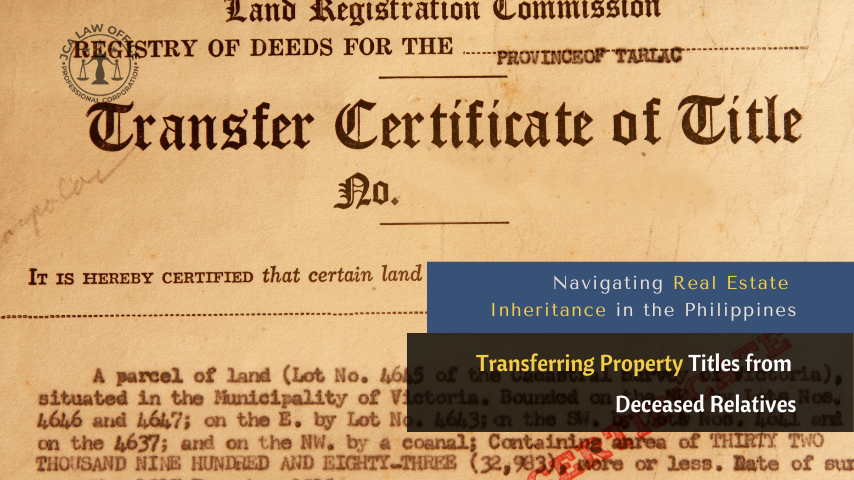
Navigating Real Estate Inheritance in the Philippines: Transferring Property Titles from Deceased Relatives

Navigating Real Estate Inheritance in Philippines - Transferring Property Titles from Deceased Relatives

Navigating Real Estate Inheritance in the Philippines: Transferring Property Titles from Deceased Relatives

A comprehensive guide for Filipino-Canadian heirs on how to transfer property titles from deceased relatives in the Philippines, including legal requirements, tax obligations, and step-by-step procedures.

In the Philippines, a common occurrence is finding a property that remains titled under the name of a deceased relative, usually a parent or grandparent. Despite the death of the original owner, these properties often continue to be utilized, maintained, or even transacted by surviving heirs without the legal paperwork having been updated. This situation can create legal and financial complexities that may potentially jeopardize ownership rights and the value of the property.

If you are an heir to such a property, it is crucial to transfer the title officially to avoid future legal disputes and to ensure the proper valuation of your inheritance. Here, we will discuss the process, requirements, and potential challenges involved in transferring real estate titles in the Philippines from deceased relatives to their living heirs.


Understanding the Importance of Title Transfers

Property titles in the Philippines are legal documents that prove ownership over a piece of land or a building. When the owner of a property dies, the title does not automatically pass on to the heirs. Instead, it remains in the name of the deceased until the legal process of transfer is completed. This delay can lead to several problems:

  1. Potential for Disputes: The property might be subject to inheritance disputes among the potential heirs, which could lead to lengthy legal battles.
  2. Inability to Transact: The heirs may not be able to sell, mortgage, or lease the property since the title is still under the deceased’s name.
  3. Tax Liabilities: The property may incur estate taxes and penalties that could diminish the value of the inheritance.

The Transfer Process: From Estate Tax Clearance to Title Transfer

The process of transferring a title from a deceased person to the living heirs involves several legal and administrative steps. These steps are generally as follows:

Step 1: Secure a Death Certificate

Obtain a certified copy of the death certificate from the local civil registry or the Philippine Statistics Authority (PSA).

Step 2: Probate of Will or Declaration of Heirs

If the deceased left a will, it must be probated, i.e., approved by the court. If there is no will, the court will have to issue a Declaration of Heirs.

Step 3: Payment of Estate Taxes

Calculate the estate tax due based on the value of the estate at the time of the owner’s death and pay this to the Bureau of Internal Revenue (BIR). This step involves filing the estate tax return and submitting the necessary documents.

Step 4: Secure a Tax Clearance

After paying the estate tax, secure a Certificate of Tax Clearance from the BIR, indicating that the estate tax has been fully paid.

Step 5: Judicial Partition or Extrajudicial Settlement of Estate

If the heirs cannot amicably decide on the distribution of the property, a court-supervised partition is necessary. If they agree, they can execute an Extrajudicial Settlement of Estate among themselves.

Step 6: Transfer of Title

Once the property has been properly partitioned or settled, the title can be transferred to the heirs. This requires filing a Deed of Adjudication with the Registry of Deeds, paying the corresponding transfer taxes, and obtaining the new titles under the heirs’ names.


Conclusion

Transferring a property title from a deceased relative in the Philippines to living heirs might appear to be a daunting task due to the number of steps and legal complexities involved. However, it is a critical process to prevent disputes and protect the value of your inheritance. It is advisable to seek legal counsel to help navigate through this process to ensure you adhere to all the requirements of the law, thereby ensuring a smooth and successful transfer.

Need Help with Philippine Property Inheritance?

JCA Law Office assists Filipino-Canadians with estate settlement, property title transfers, and extrajudicial settlements in the Philippines. Contact us for a consultation.

204-2323 Yonge St, Toronto | 1-855-522-5290

Comments

14 Responses to “Navigating Real Estate Inheritance in the Philippines: Transferring Property Titles from Deceased Relatives”

  1. Marissa Lopez Avatar
    Marissa Lopez

    Can one heir get the PAO lawyer service for civil case without the other heirs ?

    1. Jake Aguilar Avatar
      Jake Aguilar

      Please contact the Public Attorney’s Office (PAO) or visit their website.

    2. Edward Alquizalas Avatar
      Edward Alquizalas

      There is a piece of land owned by the father. The father died and the heirs had a EJS (Extra Judicial Settlement) paid the Estate Tax but didn’t transfer the Title to the their names. They opted to transfer the name to the buyer of the property. Is this allowed under the law? Are there any other taxes to be paid aside from the Capital Gains Tax, Documentary Stamps Tax and Transfer Tax?
      Thank you.

    3. Gilly Avatar
      Gilly

      Good evening, Sir/Madam.
      Question: i have a special power of atty executed in the united states for her land title here in the Philippines. SPA was not used. The owner died. Does the SPA still be legally used to transact/negotiate/sell the property by the atty-in-fact

  2. Antoinette Montojo Avatar
    Antoinette Montojo

    What if the deceased will is done in Las vegas, Nevada by a Filipino citizen? Does it still need to go into probate in the Philippines?

    1. Priscila Natividad Avatar
      Priscila Natividad

      In an extra Judicial setllement are the heirs paying donors tax?properties are tax declaration only no Title.

    2. Joy Villanueva Avatar
      Joy Villanueva

      Is the Transfer tax based on the FMV or zonal value of the property on the decedent’s date of death?

  3. Ann Castillo Avatar
    Ann Castillo

    Good day atty.,
    My maternal grandmother died leaving no will for the lot. The 5 heirs sold the lot to my mother, who is also an heir, way back in 2000. All sellers signed in the Deed of EJS and it was notarised. 3 of the sellers (heirs) have died, year 2007, 2017 and 2023, respectively.
    Q: is an Affidavit of heirship (to be signed by the heirs of the deceased) required for the transfer of title?
    Thank you.

  4. Filedocs - Alex Avatar

    Invaluable insights! Your blog post on navigating real estate inheritance in the Philippines and transferring property titles from deceased relatives offers crucial guidance for individuals dealing with estate matters. Understanding the legal procedures and requirements is essential for a smooth transfer of property titles. Thanks for sharing this informative content!

    1. Dante Manipula Avatar
      Dante Manipula

      Is there a time element to file a transfer after death and us there any penalties involve?

  5. Isabel concepcion Avatar
    Isabel concepcion

    If the title of the property is under the name “heirs of the original decedent(father)” and one of the heirs died is there still a need to pay estate tax for the heir that died (mother)? Is there a need to secure new title?

  6. emperor penguin Avatar
    emperor penguin

    Hi po. Sa case po namin, we were required by our local assessors to obtain a letter of conveyance para ma transfer ang Tax Declaration nung property, for which wala po kami kasi patay na po ang grandfather ng Tatay ko but we do have a compromise agreement. The name of the title were my fathers’, auntie and 2 uncles and the title is a CLOA title po. Ano po kaya pwede gawin?

  7. Sherwin Delos Santos Avatar
    Sherwin Delos Santos

    I have a title but under my name and my mother who recently passed away. What is the process and what are the requirements? Also since I live now in another country, can I grant my sister a special power of attorney to do this for me? thanks

  8. Alan Smith Avatar
    Alan Smith

    Hello I need to find more information . My wife purchased land next to her brothers house as an easement to the land we were buying. We also put a lean on the property title of his property. His death just happened today would we have a problem to get a loan on the easement property to pay his costs due to his death. His mother also lives on the same property. Looking to find help with his death. Alan Smith
    I will forward emails to her Denny Doron in Massin City Southern Leyte

Leave a Reply to Sherwin Delos Santos Cancel reply

Your email address will not be published. Required fields are marked *