Madalas itanong sa aming page: “Hindi kami kasal — pwede ko pa rin bang i-sponsor ang partner ko?”
Ang maikling sagot: oo, posible — pero may mahigpit na kondisyon, at mahalagang maintindihan mo ito nang tama mula sa simula.
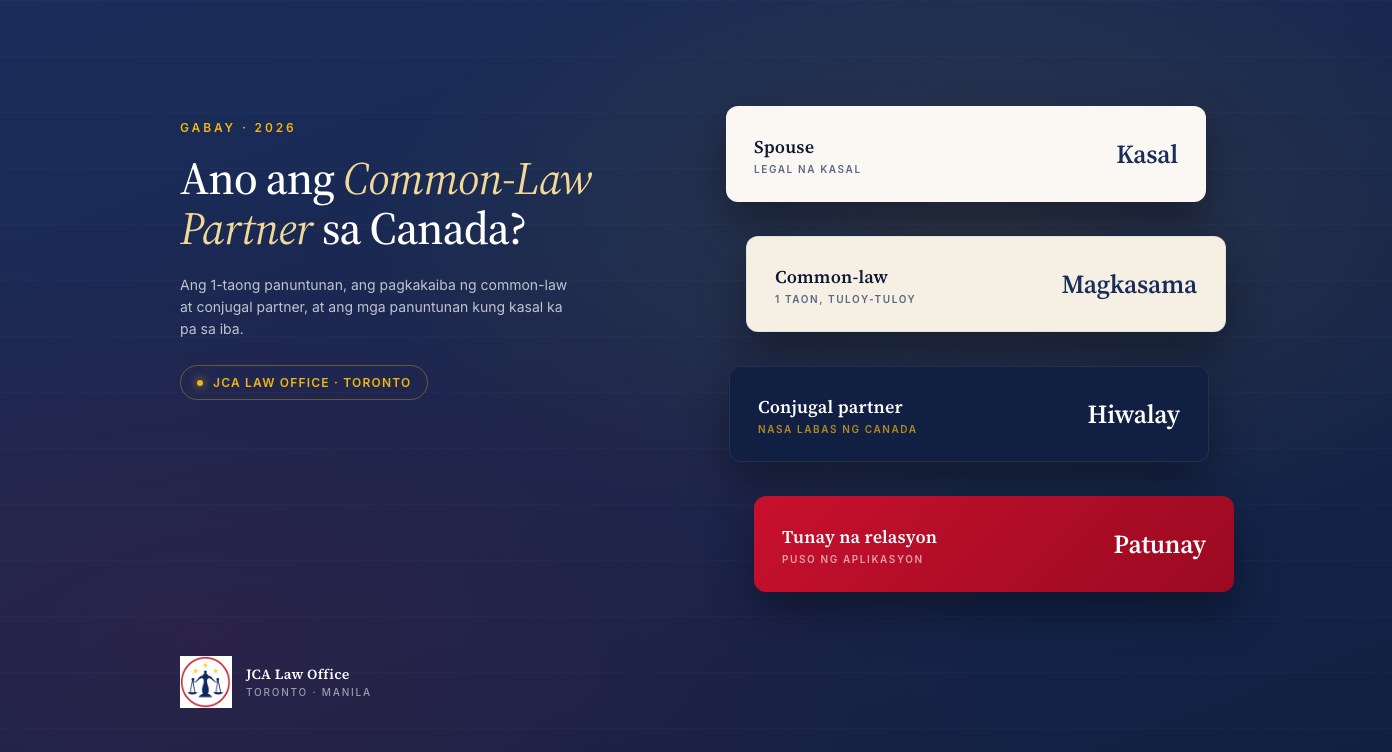
Sa immigration ng Canada, may tatlong uri ng partner na pwedeng i-sponsor:
Spouse — legal na kasal
Common-law partner — hindi kasal, pero magkasama nang matagal
Conjugal partner — hindi kasal at hindi rin nagkakasama, at ang partner ay nasa labas ng Canada — karaniwan dahil may hadlang na wala sa kontrol ninyo
Magkaiba ang tatlo. Ang maling pagpili ng kategorya ay isang karaniwang dahilan ng refusal.
Ang 1-taong panuntunan
Sa Canada, ang common-law partner ay isang taong nakatira kasama mo sa isang conjugal relationship nang hindi bababa sa isang (1) taon, tuloy-tuloy.
Tatlong salita ang mahalaga dito:
“Nakatira kasama” — iisang tahanan. Hindi sapat ang magkasintahan na magkahiwalay ng bahay, kahit gaano pa kayo katagal.
“Isang taon, tuloy-tuloy” — hindi paputol-putol. Ang maiikling paghihiwalay (bakasyon, trabaho, emergency sa pamilya) ay karaniwang okay, pero ang mahabang paghihiwalay ay pwedeng makaputol sa bilang.
“Conjugal relationship” — hindi lang magkasama sa bahay. Kailangang ipakita ang tunay na buhay-mag-asawa: nagsasama sa pananalapi, kilala kayo ng pamilya at kaibigan bilang mag-partner, may commitment sa isa’t isa, at eksklusibo ang relasyon.
Mahalaga: hindi ito katulad ng basta “live-in” sa Pilipinas. Sa Canada, ang common-law ay isang kinikilalang legal na kategorya sa immigration — pero kailangan mo itong patunayan gamit ang dokumento, hindi salita lang.
Ano ang mga patunay?
Ito ang pinakamadalas na dahilan ng problema: totoo ang relasyon, pero kulang ang papel. Karaniwang hinahanap:
Lease o titulo ng bahay na parehong nakapangalan sa inyo
Joint bank account, insurance, o mga bill na magkasama ang pangalan
Government ID o mga rekord na iisa ang address ninyo
Isa’t isa bilang beneficiary sa insurance o benepisyo
Mga litrato, mensahe, at pahayag mula sa pamilya at kaibigan sa mahabang panahon
Hindi ito tungkol sa dami. Tungkol ito sa pagpapakita ng tuloy-tuloy na pagsasama sa loob ng buong taon.
Conjugal partner — mahalaga ito sa maraming Pilipino
Ito ang bahaging madalas hindi alam, at para sa mga Pilipino, ito ang pinakamahalaga.
Sa ilalim ng batas ng Canada, ang conjugal partner ay isang taong (1) nasa labas ng Canada, at (2) may tunay na relasyon sa sponsor nang hindi bababa sa isang taon — pero hindi kayo nagkakasama sa iisang bahay at hindi rin kayo kasal.
⚠️ Mahalagang tandaan: ang conjugal partner ay kailangang nasa labas ng Canada. Kung nasa Canada na ang partner mo, hindi ito ang tamang kategorya — spouse o common-law ang titingnan.
Karaniwan, ang taong pumapasok sa kategoryang ito ay may hadlang na wala sa kontrol niya kung bakit hindi sila makapagsama o makapagpakasal. Ang mga karaniwang halimbawa:
Hindi makapag-diborsyo. Sa Pilipinas, walang absolute divorce para sa karaniwang mamamayan. Kung ang isa sa inyo ay legal na kasal pa rin sa iba at hindi makakuha ng annulment, hindi kayo makakapagpakasal — kahit matagal na kayong hiwalay. (May dalawang eksepsiyon: ang mga Muslim na Pilipino ay may divorce sa ilalim ng PD 1083, at kung ang dating asawa ay dayuhan at nakakuha ng divorce sa ibang bansa, may paraan para ito kilalanin sa Pilipinas sa ilalim ng Article 26 ng Family Code.)
Hindi makakuha ng visa para magkasama sa iisang bansa
Panganib ng persekusyon (halimbawa, sa mga bansang kriminal ang same-sex na relasyon)
Kung ito ang sitwasyon ninyo, hindi ibig sabihin na sarado na ang pinto. Ang conjugal partner category ay ginawa mismo para sa mga ganitong kaso.
💡 Ito ang madalas mali sa ibang website: hindi na kinakailangan ang hadlang. Sa sariling gabay ng IRCC para sa mga opisyal nito (huling na-update noong Hulyo 4, 2023), malinaw na nakasaad: ang kawalan ng kakayahang magpakasal ay hindi pwedeng gawing absolutong requirement — dahil kung gayon, para na ring pinipilit magpakasal ang mga taong ayaw naman talaga. Ang mag-partner na isang taon nang nasa tunay na relasyon at walang balak magpakasal ay maaari pa ring ituring na conjugal partner.
Dalawa lang ang aktwal na hinihingi: (1) isang taong conjugal relationship sa sponsor, at (2) committed at magkatuwang na relasyon, na pinagsama na ninyo ang inyong mga bagay-bagay hangga’t kaya.
Kaya kung may hadlang kayo, ilagay pa rin ito — malaking tulong ito para maipaliwanag ang sitwasyon ninyo. Pero ang puso ng aplikasyon ay ang patunay ng tunay at matagal nang relasyon. Doon dapat nakatuon ang paghahanda ninyo.
Ito ang pinakamadalas na sitwasyon, kaya ilalatag namin ang mga panuntunan nang buo. Ang panimulang punto: hindi ka pwedeng magpakasal ulit habang may nakatayong kasal. Pero may mga tunay na daan, at hindi lahat ay nangangailangan ng annulment.
1. Kung Muslim kayo — may divorce sa Pilipinas
Sa ilalim ng Presidential Decree 1083 (Code of Muslim Personal Laws), may divorce para sa mga Muslim na Pilipino. Kabilang dito ang talaq, khul’, tafwid, at faskh, sa pamamagitan ng Shari’a courts.
Karaniwang saklaw nito kapag parehong Muslim ang mag-asawa, o ikinasal kayo sa ilalim ng Muslim rites. Kung ito ang sitwasyon ninyo, may legal na paraan na matapos ang kasal — at kapag tapos na ito, spouse o common-law na ang titingnan, hindi na conjugal.
2. Kung dayuhan ang dating asawa — pwedeng kilalanin ang foreign divorce
Sa ilalim ng Article 26, ikalawang talata ng Family Code, kung ang isa sa inyo ay dayuhan at may valid na divorce na nakuha sa ibang bansa, ang Pilipino na asawa ay pwede nang makapag-asawang muli.
Malaki ang niluwag ng Korte Suprema dito sa mga nakaraang taon:
Sa Republic v. Manalo (2018), sinabi ng Korte na kahit ang Pilipino pa ang nag-file ng divorce sa ibang bansa, saklaw pa rin ito ng Article 26. Dati kasi ang pananaw ay ang dayuhan lang ang dapat nag-file.
Sa mga desisyon noong 2024, nilinaw pa: hindi mahalaga kung paano nakuha ang divorce. Sakop nito ang divorce na hiniling nang magkasundo (mutual consent) o no-fault — hindi lang ang matagal na laban sa korte.
Malaki ito para sa mga Pilipinong nasa Canada, dahil karamihan ng divorce dito ay uncontested o magkasundo.
Pero hindi ito awtomatiko. Kailangan mong magsampa ng petisyon para sa judicial recognition of foreign divorce sa Regional Trial Court sa Pilipinas. Hindi kinikilala ng korte ang dayuhang divorce nang basta-basta — kailangang patunayan ang dalawang bagay:
ang mismong divorce decree (authenticated), at
ang batas ng bansang dayuhan na nagbigay ng divorce, at pinapakita nitong pwede nang mag-asawang muli ang dayuhang asawa.
Ang mabuting balita: hindi ito bagong divorce trial. Hindi na babalikan ng korte kung tama o mali ang divorce — kinikilala lang nito ang bisa nito.
Hangga’t wala kang court decision at hindi pa naaayos ang rekord sa PSA, kasal ka pa rin sa mata ng batas ng Pilipinas — kahit hiwalay na kayo at kahit may divorce ka na sa Canada.
3. Kung parehong Pilipino kayo at hindi Muslim
Dito walang divorce. Ang mga daan ay annulment, declaration of nullity (halimbawa sa Article 36 — psychological incapacity), o legal separation (na hindi nagpapahintulot na mag-asawang muli).
Kung wala ka pang naisasampa o matagal pa ito, dito papasok ang conjugal partner category — ginawa mismo para sa taong may tunay at matagal nang relasyon pero hindi makapagpakasal dahil sa hadlang na wala sa kontrol niya.
Ano ang hinahanap ng Canada
Anuman sa tatlo ang sitwasyon mo, ito ang tinitingnan ng IRCC:
Kung tapos na ang dating kasal — patunay na ito ay legal nang natapos (divorce decree, annulment, o court recognition), at malinis na rekord sa PSA.
Kung hindi pa tapos — hindi ka pwedeng mag-apply bilang spouse. Ang conjugal partner ang kategoryang dinisenyo para sa ganitong kalagayan — tandaan lang na dito, kailangang nasa labas ng Canada ang partner.
Huwag kailanman magdeklara ng “single” kung may nakatayong kasal. Ito ay misrepresentation, at ang parusa dito ay mabigat — pwedeng 5-taong ban sa Canada. Mas mabuti ang totoong komplikadong sagot kaysa simpleng maling sagot.
Ang huling punto ang pinakamahalaga sa buong artikulong ito.
Paghahambing
Spouse
Common-law
Conjugal
Legal na kasal?
Oo
Hindi
Hindi
Kailangang magkasama sa bahay?
Hindi
Oo — 1 taon, tuloy-tuloy
Hindi
Gaano katagal ang relasyon?
—
1 taon na magkasama
1 taon na relasyon
Kailangang nasa labas ng Canada?
Hindi
Hindi
Oo
Kailan ito ginagamit
Kasal na kayo
Matagal nang magkasama
Hindi kayo magkasama at hindi rin kasal, karaniwan dahil may hadlang
Ang pagpili ng maling kategorya ay maaaring magdulot ng delay o refusal. Kung hindi ka sigurado kung saan ka papasok, ito mismo ang dapat mong linawin bago mag-apply.
Madalas itanong
Kasal pa ako sa iba pero matagal na kaming hiwalay. Pwede pa rin ba? Karaniwan po ito sa mga Pilipino, at may malinaw na mga panuntunan. Basahin ang buong seksyon sa itaas: “Paano kung kasal ka pa sa iba?”
Nagkakilala kami online at hindi pa kami nagkikita nang personal. Common-law ba kami? Hindi. Kailangan ng aktwal na pagsasama sa iisang bahay para sa common-law. Kung hindi pa kayo nagkikita nang personal, karaniwang hindi rin ito papasa sa conjugal partner, dahil kailangang patunayan ang tunay at nabuong relasyon.
Common-law kami sa Pilipinas. Awtomatiko na bang kilala ito sa Canada? Hindi awtomatiko. Ang tinitingnan ng Canada ay kung natutugunan ang kahulugan sa ilalim ng batas ng Canada — hindi kung ano ang tawag dito sa Pilipinas.
Ilang taon ang kailangan bago pwedeng mag-sponsor? Isang taon ng tuloy-tuloy na pagsasama para sa common-law. Simulan agad ang pag-iipon ng patunay — mas mahirap kunin ang mga lumang dokumento paglaon.
Susunod na hakbang
Bago mag-apply, tatlong tanong ang linawin:
Alin sa tatlo ang kategorya ninyo? Spouse, common-law, o conjugal?
Kaya mo bang patunayan ang buong taon — hindi lang sabihin?
May hadlang ba sa kasal tulad ng nakaraang kasal na hindi ma-annul?
Maraming nagtatanong sa aming Facebook page: “Ano ba talaga ang PR?”
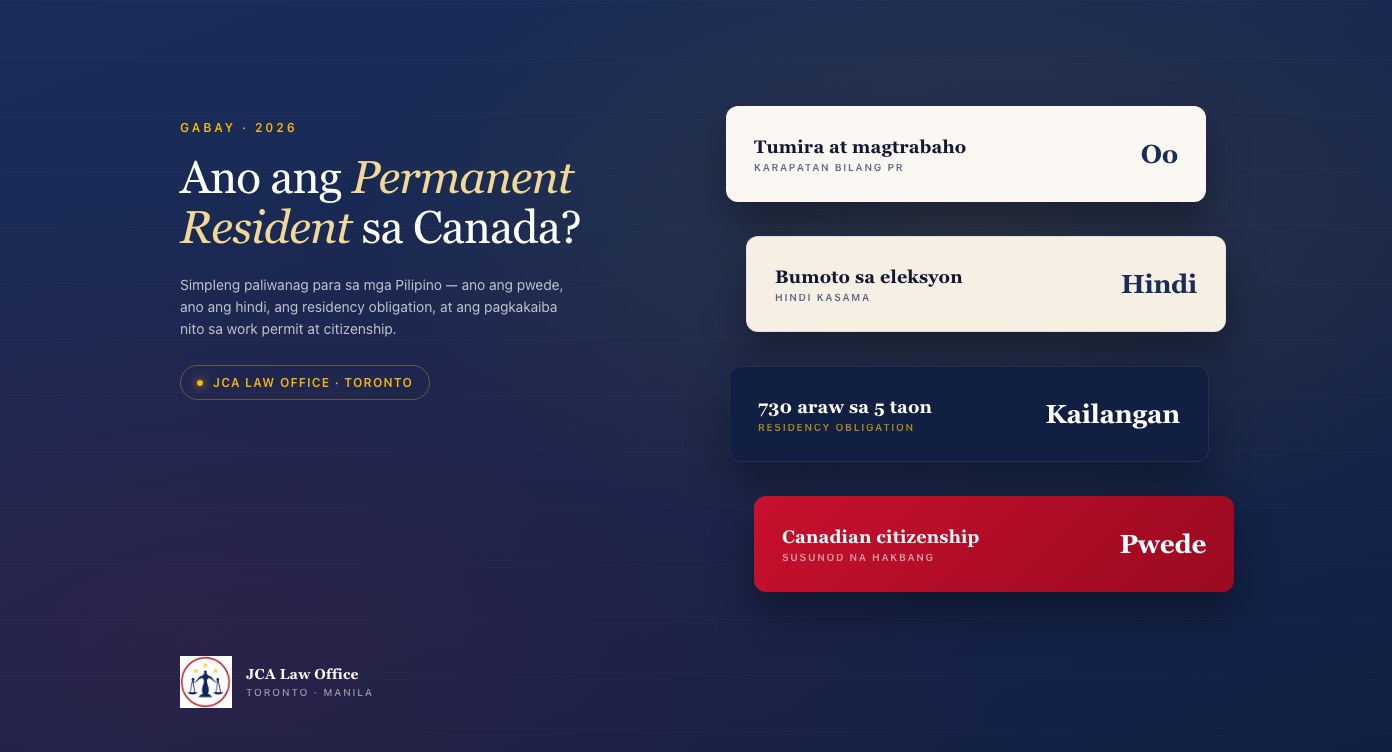
Simple lang ang sagot. Ang permanent resident (PR) ay isang taong binigyan ng pahintulot na manirahan sa Canada nang permanente — pero hindi pa siya Canadian citizen.
Ibig sabihin: taga-Pilipinas ka pa rin. Pilipino ka pa rin. Pero may karapatan ka nang tumira, magtrabaho, at mag-aral kahit saan sa Canada — nang walang expiry date sa iyong status.
Ito ang pinakamalaking pagkakaiba sa temporary resident (tulad ng work permit, study permit, o visitor visa): ang temporary status ay may katapusan. Ang PR status ay wala, hangga’t natutupad mo ang mga kondisyon.
Ano ang pwede mong gawin bilang PR?
Tumira kahit saang probinsya sa Canada
Magtrabaho para sa kahit sinong employer — hindi mo na kailangan ng work permit o LMIA
Mag-aral (at kadalasan, mas mura ang tuition kaysa sa international student)
Kumuha ng healthcare coverage at iba pang social benefits
Mag-sponsor ng asawa, partner, o anak para makasama mo sila sa Canada
Protektado ka ng batas ng Canada at ng Canadian Charter of Rights and Freedoms
Pwede kang mag-apply para maging Canadian citizen kapag naabot mo na ang mga requirement
Ano ang hindi mo pwedeng gawin?
Hindi ka pwedeng bumoto sa eleksyon sa Canada, at hindi ka pwedeng tumakbo sa pwesto
Hindi ka pwedeng humawak ng ilang trabahong nangangailangan ng mataas na security clearance
Pwedeng mawala ang PR status mo — hindi ito habambuhay na garantisado (basahin sa ibaba)
PR card vs. PR status — hindi ito magkapareho
Ito ang pinakakaraniwang pagkakalito, at mahalagang maintindihan.
Ang PR status ay ang legal mong katayuan sa Canada.
Ang PR card ay ang patunay lang ng status na iyon — parang ID.
Kapag nag-expire ang PR card mo, hindi ibig sabihin na nawala ang PR status mo. Ang kailangan mo lang ay mag-renew ng card. Nananatili ang status hangga’t hindi ito opisyal na binabawi. Basahin ang aming gabay sa pag-renew ng PR card.
Pero mahalaga ang card kapag babalik ka sa Canada galing abroad — kadalasan ay kailangan mo ito para makasakay sa eroplano pabalik.
Ang residency obligation — ang kondisyon na madalas nakakalimutan
Para mapanatili ang PR status, kailangan mong pisikal na nasa Canada nang hindi bababa sa 730 araw (mga 2 taon) sa loob ng bawat 5-taong panahon.
Hindi kailangang sunod-sunod ang mga araw. Pwedeng paputol-putol, basta’t umabot sa 730 sa loob ng 5 taon.
May ilang eksepsiyon — halimbawa, kung kasama mo ang Canadian citizen mong asawa sa labas ng Canada, o kung nagtatrabaho ka sa labas para sa isang Canadian employer. Pero mahigpit ang mga panuntunan dito, at hindi lahat ng sitwasyon ay saklaw.
Kung matagal kang nasa Pilipinas at may PR ka na, ito ang unang dapat mong suriin.
Paano nagiging PR?
Maraming daan. Ito ang mga pinakakaraniwan para sa mga Pilipino:
Daan
Para kanino
Family sponsorship
May asawa, partner, o magulang na Canadian citizen o PR
Express Entry
May edukasyon, karanasan sa trabaho, at English/French skills
Provincial Nominee (PNP)
Piniling probinsya ang nangangailangan ng iyong skills
Caregiver pathways
Mga caregiver na papasok o nasa Canada na
Temporary-to-PR
Nasa Canada na sa work o study permit, lilipat sa PR
⚠️ Nagbabago ang mga programa. Halimbawa, malaki ang binago ng Ontario sa PNP nito lamang 2026 — pinalitan ang mga dating stream ng bagong Ontario Workforce Priority stream. Kung may narinig kang programa noong isang taon, tingnan muna kung bukas pa ito ngayon bago ka magplano.
Karaniwang unang hakbang ang PR; ang citizenship ay sumusunod kapag naabot na ang mga requirement.
Madalas itanong
Kailangan ko bang isuko ang Philippine citizenship ko? Hindi. Ang PR ay hindi citizenship, kaya walang epekto sa Philippine citizenship mo. (Kapag naging Canadian citizen ka na, iba na ang usapan — sa ilalim ng RA 9225, ang mga natural-born na Pilipinong naging citizen ng ibang bansa ay pwedeng mabawi o mapanatili ang Philippine citizenship sa pamamagitan ng oath sa Philippine Consulate. Hindi ito awtomatiko, kaya magandang kumonsulta tungkol dito.)
Pwede ba akong mag-apply ng PR habang nasa Pilipinas ako? Oo. Hindi kailangang nasa Canada ka na. Marami sa mga daan sa itaas ay pwedeng simulan mula sa Pilipinas.
Pwede ko bang isama ang pamilya ko? Karaniwan, ang asawa/partner at dependent children ay pwedeng isama sa parehong aplikasyon, o i-sponsor pagkatapos mong makuha ang PR.
Gaano katagal? Nag-iiba ito depende sa programa at nagbabago paminsan-minsan. Palaging tingnan ang kasalukuyang IRCC processing times sa halip na umasa sa narinig sa iba.
Susunod na hakbang
Kung nasa Pilipinas ka at nagsisimula pa lang, ito ang dalawang tanong na sasagutin muna:
May kamag-anak ka bang Canadian citizen o PR? Kung asawa o partner — tingnan ang family sponsorship.
Kung wala — tingnan ang Express Entry o provincial programs base sa iyong edukasyon at karanasan.
Panoorin din ang aming live na programa, Immigration Atbp, kung saan sinasagot namin ang mga ganitong tanong.
Ang artikulong ito ay pangkalahatang impormasyon lamang at hindi legal advice. Ang bawat kaso ay magkaiba.
On June 25, 2026, Ontario closed eight of its provincial nomination streams as part of a full redesign of the Ontario Immigrant Nominee Program. In their place, the province announced a single employer-driven pathway on June 26, 2026: the Ontario Workforce Priority stream.
This is not a tweak. It is the biggest restructuring of Ontario’s provincial nomination program in years, and it landed with very little warning.
Sa madaling salita
Noong June 25, 2026, sinara ng Ontario ang walong (8) OINP streams — kasama na ang Employer Job Offer streams at lahat ng Express Entry streams ng probinsya. Pinalitan sila ng iisang bagong daan: ang Ontario Workforce Priority stream.
Kung may naka-pending kang EOI na walang invitation pa — awtomatikong kanselado ito. Kailangan mong mag-register ulit.
Kung may approved na job offer ang employer mo sa lumang stream — hindi ito dala-dala sa bago. Bagong job offer at bagong aplikasyon ang kailangan.
Kung nakapag-submit ka na ng aplikasyon matapos ka mabigyan ng invitation — ligtas ka. Ang lumang rules pa rin ang gagamitin sa iyo.
Bukas na ang bagong EOI system — binuksan ito ng Ontario noong August 4, 2026.
At ang pinakamalaking balita para sa marami sa atin: may hiwalay na daan para sa TEER 4 at 5 na trabaho — mga trabahong dati ay limitado lang sa iilang okupasyon. Ngayon, kahit anong okupasyon, basta may kwalipikadong job offer, at CLB 4 lang ang language requirement.
Which streams closed
The streams that no longer exist:
Employer Job Offer: Foreign Worker
Employer Job Offer: In-Demand Skills
Employer Job Offer: International Student
Master’s Graduate
PhD Graduate
Express Entry Human Capital Priorities
Express Entry French-Speaking Skilled Worker
Express Entry Skilled Trades
The new Ontario Workforce Priority stream has three routes: TEER 0–3 occupations, TEER 4–5 occupations, and self-employed physicians.
If you had something in progress, read this carefully
Ontario has been explicit about who is protected and who is not.
You are protected if you already received an invitation to apply and submitted your application. Ontario states these “will continue to be assessed against the eligibility requirements that were in effect when the application was submitted.” Nothing changes for you.
You are not protected if you had an Expression of Interest sitting in the system without an invitation. Ontario is withdrawing these automatically — in its words, EOIs and job offers registered under the former streams that have not resulted in an invitation to apply “will be automatically withdrawn over the coming weeks.”
Employers: registration carries over — you do not need to register again. But an approved employment position does not. The Employer Portal reopened on August 4, 2026, and employers must now “submit a new job offer and a new application for an approval of an employment position” under the new stream.
That last point is the one causing the most quiet damage right now. We are seeing workers who believe they still have an approved position waiting for them. They do not. The approval died with the stream.
The part that matters most to the Filipino community
The old In-Demand Skills stream limited lower-skilled applicants to a short list of approved occupations — mostly agriculture, construction, and trucking. If your job was not on the list, there was no OINP door for you.
The new TEER 4–5 pathway removes that list. Ontario now accepts any National Occupational Classification occupation, subject to the stream’s requirements. For a community heavily represented in caregiving, personal support work, food service, hospitality, warehousing, cleaning, and long-term care, this is a genuine opening that did not exist three weeks ago.
The requirements Ontario has published for the TEER 4–5 route:
Work experience: at least 9 months of cumulative, paid, full-time work experience in the employment position your employer is seeking approval for and which is set out in your job offer, gained within the 2 years before you submit your application
Language: CLB 4 or higher in all four abilities
Education: a Canadian secondary school diploma or its equivalent from another country
Job offer: full-time and permanent, in Ontario, urgently necessary to the employer’s business, and not affecting a labour dispute
Licensing: any licence or authorization required by law for the occupation
CLB 4 is a meaningfully lower language bar than most permanent residence pathways demand. For the TEER 0–3 route, the requirement is CLB 6, dropping to CLB 5 for skilled trades.
And you do not have to already be in Canada. Ontario’s requirements address applicants living outside Canada or working outside Ontario, with legal-status rules applying only to those applying from within Canada. An Ontario employer can extend a qualifying job offer to a candidate still in the Philippines or working overseas as an OFW.
One exclusion worth knowing: expressions of interest or applications where the Ontario Public Service or an OPS entity is the employer will not be accepted.
On wages — be careful what you are told
There is no single mandated minimum wage figure for this stream. Wage is scored, not gatekept: higher offered wages earn more points in the selection ranking, with the top band being $40 per hour or higher. A lower wage does not automatically disqualify a candidate; it simply scores nothing on that factor.
Be skeptical of anyone quoting you a hard “minimum wage requirement” for this stream as if it were a pass/fail threshold. Ontario has not published one.
Estimate your score
On July 20, 2026, Ontario published the full selection grid for this stream. Wage is only one of eleven scored factors — TEER level, occupation, Ontario and Canadian work experience, earnings, legal status, education, Canadian credentials, language, and where in Ontario the job is located all carry points too. A job-offer applicant is scored out of 132; a self-employed physician out of 117. Ontario has not published a cut-off, so treat the result as a measure of relative strength, not a pass mark. You can also open the standalone Workforce Priority Stream points calculator to bookmark or share.
Ontario scores every Expression of Interest against eleven factors. Answer the questions below to see your estimated score and where your best remaining points are. Nothing you enter leaves your browser.
This is an estimate, not legal advice. Scoring factors are not the same as the stream’s eligibility criteria — you must separately meet every criterion and supply documents for each factor you claim. Points are taken from Ontario’s published Workforce Priority stream scoring factors, re-checked on 18 October 2026, and may change. For advice on your own situation, book a consultation.
What it means for you — practical next steps
If your EOI was withdrawn. Do not treat this as a refusal. It is an administrative reset. Confirm with your employer that they intend to re-submit under the new stream, and be ready to register the moment the EOI system opens.
If you are working in Ontario on a work permit in a TEER 4 or 5 role. Start counting. The 9 months of full-time experience must be in the specific position your employer will seek approval for, within the 2 years before you apply. If your work permit expires before you can accumulate it, that timing problem needs attention now, not later.
If your employer is unfamiliar with the new stream. Many are. The employer carries real obligations here — years in active business, a business premises in Ontario, revenue and employee thresholds that vary by location, and hard deadlines once an invitation is issued: 14 calendar days for the employer to submit, 17 calendar days for the applicant.
If someone offers to sell you a spot. There is no way to buy priority in this stream, and there is no way to submit anything at all right now, because the EOI system is not open. Anyone charging you today for an OINP Workforce Priority application is selling you something that does not exist yet. This is the moment scammers move — a brand-new program, confused applicants, and no live portal to check against.
If you already submitted after an invitation. Do nothing differently. Your old rules still apply.
What we are watching
Ontario opened the EOI portal for the Workforce Priority stream on August 4, 2026 — about five weeks after the former streams closed, and ahead of the “later this summer” guidance the province had been giving. Phase 2 of the redesign has not been detailed. Ontario no longer runs a standalone Express Entry stream — the three former Express Entry streams closed and were not replaced in Phase 1. But an Express Entry–linked nomination is still available through the Workforce Priority stream: if your job offer is NOC TEER 0–3, or you are a self-employed physician, you can ask to be nominated through Express Entry and receive the additional 600 CRS points. TEER 4–5 offers go through the base (non–Express Entry) route instead. The real change for anyone counting on an Ontario nomination is that a qualifying Ontario job offer is now required — the old profile-only route through Human Capital Priorities is gone.
We will update this page as Ontario publishes more.
Kung hindi ka sigurado kung saan ka papasok sa bagong sistema — o kung nawalan ka ng EOI at hindi mo alam ang susunod na hakbang — mas mabuting malaman mo ngayon kaysa sa huli. Book a consultation para pag-usapan ang sitwasyon mo.
Written by Josef-Jake Camacho Aguilar, licensed in both Ontario, Canada and the Philippines. This article is general information current as of July 22, 2026, and is not legal advice for your specific situation.
Sa lahat ng tanong na natatanggap namin sa comments — sa mga video, sa mga live, sa Messenger — isa ang laging nangunguna: “Magkano po?”
It’s the right question. And you deserve a straight answer — so here it is, the honest version, from a law office that will not quote you a price in a comment section. By the end of this article you’ll understand exactly what you’d be paying for, why the price is different for every couple, and — most importantly — how to spot the people who will give you an instant price, because most of them are selling something that doesn’t exist.
Why there is no single price (and why you should be suspicious of anyone who gives you one)
“Magkano ang divorce?” is actually three different questions, because there are three different legal routes — and they have completely different cost structures:
Divorce in Canada — if you or your spouse lives here;
Judicial recognition of a foreign divorce in the Philippines — making a divorce obtained abroad legally effective back home.
Which route fits you — and what it will cost — depends on facts about your life: where you were married, where each of you lives now, your citizenships at the time of divorce, whether your spouse will cooperate, whether there are children or property, and whether you need the result recognized in one country or both. Two clients can ask the same question and have honest answers that differ by a lot — not because anyone is padding a bill, but because they are on different legal roads entirely.
That’s why a lawyer who takes your case seriously will assess it before quoting it. An instant flat price in a comment thread means the person either hasn’t understood your situation — or doesn’t care about it.
What you’re actually paying for
Government and court fees (fixed, public, the same for everyone)
Every route has official fees that go to courts and government agencies, not to any lawyer. In Ontario, for example, the court charges $224 when the divorce application is filed and $445 when the file is set down for the judge’s review — $669 total in court filing fees, set by regulation and the same no matter who represents you. (Ontario adjusts these periodically, so treat them as current as of mid-2026.)
In the Philippines, court petitions — annulment, nullity, or recognition of foreign divorce — likewise carry filing fees, plus costs that surprise people: required newspaper publication of the case, psychological evaluation in most nullity cases, certified and apostilled documents, and PSA fees for the annotated records at the end.
Professional fees (this is the part that varies — and here’s what moves it)
Legal work is priced by what the case demands. These are the factors that genuinely drive it, in every reputable firm:
Contested or uncontested. A spouse who participates (or simply doesn’t oppose) means fewer court steps. A spouse who fights everything means many more.
Where your spouse is. Serving court papers on a spouse in another country takes extra steps, time, and sometimes translation.
Children and property. A divorce alone is one thing; support, custody, and dividing property are separate issues that add real work.
One country or two. If you need your Canadian divorce recognized in the Philippines too, that’s a second proceeding, in a second legal system — with its own court, timeline, and requirements.
The state of your documents. Complete PSA records and marriage documents keep a case moving; missing or inconsistent records cost time, and time costs money.
Ask any firm you’re considering to explain which of these factors applies to you and why — that conversation tells you more about what you’ll really pay than any number in an ad.
🚩 The scam warning every Filipino should read
Because here’s the dangerous part: the people who do quote instant, cheap, flat prices. Mag-ingat po kayo kapag nakita ninyo ang mga ito:
“Divorce package sa Pilipinas — mura at mabilis!” — Walang divorce law sa Pilipinas. Kung ibinebenta sa inyo iyan ngayon, hindi ninyo binibili ang divorce; binibili ninyo ang pangako ng isang bagay na hindi umiiral. Basahin ang buong paliwanag dito.
A guaranteed price before anyone has asked you a single question about where you married, where you live, or your spouse’s citizenship.
Guaranteed timelines (“annulled in 6 months, promise!”) — no honest practitioner controls a court’s calendar.
Payment by padala or e-wallet to a “fixer” or “liaison,” not to a law office you can verify, visit, or hold accountable.
Pressure to pay today “bago tumaas ang presyo.”
Every year, Filipinos lose money to “annulment fixers” and “divorce packages” — and the worst cost isn’t the money. It’s discovering years later, when you want to remarry or sponsor a partner, that the “decision” you paid for never existed. If you’ve already encountered one of these offers, walang hiya-hiya — you’re one of thousands, and the smartest thing you can do is verify before paying another peso.
How to keep your real costs down (advice we give everyone, free)
Choose the right route first. The most expensive mistake is spending on the wrong proceeding — for example, pursuing a PH annulment when a Canadian divorce plus recognition would have done the job, or vice versa. One honest assessment at the start saves multiples of its cost.
Gather your documents early. PSA marriage certificate, CENOMAR if needed, IDs, and any foreign decrees — complete papers keep every route cheaper.
Agree on what you can. Every issue you and your spouse settle between yourselves is an issue nobody pays to fight about.
Respond quickly. Files that stall get more expensive; files that move stay lean.
Ask for the fee structure in writing — any reputable firm will explain what’s included, what’s staged over the life of the case, and what third-party costs (court, publication, PSA) are yours regardless of who represents you.
Sa madaling salita 🇵🇭
Walang iisang presyo ang divorce — tatlong magkaibang ruta (Canadian divorce, PH annulment/nullity, recognition ng foreign divorce), tatlong magkaibang gastusin.
May fixed na government fees (halimbawa, $669 ang court filing fees sa Ontario) — pareho ito kahit sino pa ang abogado ninyo.
Ang professional fees ay depende sa kaso ninyo — kung kontesteado, nasaan ang asawa, may anak o ari-arian ba, at kung kailangan ng recognition sa Pilipinas.
Ang nagbibigay ng instant na presyo sa comments, lalo na ng “divorce package sa Pilipinas” — iwasan. Walang divorce law sa Pilipinas; scam po iyon.
Ang pinakamurang unang hakbang: alamin muna kung aling ruta ang tama para sa inyo.
This article is general legal information for the Filipino community, not legal advice for your specific situation, and not a quotation of fees. Court and government fees cited are as of July 2026 and may change.
The short answer: wala pa. As of July 2026, the Philippines still has no divorce law for the general population — we remain the only country in the world, aside from Vatican City, without one. (Muslim Filipinos are the exception: divorce has long been available under Presidential Decree 1083, the Code of Muslim Personal Laws.)
But if you’ve been seeing headlines and asking “totoo ba?” — here’s exactly where things stand, and more importantly, what your real options are today if you’re a Filipino in Canada whose marriage has ended in everything but paperwork.
What actually happened to the divorce bill
In May 2024, history was made: the House of Representatives passed House Bill 9349, the Absolute Divorce Act, on third and final reading — by a razor-thin 131–109 vote. It was the first time a divorce bill ever got that far.
Then it hit the Senate. And there it sat — until the 19th Congress ended in June 2025 without a Senate vote. Under Philippine legislative rules, that means HB 9349 is dead. It didn’t carry over; it lapsed.
In the 20th Congress, which opened July 2025, divorce advocates started over. Several measures have been refiled — including House Bill 108 and House Bill 210 — but as of this writing, none has passed either chamber. Lawmakers have been trying since 2005. It may pass someday. It has not passed yet.
Ang ibig sabihin: kung may nagsabi sa’yo na “pwede ka nang mag-divorce sa Pilipinas” — hindi pa po totoo. Anyone charging you fees for a “Philippine divorce” today is selling something that does not exist.
But here’s what many Filipinos in Canada don’t realize
If you live in Canada, you don’t have to wait for the Philippine Congress. Canadian law already gives you options — and for many of our kababayan, the wait for a PH divorce law was never actually necessary.
1. You can divorce in Canada — even if you married in the Philippines
Canadian courts can dissolve your marriage if you or your spouse has been habitually resident in a province for at least one year — regardless of where you married, and regardless of your citizenship. Permanent residents, work permit holders, even those without status can qualify on residence.
Two things surprise people the most:
You do not need your spouse’s consent or cooperation. The most common ground is simply having lived separate and apart for one year. Your spouse refusing to “sign” does not stop a Canadian divorce. (Hindi hostage ang divorce mo sa pirma ng asawa mo.)
The divorce is fully valid in Canada — for remarriage in Canada, for your will and property here, and for immigration purposes.
2. Will the Philippines recognize your Canadian divorce? It depends on citizenship — and this is the trap
Under Article 26(2) of the Family Code, a divorce validly obtained abroad can be recognized in the Philippines — but only where the marriage involves a foreign citizen. The Supreme Court has made this doctrine more generous over the years:
Republic v. Orbecido (2005): citizenship is counted at the time of the divorce, not at the wedding. So if you married as two Filipinos, but your spouse later became a Canadian citizen before the divorce, Article 26(2) can apply.
Republic v. Manalo (2018): it no longer matters who filed the divorce. Even if the Filipino spouse was the one who went to court abroad, the foreign divorce can be recognized.
The trap: if both of you were still Filipino citizens when the Canadian divorce was granted — say, two permanent residents who haven’t taken Canadian citizenship — the Philippines does not recognize that divorce. In Canada you’re divorced; in the PSA’s records, kasal pa rin kayo. That mismatch has real consequences: you can’t remarry in the Philippines (remarrying there could even expose you to a bigamy case), and it complicates property, inheritance, and benefit claims back home.
And one more step people skip: even when Article 26(2) applies, PH recognition is not automatic. You need a judicial recognition of foreign divorce case in a Philippine court, then annotation of your PSA marriage certificate. Until that’s done, Philippine agencies still see you as married.
3. The immigration angle: sponsoring a new partner
This is where the divorce question and the immigration question meet — the situation we see weekly in consultations.
To sponsor a new spouse, your previous marriage must have been legally dissolved by a divorce that’s valid where it was granted. A Canadian divorce does this job for Canadian immigration purposes.
Can’t remarry yet? The common-law route exists. Canadian immigration law recognizes a common-law partner: someone you’ve cohabited with in a conjugal relationship for at least one year. And notably, IRCC’s own sponsorship guide accepts that you can be in a common-law relationship even while still legally married to someone else — you’ll need to prove the marriage broke down, that you’ve lived separate and apart from your spouse for at least a year, and only cohabitation after that separation counts toward the 12 months.
4. What about annulment, nullity, or legal separation in the Philippines?
Those remain the domestic PH routes: declaration of nullity (marriage void from the start), annulment (voidable marriages), and legal separation — which, importantly, does not allow remarriage; it only lets you live apart. Which route makes sense (and whether a Canadian divorce plus PH recognition is faster for your situation) is exactly the kind of cross-border question worth mapping out with a lawyer who works on both sides.
Sa madaling salita 🇵🇭
Wala pa ring divorce law sa Pilipinas (July 2026). Namatay ang HB 9349 sa Senado; nag-file ulit sa bagong Kongreso, pero wala pang naipapasa.
Pwede kang mag-divorce sa Canada kahit sa Pilipinas kayo kinasal — isang taon na paninirahan sa province ang kailangan, at hindi kailangan ng pirma o pahintulot ng asawa mo.
Ang recognition sa Pilipinas ay depende sa citizenship sa panahon ng divorce. Kung parehong Pilipino pa kayo — hindi kikilalanin ng PH ang Canadian divorce; kailangan ng ibang strategy.
Puwedeng mag-sponsor ng bagong partner — bilang asawa (kung may valid divorce) o bilang common-law partner (12 buwang pagsasama, kahit hindi pa tapos ang dating kasal, basta patunayan ang paghihiwalay).
Bawat sitwasyon ay iba — kumonsulta bago gumalaw.
💬 Nasa ganitong sitwasyon ka ba? Every case turns on citizenship, timing, and where you plan to remarry or sponsor. Book a consultation with our team and map out your options: jcalaw.ca/book-appointment.
What we’re watching
This is a developing story. Our team monitors the 20th Congress divorce bills, IRCC policy, and Philippine Supreme Court rulings on foreign divorce — we’ll update this article as things move, and we take up reader questions in our regular Facebook live Q&As. Sundan niyo kami — many of you found us through our videos on exactly this topic, and your questions in the comments shape what we write next.
Atty. Josef-Jake Camacho Aguilar is the principal lawyer of JCA Law Office Professional Corporation in Toronto, and is licensed as a lawyer in both Ontario, Canada and the Philippines — one of the few practitioners advising on both sides of the exact cross-border questions in this article.
This article is general legal information for the Filipino community, not legal advice for your specific situation. For advice about your case, book a consultation with our team.
For a Canadian citizen, a shoplifting charge over a forgotten bottle of perfume or an unscanned item at self-checkout is usually a manageable problem. For a Filipino permanent resident, international student, or temporary foreign worker, the same charge can put your status in Canada at risk. The reason is not the dollar value of what was taken — it is the way the Immigration and Refugee Protection Act (IRPA) classifies the offence. This guide explains how theft and shoplifting charges work under Canadian criminal law and, more importantly, why even a low-value charge can carry serious immigration consequences for a non-citizen.
This article is general information, not legal advice. Every case turns on its own facts, and you should speak with a lawyer about your specific situation.
How theft is defined and charged in Canada
Theft is defined at section 322 of the Criminal Code. In everyday language, it means taking or converting someone else’s property, without right, with the intent to deprive the owner of it. “Shoplifting” is not a separate offence with its own name — it is simply theft from a retail store, and it is prosecuted under the same theft provisions.
What matters most for both the criminal penalty and the immigration consequence is the value of the property involved. The Criminal Code draws a line at $5,000:
Offence
How it can be prosecuted
Maximum penalty
Theft under $5,000 (s.334(b))
Hybrid offence — Crown chooses summary or indictable
Up to 2 years imprisonment
Theft over $5,000 (s.334(a))
Indictable offence
Up to 10 years imprisonment
Most retail shoplifting falls into the “under $5,000” category, which is a hybrid offence. A hybrid offence is one the Crown prosecutor can elect to pursue either as a less serious “summary conviction” matter or as a more serious “indictable” matter. For a Canadian citizen, that election mainly affects the maximum sentence and court procedure. For a non-citizen, as we explain below, that election can become almost irrelevant — and that is where many newcomers are caught off guard.
The wedge: why a small theft charge becomes a big immigration problem
This is the part that surprises people. The criminal court and the immigration system do not measure seriousness the same way. A judge in criminal court might treat your first-time, low-value shoplifting as a minor matter. Immigration law, however, may treat the very same charge as “serious criminality.”
Serious criminality under IRPA s.36(1)(a)
Under section 36(1)(a) of IRPA, a permanent resident or foreign national is inadmissible for “serious criminality” if convicted in Canada of an offence punishable by a maximum term of at least 10 years. Theft over $5,000 carries a 10-year maximum, so it falls squarely into serious criminality on its face.
The deeming rule that catches low-value theft: IRPA s.36(3)(a)
Here is the non-obvious point that drives this entire article. Section 36(3)(a) of IRPA contains a deeming rule: a hybrid offence is treated as an indictable offence for immigration purposes — even if the Crown actually proceeds summarily.
In plain terms, immigration law looks at the maximum possible way the offence could have been prosecuted, not the way the Crown chose to prosecute it on the day. So even if the prosecutor treated your shoplifting as a minor summary matter, IRPA can still characterize it as an indictable offence. That is how a low-value theft charge — the kind a citizen might shrug off — can put a non-citizen on the radar for inadmissibility.
The practical takeaway is simple: do not assume that a “minor” charge is minor for your immigration status. The label that matters most to you may be applied by IRCC and the immigration system, not by the criminal court.
The consequences of a theft charge depend on whether you are a permanent resident or a temporary resident. The two groups face different risks and different procedures.
Permanent residents
A permanent resident found inadmissible for serious criminality can face a removal order and, in many cases, loss of the right to appeal that order to the Immigration Appeal Division. PR status is durable, but it is not unconditional — a serious criminality finding can unwind years of life built in Canada. The fact that you have been here a long time, have a job, or have family here does not automatically protect you.
International students and temporary foreign workers
If you hold a study permit or work permit, a theft charge can affect your ability to extend your permit, restore your status, or apply for permanent residence later. A foreign national can be found inadmissible on the basis of the deeming rule described above. For students hoping to transition to permanent residence, and for workers building toward PR, a criminal record can quietly close doors that were open before.
A discharge can change everything — but get advice first
There is an important option that can sometimes protect your status: a discharge under section 730 of the Criminal Code. When a court grants a discharge — whether absolute or conditional — the person is “deemed not to have been convicted” of the offence.
Because IRPA s.36 inadmissibility for criminality generally hinges on a conviction, a discharge will generally avoid those s.36 consequences. This is precisely why the outcome you negotiate in criminal court can matter more to your future in Canada than the sentence itself. A plea or resolution that looks acceptable on the criminal side can be devastating on the immigration side — and a resolution that includes a discharge can preserve your status.
We say “generally” deliberately. Discharges are not automatic, they are not available in every case, and immigration outcomes depend on the specific facts and the wording of the order. This is not a do-it-yourself area. Before you accept any resolution, speak with counsel who understands both the criminal and immigration sides.
Why the cross-practice angle matters
Many criminal defence lawyers focus on the criminal outcome alone — and many immigration consultants cannot advise on a criminal charge. The gap between the two is exactly where non-citizens get hurt. A defence strategy that is excellent in criminal court can still trigger inadmissibility if no one is watching the immigration consequences at the same time.
At JCA Law Office, we look at a theft or shoplifting charge through both lenses at once: the criminal exposure under the Criminal Code and the immigration exposure under IRPA. For the Filipino community in the Greater Toronto Area, that combined view is often the difference between a manageable incident and a threat to your status in Canada.
I was charged with shoplifting an item worth less than $20. Can it really affect my immigration status?
Potentially, yes. Theft under $5,000 is a hybrid offence, and under IRPA s.36(3)(a) a hybrid offence is treated as indictable for immigration purposes — even if the Crown proceeds summarily. The low dollar value does not, by itself, remove the immigration risk. You should get advice rather than assume the matter is too small to matter.
The Crown is proceeding summarily. Doesn’t that protect me?
Not on its own. The Crown’s choice to proceed summarily affects the criminal court process and maximum sentence, but IRPA s.36(3)(a) deems the hybrid offence to be indictable regardless of how the Crown elects. Immigration law looks at how the offence could have been prosecuted, not how it actually was.
What is the difference between theft under and theft over $5,000?
Theft under $5,000 (s.334(b)) is a hybrid offence with a maximum of 2 years. Theft over $5,000 (s.334(a)) is indictable with a maximum of 10 years. The 10-year maximum is what places theft over $5,000 directly within “serious criminality” under IRPA s.36(1)(a).
Can a discharge help me avoid immigration consequences?
It can, in many cases. A discharge under Criminal Code s.730 means you are deemed not to have been convicted, which generally avoids IRPA s.36 consequences that depend on a conviction. However, a discharge is not available in every case and the outcome depends on your specific facts, so you should get legal advice before relying on it.
I am an international student hoping to apply for PR. Should I just plead guilty to get it over with?
Please do not resolve a charge without advice. The resolution you accept in criminal court can directly affect whether you remain eligible for permanent residence. A quick guilty plea may feel convenient but can create a long-term inadmissibility problem. Speak with a lawyer first.
Talk to JCA Law Office
If you or a family member is facing a theft or shoplifting charge and you are not a Canadian citizen, the most valuable thing you can do is get advice early — before any plea or resolution. JCA Law Office serves the Filipino community across the Greater Toronto Area and reviews each matter through both the criminal and immigration lenses.
You can book a consultation with our team. Appointments are available Monday to Friday during regular business hours.
If you are a permanent resident or temporary resident in Canada with a past Canadian conviction, you have probably heard that a record suspension (the program once called a pardon) can “clear your record.” For employment and many everyday purposes, that is largely true. But there is one area where a record suspension does almost nothing for you: immigration. This is the single most misunderstood point we see among Filipino newcomers, and getting it wrong can put your status in Canada at risk.
This guide explains what a record suspension actually is, who can get one, and — most importantly — why it does not fix criminal inadmissibility under Canada’s immigration law. It is general information, not legal advice; your situation should be assessed on its own facts.
What is a record suspension (formerly a “pardon”)?
A record suspension is granted by the Parole Board of Canada under the Criminal Records Act (CRA). It does not erase or delete your conviction. Instead, it keeps your criminal record separate from other records held by federal departments and agencies, so that an ordinary criminal records check generally will not reveal it. The older term “pardon” was replaced by “record suspension,” but many people — and many older documents — still use the word “pardon.”
For practical purposes, a record suspension can help you with things like job applications, volunteer positions, and reducing the stigma of a past conviction. What it does not do is change how Canada’s immigration authorities view that conviction. We return to this point below, because it is the heart of this article.
Who is eligible, and how long do you have to wait?
Eligibility for a record suspension depends mainly on the type of offence and how much time has passed since you fully completed your sentence — including any jail time, parole, probation, and payment of all fines and restitution.
Waiting periods
5 years for a summary conviction offence.
10 years for an indictable offence.
These waiting periods are set out in section 4(1) of the Criminal Records Act, and the clock only starts once your sentence is fully complete — not from the date of conviction or the date of the offence.
Who is not eligible
Under sections 4(2) and 4(3) of the Criminal Records Act, some people cannot apply at all, including:
People convicted of certain Schedule 1 (sexual) offences, subject to a limited exception.
People with more than three indictable convictions, each of which carried a sentence of two years or more.
The application fee
The application fee is $50, reduced from the previous $657.77 effective January 1, 2022. The lower fee has made the process far more accessible, but a lower fee does not change the legal scope of what a record suspension can — and cannot — do.
The critical point: a record suspension does NOT fix immigration inadmissibility
Here is the misconception we correct most often. Many permanent residents and temporary residents assume that once they receive a record suspension, the conviction is “gone” for every purpose — including their immigration status. That is not how it works.
Criminal inadmissibility is governed by the Immigration and Refugee Protection Act (IRPA), primarily section 36 — a completely separate legal regime from the Criminal Records Act. A record suspension granted by the Parole Board of Canada operates under the CRA. It does not cure or remove inadmissibility under IRPA. In other words, the immigration consequences of your conviction can continue even after a record suspension is granted.
This matters because the immigration system and the criminal-records system answer different questions:
A record suspension answers: “Should this conviction stay separate from routine background checks for employment and similar purposes?”
Criminal inadmissibility answers: “Can this person enter or remain in Canada given their conviction?”
Because these are different tracks under different statutes, fixing one does not automatically fix the other. If your goal is to protect your status in Canada, the immigration consequences must be addressed through immigration remedies — not through a record suspension. For the full framework, see our guide to criminal inadmissibility in Canada.
The separate immigration track: what actually addresses inadmissibility
If a past conviction has made you criminally inadmissible, the remedies live entirely within the immigration system and must be pursued on their own. The main options include:
Criminal rehabilitation — a finding by immigration authorities that you are unlikely to reoffend, addressing the inadmissibility directly.
A Temporary Resident Permit (TRP) — a discretionary permit that may allow entry or continued stay despite inadmissibility, where justified.
Appeals — depending on your status and circumstances, you may have rights to challenge an inadmissibility or removal decision.
These remedies are independent of any record suspension. You may pursue a record suspension for non-immigration reasons and, separately, an immigration remedy to deal with inadmissibility — but the one will not substitute for the other.
Why this matters for Filipino PRs and temporary residents
For members of the Filipino community who have built a life in Canada, the stakes are real. A conviction can affect your ability to travel, sponsor family members, renew status, or apply for citizenship — and a record suspension on its own does not lift those immigration consequences. Relying on a pardon to protect your status can leave you exposed at exactly the wrong moment, such as when you are flagged at a port of entry or during a status application.
Does a record suspension remove my criminal inadmissibility to Canada?
No. A record suspension is granted under the Criminal Records Act and does not cure inadmissibility under the Immigration and Refugee Protection Act. Immigration inadmissibility must be addressed separately, through remedies such as criminal rehabilitation, a Temporary Resident Permit, or an appeal.
What is the difference between a “pardon” and a “record suspension”?
They refer to the same modern program. “Pardon” is the older term; the current legal term is “record suspension,” granted by the Parole Board of Canada under the Criminal Records Act.
How long do I have to wait before I can apply?
Generally 5 years after completing your sentence for a summary conviction offence, and 10 years for an indictable offence. The waiting period starts only once your entire sentence — including fines, parole, and probation — is fully complete.
How much does a record suspension application cost?
The application fee is $50, reduced from $657.77 effective January 1, 2022.
Is everyone eligible for a record suspension?
No. People convicted of certain Schedule 1 (sexual) offences are generally ineligible, subject to a limited exception, as are people with more than three indictable convictions each carrying a sentence of two years or more.
Speak with JCA Law Office
If you have a past Canadian conviction and you are worried about your status, the most important step is to treat the criminal-record question and the immigration question as two separate problems — and to address both deliberately. JCA Law Office works at the intersection of criminal and immigration law and can help you understand which remedies apply to your situation.
To discuss your circumstances, you can book a consultation with our team. We are available Monday to Friday and will review your record-suspension and immigration questions together.
This article provides general information only and is not legal advice. For advice about your specific situation, please consult a qualified lawyer.
If you are a permanent resident, a student or worker on a temporary permit, or someone preparing a citizenship application, being asked to enter into a peace bond can feel alarming. The good news is reassuring: a peace bond is not a criminal conviction, and on its own it does not make you inadmissible to Canada. Still, the way a peace bond interacts with immigration and citizenship processing is exactly the kind of cross-over issue that catches Filipino newcomers off guard — a pure criminal lawyer may not flag the immigration angle, and a pure immigration consultant may not understand the criminal side. JCA Law Office handles both, and this guide explains what a peace bond is, what it does (and does not) do to your status, and how to protect yourself.
What Is a Peace Bond?
A peace bond is a court order made under section 810 of the Criminal Code. In plain terms, it is a promise to the court that you will keep the peace and be of good behaviour for a set period — up to a maximum of 12 months. A peace bond can carry conditions, such as staying away from a particular person or place, not contacting someone, or not possessing weapons.
Peace bonds often arise when a criminal charge is resolved without a trial or conviction. The Crown may agree to withdraw the charge in exchange for the accused person entering into a peace bond. This is a common, practical outcome — but it is important to understand what you are actually agreeing to.
Agreeing to a peace bond is not an admission of guilt
Entering into a peace bond does not mean you are admitting that you committed a crime. There is no finding of guilt and no sentence. That distinction matters enormously for non-citizens, because Canadian immigration law is built around the concept of a conviction.
Breaching a peace bond is a separate offence
While the bond itself is not a conviction, breaching the conditions of a peace bond is a separate criminal offence — punishable by up to four years. This is why you should treat every condition seriously and seek advice before agreeing to terms you may not be able to follow.
Does a Peace Bond Affect Your Immigration Status?
This is the question most Filipino permanent residents and temporary residents ask, and the answer is reassuring when stated accurately.
Canada’s inadmissibility rules for criminality live in section 36 of the Immigration and Refugee Protection Act (IRPA). Those rules are triggered by convictions — for example, being convicted of an offence, or being convicted of an offence carrying a certain maximum penalty. Because a peace bond is not a conviction, it does not create a criminal record, and on its own it does not trigger IRPA section 36 inadmissibility.
In other words, accepting a peace bond to resolve a charge — rather than risking a trial that could end in a conviction — is often the outcome that best protects a non-citizen’s status. But “does not automatically cause inadmissibility” is not the same as “will never be noticed.” A peace bond may still prompt questions during immigration processing.
What the courts have said
In Suthakar v. Canada (Citizenship and Immigration), 2024 FC 1285, the Federal Court found it unreasonable to treat withdrawn charges and a peace bond as if they amounted to “criminal history” without more. The takeaway, stated conservatively: a peace bond may prompt questions during immigration or citizenship processing, but it does not by itself cause inadmissibility. It is not a guarantee that a peace bond will be ignored — rather, decision-makers should not simply equate a peace bond with criminality on its own.
Peace Bonds and Background Checks (CPIC)
Even though a peace bond is not a conviction, you should be aware that an active peace bond can still appear on a CPIC (Canadian Police Information Centre) record and on vulnerable-sector checks while it remains in force. This matters in practical situations — for example, when an officer reviews your file, when you renew a document, or when an employer or licensing body runs a background check.
The conservative and accurate way to think about it: while the bond is active, it may be visible. That visibility can lead to questions, requests for explanation, or requests for court documents — even if it does not lead to a finding of inadmissibility. Being prepared to explain the context calmly and accurately is part of protecting your status.
Peace Bonds and Citizenship Applications
For permanent residents working toward citizenship, the analysis is similar. Canada’s citizenship prohibitions are generally tied to convictions and certain charges — not to peace bonds. Because a peace bond is not a conviction, it is not a prohibition bar to citizenship on its own.
That said, an active bond may surface during processing of your application. Stated conservatively, this means a citizenship officer could see it and ask about it. Disclosing accurately, explaining the circumstances, and providing supporting court records (where appropriate) is far better than appearing to conceal something that a background check will reveal anyway.
Why the Criminal-and-Immigration Combination Matters
This is where many Filipino newcomers get caught. A criminal defence lawyer may rightly tell you that a peace bond is “a great result — no conviction, no record.” That is true in criminal terms. But if no one is thinking about your immigration file, you may not be told how the bond could surface during a status renewal, a sponsorship application, or a citizenship grant — or how to prepare for it.
Equally, an immigration advisor who is not looking at the criminal side may not be able to assess whether accepting a peace bond, negotiating its conditions, or fighting the underlying charge is the smartest move for your particular status. JCA Law Office sits at the intersection of criminal and litigation law and immigration, so the same team can weigh both consequences at once.
Do not agree on the spot. A peace bond is often a good outcome, but you should understand the conditions and how long they last before you consent.
Read every condition carefully. Remember that breaching a condition is a separate criminal offence that could carry far more serious consequences than the original matter.
Tell your lawyer your immigration status. Whether you are a permanent resident, a worker, a student, or a citizenship applicant changes the analysis.
Keep your court documents. If a peace bond ever surfaces during immigration or citizenship processing, being able to provide accurate records makes a calm, complete response possible.
Be truthful in all applications. Disclose accurately when asked. Concealment is far riskier than a peace bond that is not a conviction in the first place.
Frequently Asked Questions
Will a peace bond make me inadmissible to Canada?
No, not on its own. A peace bond is a section 810 Criminal Code order, not a conviction, so it does not create a criminal record and does not by itself trigger IRPA section 36 inadmissibility. It may, however, prompt questions during processing.
Does a peace bond show up on a background check?
An active peace bond can still appear on CPIC and vulnerable-sector checks while it is in force. That visibility can lead to questions, but it is not the same as a conviction or a finding of inadmissibility.
Can a peace bond stop me from becoming a Canadian citizen?
A peace bond is not a conviction, so it is not a prohibition bar to citizenship on its own. An active bond may surface during processing, so disclose accurately and be ready to explain the circumstances.
What happens if I breach my peace bond?
Breaching the conditions of a peace bond is a separate criminal offence, punishable by up to four years. A breach could lead to a conviction — which is exactly the kind of outcome that can have immigration consequences. Treat every condition seriously.
Should I accept a peace bond or fight the charge?
It depends on the facts, the charge, and your immigration status. For many non-citizens, a peace bond that avoids a conviction is a strong result — but the right answer requires looking at both the criminal and the immigration picture together. That is the kind of dual analysis JCA Law Office provides.
How JCA Law Office Can Help
JCA Law Office represents members of the Filipino-Canadian community on both sides of this issue — the criminal matter and the immigration or citizenship consequences. We can review the charge you are facing, advise on whether a peace bond is the right outcome for your status, help you understand the conditions, and prepare you for how the matter may surface in future immigration or citizenship processing.
To discuss your situation, you can book a consultation with our team. Appointments are available during regular business hours, Monday to Friday.
This article provides general information only and is not legal advice. Every situation is different. Please book a consultation to obtain advice specific to your circumstances.
On May 4, 2026, Immigration Minister Lena Metlege Diab announced progress on the federal In-Canada Workers Initiative — a one-time measure (announced in Budget 2025) that will move up to 33,000 temporary workers in Canada to permanent residence across 2026 and 2027, with at least 20,000 PR confirmations targeted for 2026 and the remainder in 2027. The initiative deliberately focuses on workers in rural and smaller communities — all 41 of Canada’s Census Metropolitan Areas (CMAs), including Toronto, Vancouver, Montreal, Calgary, Edmonton and Ottawa-Gatineau, are out.
This is the most significant federal move in 2026 for Filipino temporary workers in Canadian agriculture, food processing, hospitality, healthcare, transportation and care services outside the big cities. But the most important thing to understand up front: this is not a new application portal.
⚠️ The single most-asked question we’re getting wrong online: “When does the portal open?” There is no new portal. The In-Canada Workers Initiative accelerates the processing of permanent residence applications that have already been submitted under five existing federal programs (listed below). If you have a PR application in one of those inventories and you’ve lived in a smaller community for two or more years, IRCC will move your file faster — you don’t have to do anything new. If you don’t have one of those PR applications already in process, this measure on its own does not give you a way to apply for PR.
What IRCC has confirmed (May 4, 2026)
Up to 33,000 PR confirmations across 2026 and 2027, with a target of at least 20,000 in 2026.
3,600 workers were already granted permanent residence under this initiative between January 1 and February 28, 2026. The acceleration is already running.
No new application stream. IRCC is fast-tracking eligible files already in inventory under existing programs (see “Who qualifies” below).
Geographic restriction. Workers must have been living in a smaller community in Canada for two years or more. All 41 Census Metropolitan Areas are excluded.
“Applicants do not need to take any action.” IRCC will identify and accelerate eligible files in the existing queues.
Companion measure (April 2026): rural employers in participating provinces get TFWP flexibilities — they can retain temporary foreign workers above the standard cap, and the low-wage cap is raised from 10% to 15% in eligible regions. Nova Scotia and Manitoba opted in fully; Quebec opted in to retain-above-cap only.
Who qualifies
To benefit from the In-Canada Workers Initiative, a worker must:
Already have a permanent residence application in process under one of these five federal programs:
Provincial Nominee Program (PNP) — workers nominated by provinces other than Quebec
Atlantic Immigration Program (AIP) — workers in Nova Scotia, New Brunswick, PEI or Newfoundland and Labrador with a designated employer
Community immigration pilots — Rural Community Immigration Pilot (RCIP) and Francophone Community Immigration Pilot (FCIP)
Caregiver pilots — including the Home Child Care Provider, Home Support Worker, and the new Home Care Worker pilots
Agri-Food Pilot — eligible agriculture and food-processing workers
Have been living in a smaller community in Canada for two or more years — i.e., outside any of the 41 Census Metropolitan Areas.
If you do not have a PR application in one of these five programs, the In-Canada Workers Initiative does not — by itself — give you a way to apply. Your route to PR remains the underlying program (PNP, AIP, RCIP/FCIP, caregiver, or Agri-Food). The initiative accelerates files already in those queues; it does not create a new front door.
Which cities are excluded?
Statistics Canada designates 41 Census Metropolitan Areas. Workers whose two-year residency was inside any of them are not eligible for the acceleration, even if they otherwise qualify under a feeder program. The CMA list includes:
Quebec: Montreal, Quebec City, Sherbrooke, Saguenay, Trois-Rivières, Drummondville.
British Columbia: Vancouver, Victoria, Kelowna, Abbotsford-Mission, Nanaimo, Chilliwack, Kamloops.
Alberta & Prairies: Calgary, Edmonton, Winnipeg, Saskatoon, Regina, Lethbridge, Red Deer.
Atlantic: Halifax, St. John’s, Moncton, Fredericton, Saint John.
If you’ve lived and worked in a smaller community outside these CMAs for the past two years — places like Tofino, North Bay, Brandon, Yorkton, Truro, or Charlottetown — and you have a PR application in one of the five feeder programs, you are in the eligible pool.
Why is the federal government doing this?
The 2026-2028 federal Immigration Levels Plan cut overall temporary resident admissions by roughly 43% (from 673,650 in 2025 to 385,000 in 2026), and tightened the low-wage TFW cap to 10% (with some sectors — food manufacturing, construction, hospitals and residential care — retaining a 20% ceiling). Smaller communities, where temporary foreign workers are often a much higher share of the local workforce, were hit hardest. Resort towns, agricultural regions, and rural healthcare networks have been raising the alarm for over a year. Read our breakdown of the 2026-2028 Levels Plan for the broader policy context.
Who is most likely to benefit (Filipino-Canadian focus)
Among our clients, the Filipino workers most likely to see real acceleration from this initiative are people who have already taken the harder step of getting into a feeder program:
RCIP applicants in designated rural communities (e.g., North Bay, Sault Ste. Marie, Brandon, Pictou County) who already have a community recommendation and a federal PR application in process.
AIP-stream workers in Atlantic Canada with a designated employer and a PR application in process.
Provincial nominees from Manitoba, Saskatchewan, and other provinces whose work has been in smaller communities (not Winnipeg, Saskatoon, Regina, etc.).
Caregivers — particularly those on the new Home Care Worker Pilot — placed with employers outside the CMAs.
Agri-Food Pilot applicants in food processing and agriculture across rural Ontario, Manitoba, Quebec and BC.
If you are on a closed work permit in a smaller community but you do not yet have a PR application in any of these programs, the practical implication is the opposite of “wait for the portal.” You should be looking at the underlying programs — RCIP, AIP, the relevant PNP stream, the caregiver pilots, or Agri-Food — and assessing whether you can build an application now. Our work permit vs. LMIA guide is a useful starting point.
What you should actually be doing right now
Confirm whether you have a PR application in inventory under one of the five feeder programs. Check your IRCC online account, your AOR (Acknowledgement of Receipt), and any provincial nomination certificate. If you do, you may already be in the acceleration pool.
Confirm your address-of-residence history is documented. The two-year requirement is geographic — IRCC will look at where you have actually been living. T4 employer addresses, residential leases, utility bills, and provincial health-card records all matter.
Confirm your work permit and tax compliance are clean. Status compliance, filed tax returns, and a clean enforcement record are universal expectations on any PR pathway.
If you do not have a PR application yet, look at the feeder programs themselves. RCIP requires a community recommendation; AIP requires a designated employer; PNPs vary by province; the caregiver and Agri-Food pilots have their own intake rules. The In-Canada Workers Initiative does not bypass any of these.
If you’re on a work permit that’s expiring soon, talk to a licensed immigration lawyer about extensions, bridging open work permits, or maintained status — losing valid status while a PR application is in process can be costly.
Common questions
I work in Toronto / Vancouver / Montreal — am I out of luck?
For the In-Canada Workers Initiative acceleration, yes — the CMA exclusion is firm. But Express Entry, the Provincial Nominee Programs (where the work location is outside the CMA), spousal sponsorship, the Caregiver Pathway, and other federal streams remain open and continue to process applications normally. See our complete guide to PR pathways for Filipinos in Canada.
Is this the same as RCIP, RNIP, or AIP?
It is not a separate program — it is an acceleration layer on top of RCIP, FCIP, AIP, the PNP, the caregiver pilots, and the Agri-Food Pilot. RNIP (the predecessor of RCIP) closed to new applications. The 33,000 PR confirmations come from inventory in those existing programs; the In-Canada Workers Initiative is the engine that prioritises and processes them faster.
Do I need to file a new application?
No. IRCC has stated that “applicants do not need to take any action.” If your application is in one of the five feeder-program inventories and you meet the smaller-community-residency criterion, IRCC identifies and accelerates your file.
How does IRCC decide whose file to accelerate?
IRCC has not published a formal selection algorithm. Public statements suggest the prioritisation is by feeder program, geography (smaller community), occupational shortage area, and the strength/age of the file. We will update this article as IRCC publishes operational details.
If 3,600 PRs were already granted by the end of February, are most of the 33,000 spots gone?
No. 3,600 of approximately 33,000 is roughly 11% of the two-year cap. The 2026 target alone is at least 20,000, and 2027 has the remainder. There is meaningful runway left — but the accelerated processing has been quietly under way since January, so people whose files were already in inventory have the head start.
Does my work need to be in a specific NOC or job category?
The feeder program decides that. PNP streams, RCIP, AIP, the caregiver pilots and Agri-Food each have their own occupational lists. The In-Canada Workers Initiative does not impose a separate NOC list on top.
📞 Need help figuring out where you actually stand? The most useful thing we can do for most clients in this category is a 15-minute application audit: which feeder program (if any) is your PR application in, where does the smaller-community residency stand, and what is the realistic timeline. Book a free consultation: call 1-855-522-5290 (toll-free) or 647-367-1634 (Toronto), or contact us online. Our Filipino-Canadian immigration team has been working with rural and resort-community clients — from Tofino to North Bay — since the RCIP launched in 2025.
This article reflects the IRCC announcement of May 4, 2026 and supporting publications available as of May 5, 2026. Immigration policy is changing rapidly; verify critical details against the official IRCC publication or speak with a licensed immigration lawyer before making decisions. JCA Law Office Professional Corporation is a Toronto-based law firm serving the Filipino-Canadian community across Canada.
Being arrested or having a loved one arrested is one of the most stressful experiences anyone can face — and it is especially overwhelming if you are a newcomer to Canada unfamiliar with the criminal justice system. If you or a family member has been arrested and detained in Ontario, understanding the bail process is critical. A bail hearing determines whether the accused will be released from custody while awaiting trial or remain in jail.
This guide explains what happens after an arrest, how bail hearings work in Ontario, what a surety is, what conditions you may face, and the unique immigration consequences that non-citizens must consider. At JCA Law Office in Midtown Toronto (Yonge-Eglinton), we provide services in English and Tagalog to help members of the Filipino-Canadian community navigate the bail process with confidence.
What Happens After an Arrest in Ontario?
When a person is arrested in Ontario, one of two things happens:
Path 1: Release by the Police
For less serious offences, the arresting officer has the discretion to release the accused at the police station. Under the Criminal Code, the principle of restraint (s. 493.1) requires that police give “primary consideration to the release of the accused at the earliest reasonable opportunity and on the least onerous conditions.” The officer may release the person on:
An appearance notice — a document requiring the person to attend court on a specific date
An undertaking — a written promise to appear in court, which may include conditions such as staying away from a certain person or location
If released by police, the person does not need a bail hearing.
Path 2: Held for a Bail Hearing (Judicial Interim Release)
If the police decide the accused should not be released — because the charges are serious, there are concerns about public safety, or the person is considered a flight risk — the accused will be held in custody and brought before a justice of the peace or a judge for a bail hearing.
Under s. 503 of the Criminal Code, the accused must be brought before a justice within 24 hours of arrest, or “as soon as possible” if no justice is available within that period. In practice, bail hearings in Ontario usually take place in a bail court at the nearest courthouse the morning after arrest, or on the next day the court sits (for example, if the arrest happens on a Friday evening, the hearing may not occur until Monday).
The Ladder Principle: Types of Release (R. v. Antic, 2017 SCC 27)
The Supreme Court of Canada’s landmark decision in R. v. Antic, 2017 SCC 27 confirmed the “ladder principle” of bail, which is now codified at s. 515(2) of the Criminal Code. The principle requires the justice to start at the least restrictive form of release and only move to a more restrictive option if the Crown shows why the less restrictive form is inadequate.
Think of it as climbing the rungs of a ladder — the justice must reject each lower rung before moving up:
Rung
Form of Release
What It Means
1 (Least Restrictive)
Unconditional release — undertaking without conditions
The accused promises to attend court. No other restrictions.
2
Undertaking with conditions
The accused promises to attend court and agrees to follow certain conditions (e.g., curfew, no-contact order).
3
Recognizance without surety
The accused signs a formal bond pledging to pay a sum if they fail to appear. No surety needed.
4
Recognizance with surety
A responsible person (the surety) pledges to supervise the accused and forfeits money if the accused breaches conditions.
5
Cash deposit or cash bail
The accused or surety deposits actual money with the court. Used only in exceptional circumstances.
6 (Most Restrictive)
Detention
The accused remains in custody until trial. This is a last resort.
As the Supreme Court emphasized in Antic, cash bail should only be imposed in exceptional circumstances and must never be set so high that it effectively becomes a detention order. The default position in Canadian law is release, not detention.
The Three Grounds for Detention (s. 515(10))
The Crown can argue that the accused should be detained (kept in jail) only on one or more of these three statutory grounds:
(a) Primary Ground: Ensuring Attendance in Court
Detention is necessary to ensure the accused will show up for their court dates. The Crown may point to factors like a lack of ties to the community, previous failures to appear, or the severity of the potential sentence (which creates an incentive to flee).
For newcomers: This ground can be challenging if you have recently arrived in Canada, have family abroad, or hold a passport from another country. The Crown may argue there is a flight risk. However, strong community ties, employment, and a proposed surety can help counter this.
(b) Secondary Ground: Protection of Public Safety
Detention is necessary for the protection or safety of the public, considering the likelihood that the accused will reoffend or interfere with the administration of justice (e.g., contact witnesses, destroy evidence).
(c) Tertiary Ground: Maintaining Confidence in Justice
Detention is necessary to maintain public confidence in the administration of justice. The justice considers the apparent strength of the Crown’s case, the gravity of the offence, the circumstances surrounding it, and the potential length of the prison sentence. This ground is used for the most serious offences.
Reverse Onus Bail: When the Accused Must Show Cause (s. 515(6))
Normally, the Crown must justify why the accused should be detained. However, in certain situations listed in s. 515(6) of the Criminal Code, the burden shifts: the accused must show cause why their detention is not justified. This is called reverse onus.
Reverse onus applies when the accused is charged with:
An indictable offence committed while already on release for another indictable offence
Criminal organization offences
Terrorism offences
Certain firearms offences, including offences committed while under a firearms prohibition order
Intimate partner violence where the accused has a prior conviction for violence against an intimate partner
An indictable offence while not ordinarily resident in Canada
Certain drug trafficking offences under the Controlled Drugs and Substances Act
Important for non-citizens: If you are not a Canadian citizen or permanent resident, the reverse onus provision for non-residents (being charged with an indictable offence while “not ordinarily resident in Canada”) could apply to you, making it harder to obtain bail. This is one reason why having experienced legal counsel at your bail hearing is essential.
A surety is a person who agrees to supervise the accused while they are on bail and promises to pay a certain amount of money to the court if the accused breaks their bail conditions or fails to appear. The surety does not usually deposit cash upfront — rather, they pledge a financial amount that they would owe the court only if things go wrong.
What Makes a Good Surety?
The justice will evaluate whether the proposed surety is suitable. Key factors include:
Relationship to the accused: Family members, close friends, or community leaders are common. The surety should know the accused well enough to supervise them.
Character and criminal record: The surety must not have a criminal record (or if they do, it must be disclosed and assessed). They must be trustworthy in the eyes of the court.
Financial means: The surety must have enough assets or income to credibly pledge the required amount. They will be asked about their employment, savings, and property.
Ability to supervise: The surety must live close enough to the accused and have the time and willingness to ensure the accused follows their conditions.
Understanding of obligations: The surety must understand that they can be held financially responsible and that they have a duty to call police if the accused breaks conditions.
Common Surety Challenges for Newcomers
Members of the Filipino-Canadian community who are relatively new to Canada often face unique challenges in finding a surety:
Limited family network in Canada: Your close relatives may still be in the Philippines. The court may accept a friend, employer, or community leader as a surety.
Surety’s immigration status: A proposed surety who is on a temporary visa (e.g., work permit or visitor visa) may be viewed as less reliable because they could leave Canada. Permanent residents and citizens are generally preferred.
Financial proof: Newcomers may not have extensive financial history in Canada. Bank statements, employment letters, and tax documents can help demonstrate financial stability.
Language barriers: The surety must understand their legal obligations. At JCA Law Office, our team speaks Filipino (Tagalog) and can help explain the surety’s responsibilities clearly.
Common Bail Conditions and Their Impact
If the justice grants bail, the release will almost always come with conditions. Violating any condition is a separate criminal offence under s. 145 of the Criminal Code and can result in arrest and a new reverse onus bail hearing. Common conditions include:
Condition
Description
Impact
No-contact order
Prohibition from communicating with the complainant or specified persons
Extremely common in domestic assault cases. May require finding alternative housing if you live with the complainant.
Curfew
Must be at your residence between specified hours (e.g., 10 PM to 6 AM)
Can affect shift workers, those with night-time employment, or caregivers.
House arrest
Must remain at residence at all times except for pre-approved activities (work, medical, legal appointments)
Significant restriction on daily life. Exceptions must be clearly defined.
Area restriction
Prohibition from attending a specific location (e.g., the complainant’s home or workplace)
May disrupt daily routine depending on location.
Weapons prohibition
Surrender all firearms, ammunition, and weapons
Applies even if you own firearms legally.
Passport surrender
Must turn over passport(s) to the court or surety
Critical for non-citizens — may conflict with immigration reporting requirements or travel needs.
Reporting conditions
Must report to police at specified intervals (e.g., weekly)
Must be complied with strictly; missed reports can lead to arrest.
No alcohol or drugs
Prohibition from consuming alcohol or non-prescription drugs
Common in impaired driving and assault cases.
Your defence lawyer’s role at the bail hearing includes arguing for the least restrictive conditions necessary, consistent with the ladder principle established in R. v. Antic.
Immigration Consequences for Non-Citizens on Bail
If you are not a Canadian citizen — whether you are a permanent resident, a work permit holder, a student, or a visitor — being arrested and held on bail carries additional immigration risks that Canadian citizens do not face. This is one of the most critical areas where the Filipino-Canadian community needs specialized legal advice.
CBSA Detention Under IRPA s. 55
Even if a criminal court justice grants you bail, the Canada Border Services Agency (CBSA) has independent authority under s. 55 of the Immigration and Refugee Protection Act (IRPA) to arrest and detain you if an officer believes you are inadmissible to Canada and pose a danger to the public or are unlikely to appear for immigration proceedings.
This means you could be released on criminal bail and then immediately detained by CBSA under a completely separate legal regime. Immigration detention is reviewed by the Immigration Division of the Immigration and Refugee Board (IRB) — within 48 hours of detention, then again within 7 days, and every 30 days thereafter.
Passport Surrender Creates a Practical Problem
If you are ordered to surrender your passport as a bail condition, this can conflict with your immigration obligations. You may need your passport to attend immigration appointments, renew your work or study permit, or comply with IRCC requirements. Your criminal lawyer and immigration lawyer must coordinate to address this conflict — for example, by seeking a bail variation to allow passport access for immigration purposes under court supervision.
Bail Conditions and Work Permit Compliance
Conditions like house arrest, curfew, or area restrictions may affect your ability to maintain employment — which is often a condition of your work permit or immigration status. Losing your job could jeopardize your immigration application. Your lawyer should argue for conditions that allow you to continue working.
Preparation is essential. Whether you are the accused or the proposed surety, here is what you need to know and bring:
If You Are the Proposed Surety
Bring the following documents to the courthouse:
Government-issued photo ID (driver’s licence, passport, or PR card)
Proof of employment (recent pay stubs, employment letter, or business registration)
Proof of address (utility bill, lease agreement, or mortgage statement)
Proof of financial assets (bank statements, RRSP statements, property assessment)
Immigration documents (if applicable — PR card, citizenship certificate, or work permit)
Be prepared to be questioned by the Crown attorney about your relationship to the accused, your understanding of the surety obligations, your plan to supervise the accused, and your willingness to call police if conditions are breached.
What the Defence Lawyer Will Argue
Your lawyer will present a release plan to the justice that addresses all three grounds for detention. The lawyer will typically argue:
The accused will attend court — pointing to community ties, employment, family responsibilities, and the surety’s supervision.
Public safety is not at risk — the proposed conditions (no-contact, curfew, surety supervision) are sufficient to protect the community.
Detention is not necessary for public confidence — the presumption of innocence, the accused’s lack of criminal history, and the proposed conditions are adequate.
How to Behave in Bail Court
Dress appropriately — business casual or neat, clean clothing
Arrive early — bail courts can be unpredictable in scheduling
Do not speak unless spoken to — your lawyer will speak for you
Be respectful — address the justice as “Your Honour” or “Your Worship”
Stay calm — emotional outbursts can harm your case
Turn off your phone
What If Bail Is Denied? Bail Review (s. 520)
If the justice denies bail, it is not the end of the road. Under s. 520 of the Criminal Code, the accused may apply to a Superior Court judge for a bail review. The accused must give the Crown at least two clear days’ written notice of the application.
At a bail review, the judge can consider:
Transcripts and evidence from the original bail hearing
New evidence not available at the first hearing (e.g., a new surety, a better release plan, a residential address)
Errors in law made by the original justice
If the bail review succeeds, the judge will vacate the original order and substitute a new release order under s. 515. Note that after any decision on a s. 520 or s. 521 application, a further application cannot be made within 30 days without leave of the court.
Conversely, under s. 521, the Crown can also seek a bail review to revoke bail that was granted — for example, if the accused breaches conditions or new information comes to light.
Domestic Assault and Bail: Special Considerations
Domestic assault charges carry particularly strict bail consequences. If the accused has a prior conviction for intimate partner violence, the bail hearing becomes reverse onus under s. 515(6) — meaning the accused must prove why they should be released.
In almost all domestic assault cases, bail conditions will include:
A no-contact order with the complainant
A prohibition from attending the shared residence
Sometimes a no-contact order extending to children
This means the accused may need to find alternative housing immediately. For newcomers with limited resources or family support in Canada, this can be especially difficult. Your lawyer can help arrange appropriate accommodations and argue for the least restrictive conditions possible.
Assault Charges + Immigration: If you are a permanent resident or work permit holder charged with domestic assault, your immigration status may be at risk. Read our guide on assault charges and permanent resident status.
Frequently Asked Questions About Bail Hearings in Ontario
How long does a bail hearing take?
Most bail hearings take between 30 minutes and 2 hours, depending on the complexity of the case, the number of witnesses (including the surety), and whether the Crown consents to release. Contested hearings — where the Crown opposes release — take longer. In some cases, bail hearings may be adjourned to allow the defence more time to prepare a release plan.
Can I get bail on a murder charge?
Bail for murder charges is handled differently. Under s. 522 of the Criminal Code, only a Superior Court judge (not a justice of the peace) can grant bail for murder. The accused bears the burden of showing why detention is not justified (reverse onus). While bail on murder charges is rare, it is not impossible — particularly if the Crown’s case has weaknesses or there are exceptional circumstances.
What happens if the accused breaches bail conditions?
Breaching bail conditions is a criminal offence under s. 145(4) of the Criminal Code. The accused can be arrested without a warrant and will face a new reverse onus bail hearing for the breach charge — meaning they must show why they should be released again. The surety may also have their recognizance estreated (meaning they must pay the pledged amount).
Can the surety withdraw after bail is granted?
Yes. A surety can apply to be relieved of their obligations at any time by bringing the accused to the courthouse and requesting to be removed as surety. The accused will then be taken into custody and a new bail hearing will be required, at which a new surety or a different form of release must be proposed.
Does getting bail mean the charges will be dropped?
No. Bail is only about whether the accused is released from custody while awaiting trial. The criminal charges remain and must be dealt with through the court process — whether by negotiation, withdrawal, peace bond, guilty plea, or trial. Bail has nothing to do with guilt or innocence.
I am on a work permit. Will I be deported if I am charged?
Being charged does not automatically lead to deportation, but it can trigger an immigration investigation by CBSA. If you are convicted of an offence punishable by a maximum term of 10 years or more, or sentenced to more than 6 months imprisonment, you may be found criminally inadmissible under IRPA. Even before conviction, CBSA can detain you under IRPA s. 55 if they believe you are inadmissible. It is crucial to have both a criminal lawyer and an immigration lawyer working together on your case.
How JCA Law Office Can Help
At JCA Law Office Professional Corporation, located in the Yonge-Eglinton area of Midtown Toronto, we understand that facing the criminal justice system as a newcomer is uniquely challenging. Our team speaks Filipino (Tagalog) and English, and we are experienced in both criminal defence and immigration law — which means we can address the full picture of your legal situation.
We assist clients with:
Bail hearings — preparing the release plan, coaching the surety, and advocating for the least restrictive conditions
Bail reviews — if bail is denied, we can bring a s. 520 review before a Superior Court judge
Bail variations — if your conditions need to be changed (e.g., to allow travel for immigration purposes)
Coordinating criminal and immigration defence — ensuring your criminal case strategy accounts for immigration consequences, consistent with the Supreme Court’s guidance in R. v. Pham, 2013 SCC 15
If you or a family member has been arrested, time is critical. A bail hearing can happen within 24 hours of arrest, and having a lawyer prepared with a strong release plan makes a significant difference.
Arrested or Need Bail Help?
Call JCA Law Office now at 1-855-522-5290 for urgent assistance with bail hearings in Ontario.
If you have been charged with a criminal offence in Toronto, you need a lawyer who will fight for you — and who understands what is at stake beyond the courtroom.
Being arrested or charged is terrifying. Your mind races: Will I lose my job? Will I go to jail? What happens to my family? Will this affect my PR status or citizenship application?
Take a breath. You have rights. You have options. And you do not have to face this alone.
At JCA Law Office, we provide criminal defence services in English and Tagalog from our office at Yonge-Eglinton in Midtown Toronto. We are one of the few law firms in the GTA that practise both criminal defence and immigration law — which means we do not just defend you against the charge. We protect your entire future in Canada.
Why JCA Law Office Is Different from Other Toronto Criminal Lawyers
Most criminal lawyers in Toronto focus on one thing: the criminal charge. They negotiate with the Crown, appear in court, and aim for the best criminal outcome. That is important — but it is not enough.
For permanent residents, work permit holders, international students, and anyone in the immigration process, a criminal conviction can trigger consequences far worse than the sentence itself. A criminal charge can affect your immigration status, your ability to sponsor family members, and even your right to remain in Canada.
Most criminal lawyers do not consider these immigration consequences. We do — because we practise in both areas.
Dual Criminal and Immigration Expertise
The Supreme Court of Canada recognized in R. v. Pham, 2013 SCC 15, that immigration consequences are a relevant factor in criminal sentencing. A sentence of six months or more can strip a permanent resident of their right to appeal a removal order to the Immigration Appeal Division under IRPA s. 64(2). An offence carrying a maximum punishment of at least 10 years can trigger a finding of serious criminality under IRPA s. 36(1).
These are not hypothetical risks. They are predictable consequences that a properly informed lawyer can help you avoid. At JCA Law Office, we structure every criminal defence strategy with your immigration status in mind — whether that means negotiating a sentence below the six-month threshold, seeking a peace bond instead of a conviction, or pursuing a discharge that does not create a criminal record.
Criminal law is complicated enough in your first language. When you are charged with an offence in Canada and English is not your first language, the stress multiplies. You may not fully understand what the officer is telling you, what your charges mean, or what your lawyer is advising.
At JCA Law Office, our team speaks Tagalog. You can discuss your case, ask questions, and understand your options in the language you are most comfortable with. This is not just a convenience — it is a fundamental part of effective legal representation.
When you can communicate freely with your lawyer, you provide better instructions. When your lawyer understands your cultural context — the importance of family reputation, the weight of community standing, the sacrifices your family made to come to Canada — they can advocate for you more effectively.
We Understand the Filipino-Canadian Community
Many members of the Filipino-Canadian community in Toronto arrived through pathways like the caregiver program, provincial nominee programs, or family sponsorship. Years of separation from family, long work hours, and the pressure of building a new life in Canada create unique stresses.
We understand these pressures. We understand that a criminal charge does not define who you are. And we understand that what keeps you awake at night is not just the court date — it is the fear of losing everything you worked so hard to build.
That understanding shapes how we approach every case.
Conveniently Located at Yonge-Eglinton, Midtown Toronto
Our office is located at 2323 Yonge Street, Suite 204, directly at the Yonge-Eglinton intersection in Midtown Toronto. We are steps from Eglinton station on TTC Line 1 and the Eglinton Crosstown LRT, making us easily accessible from anywhere in the city — North York, Scarborough, Etobicoke, and the wider GTA.
Need to speak with a criminal lawyer today? Call 1-855-522-5290.
Criminal Charges We Defend in Toronto
JCA Law Office handles a wide range of criminal matters in the Ontario Court of Justice and the Superior Court of Justice. Below are some of the most common charges we defend — with links to our detailed guides on immigration consequences.
Assault and Domestic Assault
Assault charges — including simple assault, assault with a weapon, assault causing bodily harm, and aggravated assault — are among the most common criminal charges in Toronto. Domestic assault charges carry additional complications, including no-contact conditions that can separate you from your family and mandatory charging policies that mean the Crown proceeds even if the complainant does not want to.
For permanent residents, an aggravated assault conviction (maximum 14 years) triggers serious criminality under IRPA s. 36(1). Even a simple assault conviction can affect pending sponsorship applications and citizenship eligibility.
Since the 2018 amendments under Bill C-46, impaired driving offences now carry a maximum penalty of 10 years imprisonment. This means a DUI conviction now constitutes serious criminality for immigration purposes — a dramatic change that many people (and many criminal lawyers) still do not fully appreciate.
A single DUI conviction can lead to a removal order for a permanent resident. It can also render you criminally inadmissible to Canada if you are a foreign national.
Theft under $5,000 and fraud under $5,000 are hybrid offences that can often be resolved without a criminal record — through diversion programs, restitution, or discharges. Theft or fraud over $5,000 carries a maximum of 10 years, placing it in the serious criminality category.
Early legal advice is critical. We have helped clients resolve shoplifting and minor fraud charges with no criminal record, preserving their immigration status and employment prospects.
Drug Offences
Drug offences range from simple possession to trafficking and production. Possession of a controlled substance can sometimes be addressed through diversion or a discharge. Trafficking and production carry severe penalties and virtually always trigger serious criminality findings.
The defence strategy for drug offences often involves challenging the legality of the search, the continuity of evidence, or the basis for the charge itself.
Bail Hearings
If you or a family member has been arrested and held in custody, securing bail is the immediate priority. JCA Law Office handles urgent bail hearings in Toronto, Brampton, Newmarket, and Oshawa. We prepare bail plans that address the Crown’s concerns — including sureties, conditions, and release plans — to get you home as quickly as possible.
Immigration-Related Criminal Matters
Beyond defending the criminal charge itself, we assist with the immigration consequences that flow from criminal proceedings. This includes criminal rehabilitation applications (fees of $200 for criminality or $1,000 for serious criminality), Temporary Resident Permits, and strategic sentencing submissions that account for immigration thresholds.
You have the right to understand your charges. You have the right to communicate with your lawyer. And you have the right to make informed decisions about your defence.
These rights are meaningless if there is a language barrier between you and your lawyer.
Consider what happens in a typical criminal case:
The police read you your rights and take a statement — in English.
The Crown discloses evidence — hundreds of pages of witness statements, officer notes, and forensic reports — in English.
Your lawyer explains plea options, sentencing ranges, and trial strategy — in English.
You testify in court and are cross-examined by the Crown — in English.
At every stage, a misunderstanding can have devastating consequences. A statement to police that you did not fully understand. A plea deal you accepted because you could not grasp the alternatives. Instructions to your lawyer that were lost in translation.
At JCA Law Office, we eliminate that barrier. Our Tagalog-speaking team ensures you understand every aspect of your case — from the initial consultation to the final resolution. You can ask questions, express concerns, and give instructions in the language you think in.
That is not a luxury. That is effective legal representation.
The Criminal Court Process in Ontario: A Guide for Newcomers
If you have never been involved in the Canadian criminal justice system, the process can feel overwhelming and confusing. Here is a simplified overview of what to expect.
Step 1: Arrest or Release with Conditions
If the police believe you committed an offence, they may arrest you or release you with an undertaking — a document listing conditions you must follow (such as staying away from a certain person or address). If you are held in custody, you will appear before a Justice of the Peace for a bail hearing, usually within 24 hours.
Step 2: First Appearance
Your first court date is typically an administrative appearance. You (or your lawyer) attend to receive disclosure — the Crown’s evidence against you. You do not enter a plea at this stage. Your lawyer will review the disclosure and advise you on the strength of the case.
Step 3: Disclosure Review and Legal Advice
This is where your lawyer earns their fee. We review every piece of evidence — witness statements, police notes, surveillance footage, forensic reports — and identify weaknesses in the Crown’s case. We also assess your immigration situation to understand what outcomes are safe and what outcomes carry risk.
Step 4: Resolution or Trial
Most criminal cases in Ontario are resolved without a trial. Resolution options include:
Withdrawal of charges — The Crown drops the case entirely.
Peace bond — You agree to keep the peace for a period (usually 12 months) and the charge is withdrawn. No criminal record.
Diversion — You complete a program (community service, counselling) and the charge is withdrawn. No criminal record.
Discharge (absolute or conditional) — You are found guilty but not convicted. After the discharge period, no criminal record (though immigration authorities may still have access to the finding of guilt).
Guilty plea with sentencing submissions — If a conviction is unavoidable, we make sentencing submissions that minimize the penalty and protect your immigration status.
Trial — If the Crown’s case has significant weaknesses, we take the matter to trial and challenge the evidence.
At JCA Law Office, we pursue the resolution that best protects both your criminal record and your immigration status. These goals are not always the same — and that is exactly why you need a lawyer who practises in both areas.
What to Do If You Are Arrested in Toronto
If the police arrest you or want to question you, follow these steps:
1. Exercise Your Right to Silence
You have the right to remain silent under the Canadian Charter of Rights and Freedoms. Beyond providing your name, date of birth, and address, you do not have to answer any questions. Politely say: “I wish to remain silent until I speak with a lawyer.”
Anything you say to the police can and will be used against you in court. This includes casual conversations, apologies, and explanations.
2. Ask to Speak with a Lawyer
You have the right to speak with a lawyer immediately upon arrest. The police must stop questioning you and provide you with access to a phone. Call JCA Law Office at 1-855-522-5290. If it is after hours, you can also call Legal Aid Ontario’s duty counsel at 1-800-668-8258.
3. Do Not Sign Anything Without Legal Advice
The police may ask you to sign statements, waivers, or consent forms. Do not sign anything until you have spoken with a lawyer. Even documents that seem routine can have serious legal consequences.
4. Do Not Resist Arrest
Even if you believe the arrest is unjust, do not physically resist. Resisting arrest is a separate criminal offence. Stay calm, comply with the officer’s physical directions, and exercise your rights verbally: “I do not consent to a search. I wish to remain silent. I want to speak with a lawyer.”
5. Write Down Everything You Remember
As soon as you are released, write down everything you remember about the arrest: what the officers said, what you said, whether they searched you, and any witnesses who were present. This information can be critical to your defence.
Real Results for Real Clients
We cannot share client names, but we can share the types of results we achieve for people in situations like yours.
A permanent resident from North York charged with domestic assault was facing a no-contact order that separated him from his wife and children. We secured his release on bail with modified conditions, negotiated with the Crown, and resolved the matter with a peace bond — no criminal record, no conviction, no immigration consequences. His family stayed together.
A work permit holder in Scarborough charged with impaired driving risked losing her work permit and becoming inadmissible to Canada. We challenged the breathalyzer evidence, identified procedural deficiencies in the traffic stop, and the Crown withdrew the charge entirely. She kept her work permit and later obtained permanent residence.
A caregiver from Mississauga charged with theft under $5,000 had her spousal sponsorship application pending when she was charged. A conviction would have complicated her immigration process. We enrolled her in a diversion program and the charge was withdrawn after she completed community service hours. Her sponsorship application proceeded without interruption.
These outcomes are not guaranteed — every case is different. But they illustrate what is possible when your criminal lawyer understands both the criminal justice system and the immigration system.
Criminal defence fees depend on the charge, the complexity of the case, and whether it goes to trial. JCA Law Office offers transparent flat-fee and block-fee arrangements for most criminal matters, so you know what to expect from the start. We also accept Legal Aid Ontario certificates. Call 1-855-522-5290 for a consultation to discuss fees specific to your situation.
Can I get Legal Aid for criminal charges?
Yes. If you meet Legal Aid Ontario’s financial eligibility requirements, you may qualify for a Legal Aid certificate that covers your criminal defence costs. You can apply online at legalaid.on.ca or call 1-800-668-8258. JCA Law Office accepts Legal Aid certificates.
Will I go to jail if I am charged with a criminal offence?
Being charged does not mean you will go to jail. Many criminal matters are resolved through peace bonds, diversion programs, discharges, or suspended sentences that do not involve incarceration. The outcome depends on the offence, your criminal history, and the quality of your defence. Early legal advice significantly improves your chances of avoiding jail time.
Will a criminal charge affect my immigration status?
It can. Under IRPA s. 36(1), a conviction for an offence punishable by a maximum term of imprisonment of at least 10 years may trigger a finding of serious criminality, which can lead to a removal order. Under IRPA s. 64(2), a sentence of at least six months eliminates your right to appeal that removal order to the Immigration Appeal Division. Even less serious convictions can affect sponsorship applications, work permits, and citizenship timelines. Read our full guide: Criminal Charges and Immigration Status in Canada.
How long does a criminal case take in Ontario?
Timelines vary. A straightforward matter resolved through a peace bond or diversion may conclude in 2 to 4 months. Contested matters that go to trial can take 8 to 18 months depending on court scheduling and complexity. Under R. v. Jordan, the court must complete a trial within 18 months (Ontario Court of Justice) or 30 months (Superior Court) from the date of charge.
Do I need a criminal lawyer even for a first offence?
Yes. A first offence can still result in a criminal record that affects your employment, travel, and immigration status for years. A criminal lawyer can often negotiate outcomes that avoid a conviction entirely — such as a peace bond, discharge, or diversion — preserving a clean record. These alternatives are significantly harder to obtain without legal representation.
Contact JCA Law Office — Criminal Defence in Toronto
If you are facing criminal charges in Toronto, do not wait. The earlier we are involved in your case, the more options we have to protect you.
JCA Law Office Professional Corporation
2323 Yonge Street, Suite 204
Toronto, ON M4P 2C9
(Yonge-Eglinton, Midtown Toronto — steps from Eglinton Station, TTC Line 1)
Phone:1-855-522-5290 Languages: English and Tagalog Services: Criminal Defence, Immigration Law, Family Law
Disclaimer: This article provides general legal information and does not constitute legal advice. Every criminal case is unique, and outcomes depend on the specific facts and circumstances. Contact JCA Law Office for advice tailored to your situation. Last updated: March 2026.
Assault is the most commonly charged criminal offence in Canada. For permanent residents, work permit holders, and anyone involved in a sponsorship application, an assault charge can trigger immigration consequences that are far more severe than the criminal penalties themselves. A conviction could lead to inadmissibility findings, loss of appeal rights, deportation, or the collapse of a family sponsorship application.
This guide explains exactly how different types of assault charges under the Criminal Code interact with the Immigration and Refugee Protection Act (IRPA). We cover the immigration thresholds that matter, the special dangers of domestic assault charges, and the defence strategies that can protect both your criminal record and your immigration status.
Not all assault charges carry the same immigration consequences. The critical factor is the maximum term of imprisonment available for the offence, not the sentence you actually receive. Under IRPA section 36(1), an offence punishable by a maximum term of imprisonment of at least 10 years constitutes serious criminality, regardless of whether you receive a conditional discharge, a fine, or no jail time at all.
Here is how the four main assault offences break down:
Simple Assault (Criminal Code, s. 266)
Simple assault is a hybrid offence. When prosecuted by indictment, the maximum penalty is 5 years imprisonment. When prosecuted by summary conviction, the maximum is 2 years less a day.
Immigration classification: Because the maximum penalty on indictment is 5 years (below the 10-year threshold), simple assault does not trigger serious criminality under IRPA s. 36(1) based on the nature of the offence alone. However, a conviction still constitutes criminality under IRPA s. 36(2) for foreign nationals (including work permit and study permit holders). For permanent residents, a single simple assault conviction will not normally result in inadmissibility unless the sentence imposed exceeds six months.
Simple assault covers a wide range of conduct, from pushing someone during an argument to a bar fight. There is no requirement that the victim suffer any injury.
Assault with a Weapon or Causing Bodily Harm (Criminal Code, s. 267)
This offence is also hybrid, but the maximum penalty on indictment is 10 years imprisonment. It applies when the accused, in committing an assault:
Carries, uses, or threatens to use a weapon or imitation of a weapon
Causes bodily harm to the complainant
Chokes, suffocates, or strangles the complainant
Immigration classification: With a maximum penalty of 10 years, this offence triggers serious criminality under IRPA s. 36(1). A permanent resident convicted of this offence is inadmissible regardless of the actual sentence received. This is one of the most important distinctions in immigration law: even a conditional discharge for assault causing bodily harm can make you inadmissible as a permanent resident.
Aggravated Assault (Criminal Code, s. 268)
Aggravated assault is a straight indictable offence (it cannot be prosecuted summarily). The maximum penalty is 14 years imprisonment. It applies where the accused wounds, maims, disfigures, or endangers the life of the complainant.
Immigration classification: Serious criminality under IRPA s. 36(1). The consequences are the same as for s. 267, but the charge itself is more difficult to resolve through plea negotiations because of its severity.
Sexual Assault (Criminal Code, s. 271)
Sexual assault is a hybrid offence with a maximum penalty of 10 years on indictment (or 14 years if the complainant is under 16). Where the complainant is under 16, there is also a mandatory minimum sentence of one year.
Immigration classification: Serious criminality under IRPA s. 36(1). In addition, a sexual assault conviction triggers the sponsorship bar under the Immigration and Refugee Protection Regulations, preventing the convicted person from sponsoring a spouse or family member.
Immigration Consequences at a Glance
The following table summarizes how each type of assault charge interacts with IRPA:
Offence
Criminal Code
Max Penalty (Indictment)
IRPA Classification
Triggers Serious Criminality?
IAD Appeal If Sentenced 6+ Months?
Simple Assault
s. 266
5 years
Criminality (s. 36(2)) for foreign nationals
No (unless sentenced >6 months)
Lost if sentenced to at least 6 months
Assault with Weapon / Causing Bodily Harm
s. 267
10 years
Serious criminality (s. 36(1))
Yes (regardless of sentence)
Lost if sentenced to at least 6 months
Aggravated Assault
s. 268
14 years
Serious criminality (s. 36(1))
Yes (regardless of sentence)
Lost if sentenced to at least 6 months
Sexual Assault
s. 271
10 years
Serious criminality (s. 36(1))
Yes (regardless of sentence)
Lost if sentenced to at least 6 months
Key distinction: Under IRPA s. 36(1), serious criminality is triggered by conviction for an offence with a maximum term of imprisonment of at least 10 years, OR by a sentence of more than six months actually imposed. Under IRPA s. 64(2), the right to appeal to the Immigration Appeal Division (IAD) is lost when a sentence of at least six months is imposed. These are two different thresholds with different legal effects. The s. 64(2) threshold was lowered from “more than 2 years” to “at least six months” by Bill C-43 (Faster Removal of Foreign Criminals Act) in 2013.
Domestic Assault: Special Considerations for Immigration
Domestic assault charges deserve separate attention because they sit at the intersection of criminal law, immigration law, and family law in ways that create unique dangers for newcomer families.
Ontario’s Mandatory Charging Policy
In Ontario, police are required to lay charges whenever they have reasonable grounds to believe that a domestic assault has occurred. Officers do not have discretion to walk away from a domestic call without laying a charge if the evidence supports one. This means that a verbal argument that escalates, a push during a heated moment, or even a misunderstanding can result in criminal charges, even when the other partner does not want charges laid and even when the contact was minor.
Once charges are laid, the decision to proceed or withdraw rests with the Crown Attorney, not the complainant. Ontario’s Crown prosecution policy explicitly instructs prosecutors not to withdraw domestic assault charges simply because the complainant asks them to. The Crown considers the safety of the complainant and the broader public interest.
For the Filipino-Canadian community, this is an important reality to understand. Cultural differences in conflict resolution, language barriers during police interactions, and unfamiliarity with Canadian policing norms can all contribute to situations where charges are laid in circumstances that do not reflect genuine violence.
Bail Conditions and Family Impact
When a person is charged with domestic assault, the court will almost always impose a no-contact order as a condition of bail. This means the accused cannot communicate with or be in the presence of the complainant. If the complainant is a spouse or partner, this effectively forces the accused out of the family home.
These conditions remain in place until the case is resolved, which in Ontario can take 6 to 18 months or longer. For families with children, mortgage obligations, and a single household income, a no-contact order can be devastating. The accused may need to find alternative housing and cannot participate in childcare or family decisions.
If the complainant and accused want to resume contact before the case concludes, a formal application to vary bail conditions must be made to the court. The court will consider the complainant’s wishes but is not bound by them.
The Sponsorship Bar: Family Violence Convictions
Beyond the standard inadmissibility provisions, the Immigration and Refugee Protection Regulations (IRPR) contain a specific sponsorship bar that applies to persons convicted of offences involving violence against family members.
Under IRPR s. 133(1)(e), a person is ineligible to sponsor a spouse, common-law partner, conjugal partner, or dependent child if they have been convicted of:
An offence causing bodily harm to a family member, current or former partner, or their relatives
An attempt or threat to commit such an offence
A sexual offence against any person
An indictable offence involving the use of violence punishable by a maximum of at least 10 years
The sponsorship bar remains in effect until the person receives a record suspension (pardon) or five years have elapsed since the completion of the sentence imposed.
This has profound implications. A Canadian citizen convicted of domestic assault cannot sponsor their overseas spouse until the bar is lifted. A permanent resident convicted of domestic assault faces both potential inadmissibility and the inability to sponsor family members. For families relying on spousal sponsorship or family sponsorship, a domestic assault conviction can separate families for years.
Impact on Pending Sponsorship Applications
If you have a pending sponsorship application and you are charged with or convicted of domestic assault, IRCC may:
Refuse the sponsorship application based on sponsor ineligibility
Delay processing until the criminal matter is resolved
Request additional information about the charges and their outcome
Even if the charges are ultimately withdrawn or you are acquitted, the delay alone can be significant. Sponsorship applications already take 12 to 24 months to process, and a criminal charge can add months or years to that timeline.
Serious Criminality vs. Criminality: Why the Distinction Matters
Understanding the difference between serious criminality (IRPA s. 36(1)) and criminality (IRPA s. 36(2)) is essential because the consequences are dramatically different:
Factor
Criminality (s. 36(2))
Serious Criminality (s. 36(1))
Applies to
Foreign nationals only
Permanent residents and foreign nationals
Trigger (conviction in Canada)
Conviction for indictable offence, or two summary offences not arising from a single occurrence
Conviction for offence with max penalty of at least 10 years, OR sentence of more than 6 months imposed
IAD appeal available?
Yes
No, if sentenced to at least 6 months (s. 64(2))
Rehabilitation application
Available after 5 years ($200 fee)
Available after 5 years ($1,000 fee)
Deemed rehabilitation
Available after 10 years (automatic for single offence)
Not available for serious criminality
Record suspension helps?
Yes, resolves inadmissibility
Yes, resolves inadmissibility
For permanent residents, this distinction is especially critical. A PR convicted of simple assault (s. 266, max 5 years) is generally not inadmissible based on that conviction alone. But a PR convicted of assault causing bodily harm (s. 267, max 10 years) is inadmissible for serious criminality even if the judge imposes a conditional discharge with no jail time. The inadmissibility flows from the nature of the offence, not the sentence.
The Six-Month Sentence Threshold: Two Rules You Must Know
The six-month mark appears in two different IRPA provisions, and confusing them is a common and dangerous mistake:
Rule 1 — IRPA s. 36(1)(a): Inadmissibility for serious criminality. A permanent resident or foreign national is inadmissible if convicted of an offence punishable by a maximum of at least 10 years, or if a term of imprisonment of more than six months has been imposed. This means a sentence of exactly six months does not trigger this provision, but a sentence of six months and one day does.
Rule 2 — IRPA s. 64(2): Loss of IAD appeal rights. A permanent resident loses the right to appeal a removal order to the Immigration Appeal Division if they are sentenced to a term of imprisonment of at least six months. This means a sentence of exactly six months does trigger this provision.
The practical consequence: a permanent resident sentenced to exactly six months for simple assault would not be found inadmissible under s. 36(1) on the basis of sentence length alone, but would lose their IAD appeal rights under s. 64(2). A skilled lawyer must navigate both thresholds carefully. The Supreme Court of Canada recognized the importance of immigration consequences in sentencing in R. v. Pham, 2013 SCC 15, holding that judges must consider a sentence’s collateral immigration consequences.
Defence Strategies That Protect Your Immigration Status
When a non-citizen faces assault charges, the criminal defence strategy must account for immigration consequences from the very beginning. The following outcomes can help preserve your status:
1. Peace Bond (Criminal Code, s. 810)
A peace bond is not a conviction. The accused agrees to keep the peace and be of good behaviour for a specified period (usually 12 months), and the charges are withdrawn. Because there is no conviction, a peace bond does not trigger inadmissibility under IRPA s. 36.
Peace bonds are commonly available for simple assault charges, particularly where:
The accused has no prior criminal record
No significant injuries occurred
The complainant supports resolution without a conviction
The accused has completed counselling or the PAR program
Immigration benefit: No conviction means no inadmissibility finding, no sponsorship bar, and no impact on pending immigration applications. A peace bond is the best possible outcome for anyone with immigration concerns.
2. Withdrawal After Completing the Partner Assault Response (PAR) Program
Ontario’s Partner Assault Response (PAR) program is a court-ordered 12-session counselling program for persons charged with domestic assault. It is run by community agencies across Ontario and takes approximately 4 to 5 months to complete.
When the accused successfully completes the PAR program, the Crown Attorney may agree to withdraw the charges or resolve the matter with a peace bond. This outcome avoids a conviction entirely.
The PAR program is typically available for first-time domestic assault charges where the injuries are not serious. Your lawyer must negotiate entry into the program early in the process, often at the first or second court appearance.
3. Discharge (Criminal Code, s. 730)
A discharge (absolute or conditional) means the accused is found guilty but not convicted. Discharges are available for offences that carry no mandatory minimum sentence and where the maximum penalty is less than 14 years.
Simple assault (s. 266) is eligible for a discharge. However, there is an important immigration nuance: although a discharge is not a “conviction” under Canadian criminal law, IRCC and immigration tribunals have sometimes treated discharges as equivalent to convictions for immigration purposes, particularly for foreign nationals. For permanent residents, a discharge for simple assault is generally not problematic, but the issue can be more complex for work permit holders or visitor visa applicants.
Practical tip: A peace bond or withdrawal is always preferable to a discharge from an immigration perspective.
4. Pham Submissions: Keeping the Sentence Below Six Months
Where a conviction cannot be avoided, the next priority is keeping the sentence below the critical immigration thresholds. Following R. v. Pham (2013 SCC 15), defence counsel can make submissions asking the judge to consider the collateral immigration consequences of the sentence.
A Pham submission argues that a sentence at the lower end of the appropriate range is justified because a longer sentence would trigger disproportionate immigration consequences (such as loss of IAD appeal rights at the six-month mark or a finding of serious criminality). The Supreme Court held that immigration consequences are a “relevant consideration” in sentencing, though they cannot result in a sentence that falls outside the appropriate range.
For a permanent resident convicted of simple assault, a Pham submission can be the difference between keeping and losing appeal rights.
5. Alternative Measures and Diversion Programs
Some jurisdictions offer alternative measures or diversion programs that allow charges to be resolved without a trial or conviction. These programs may involve community service, counselling, restitution to the victim, or other conditions. Successful completion results in charges being withdrawn.
Eligibility varies by jurisdiction and is generally limited to less serious offences and first-time offenders.
Real-World Scenarios for Filipino-Canadian Families
The following scenarios illustrate how assault charges interact with immigration status in situations we commonly see in our practice:
Scenario 1: Permanent Resident Charged with Domestic Assault After a Verbal Argument
Situation: Marco is a permanent resident. He and his wife have a loud argument. A neighbour calls police. When officers arrive, Marco’s wife says he grabbed her arm during the argument. Police charge Marco with simple assault (s. 266). His wife tells officers she does not want charges laid, but police proceed under Ontario’s mandatory charging policy.
Immigration risk: Simple assault has a maximum penalty of 5 years, below the 10-year serious criminality threshold. If convicted and sentenced to less than six months, Marco would not face inadmissibility as a permanent resident. However, a conviction would trigger the sponsorship bar under IRPR s. 133(1)(e), preventing Marco from sponsoring any family members for five years after completing his sentence.
Best strategy: Marco’s lawyer should negotiate entry into the PAR program. After completing 12 sessions, the Crown may agree to withdraw the charges or resolve the matter with a peace bond. No conviction means no inadmissibility finding and no sponsorship bar.
Scenario 2: Work Permit Holder Charged with Simple Assault at Work
Situation: Ana holds a work permit and is charged with simple assault after a physical altercation with a co-worker. No weapons were involved and no significant injuries occurred.
Immigration risk: As a foreign national, Ana is subject to the criminality provisions under IRPA s. 36(2). A conviction for any indictable offence (and simple assault is hybrid, meaning it can be prosecuted by indictment) can render her inadmissible. Unlike permanent residents, foreign nationals can be found inadmissible for criminality even for a single offence with no jail time. This could result in a removal order, and Ana would need to leave Canada.
Best strategy: Avoid a conviction at all costs. A peace bond or diversion program is essential. If a conviction is unavoidable, a discharge may help, but its effectiveness for immigration purposes is uncertain for foreign nationals. Ana should consult both a criminal lawyer and an immigration lawyer immediately.
Scenario 3: Canadian Citizen With an Old Assault Conviction Wants to Sponsor a Spouse
Situation: David is a Canadian citizen. In 2019, he was convicted of assault causing bodily harm (s. 267) after a fight and received a 90-day sentence. He has since rebuilt his life and wants to sponsor his wife from the Philippines.
Immigration risk: Section 267 is an indictable offence involving violence with a maximum penalty of 10 years. David’s conviction triggers the sponsorship bar under IRPR s. 133(1)(e). He cannot sponsor his wife until either: (a) he obtains a record suspension (pardon), or (b) five years have elapsed since he completed his sentence (including any probation).
Best strategy: If David completed his sentence (including probation) by 2020, the five-year waiting period would end in 2025, and he may now be eligible to sponsor. Alternatively, he can apply for a record suspension. The current fee for a record suspension application is $50 (reduced from $657.77 effective January 1, 2022). A record suspension eliminates the sponsorship bar permanently. David should begin the spousal sponsorship process with guidance from a lawyer who understands both the criminal and immigration dimensions.
After a Conviction: Rehabilitation and Record Suspensions
If you have already been convicted of an assault offence, there are pathways to resolve the immigration consequences:
Criminal Rehabilitation
If at least five years have passed since you completed your sentence (including probation and fines), you can apply for criminal rehabilitation through IRCC. If approved, you are no longer inadmissible.
Fee: $200 for criminality; $1,000 for serious criminality
Processing time: 6 to 12 months or longer
Effect: Permanent resolution of inadmissibility
Record Suspension (Pardon)
A record suspension under the Criminal Records Act seals your criminal record. Once granted, the conviction can no longer be used as the basis for an inadmissibility finding.
Eligibility: 5 years after completing sentence (summary offences) or 10 years (indictable offences)
Fee: $50
Effect: Resolves inadmissibility and removes the sponsorship bar
Can I be deported for a simple assault conviction?
It depends on your immigration status. Permanent residents are generally not inadmissible for a single simple assault conviction (max 5 years, below the 10-year threshold) unless sentenced to more than six months. Foreign nationals (work permit, study permit, visitor) can be found inadmissible for any indictable offence under IRPA s. 36(2), which includes simple assault when prosecuted by indictment.
My spouse does not want to press charges. Can the charges be dropped?
In Ontario, the Crown Attorney decides whether to proceed with domestic assault charges, not the complainant. The complainant’s wishes are a factor, but the Crown will also consider safety concerns and the public interest. That said, a complainant who does not wish to proceed may influence the Crown’s decision, particularly if the accused has completed the PAR program and there is no history of violence.
Does a peace bond affect my immigration status?
A peace bond under s. 810 of the Criminal Code is not a conviction. It does not trigger inadmissibility under IRPA s. 36 and does not activate the sponsorship bar. However, the peace bond will appear on police records (CPIC) for its duration, and U.S. Customs and Border Protection may ask about it. After the peace bond expires (usually 12 months), it no longer appears on standard criminal record checks.
I was convicted of assault causing bodily harm but received no jail time. Am I inadmissible?
Yes, if you are a permanent resident or foreign national. Assault causing bodily harm (s. 267) carries a maximum penalty of 10 years, which meets the serious criminality threshold under IRPA s. 36(1). The inadmissibility finding is based on the maximum available penalty, not the sentence actually imposed. A discharge under s. 730 is technically not a conviction and should not trigger inadmissibility under IRPA, but the finding of guilt remains on record and CBSA may still raise concerns. A discharge for this offence should not be treated as a guaranteed safe outcome.
How does a domestic assault charge affect my ability to sponsor my spouse?
A charge alone does not trigger the sponsorship bar, but it may cause IRCC to delay or request more information about your application. A conviction for an offence causing bodily harm to a family member triggers the sponsorship bar under IRPR s. 133(1)(e). You will be unable to sponsor until you receive a record suspension or five years have elapsed since completing your sentence.
What is a Pham submission and how can it help me?
A Pham submission is a sentencing argument based on the Supreme Court of Canada decision in R. v. Pham (2013 SCC 15). It asks the sentencing judge to consider the collateral immigration consequences of the sentence. For example, if you are a permanent resident facing a sentence near six months, your lawyer can argue that a sentence of five months (rather than seven) is appropriate because a longer sentence would cause you to lose your IAD appeal rights under IRPA s. 64(2). The court can adjust the sentence within the appropriate range to avoid disproportionate immigration consequences.
Can I travel to the United States with an assault charge or conviction on my record?
U.S. Customs and Border Protection (CBP) has access to Canadian criminal records through information-sharing agreements. An assault conviction, even a minor one, can result in denial of entry to the United States. A peace bond may also raise questions at the border, though it is not a conviction. If you need to travel to the U.S., discuss your options with a lawyer before attempting to cross.
How long does a domestic assault case take to resolve in Ontario?
Most domestic assault cases in Ontario take 6 to 18 months from charge to resolution. Cases involving the PAR program typically take 5 to 7 months from the date of enrollment. More complex cases, especially those proceeding to trial, can take 12 months or longer. During this time, bail conditions (including no-contact orders) remain in effect.
Why You Need a Lawyer Who Understands Both Criminal and Immigration Law
An assault charge for a non-citizen is never just a criminal law problem. A criminal lawyer who is not aware of immigration consequences may negotiate a plea that results in a conviction triggering serious criminality, loss of appeal rights, or the sponsorship bar. An immigration lawyer who does not understand criminal procedure may not appreciate the range of outcomes available in the criminal courts.
At JCA Law Office, we handle both criminal defence and immigration matters. Our office is located in Midtown Toronto at Yonge and Eglinton, and we provide services in English and Tagalog. We understand the concerns of the Filipino-Canadian community and the unique pressures that criminal charges place on newcomer families.
If you or a family member is facing assault charges and you are concerned about immigration consequences, call us at 1-855-522-5290 or book an appointment online. Early legal advice is critical. The decisions made in the first days after a charge can determine whether you keep your permanent resident status, your appeal rights, and your ability to sponsor family members.
Disclaimer: This article provides general legal information and is not legal advice. Every situation is different. Contact JCA Law Office at 1-855-522-5290 or book an appointment for advice specific to your circumstances. Last updated: March 2026.
A criminal record — whether from Canada, the Philippines, or any other country — can have serious consequences for your immigration status. If you are a permanent resident, a foreign national, or someone hoping to come to Canada, a past conviction may make you criminally inadmissible under Canadian immigration law.
This guide explains exactly what criminal inadmissibility means, how Canada assesses foreign offences (including Philippine offences), and the pathways available to overcome it. Whether you are sponsoring a family member, returning to Canada after a trip abroad, or applying for permanent residence, understanding these rules is essential.
This is the third article in our criminal law and immigration series. If you have not yet read the earlier guides, we recommend starting with our overview of how criminal charges affect immigration status in Canada, and our detailed guide on DUI and immigration consequences. This article focuses on what happens after a conviction — the inadmissibility determination itself and how to resolve it.
What Is Criminal Inadmissibility Under Canadian Law?
Criminal inadmissibility is a determination under the Immigration and Refugee Protection Act (IRPA) that a person’s criminal history makes them ineligible to enter or remain in Canada. It is governed primarily by section 36 of IRPA, which creates two distinct categories based on the seriousness of the offence.
Unlike a criminal charge or trial — which takes place in criminal court — an inadmissibility finding is an immigration consequence. It can affect permanent residents, temporary residents, refugee claimants, and foreign nationals seeking entry to Canada. The stakes are high: an inadmissibility finding can result in a removal order, denial of entry at the border, or refusal of a visa or permanent residence application.
Serious Criminality — IRPA s. 36(1)
Serious criminality applies to both permanent residents and foreign nationals. A person is inadmissible on grounds of serious criminality if they have been:
Convicted in Canada of an offence punishable by a maximum term of imprisonment of at least 10 years, or
Convicted in Canada of an offence for which a term of imprisonment of more than 6 months was actually imposed, or
Convicted outside Canada of an offence that, if committed in Canada, would be punishable by a maximum term of at least 10 years
Serious criminality has the most severe immigration consequences. For permanent residents, a finding of serious criminality under s. 36(1) removes the right to appeal a removal order to the Immigration Appeal Division (per IRPA s. 64), which significantly limits legal options. For a deeper discussion of how charges at the serious criminality level affect immigration status, see our criminal charges and immigration guide.
Criminality — IRPA s. 36(2)
Criminality (the less serious category) applies only to foreign nationals. A foreign national is inadmissible on grounds of criminality if they have been:
Convicted in Canada of an indictable offence, or an offence under an Act of Parliament punishable by way of indictment, or
Convicted of two or more offences not arising out of a single occurrence under any Act of Parliament, or
Convicted outside Canada of an offence that, if committed in Canada, would constitute an indictable offence, or of two or more offences not arising from a single occurrence
The distinction matters because permanent residents can only be found inadmissible under s. 36(1) (serious criminality), while foreign nationals can be found inadmissible under either provision. This is an important nuance that affects the legal strategy for each case.
How Foreign Offences Are Assessed: The Equivalency Test
One of the most critical aspects of criminal inadmissibility for immigrants is how Canada assesses foreign criminal convictions. Under IRPA s. 36(3)(b), a foreign conviction is assessed by determining its equivalence to a Canadian offence.
This means that if you were convicted of an offence in the Philippines, the United States, or any other country, Canadian immigration authorities will analyze the foreign offence and determine what it would correspond to under the Criminal Code of Canada or another federal statute. The key question is: if the same conduct had occurred in Canada, what offence would it constitute, and what is the maximum sentence?
Canadian courts and immigration officers use three recognized approaches to determine equivalency:
Comparison of exact wording — comparing the elements of the foreign offence with the elements of a Canadian offence
Examination of the evidence — reviewing the foreign court documents, police reports, and evidence to determine what conduct actually occurred
Combination approach — using both the legal elements and the underlying evidence
This equivalency determination can be complex. Foreign legal systems often define offences differently than Canada does. The burden of proof is on a balance of probabilities — not beyond a reasonable doubt.
Philippine Offences and Canadian Equivalency
For members of the Filipino-Canadian community, understanding how Philippine criminal offences are equivalenced to Canadian law is particularly important. Many Filipino immigrants, sponsored family members, or returning permanent residents may have had involvement with the Philippine justice system. Below are common Philippine offences and how they may be assessed for Canadian immigration purposes.
R.A. 9262 — Violence Against Women and Their Children (VAWC)
The Anti-Violence Against Women and Their Children Act of 2004 (Republic Act No. 9262) is one of the most commonly encountered Philippine offences in immigration cases. VAWC covers a broad range of conduct including physical violence, sexual violence, psychological abuse, and economic abuse against women and children.
For Canadian equivalency purposes, a VAWC conviction may be assessed as equivalent to:
Assault (Criminal Code s. 266) — maximum 5 years if prosecuted by indictment
Assault causing bodily harm (s. 267) — maximum 10 years
Uttering threats (s. 264.1) — maximum 5 years
Criminal harassment (s. 264) — maximum 10 years
Mischief or property damage in cases involving economic abuse
The specific Canadian equivalent depends on the actual conduct underlying the VAWC conviction. Because R.A. 9262 is a broad statute covering many types of behaviour, immigration officers and lawyers must carefully examine the court records and evidence to determine which Canadian offence applies. A VAWC conviction for physical violence may trigger serious criminality, while one for economic abuse may result in a less severe equivalency.
Drug Offences Under the Comprehensive Dangerous Drugs Act (R.A. 9165)
The Philippines has some of the most severe drug laws in the world. Under R.A. 9165, even minor drug possession can carry lengthy sentences. For Canadian equivalency purposes, these offences are assessed under the Controlled Drugs and Substances Act (CDSA):
Simple possession (CDSA s. 4) — for small quantities of certain substances, this may be a summary conviction offence with lower maximums
Possession for the purpose of trafficking (CDSA s. 5) — maximum life imprisonment for Schedule I substances (such as methamphetamine or cocaine)
Trafficking (CDSA s. 5) — maximum life imprisonment
Drug trafficking convictions in the Philippines will almost certainly be assessed as serious criminality under Canadian law, given the high maximum sentences under the CDSA. Even a conviction for possession may be sufficient for an inadmissibility finding, depending on the substance and quantity involved.
Estafa (Fraud) Under the Revised Penal Code
Estafa is the Philippine equivalent of fraud. It covers a wide range of deceptive conduct, including misappropriation of funds, bouncing cheques, and false pretences. For Canadian equivalency purposes, estafa is typically assessed as equivalent to:
Fraud (Criminal Code s. 380) — maximum 14 years if the value exceeds $5,000; maximum 2 years if under $5,000
Theft (s. 334) — maximum 10 years if over $5,000
Forgery (s. 367) — maximum 10 years
Depending on the amount involved and the specific conduct, an estafa conviction may fall under either serious criminality or criminality. Cases involving large sums are more likely to be assessed as equivalent to fraud over $5,000, which carries a 14-year maximum and triggers serious criminality.
How Criminal Inadmissibility Is Discovered and Enforced
Understanding the process by which criminal inadmissibility is identified and enforced is important for anyone navigating this issue.
How CBSA Discovers Criminal History
The Canada Border Services Agency (CBSA) and Immigration, Refugees and Citizenship Canada (IRCC) discover criminal history through several channels:
CPIC (Canadian Police Information Centre) — automatically flagged for Canadian convictions when you interact with immigration authorities
FBI/NCIC databases — shared with Canada through information-sharing agreements, particularly for US convictions
Police certificates — required as part of most immigration applications (for the Philippines, this is the NBI Clearance)
Declarations on immigration forms — applicants are required to disclose criminal history; failure to do so can result in misrepresentation findings (IRPA s. 40)
Port of entry questioning — CBSA officers may ask about criminal history when you arrive at a Canadian airport or land border
Intelligence sharing — Canada has intelligence-sharing arrangements with many countries
The A44 Report and Admissibility Hearing
When an immigration officer or CBSA officer believes that a permanent resident or foreign national is inadmissible, they may prepare a report under IRPA section 44(1), commonly called an “A44 report.” This formal document sets out the grounds for inadmissibility and the evidence supporting the allegation.
The process then unfolds as follows:
A44(1) Report prepared — the officer documents the inadmissibility allegation and the supporting facts
Minister’s Delegate review — a senior official (the Minister’s Delegate) reviews the report under s. 44(2) and decides whether the report is “well-founded”
Referral to Immigration Division — if the report is well-founded, it is referred to the Immigration Division (ID) of the Immigration and Refugee Board for an admissibility hearing
Admissibility hearing — a hearing is held where CBSA presents evidence and the individual has the opportunity to respond. The ID member decides on a balance of probabilities whether the person is inadmissible
Removal order — if the person is found inadmissible, the ID issues a removal order (departure order, exclusion order, or deportation order depending on the grounds)
For less serious cases involving foreign nationals, a Minister’s Delegate may issue a removal order directly without referring the case to the Immigration Division. This is common for straightforward cases at ports of entry.
If you receive an A44 report or are told you will face an admissibility hearing, you should seek legal advice immediately. There are defences and procedural safeguards available, but they must be raised promptly. Contact our office at 1-855-522-5290 if you are facing an admissibility hearing.
Five Pathways to Overcome Criminal Inadmissibility
A finding of criminal inadmissibility does not have to be permanent. Canadian immigration law provides several mechanisms to resolve inadmissibility and restore your ability to enter or remain in Canada. The right pathway depends on the type of offence, when it occurred, and your immigration status.
Criminal rehabilitation is a formal application to IRCC to be declared rehabilitated and no longer inadmissible. Once approved, it is a permanent resolution — you will not need to reapply for future entries to Canada (unless you commit a new offence).
Eligibility requirements:
At least 5 years must have passed since the completion of all sentences (including fines, probation, and restitution)
You must demonstrate that you have been rehabilitated and are unlikely to commit further offences
You must not have committed any new offences since the original conviction
Fees (as of December 2025):
$200 CAD — for offences that would be punishable in Canada by a maximum sentence of less than 10 years (criminality)
$1,000 CAD — for offences that would be punishable in Canada by a maximum sentence of 10 years or more (serious criminality)
Processing time: Criminal rehabilitation applications typically take 12 to 18 months to process, though some cases may take longer depending on complexity and the visa office handling the file.
What to include in a strong application:
Certified court documents from the country of conviction (translated into English or French if necessary)
Police certificates from every country where you have lived for 6 months or more since turning 18
A detailed personal statement explaining the circumstances of the offence, what you have learned, and how your life has changed
Evidence of rehabilitation: employment records, community involvement, character reference letters, completion of counselling or treatment programs
Proof that all sentences have been completed (fines paid, probation completed, etc.)
2. Deemed Rehabilitation (Automatic by Operation of Law)
Deemed rehabilitation means you are automatically considered rehabilitated by operation of law, without needing to submit an application. It applies when enough time has passed and the offence meets certain criteria.
You may be deemed rehabilitated if:
At least 10 years have passed since completion of all sentences
You were convicted of only one offence
The offence, if committed in Canada, would be punishable by a maximum prison term of less than 10 years
The offence did not involve serious property damage, physical harm to another person, or the use of a weapon
If you meet all of these criteria, you are deemed rehabilitated and should be able to enter Canada without a criminal rehabilitation application or TRP. However, there is a practical consideration: you may still need to demonstrate your eligibility at the port of entry. Carrying certified court records, proof of sentence completion, and a timeline showing 10+ years have elapsed is advisable.
Deemed rehabilitation does not apply to offences that correspond to Canadian offences with a maximum sentence of 10 years or more. For those cases, you must apply for individual criminal rehabilitation.
3. Temporary Resident Permit (TRP)
A Temporary Resident Permit allows a person who is inadmissible to Canada to enter or remain in the country for a specific purpose and period. Unlike criminal rehabilitation, a TRP is not a permanent solution — it provides temporary authorization only.
When to use a TRP:
You need to enter Canada before you are eligible for criminal rehabilitation (i.e., fewer than 5 years since sentence completion)
You have an urgent reason to be in Canada — such as a family emergency, business obligation, or medical treatment
Your criminal rehabilitation application is still being processed and you need to travel to Canada in the meantime
Key details:
Fee: $200 CAD (as of December 2025)
Processing time: Varies widely — can be processed in as little as a few hours at a port of entry, or 4 to 8 months if submitted through a visa office
Validity: Up to 3 years, at the officer’s discretion
Decision standard: The officer weighs whether your need to enter Canada outweighs the risk you may pose to Canadian society
A TRP application should include strong documentation of your reason for travel, evidence of ties to your home country (to show you will leave when the permit expires), and supporting evidence of rehabilitation.
4. Record Suspension (Canadian Pardon)
For convictions that occurred in Canada, a record suspension (formerly called a pardon) under the Criminal Records Act removes the inadmissibility. IRPA s. 36(3)(b) specifically states that inadmissibility cannot be based on a conviction for which a record suspension has been ordered and has not been revoked.
Eligibility:
Summary conviction offences: 5 years after completion of sentence
Indictable offences: 10 years after completion of sentence
All fines, restitution, and victim surcharges must be paid
Must demonstrate good conduct and no new convictions
A record suspension is processed by the Parole Board of Canada and typically takes 6 to 12 months. The fee is $50 CAD (reduced from $657.77 effective January 1, 2022).
Important: A foreign pardon or record suspension may not automatically resolve inadmissibility in Canada. Canadian authorities will assess whether the foreign pardon is equivalent to a Canadian record suspension. This is particularly relevant for individuals with pardons from the Philippines or other countries.
5. Legal Opinion Letters for Sentencing Courts (R. v. Pham)
In the landmark 2013 decision R. v. Pham, 2013 SCC 15, the Supreme Court of Canada confirmed that immigration consequences are a relevant factor in criminal sentencing. This means that if you are a non-citizen facing criminal charges in Canada, the sentencing judge may consider the immigration impact of the sentence when determining an appropriate punishment.
In practice, this means:
An immigration lawyer can provide a legal opinion letter to the criminal defence lawyer or sentencing court, explaining the immigration consequences of various sentencing outcomes
A sentence of less than six months can make the difference between retaining and losing IAD appeal rights for a permanent resident found inadmissible under s. 36(1)
The court cannot impose an unfit sentence solely to avoid immigration consequences, but where the appropriate sentencing range permits it, immigration consequences can tip the balance
This is why coordination between your criminal defence lawyer and an immigration lawyer is critical. At JCA Law Office, we regularly provide immigration opinion letters to support sentencing submissions. If you or a family member is facing criminal charges, book a consultation as early as possible — ideally before sentencing.
Comparison: Rehabilitation vs. Deemed Rehabilitation vs. TRP
The following table summarizes the key differences between the three main pathways for overcoming criminal inadmissibility:
Feature
Criminal Rehabilitation
Deemed Rehabilitation
Temporary Resident Permit (TRP)
Type
Application-based
Automatic (by law)
Application-based
Waiting period
5 years after sentence completion
10 years after sentence completion
No minimum waiting period
Eligible offences
Any criminal offence
Single offence with Canadian maximum under 10 years
Any criminal offence
Fee
$200 or $1,000 CAD
No fee
$200 CAD
Processing time
12–18 months
Assessed at port of entry or with application
Hours (at border) to 8 months (visa office)
Effect
Permanent resolution
Permanent resolution
Temporary (up to 3 years)
Best for
Long-term resolution when 5+ years have passed
Old, minor offences (10+ years ago)
Urgent travel needs; while rehabilitation is pending
Practical Scenarios for Filipino-Canadian Families
Criminal inadmissibility affects real families in real ways. Here are three common scenarios that members of the Filipino-Canadian community may face.
Scenario 1: Sponsoring a Spouse With an Old Offence in the Philippines
Maria, a Canadian citizen in Toronto, wants to sponsor her husband Jose for permanent residence. Jose was convicted of estafa (fraud) in the Philippines 8 years ago for a bouncing cheque matter. He served a short sentence and paid all fines.
Analysis: The estafa conviction will be equivalenced to a Canadian offence during the sponsorship application process. If the amount involved was under $5,000, it may be equivalent to fraud under $5,000 (maximum 2 years) — a less serious offence. If over $5,000, it could be equivalent to fraud over $5,000 (maximum 14 years) — serious criminality.
Options: Because 8 years have passed since sentence completion, Jose is eligible for criminal rehabilitation (5-year threshold met). If the offence is assessed as having a Canadian maximum under 10 years and it has been 10 years, he may qualify for deemed rehabilitation. The sponsorship application should include a criminal rehabilitation application filed concurrently. For more details on the sponsorship process, see our spousal sponsorship guide for Filipinos.
Scenario 2: A Permanent Resident Flagged at the Border
Carlo is a permanent resident who has lived in Canada for 12 years. He travels to the Philippines to visit family. Upon returning to Pearson Airport, a CBSA officer discovers through questioning that Carlo had a VAWC (R.A. 9262) case in the Philippines before he immigrated — a conviction for psychological abuse against a former partner, which he did not disclose on his original PR application.
Analysis: This is a serious situation involving potential misrepresentation (IRPA s. 40) in addition to criminal inadmissibility. The VAWC conviction for psychological abuse may be equivalenced to criminal harassment (maximum 10 years) or uttering threats (maximum 5 years), depending on the specific conduct. CBSA may prepare an A44 report and refer the case for an admissibility hearing.
Options: Carlo needs immediate legal representation. As a permanent resident, he is only inadmissible if the offence constitutes serious criminality under s. 36(1). If the Canadian equivalent has a maximum under 10 years and Carlo was not sentenced to more than 6 months, he may not be inadmissible on criminal grounds — but the misrepresentation allegation is separate and must also be addressed. This is a case where early legal intervention is critical.
Scenario 3: A Caregiver Applying for PR With a Minor Offence
Ana came to Canada on a work permit through the Home Support Worker Pilot. She has completed her work requirements and is now applying for permanent residence. During the application process, her NBI Clearance reveals a conviction for slight physical injuries under the Revised Penal Code from 15 years ago, for which she paid a fine.
Analysis: A conviction for slight physical injuries in the Philippines is likely equivalent to simple assault (Criminal Code s. 266), which carries a maximum of 5 years by indictment. Because 15 years have passed and this is a single offence with a Canadian maximum under 10 years, Ana likely qualifies for deemed rehabilitation.
Options: Ana should include a cover letter with her PR application explaining the offence and asserting deemed rehabilitation. She should attach certified Philippine court records (translated into English), proof of sentence completion, and a timeline showing more than 10 years have passed. A lawyer’s opinion letter confirming deemed rehabilitation eligibility will strengthen the application significantly.
Document Checklist for a Criminal Rehabilitation Application
If you are applying for criminal rehabilitation, prepare the following documents:
Completed application forms — IMM 1444 (Application for Criminal Rehabilitation) and supporting schedules
Certified court documents — records of conviction, sentencing, and any appeals from the country of conviction
Police certificates — from every country where you have lived for 6 or more months since age 18 (for the Philippines, this is the NBI Clearance)
Proof of sentence completion — receipts for fines paid, probation completion letters, release documents
Personal declaration / statement — explaining the circumstances of the offence, accepting responsibility, and describing how you have changed
Evidence of rehabilitation — employment letters, community involvement, volunteer work, education, counselling or treatment records
Character reference letters — from employers, community leaders, religious leaders, or family members
Proof of identity — valid passport, birth certificate
Translations — certified English or French translations of any documents not in one of Canada’s official languages
Processing fee — $200 or $1,000 CAD, depending on the offence
Tip: The strength of your application depends largely on the quality of your personal statement and supporting evidence. A well-prepared application tells a compelling story of genuine rehabilitation. Working with an experienced immigration lawyer significantly improves your chances of approval.
Frequently Asked Questions
Can I be found inadmissible for a charge that was withdrawn or dismissed?
Generally, no. Under IRPA s. 36(3)(b), inadmissibility cannot be based on a conviction in respect of which there has been a final determination of acquittal. A withdrawn or dismissed charge does not result in a conviction. However, if you were not convicted but there are reasonable grounds to believe you committed the act, CBSA may still raise inadmissibility concerns on other grounds. Always disclose charges even if they were withdrawn.
Does a youth record in the Philippines affect my admissibility to Canada?
Canadian law generally provides that offences committed as a young person (under 18) are treated differently. However, for foreign convictions, the analysis depends on how the conviction is treated in the country of origin and its Canadian equivalent. If the conviction appears on an NBI Clearance, it may still be flagged during the immigration process. Consult a lawyer for advice specific to your situation.
What happens if I do not disclose a criminal record on my immigration application?
Failing to disclose a criminal record is misrepresentation under IRPA s. 40, which is itself a ground for inadmissibility. Misrepresentation can result in a 5-year ban from applying for any immigration status, refusal of your current application, and if discovered after you receive permanent residence, potential revocation of your PR status. Always disclose your full criminal history.
Can I apply for criminal rehabilitation from inside Canada?
Criminal rehabilitation applications are generally submitted from outside Canada through a visa office. However, if you are in Canada and facing inadmissibility concerns (for example, during a PR application or at an admissibility hearing), your lawyer can present rehabilitation arguments as part of the ongoing immigration proceedings. A TRP may also be issued for a person who is already in Canada.
My offence in the Philippines has been expunged or pardoned. Am I still inadmissible?
A foreign pardon or expungement does not automatically resolve inadmissibility in Canada. Canadian authorities will assess whether the foreign pardon is equivalent in effect to a Canadian record suspension. The analysis depends on the specific laws of the foreign country. In many cases, a criminal rehabilitation application is still necessary even if the offence has been pardoned in the Philippines.
How far back does Canada check criminal records?
There is no time limit. Canada can consider criminal convictions from any point in your life, regardless of how long ago they occurred. However, if sufficient time has passed and the offence qualifies, deemed rehabilitation (10+ years) or criminal rehabilitation (5+ years) may resolve the inadmissibility.
Can criminal inadmissibility affect my Canadian citizenship application?
Yes. To be eligible for Canadian citizenship, you must be a permanent resident and meet residency requirements. If you are found inadmissible and a removal order is issued, you may lose your PR status, which would make you ineligible for citizenship. Additionally, under the Citizenship Act, certain criminal prohibitions apply — for example, you cannot take the citizenship oath while serving a conditional sentence or while charged with an indictable offence.
Does a DUI conviction make me inadmissible to Canada?
Yes. Since December 2018, impaired driving offences in Canada carry a maximum sentence of 10 years, which means a DUI — whether committed in Canada or abroad — can trigger serious criminality under s. 36(1). This is one of the most common inadmissibility issues. For a detailed discussion, see our complete guide on DUI and immigration consequences in Canada.
How JCA Law Office Can Help
Criminal inadmissibility is one of the most complex areas of Canadian immigration law. It requires expertise in both criminal law and immigration law — and the intersection between them. At JCA Law Office Professional Corporation, located at Yonge-Eglinton in Midtown Toronto, we provide comprehensive legal services for clients facing criminal inadmissibility, including:
Criminal rehabilitation applications — we prepare thorough, well-documented applications that demonstrate genuine rehabilitation
Deemed rehabilitation assessments — we analyze your criminal history and Canadian equivalency to determine if you qualify
Temporary Resident Permit applications — for urgent travel needs while rehabilitation is pending
Admissibility hearing representation — we defend clients at Immigration Division hearings
Immigration opinion letters for criminal sentencing courts — following R. v. Pham, we work with criminal defence counsel to minimize immigration consequences
Foreign offence equivalency analysis — we assess Philippine and other foreign convictions to determine the correct Canadian equivalent
Spousal sponsorship with criminal inadmissibility issues — we handle the immigration application and rehabilitation application together
We are proud to serve the Filipino-Canadian community and offer services in English and Tagalog. Our team speaks Filipino (Tagalog) and understands the Philippine legal system, which is essential for accurately assessing the equivalency of Philippine offences and preparing effective rehabilitation applications.
Do not wait until you are refused entry at the border or receive a removal order. If you have a criminal record — in Canada, the Philippines, or any other country — and you are concerned about how it may affect your immigration status, contact us for a confidential consultation.
A single impaired driving charge can unravel years of effort to build a life in Canada. Since December 2018, a DUI conviction is no longer a minor criminal matter under Canadian immigration law — it is classified as serious criminality, carrying the same immigration weight as offences like aggravated assault or robbery. For permanent residents, work permit holders, international students, and citizenship applicants, the consequences can be devastating.
This guide is part of our Criminal Charges and Immigration Status in Canada series. While that article provides a broad overview of how criminal charges affect immigration, this guide focuses exclusively on DUI and impaired driving — the offence most likely to catch newcomers off guard because of how dramatically the law changed in 2018.
At JCA Law Office in Midtown Toronto (Yonge-Eglinton), we regularly help members of the Filipino-Canadian community and other newcomers navigate the intersection of criminal and immigration law. We understand how a single mistake at a family gathering or community celebration can trigger life-altering legal consequences. This guide explains exactly what is at stake and what you can do about it.
How Bill C-46 Changed Everything for Immigrants with a DUI
Before December 18, 2018, impaired driving offences carried a maximum penalty of 5 years imprisonment. Under the Immigration and Refugee Protection Act (IRPA), an offence punishable by a maximum of less than 10 years falls under section 36(2) — “criminality” rather than “serious criminality.” This meant that a DUI conviction, while still a criminal offence, had more limited immigration consequences and more available remedies.
When Bill C-46 came into force on December 18, 2018, the maximum sentence for impaired driving offences under section 320.14 of the Criminal Code increased to 10 years imprisonment. This single change had a seismic effect on immigration law:
DUI offences committed after December 18, 2018 now fall under IRPA section 36(1) — “serious criminality”
Permanent residents convicted of a DUI can face deportation proceedings regardless of the actual sentence imposed
Foreign nationals with a DUI conviction (even from their home country) may be found inadmissible to Canada
Deemed rehabilitation (automatic clearance after 10 years) is no longer available for post-2018 DUI convictions
The critical distinction: Under IRPA section 36(1), inadmissibility is triggered by the maximum possible sentence for the offence — not the sentence actually imposed by the court. This means a permanent resident who receives only a $1,000 fine for a first-offence DUI still faces the same immigration consequences as someone sentenced to jail time.
DUI Offences Under the Criminal Code (Section 320.14)
Part VIII.1 of the Criminal Code covers offences relating to conveyances (motor vehicles, vessels, aircraft, and railway equipment). The primary impaired driving offences are:
Section 320.14(1) — Operation While Impaired
(a) Impaired operation — Operating a conveyance while impaired to any degree by alcohol, a drug, or a combination of both
(b) Over 80 (blood alcohol concentration) — Having a blood alcohol concentration (BAC) equal to or exceeding 80 mg of alcohol per 100 mL of blood within two hours of operating a conveyance
(c) Blood drug concentration — Having a blood drug concentration equal to or exceeding the prescribed level within two hours of operating
(d) Combined alcohol and drug levels — Having a combined blood alcohol and blood drug concentration at or above prescribed levels
Section 320.15 — Failure or Refusal to Comply with Demand
Refusing to provide a breath or blood sample when lawfully demanded by a police officer carries the same penalties as impaired driving. Many people mistakenly believe that refusing a breathalyzer will help them avoid a DUI charge — it does not. Refusal is a separate criminal offence with identical consequences, including the immigration implications.
Section 320.14(2) and (3) — Impaired Driving Causing Bodily Harm or Death
Where impaired driving causes bodily harm, the maximum sentence is 14 years. Where it causes death, the maximum is life imprisonment. These are indictable-only offences with the most severe immigration consequences possible.
DUI Penalties in Canada: Complete Breakdown
The following table outlines the mandatory minimum penalties under section 320.19 of the Criminal Code for impaired driving, over 80, and refusal offences:
Penalty
First Offence
Second Offence
Third+ Offence
Minimum Fine
$1,000
N/A (jail mandatory)
N/A (jail mandatory)
Minimum Jail
None (fine only)
30 days
120 days
Maximum Sentence
10 years imprisonment (summary: 2 years less a day)
Driving Prohibition
1 to 3 years
2 to 10 years
3 years to life
Criminal Record
Yes — all convictions result in a permanent criminal record
Enhanced Penalties for High BAC
For first offences where the blood alcohol concentration is elevated, the minimum fine increases:
BAC 120–159 mg/100 mL: Minimum fine of $1,500
BAC 160+ mg/100 mL: Minimum fine of $2,000
Ontario also imposes additional administrative penalties through the Highway Traffic Act, including an immediate 90-day licence suspension, vehicle impoundment, and mandatory participation in the Ignition Interlock Program.
Immigration Consequences by Status: A Detailed Breakdown
The immigration consequences of a DUI conviction vary significantly depending on your immigration status. Below is a detailed analysis for each category. For a broader overview of how criminal charges affect all immigration statuses, see our parent guide on criminal charges and immigration.
Permanent Residents
Permanent residents face the most complex consequences because they have the most to lose — their right to remain in Canada.
How the process unfolds:
A44 Report: After a DUI conviction, a CBSA officer may prepare a report under section 44(1) of IRPA, alleging that you are inadmissible on grounds of serious criminality under section 36(1)
Referral to Immigration Division: The report is reviewed by a Minister’s Delegate, who may refer the matter to the Immigration Division (ID) for an admissibility hearing
Deportation Order: If the ID finds you inadmissible, a deportation order is issued
Appeal Rights: Your right to appeal depends entirely on the sentence imposed in criminal court
Critical: The 6-Month Threshold (IRPA Section 64(2))
If your criminal sentence is less than 6 months, you retain the right to appeal the deportation order to the Immigration Appeal Division (IAD). The IAD can grant a stay of the deportation order based on humanitarian and compassionate grounds.
If your sentence is 6 months or more, you lose all appeal rights under section 64(2) of IRPA. The deportation order becomes final, and your only recourse is a Federal Court judicial review — a much more limited remedy.
This is why sentencing strategy in the criminal case is absolutely critical for permanent residents.
Key points for permanent residents:
A DUI conviction triggers inadmissibility under section 36(1) based on the maximum possible sentence (10 years), regardless of what sentence you actually receive
Even a $1,000 fine with no jail time can lead to deportation proceedings
If you are sentenced to less than 6 months, you can appeal to the IAD and present humanitarian and compassionate factors (length of time in Canada, family ties, employment, community involvement)
If sentenced to 6 months or more, you lose IAD appeal rights entirely
A deportation order requires you to obtain an Authorization to Return to Canada (ARC) before you can re-enter, even if you have family here
Work Permit Holders
Work permit holders are classified as foreign nationals under IRPA. A DUI conviction has immediate and severe consequences:
Inadmissibility: A conviction renders you inadmissible under section 36(1), which can result in a removal order
No IAD appeal: Foreign nationals do not have access to the Immigration Appeal Division — your remedies are more limited than those available to permanent residents
LMIA and employer impact: If your work permit is LMIA-based, a criminal conviction may affect your employer’s compliance record and future LMIA applications
Renewal denied: Even if you are not immediately removed, a DUI conviction will almost certainly result in denial of any future work permit extension or renewal
Pathway to PR blocked: If you were planning to apply for permanent residence through Express Entry, a Provincial Nominee Program, or another pathway, a DUI conviction creates a serious inadmissibility barrier
Study Permit Holders and International Students
International students on study permits face similar consequences to work permit holders, with additional impacts:
PGWP eligibility: A DUI conviction may render you inadmissible and therefore ineligible for a Post-Graduation Work Permit (PGWP), effectively ending your pathway to permanent residence through the Canadian Experience Class
Study permit renewal: A conviction creates inadmissibility that can result in denial of study permit renewal
Removal from Canada: You may receive a removal order, forcing you to leave before completing your studies
Co-op and internship impact: Many co-op programs and professional placements require a clear criminal record check
Citizenship Applicants
If you are a permanent resident who has applied for or is preparing to apply for Canadian citizenship, a DUI conviction creates multiple obstacles:
Prohibition period: Under the Citizenship Act, you cannot become a Canadian citizen while you are charged with, on trial for, or subject to a removal order for an offence under any Act of Parliament
Time does not count: Any time served under a conditional sentence, probation, or while subject to a sentence does not count toward the physical presence requirement for citizenship
Dual jeopardy: You face both the criminal consequences and the risk of deportation, which would permanently end your citizenship application
Good character requirement: IRCC considers criminal history when assessing whether an applicant meets the “good character” requirement under the Citizenship Act
Visitors and Tourists
Visitors to Canada — including those with a valid visitor visa or from visa-exempt countries — can be refused entry at the border if they have a DUI conviction from any country. This includes:
eTA holders: Your eTA may be cancelled or you may be found inadmissible at the port of entry
Visitor visa holders: A valid visa does not guarantee entry — CBSA officers have the authority to refuse entry based on inadmissibility
Super Visa holders: Parents and grandparents visiting on a Super Visa face the same inadmissibility rules
Sponsored Persons Overseas (Spousal Sponsorship and Family Class)
If you are being sponsored for permanent residence and you have a DUI conviction from the Philippines or another country, you may be found inadmissible based on equivalencing — where Canadian immigration officers assess whether the foreign offence would constitute a criminal offence in Canada.
Inadmissibility finding: A foreign DUI conviction that is equivalent to a Canadian DUI offence triggers serious criminality inadmissibility
Sponsorship delayed or refused: The sponsored person must obtain criminal rehabilitation or a Temporary Resident Permit (TRP) before the application can be approved
Processing delays: Criminal rehabilitation applications add 12 to 24 months to an already lengthy sponsorship process
Immigration Consequences Summary Table
Immigration Status
DUI Consequence
Appeal Rights
Path to Recovery
Permanent Resident (sentence < 6 months)
Deportation order issued
IAD appeal available
IAD stay on H&C grounds
Permanent Resident (sentence 6+ months)
Deportation order issued
No IAD appeal
Federal Court judicial review only
Work Permit Holder
Removal order; no renewal
No IAD appeal
Criminal rehabilitation + new application
Study Permit Holder
Removal order; PGWP blocked
No IAD appeal
Criminal rehabilitation + new application
Citizenship Applicant
Application frozen; risk of deportation as PR
Depends on sentence
Resolve criminal + immigration matters first
Visitor / Tourist
Entry refused at border
N/A
TRP or criminal rehabilitation
Sponsored Person (overseas)
Inadmissible; sponsorship delayed/refused
N/A
Criminal rehabilitation required
Defence Strategies: Protecting Both Your Criminal Record and Immigration Status
When a non-citizen faces a DUI charge, the defence strategy must address both the criminal proceedings and the immigration consequences simultaneously. A criminal lawyer who does not understand immigration law may secure what appears to be a good deal in criminal court — but that deal could still lead to deportation. Here are the key defence strategies:
1. Charter of Rights Challenges
The Canadian Charter of Rights and Freedoms provides several grounds to challenge DUI evidence and procedures:
Section 8 — Unreasonable Search and Seizure: If the police obtained breath or blood samples without proper authorization, the evidence may be excluded. This includes challenging whether the approved screening device was properly calibrated and operated.
Section 9 — Arbitrary Detention: While brief stops at RIDE checkpoints are generally lawful, the detention must not extend beyond what is reasonably necessary. If officers detained you without reasonable grounds to suspect impairment, the detention may be arbitrary.
Section 10(b) — Right to Counsel: Once you are arrested (as opposed to briefly detained at a RIDE checkpoint), you have the right to speak with a lawyer without delay. If the police failed to inform you of this right, delayed your access to counsel, or continued questioning after you requested a lawyer, any evidence obtained may be excluded under section 24(2) of the Charter.
2. Challenging Breathalyzer and Blood Evidence
Technical and procedural challenges to the breath or blood test results can be effective:
Approved instrument maintenance: Was the breathalyzer properly maintained and calibrated according to the manufacturer’s specifications?
Operator qualifications: Was the breath technician properly qualified and certified?
Two-hour window: Under section 320.14(1)(b), the Crown must prove BAC within two hours of operating the vehicle. Delays in testing may create a defence
Bolus drinking defence: If you consumed alcohol shortly before driving and your BAC was still rising, your BAC at the time of driving may have been below the legal limit
Mouth alcohol: Recent consumption, dental work, or medical conditions can produce falsely elevated readings
3. Seeking a Withdrawal, Peace Bond, or Alternative Resolution
The best outcome for immigration purposes is to avoid a conviction entirely. Strategies include:
Withdrawal of charges: If Charter violations or evidentiary problems are identified, the Crown may withdraw the charges
Peace bond (section 810): In some cases, particularly where the evidence is weak, the Crown may agree to a peace bond, which is not a criminal conviction and does not trigger inadmissibility
Diversion programs: Some jurisdictions offer diversion for first-time offenders, though availability for impaired driving charges is limited
4. Pham Submissions: Sentencing Below 6 Months
The 2013 Supreme Court of Canada decision in R v Pham established that sentencing judges may consider the collateral immigration consequences of a sentence. This is particularly important for the 6-month threshold under IRPA section 64(2).
How Pham submissions work:
Defence counsel advises the sentencing judge of the immigration consequences if the sentence reaches or exceeds 6 months
The judge may exercise discretion to impose a sentence at the lower end of the appropriate range — or slightly below it — to preserve the accused’s IAD appeal rights
The sentence must still be proportionate to the offence and the offender’s degree of responsibility — immigration consequences cannot distort the sentence, but they can inform it
An appellate court can also vary a sentence under Pham if the trial judge was not aware of the immigration consequences
Why This Matters: For a permanent resident facing a second-offence DUI (minimum 30 days jail), a Pham submission can be the difference between preserving IAD appeal rights and losing them entirely. If the Crown seeks a sentence of 6 months or more, the defence must advocate for a sentence below that threshold whenever the sentencing range permits it.
5. Conditional and Absolute Discharges
A discharge (conditional or absolute) results in a finding of guilt but not a conviction, which would normally avoid immigration consequences. However, discharges are generally not available for DUI offences because section 320.19 imposes mandatory minimum penalties (a minimum $1,000 fine for a first offence). A discharge cannot be granted where a minimum punishment is prescribed by law.
This is another reason why avoiding a conviction entirely — through Charter challenges, evidentiary issues, or alternative resolutions — is so critical for non-citizens charged with impaired driving.
Criminal Rehabilitation and Deemed Rehabilitation
If you have already been convicted of a DUI and are dealing with inadmissibility, there are pathways to overcome it — but they require time and planning.
Criminal Rehabilitation (Application-Based)
You may apply for criminal rehabilitation 5 years after completing your entire sentence (including fines paid, probation completed, driving prohibition served, and ignition interlock requirements fulfilled).
Processing fee: $1,000 CAD for serious criminality offences
Processing time: 12 to 24 months on average
One-time process: If approved, you are permanently deemed rehabilitated and inadmissibility is resolved
Evidence required: You must demonstrate that you are unlikely to commit further criminal acts, through evidence of stable employment, community ties, treatment programs completed, and good conduct
Deemed Rehabilitation (Automatic, Time-Based)
Deemed rehabilitation occurs automatically 10 years after completing your entire sentence, without needing to apply. However, there is a critical distinction based on when the offence was committed:
Offence Date
Maximum Sentence
Deemed Rehabilitation Available?
Before December 18, 2018
5 years (under old law)
Yes — 10 years after sentence completion
After December 18, 2018
10 years (under Bill C-46)
No — must apply for criminal rehabilitation
Because deemed rehabilitation is only available for offences punishable by a maximum of less than 10 years, post-2018 DUI convictions (punishable by exactly 10 years) do not qualify. This means the only pathway is a formal criminal rehabilitation application.
Temporary Resident Permit (TRP)
If you need to enter Canada before you are eligible for criminal rehabilitation (i.e., less than 5 years since sentence completion), you may apply for a Temporary Resident Permit. A TRP is discretionary and requires demonstrating that your need to be in Canada outweighs the health or safety risk. TRPs are typically granted for specific purposes such as employment, family emergencies, or business.
What to Do at a RIDE Check or If You Are Pulled Over
Ontario’s RIDE (Reduce Impaired Driving Everywhere) program operates year-round, with increased frequency during holiday seasons, summer weekends, and community celebration periods. Here is what you need to know:
During the RIDE Stop
Stay calm and be polite. A brief stop for sobriety screening is lawful under the Criminal Code. Roll down your window and follow the officer’s instructions
You must provide your licence, registration, and insurance when asked
You must comply with a breath demand. Under Bill C-46, police can demand a roadside breath sample from any driver they lawfully stop — they no longer need to suspect impairment first. Refusing is a criminal offence with the same penalties as impaired driving
You do not have the right to speak to a lawyer before providing a roadside breath sample. This right activates upon arrest, not during the initial screening
Do not volunteer information. You are not required to answer questions about where you were, how much you drank, or where you are going
If You Are Arrested
Your Charter rights activate immediately. You must be informed of the reason for arrest and your right to counsel (section 10(b))
Exercise your right to a lawyer. Ask to speak with a criminal defence lawyer immediately. If you do not have a lawyer, ask for duty counsel
Do not make statements. Anything you say can be used against you. Politely decline to answer questions until you have spoken with a lawyer
Comply with the evidentiary breath demand. At the station, you will be asked to provide breath samples on an approved instrument. Refusal at this stage is also a criminal offence
Contact a lawyer who understands immigration law. If you are not a Canadian citizen, your first call should be to a lawyer who handles both criminal and immigration matters
For Non-Citizens: If you are arrested for impaired driving, do NOT accept a guilty plea or resolution without first understanding the immigration consequences. A “good deal” in criminal court can still result in deportation. Contact a lawyer who practices in both criminal and immigration law before making any decisions. Book an appointment with JCA Law Office for a consultation that addresses both sides of your case.
Real-World Scenarios for the Filipino-Canadian Community
The Filipino-Canadian community is known for close family ties and vibrant social gatherings — birthdays, fiestas, baptisms, weddings, and holiday celebrations. These joyful events can sometimes involve alcohol, and it is important to understand how quickly a DUI charge can happen and how severely it can affect your immigration status.
Scenario 1: The Family Celebration
A permanent resident attends a family birthday party in Mississauga. He has a few drinks over several hours and feels fine to drive home. He is stopped at a RIDE checkpoint on his way back to Toronto. A roadside breath test shows he is over 80 mg. He is arrested and charged under section 320.14(1)(b).
Immigration risk: Even though he has lived in Canada for 15 years, has Canadian-born children, and has never been in trouble with the law, a conviction means he faces deportation proceedings under section 36(1) of IRPA. If his criminal lawyer negotiates a $1,000 fine and 1-year driving prohibition (a typical first-offence outcome), he preserves his right to appeal at the IAD — but only if he also has a lawyer prepared to fight the immigration case.
Scenario 2: The International Student
A Filipino student at a Toronto university is in her final year and planning to apply for a PGWP after graduation. After a friend’s graduation party, she is stopped by police and charged with impaired driving. Even before the criminal case is resolved, she is anxious about her immigration future.
Immigration risk: If convicted, she becomes inadmissible and ineligible for a PGWP. Her pathway to permanent residence through the Canadian Experience Class is effectively closed. The priority must be avoiding a conviction entirely — through Charter challenges or alternative resolutions.
Scenario 3: The Overseas Sponsor
A Canadian citizen is sponsoring his wife from the Philippines. During the application process, the visa office discovers that the wife had a DUI conviction in the Philippines several years ago. The conviction is found to be equivalent to a Canadian impaired driving offence.
Immigration risk: The wife is found inadmissible on grounds of serious criminality. The sponsorship cannot be approved until she obtains criminal rehabilitation (which requires waiting 5 years after sentence completion) or a TRP. This can delay family reunification by years.
Frequently Asked Questions
Can I be deported for a first-offence DUI?
Yes. Since Bill C-46 came into force in December 2018, a single DUI conviction is classified as serious criminality under IRPA. Permanent residents, work permit holders, and study permit holders can all face removal proceedings after a first-offence conviction, regardless of the sentence imposed.
Does it matter if I only received a fine and no jail time?
For determining inadmissibility, no — the classification as serious criminality is based on the maximum possible sentence (10 years), not the actual sentence. However, the actual sentence matters enormously for your appeal rights. A sentence under 6 months preserves your right to appeal at the Immigration Appeal Division.
What if my DUI charge is still before the court and I have not been convicted?
A charge alone (without a conviction) does not make you inadmissible on grounds of criminality. However, it can still cause problems: it may delay immigration applications, you may face questions at the border, and CBSA may flag your file for follow-up after the case concludes. It is critical to resolve the criminal case in a way that avoids a conviction if possible.
Can I get a discharge for a DUI charge?
Generally, no. A conditional or absolute discharge is not available for offences that carry mandatory minimum penalties. DUI offences have a mandatory minimum $1,000 fine, which makes a discharge unavailable. This is one of the reasons DUI charges are so dangerous for non-citizens — the usual “safety valve” of a discharge is not available.
What is the difference between a DUI before and after December 2018?
A DUI offence committed before December 18, 2018 carries a maximum penalty of 5 years and falls under regular “criminality” (IRPA s.36(2)). A DUI committed after that date carries a 10-year maximum and constitutes “serious criminality” (s.36(1)). The post-2018 classification has far more severe immigration consequences, including the loss of deemed rehabilitation eligibility.
I was convicted of DUI 6 years ago. Can I enter Canada now?
If the offence occurred before December 18, 2018, and at least 10 years have passed since you completed your sentence (including fines, probation, and driving prohibition), you may be deemed rehabilitated and eligible to enter. If the offence occurred after that date, deemed rehabilitation is not available — you must apply for criminal rehabilitation (eligible 5 years after sentence completion). If it has been 6 years since the conviction but less than 5 since sentence completion, a Temporary Resident Permit may be an option.
Should I hire a criminal lawyer or an immigration lawyer?
Ideally, both — or a firm that practices in both areas. The criminal case and the immigration case are interconnected, and decisions made in one directly affect the other. At JCA Law Office, we handle both criminal defence and immigration matters, ensuring your defence strategy is coordinated across both proceedings.
How JCA Law Office Can Help
At JCA Law Office Professional Corporation, located at Yonge-Eglinton in Midtown Toronto, we provide integrated criminal defence and immigration legal services. Our team understands that for non-citizens, a DUI charge is never just a criminal matter — it is an immigration matter too.
Our services include:
DUI and impaired driving defence — Charter challenges, breathalyzer evidence review, trial preparation, and negotiation with the Crown
Immigration consequence assessment — detailed analysis of how a DUI charge or conviction affects your specific immigration status and options
Pham sentencing submissions — advocating for sentences that preserve your immigration appeal rights
Criminal rehabilitation applications — preparing and filing rehabilitation applications to overcome inadmissibility
IAD appeal representation — representing permanent residents at Immigration Appeal Division hearings
Coordinated defence strategy — ensuring that every decision in the criminal case considers the immigration consequences
We offer services in English and Tagalog, and we understand the unique concerns of the Filipino-Canadian community. Whether you are a permanent resident, a work permit holder, an international student, or a family member sponsoring a loved one, we can help you protect your future in Canada.
Facing a DUI Charge? Get Legal Help Now.
A DUI conviction can cost you your immigration status. Do not plead guilty without understanding the full consequences.
A single criminal charge can upend years of hard work building a life in Canada. For members of the Filipino-Canadian community in Toronto who have invested everything in their immigration journey, the intersection of criminal law and immigration law is one of the most high-stakes areas of Canadian law. Whether you hold a work permit, have permanent resident status, or are in the process of applying for citizenship or sponsoring a family member, a criminal charge or conviction can have consequences far beyond the criminal courtroom.
This guide explains how the Immigration and Refugee Protection Act (IRPA) classifies criminal offences for immigration purposes, what is at stake for different categories of residents, and what steps you should take if you or a family member faces criminal charges in Canada.
How IRPA Classifies Criminal Offences: Serious Criminality vs. Criminality
Canadian immigration law does not treat all criminal offences equally. Section 36 of the Immigration and Refugee Protection Act (IRPA) creates two distinct categories of criminal inadmissibility, and the category your offence falls into determines the severity of the immigration consequences you face.
Serious Criminality (IRPA s. 36(1))
Serious criminality applies to both permanent residents and foreign nationals. You may be found inadmissible on grounds of serious criminality if:
You have been convicted in Canada of an offence under a federal Act punishable by a maximum term of imprisonment of at least 10 years, regardless of the actual sentence you received; or
You have been convicted in Canada of an offence for which a term of imprisonment of more than six months has actually been imposed; or
You have been convicted outside Canada of an offence that, if committed in Canada, would constitute an offence punishable by a maximum term of at least 10 years.
A finding of serious criminality has the most severe immigration consequences. Most critically, permanent residents found inadmissible for serious criminality lose their right to appeal a removal order to the Immigration Appeal Division (IAD) under IRPA s. 64(2) if the sentence imposed was six months or more.
Criminality (IRPA s. 36(2))
Criminality applies only to foreign nationals (not permanent residents). A foreign national is inadmissible for criminality if:
They have been convicted in Canada of an offence punishable by way of indictment; or
They have been convicted of two or more offences under any Act of Parliament that did not arise out of a single occurrence; or
They committed an act outside Canada that would constitute an indictable offence under Canadian law.
The Hybrid Offence Trap
One of the most misunderstood aspects of immigration-criminal law is how Canada treats hybrid offences (offences that the Crown can elect to prosecute either by indictment or by summary conviction). Under IRPA s. 36(3)(a), a hybrid offence is deemed to be an indictable offence for immigration purposes, even if the Crown proceeded summarily. This means many offences that may seem minor in the criminal courts can trigger serious immigration consequences.
For example, a common assault charge under Criminal Code s. 266 is a hybrid offence. Even if prosecuted summarily and resulting in a small fine, it is treated as an indictable offence for IRPA purposes, potentially making a foreign national inadmissible.
Impact on Permanent Residents
Many Filipino-Canadians in Toronto have worked hard to achieve permanent resident status, whether through Express Entry, Provincial Nominee Programs, spousal sponsorship, or the caregiver pathway. A criminal conviction can put that status at serious risk.
What Permanent Residents Face
Inadmissibility report: Under IRPA s. 44, an immigration officer or CBSA officer who forms the opinion that a permanent resident is inadmissible may prepare a report, which is referred to the Immigration Division for an admissibility hearing.
Removal order: If the Immigration Division finds you inadmissible, a deportation order may be issued. This bars you from returning to Canada without written authorization from IRCC.
Loss of appeal rights: Under IRPA s. 64(2), if you are found inadmissible for serious criminality and a sentence of six months or more was imposed, you lose your right to appeal the removal order to the Immigration Appeal Division. This is one of the harshest consequences in Canadian immigration law.
Humanitarian and compassionate considerations: If you retain appeal rights (sentence under six months), the IAD can consider factors such as family ties in Canada, the best interests of children, length of residence, and establishment in Canada when deciding whether to stay a removal order under IRPA s. 68.
Critical Threshold: The six-month sentence mark is a bright line in immigration law. The difference between a sentence of five months and 29 days versus six months can mean the difference between having a right to appeal a deportation order and having no appeal at all. This is why criminal sentencing strategy must account for immigration consequences.
Impact on Work Permit Holders and Temporary Residents
If you are in Canada on a work permit, study permit, or visitor visa, you are classified as a foreign national under IRPA. Foreign nationals face a lower threshold for criminal inadmissibility than permanent residents.
Consequences for Foreign Nationals
A single hybrid or indictable offence conviction can make you inadmissible, regardless of the sentence imposed.
Two summary conviction offences not arising from a single event can also trigger inadmissibility.
Your work permit or study permit may be cancelled or not renewed upon expiry.
You may be issued a removal order (exclusion order or deportation order depending on severity) and barred from re-entering Canada.
No IAD appeal right: Foreign nationals do not have the right to appeal removal orders to the Immigration Appeal Division. Your recourse is limited to judicial review at the Federal Court.
For Filipino workers in Canada on LMIA-based work permits or caregiver work permits, this is particularly concerning. A criminal charge can interrupt your pathway to permanent residence and derail years of planning. Even a charge that is later withdrawn may appear on background checks and cause complications at the border.
Impact on Canadian Citizenship Applications
If you are a permanent resident applying for Canadian citizenship, criminal charges or convictions can create significant obstacles under the Citizenship Act.
Prohibited period: Under the Citizenship Act, you cannot become a citizen while you are serving a sentence (including a conditional sentence, probation, or parole) for an indictable offence or an offence under the Citizenship Act.
Time does not count: Time served under a sentence for an indictable offence does not count toward the physical presence requirement for citizenship (1,095 days in 5 years).
Charges (even without conviction): If you have pending criminal charges, your citizenship application will typically be held in abeyance (paused) until the criminal matter is resolved. This can delay your application by months or years.
Revocation risk: If you obtained citizenship through fraud, misrepresentation, or by knowingly concealing material circumstances (including a criminal history), your citizenship may be revoked.
Impact on Sponsorship Applications
Criminal charges affect sponsorship from both sides: whether you are the sponsor or the person being sponsored.
If You Are the Sponsor
Under IRPA regulations, a person may be ineligible to sponsor if they have been convicted of certain offences, particularly:
Sexual offences
Offences resulting in bodily harm against a family member (spouse, common-law partner, child, or other relative)
An attempt or threat to commit any of the above
The sponsorship bar applies for a specified period after sentence completion. This can be devastating for Filipino families in Toronto who are waiting to reunite with spouses, parents, or children in the Philippines through spousal sponsorship or family sponsorship.
If You Are Being Sponsored
A sponsored person who is convicted of a criminal offence may be found inadmissible, which can result in the refusal of their permanent residence application or, if already in Canada, the issuance of a removal order. The sponsored person’s criminal history (including offences committed in the Philippines or other countries) will be assessed using the equivalency test under IRPA s. 36(3)(b), which asks: if this offence had been committed in Canada, would it constitute an indictable offence?
Case Study: DUI and Immigration — A Common and Costly Mistake
Impaired driving (DUI) is one of the most common criminal charges in Canada and one of the most consequential for immigration purposes. Since December 2018, when Bill C-46 came into force, impaired driving offences carry significantly higher maximum penalties.
Why DUI Is Now “Serious Criminality”
Under Criminal Code s. 320.14, operation of a conveyance while impaired is a hybrid offence with a maximum penalty of 10 years imprisonment when prosecuted by indictment. This single change transformed DUI from a “criminality” issue into a potential “serious criminality” finding under IRPA s. 36(1).
Warning: Even a first-offence DUI with a minimum fine and no jail time is classified as serious criminality for immigration purposes because the maximum available penalty is 10 years. The actual sentence does not matter for the classification — only the maximum penalty in the Criminal Code matters.
DUI Consequences by Immigration Status
Immigration Status
Consequence of DUI Conviction
Permanent Resident
Inadmissible for serious criminality. If sentenced to 6+ months, loses IAD appeal rights. May face deportation order.
Work Permit Holder
Inadmissible. Work permit may be cancelled. Removal order likely. No IAD appeal right.
Study Permit Holder
Inadmissible. Study permit may be cancelled. May be barred from completing studies in Canada.
Citizenship Applicant
Application held in abeyance. Sentence time does not count toward residence. Probation period delays eligibility.
Sponsor
Generally does not bar sponsorship (DUI is not a listed offence), but pending charges may delay application processing.
Person Being Sponsored (overseas)
DUI equivalent may render applicant inadmissible. May need criminal rehabilitation before admission to Canada.
A Real-World Scenario
Consider this situation: A permanent resident who came to Canada through the caregiver program 10 years ago, now with three Canadian-born children, is charged with impaired driving after a community celebration. If convicted and sentenced to six months or more, they could face a deportation order with no right to appeal, despite a decade of contributing to Canadian society and having Canadian citizen children who depend on them.
This is why the criminal defence strategy must be informed by immigration consequences from the very first court appearance.
Other Common Offences and Their Immigration Impact
Offence
Criminal Code Section
Max Penalty (Indictment)
IRPA Classification
Assault
s. 266
5 years
Criminality (foreign nationals)
Assault Causing Bodily Harm
s. 267
10 years
Serious Criminality
Uttering Threats
s. 264.1
5 years
Criminality (foreign nationals)
Theft Under $5,000
s. 334(b)
2 years
Criminality (foreign nationals)
Theft Over $5,000
s. 334(a)
10 years
Serious Criminality
Fraud Over $5,000
s. 380(1)(a)
14 years
Serious Criminality
Impaired Driving (DUI)
s. 320.14
10 years
Serious Criminality
Drug Possession (simple)
CDSA s. 4
Varies by schedule
May trigger criminality or serious criminality
Domestic Assault
s. 266/267
5-10 years
Criminality or Serious Criminality + sponsorship bar
What To Do If You Are Charged: A Step-by-Step Guide
If you or a family member is facing criminal charges and you have an immigration status to protect, the following steps are critical.
Step 1: Do Not Plead Guilty Without Legal Advice
This is the most important rule. Many people plead guilty to criminal charges at duty counsel’s recommendation without understanding the immigration consequences. A guilty plea to a hybrid offence can trigger inadmissibility, even if the sentence seems light. Never enter a plea without first consulting a lawyer who understands both criminal and immigration law.
Step 2: Retain a Lawyer Who Understands Both Criminal and Immigration Law
Criminal lawyers who do not practice immigration law may not appreciate the devastating collateral consequences of certain pleas, sentencing positions, or resolutions. Similarly, immigration lawyers who do not handle criminal matters may not know how to structure a criminal defence to minimize immigration impact.
At JCA Law Office, we practice both criminal defence and immigration law, which allows us to develop a unified legal strategy that protects your rights in both the criminal courts and the immigration system simultaneously.
Step 3: Explore All Criminal Law Options
Depending on the circumstances, there may be several outcomes that avoid or minimize immigration consequences:
Withdrawal of charges: If the evidence is weak or there are Charter issues, the Crown may withdraw the charges entirely.
Peace bond (s. 810): In some cases, charges may be resolved with a peace bond, which is not a conviction and generally does not trigger inadmissibility.
Absolute or conditional discharge: Under Criminal Code s. 730, a discharge means you are found guilty but not convicted. For immigration purposes, a discharge is generally not treated as a conviction under IRPA, which can preserve your immigration status.
Sentence below six months: For permanent residents facing serious criminality findings, keeping the sentence below six months preserves IAD appeal rights.
Diversion programs: Pre-charge or post-charge diversion programs can result in charges being withdrawn, avoiding a conviction entirely.
If a conviction is unavoidable, your lawyer should take steps to mitigate the immigration fallout:
Sentencing submissions: Make submissions to the criminal court about the immigration consequences of the sentence, citing the Supreme Court of Canada’s decision in R. v. Pham (2013 SCC 15), which confirmed that immigration consequences are a relevant factor in sentencing.
Criminal rehabilitation application: After at least five years have passed since the completion of all sentences, you may apply for criminal rehabilitation, which permanently removes the criminal inadmissibility.
Record suspension (pardon): A Canadian record suspension under the Criminal Records Act can eliminate inadmissibility for Canadian offences.
Temporary Resident Permit (TRP): If you need to remain in or enter Canada before you are eligible for rehabilitation, a TRP may be available in compelling circumstances.
Step 5: Do Not Miss Immigration Deadlines
Criminal proceedings can take months or years to resolve. During this time, your work permit, study permit, or other immigration documents may expire. Do not let your status lapse while dealing with criminal charges. Your lawyer should ensure all renewal applications and status maintenance filings are submitted on time.
Why You Need a Lawyer Who Understands Both Criminal and Immigration Law
The intersection of criminal and immigration law in Canada is one of the most technically complex areas of legal practice. A defence strategy that produces a good result in criminal court can simultaneously cause catastrophic harm to your immigration status if the immigration consequences are not considered from day one.
Here are some examples of how a dual-practice lawyer can make a difference:
Scenario
Criminal-Only Lawyer
Criminal + Immigration Lawyer
PR charged with assault causing bodily harm
Negotiates guilty plea with 8-month sentence (considers it a “good deal”)
Negotiates to keep sentence under 6 months to preserve IAD appeal rights, or pursues discharge
Work permit holder charged with theft
Resolves with conditional discharge and probation
Seeks absolute discharge or peace bond to avoid any risk of inadmissibility finding
PR charged with first DUI
Pleads guilty, accepts minimum fine
Seeks withdrawal, peace bond, or discharge where possible; makes Pham submissions on sentence to minimize immigration exposure
How JCA Law Office Can Help
JCA Law Office Professional Corporation provides criminal defence services with a deep understanding of immigration law consequences. Our team offers services in English and Tagalog, and we understand the unique concerns of the Filipino-Canadian community in Toronto.
When you retain JCA Law Office for a criminal matter, we:
Assess the immigration impact immediately upon reviewing your charges, before your first court appearance.
Develop a unified criminal-immigration strategy that protects both your liberty and your immigration status.
Advocate for sentencing outcomes that minimize or eliminate immigration consequences, including discharges, peace bonds, and sentences below critical thresholds.
Handle any resulting immigration proceedings, including admissibility hearings, criminal rehabilitation applications, and Temporary Resident Permit requests.
Communicate in English and Tagalog, ensuring you fully understand your options and the stakes involved.
Free Consultation: If you or a family member is facing criminal charges and you are concerned about immigration consequences, contact JCA Law Office for a consultation. The earlier we are involved, the more options we have to protect your status. Book an appointment here or call us at 1-855-522-5290.
Frequently Asked Questions
Can I be deported if I am a permanent resident with a criminal conviction?
Yes. Permanent residents can be found inadmissible under IRPA s. 36(1) for serious criminality and may face a deportation order. If the sentence imposed is six months or more, you lose your right to appeal the deportation to the Immigration Appeal Division. However, if the sentence is under six months, you retain appeal rights and may be able to argue humanitarian and compassionate factors to stay the removal.
Does a criminal charge (without a conviction) affect my immigration status?
A charge alone does not make you inadmissible under IRPA. However, pending charges can delay immigration applications (such as citizenship or PR renewal), and officers at the border may question you about pending charges. Additionally, if you are a foreign national, CBSA may still prepare a report and refer you for an admissibility hearing based on reasonable grounds to believe you committed the acts alleged.
Will a conditional discharge affect my immigration?
Generally, a conditional or absolute discharge under Criminal Code s. 730 is not treated as a “conviction” for IRPA purposes. This makes seeking a discharge one of the most effective strategies for protecting immigration status. However, the underlying facts may still be relevant for certain immigration assessments, so it is important to discuss the specifics with a lawyer who practices both criminal and immigration law.
I got a DUI. Can I still sponsor my spouse from the Philippines?
A DUI conviction does not automatically bar you from sponsoring a family member. The sponsorship bars under IRPA regulations primarily target offences involving violence against family members and sexual offences. However, a DUI conviction could affect your own immigration status (if you are not yet a citizen), and pending charges may delay the processing of your sponsorship application. Consult with a lawyer to assess your specific situation.
What is the difference between a peace bond and a conviction for immigration purposes?
A peace bond (Criminal Code s. 810) is an agreement to keep the peace and be of good behaviour, typically for 12 months. It is not a conviction and does not result in a criminal record. For immigration purposes, a peace bond resolution generally does not trigger inadmissibility under IRPA s. 36, making it one of the most immigration-friendly outcomes in criminal court.
How long does criminal rehabilitation take?
You must wait at least five years after the completion of all sentences before you can apply for criminal rehabilitation. The application itself can take 12 months or longer to process. For offences with a maximum penalty under 10 years, you may also qualify for deemed rehabilitation (automatic) after 10 years have passed since sentence completion, without needing to apply.
Key Takeaways
IRPA classifies offences as “serious criminality” (10+ year maximum) or “criminality” (indictable offence), with different consequences for permanent residents and foreign nationals.
Hybrid offences are treated as indictable for immigration purposes, even if prosecuted summarily.
A DUI conviction is now serious criminality under IRPA due to the 10-year maximum penalty since 2018.
The six-month sentencing threshold is critical for permanent residents: above it, you lose IAD appeal rights.
Discharges and peace bonds are the most immigration-friendly criminal outcomes.
The Supreme Court of Canada confirmed in R. v. Pham that immigration consequences are a valid sentencing consideration.
Do not plead guilty to any criminal charge without understanding the immigration consequences first.
Retain a lawyer who practices both criminal defence and immigration law to develop a unified strategy.
Disclaimer: This article provides general legal information only and does not constitute legal advice. Every case is unique, and the immigration consequences of a criminal charge depend on your specific circumstances, immigration status, and the nature of the offence. Contact JCA Law Office for advice about your situation.
IRCC publishes estimated processing times on their website, but these are averages. Here is what Filipino applicants can realistically expect in 2026:
Processing Stage
Inland (Canada)
Outland (Manila)
Sponsor eligibility review
3-5 months
3-5 months
Acknowledgement of Receipt (AOR)
2-8 weeks after submission
2-8 weeks after submission
File transfer to visa office
N/A (processed in Canada)
1-2 months after sponsor approval
PR application review
18-24 months
8-14 months
Medical exam request
Submitted upfront
After Approval-in-Principle (AIP)
Passport request / COPR
After final approval
After medical clears
Total estimated timeline
~25 months (IRCC, mid-2026)
~16 months (IRCC, mid-2026)
IRCC’s published processing times (as of mid-2026): approximately 25 months for inland and 16 months for outland spousal sponsorship applications (outside Quebec). IRCC updates these figures monthly — check IRCC’s processing times tool for the current estimate. In practice, cases can take longer due to additional document requests, background checks, or processing backlogs.
The Manila Visa Office: What Filipino Applicants Should Know
For outland applications from Filipino spouses, the case is processed at the Canadian Embassy in Manila (Immigration Section). Here are key facts about this visa office:
Volume: The Manila visa office handles one of the highest volumes of spousal sponsorship applications worldwide, given the large Filipino diaspora in Canada (~1 million Filipinos).
High approval rate: Spousal sponsorship from the Philippines has historically had a high approval rate when applications are complete and genuine.
Document familiarity: Officers are very familiar with Philippine documents (PSA, CENOMAR, NBI). They know exactly what to look for — and what red flags to watch for.
Interviews: Most straightforward cases are not called for interviews. However, if there are concerns about the genuineness of the relationship, an interview may be scheduled at the Manila office.
Timeline Breakdown: What Happens at Each Stage
Stage 1: Submission and Acknowledgement (Weeks 1-8)
After you submit your complete application package to IRCC (online or by mail), you will receive an Acknowledgement of Receipt (AOR). This confirms IRCC has your application and assigns a file number. The AOR typically arrives within 2-8 weeks.
Filipino applicant tip: Make sure all your PSA documents are on security paper and your CENOMAR is recent. Applications returned for incomplete documents at this stage add 2-3 months to your timeline.
IRCC reviews the Canadian sponsor’s eligibility: Are they a citizen or PR? Do they meet income requirements (if applicable)? Have they previously sponsored a spouse (3-year bar)? Do they have a criminal record that would disqualify them?
Once the sponsor is approved, the sponsored person’s application moves to the next stage.
Stage 3: PR Application Processing (Months 5-14)
This is the longest stage. The visa office reviews:
Relationship genuineness: Is the marriage or common-law relationship genuine? Officers review your relationship evidence, communication history, and personal statements.
Background checks: Criminal and security checks in all countries where the sponsored person has lived.
Admissibility: Health and security admissibility to Canada.
Document verification: All Philippine documents are verified for authenticity.
Stage 4: Medical Exam and Biometrics
Inland: Medical exam is submitted upfront with the application. Biometrics are requested after AOR.
Outland: Medical exam is requested after Approval-in-Principle (AIP). You will receive an email from IRCC instructing you to complete the medical exam within a specified timeframe (usually 30 days). Use the IRCC Panel Physician Finder to locate an approved doctor in the Philippines.
Key Philippine cities with panel physicians: Manila (multiple clinics), Cebu City, Davao City, Clark/Angeles City.
Stage 5: Final Decision and Landing
Inland: You receive your Confirmation of Permanent Residence (COPR) and PR card is mailed to your Canadian address. You are already in Canada — no landing interview needed.
Outland: You receive a Counterfoil (PR visa) stamped in your passport. You must travel to Canada and complete the landing process at a port of entry before the visa expires (usually within 1 year or before your medical results expire — whichever comes first).
Factors That Cause Delays for Filipino Applicants
Based on our experience handling hundreds of Filipino spousal sponsorship cases, these are the most common causes of processing delays:
1. Incomplete or Incorrect Documents
The #1 cause of delays. Applications returned for missing documents add 2-4 months. Common issues: expired CENOMAR, church-only marriage certificate, missing police clearances from OFW countries. See our complete document checklist to avoid this.
2. PSA Document Procurement Timelines
Getting PSA documents can take time, especially from abroad:
PSA Serbilis (within Philippines): 4-6 business days for Metro Manila, 6-8 days for provinces.
Philippine Consulate (from Canada): 6-8 weeks, sometimes longer.
Late registration of marriage: If a marriage was never registered with the civil registrar, the late registration process can take 3-6 months before a PSA copy is available.
3. Police Clearances from OFW Countries
Many Filipino spouses have worked abroad as OFWs. Getting police clearances from the Middle East (UAE, Saudi Arabia, Qatar, Kuwait) can take 2-4 months. Start requesting these as soon as you decide to apply.
4. Additional Document Requests (ADRs)
If the visa office needs more information, they will send an ADR. You typically have 30 days to respond. Common ADR requests for Filipino applicants:
Updated CENOMAR (if the original has become too old).
Additional relationship evidence.
Explanation of gaps in travel or employment history.
Proof of the sponsor’s financial ability.
5. Name Discrepancies
Differences in name spelling between the Philippine passport and PSA documents trigger additional verification. This is very common — Filipino naming conventions (middle name being mother’s maiden name, suffixes like Jr./III, nicknames on older documents) often create mismatches that require affidavits of discrepancy.
How to Speed Up Your Application
Submit a complete application the first time. Use our document checklist to ensure nothing is missing.
Order PSA documents early. Don’t wait until you’re ready to file — start getting birth certificates, CENOMAR, and marriage certificates 2-3 months in advance.
Request OFW police clearances immediately. These take the longest and can be done in parallel with other preparation.
Prepare a strong relationship evidence package. A well-organized package reduces the chance of an ADR for more evidence.
Respond to ADRs promptly. If IRCC requests additional documents, respond within the deadline — delays in responding directly delay your processing.
Apply online. Online applications are generally processed faster than paper applications.
Work with an immigration lawyer. A lawyer ensures your application is complete, properly organized, and addresses potential red flags before submission.
Tracking Your Application
After submission, you can track your application status through:
IRCC Online Portal: Log in at canada.ca to check status updates.
IRCC Web Form: Submit an enquiry if your application has exceeded normal processing times.
Your lawyer: If represented, your lawyer can check status and follow up with IRCC on your behalf.
📞 Concerned about processing delays? Our Filipino-Canadian immigration lawyers can review your application status, advise on next steps, and follow up with IRCC when needed. Book a consultation or call 1-855-522-5290.
Frequently Asked Questions
How long does spousal sponsorship take from the Philippines in 2026?
For outland applications processed by the Manila visa office, IRCC’s published processing time is approximately 16 months as of mid-2026, which includes the sponsor-approval stage before the file moves to the PR stage. Inland applications from within Canada are currently longer, at approximately 25 months. IRCC updates these figures monthly, so check the IRCC processing times tool for the current estimate.
Is the Manila visa office faster than other visa offices?
The Manila visa office has historically been one of the more efficient offices for spousal sponsorship due to its high volume and familiarity with Filipino documentation. However, processing times can fluctuate based on application volume and staffing levels.
What is the fastest way to bring my Filipino spouse to Canada?
The fastest approach is usually inland sponsorship combined with a Spousal Open Work Permit (SOWP). Your spouse can enter Canada on a visitor visa, you submit the inland sponsorship application, and once you receive the Acknowledgement of Receipt (AOR), your spouse applies for the SOWP. The SOWP is typically processed within 3-4 months, allowing your spouse to start working while the sponsorship processes (currently around 25 months for inland applications, per IRCC as of mid-2026). Outland applicants can also apply for SOWP, but only after receiving Approval-in-Principle (AIP).
Why was my application returned?
Applications are most commonly returned for incomplete documents (missing forms, expired documents, incorrect document types), missing fees, or missing signatures. A returned application is not a refusal — you can resubmit with the correct documents. However, it adds 2-3 months to your timeline.
This guide was prepared by JCA Law Office Professional Corporation, a Toronto-based immigration law firm serving the Filipino-Canadian community since 2016. Last updated March 2026.
One of the biggest decisions Filipino couples face when applying for spousal sponsorship in Canada is whether to apply inland (from within Canada) or outland (processed through IRCC’s visa-office network). Each pathway has different processing times, travel rules and practical implications — and the right choice depends on your specific situation.
🕒 Processing times change every month. The figures on this page are IRCC’s published processing times as of early September 2026 (applications outside Quebec). Before you decide, check IRCC’s processing times tool for the current estimate.
What Is Inland Spousal Sponsorship?
Inland sponsorship (the “spouse or common-law partner in Canada class”) is for couples who live together in Canada. The sponsored spouse must be in Canada and living with the sponsor when the application is submitted, and the application is processed in Canada.
Key Features of Inland Sponsorship
Spouse must live with you in Canada, normally with valid or maintained temporary resident status. (Out-of-status spouses may still qualify under IRCC’s spousal public policy — see Scenario 4.)
Open work permit: a sponsored spouse who lives with you in Canada and has valid or maintained status can apply for an open work permit while the sponsorship is processed.
Travel is risky: your spouse can leave Canada, but there is no guarantee they will be allowed back in — especially if they need a visitor visa — and the inland class requires you to be living together in Canada.
Processing time (September 2026): about 26 months (IRCC, outside Quebec).
What Is Outland Spousal Sponsorship?
Outland sponsorship (the “family class”) is processed through IRCC’s international network of offices. The sponsored spouse can be in the Philippines, in a third country, or even in Canada while it is processed.
Key Features of Outland Sponsorship
Spouse can be anywhere — in the Philippines, Canada, or another country.
Open work permit: if your spouse is living with you in Canada with valid or maintained status, IRCC’s current public policy lets them apply for an open work permit even though the sponsorship was filed outland. A spouse outside Canada cannot get one.
Travel: your spouse can travel during processing; the application does not depend on them staying in Canada.
Processing time (September 2026): about 18 months (IRCC, outside Quebec) — currently faster than inland.
An interview is possible but not common in straightforward cases.
Side-by-Side Comparison
Factor
Inland
Outland
Where is the spouse?
Living with you in Canada
Anywhere
Open work permit
Yes, if in Canada with valid or maintained status
Yes, if living with you in Canada with valid or maintained status
Can the spouse leave Canada?
Risky — re-entry not guaranteed
Yes
Processing time (Sept. 2026, outside Quebec)
~26 months
~18 months
Medical exam
After you apply, when IRCC sends instructions
After you apply, when IRCC sends instructions
Out-of-status spouse in Canada
Possible under IRCC’s spousal public policy
Not practical
Common Filipino Scenarios: Which Should You Choose?
Every couple’s situation is different. Here are the most common scenarios we see with our Filipino clients — updated for September 2026 processing times.
Scenario 1: Your Spouse Is in Canada on a Visitor Visa
It depends — and outland is now worth a serious look. Until recently most couples in this situation filed inland. With inland taking about 26 months and outland about 18 (September 2026), many couples living together in Canada now choose outland.
Either way, your spouse may be able to work: if they live with you and keep valid or maintained status, they can apply for an open work permit under IRCC’s current public policy whether you file inland or outland.
Keep their status valid: apply to extend their visitor status (or for the open work permit) before it expires. If they apply in time, they keep maintained status while IRCC decides (IRPR s. 183(5)). Applying after it has expired does not create maintained status.
Outland advantage: faster processing and freedom to travel.
Inland advantage: the application stays in Canada, which matters most if your spouse’s status is uncertain.
Scenario 2: Your Spouse Is in the Philippines
Recommended: Outland sponsorship. If your spouse is in the Philippines, outland is the only practical option.
Advantage: your spouse can keep working, caring for family and preparing documents in the Philippines while waiting.
Disadvantage: you may be apart for much of the processing period (about 18 months as of September 2026).
Tip: your spouse can apply for a visitor visa separately. An outland sponsorship does not stop them from visiting, though the visitor application is assessed on its own.
Scenario 3: Your Spouse Is an OFW (Overseas Filipino Worker)
Recommended: Outland sponsorship. If your spouse works abroad (for example in the Middle East, Hong Kong or Singapore), outland lets them keep earning while the application is processed. Remember that they need police certificates from every country they have lived in for 6 months or more in a row since age 18.
Scenario 4: Your Spouse Overstayed in Canada
Usually inland — and only with legal advice. Since 2005, IRCC has had a public policy that lets it process inland spousal applications even when the sponsored spouse has lost status, as long as every other requirement is met and they are not otherwise inadmissible. A complex immigration history can also include criminal charges — if that applies, read how criminal inadmissibility works and how assault charges can affect a permanent resident’s status before you apply.
An overstay does not automatically disqualify your spouse, but applying does not restore their status or give them maintained status.
Under the public policy, an out-of-status spouse must wait for approval in principle before applying for an open work permit.
An outland application is not recommended here — your spouse would have to leave Canada and could face re-entry problems because of the overstay.
🚨 Important: If your spouse has overstayed or has a complex immigration history, consult an immigration lawyer before applying. Errors in this situation can lead to a removal order, which creates much bigger problems. Book a consultation with our team.
Scenario 5: You Recently Married During a Visit to the Philippines
Recommended: Outland sponsorship. If you married in the Philippines and your spouse is still there, outland is the natural choice. Make sure you:
Wait for the PSA marriage certificate to be available — the marriage must first be registered with the local civil registrar and transmitted to PSA, which can take a few months.
Order the CENOMAR and other PSA documents promptly.
Collect relationship evidence from the trip (photos, receipts, hotel bookings, flight records).
The Open Work Permit: No Longer Only an Inland Advantage
For years, the spousal open work permit was the main reason Filipino couples chose inland. Under IRCC’s current public policy it is available to sponsored spouses in both streams, as long as they:
live at the same address as their Canadian citizen or permanent resident sponsor in Canada;
have valid temporary resident status, have maintained status, or are eligible for and have applied to restore their status; and
have a sponsorship and permanent residence application submitted (out-of-status spouses processed under the spousal public policy must wait for approval in principle).
It is an open work permit — your spouse can work for almost any employer in Canada while waiting. Work permit processing times also change, so check IRCC’s processing times tool when you apply.
Processing Times: Inland vs. Outland (September 2026)
IRCC’s published processing times as of early September 2026:
Stream
Outside Quebec
Quebec
Inland (spouse living inside Canada)
~26 months
~32 months
Outland (spouse living outside Canada)
~18 months
~33 months
Note: These are IRCC’s estimates, not guarantees. They are updated regularly and your application can take longer if it is incomplete or needs extra review. Always check the IRCC processing times tool before filing. For how long each stage takes for Filipino applicants, see our spousal sponsorship processing time guide.
Medical Exam: Wait for IRCC’s Instructions
For spousal sponsorship, IRCC does not accept upfront medical exams — inland or outland. After you submit your complete application, IRCC sends your spouse instructions, and the exam must be done within 30 days of receiving them.
Can You Switch from Inland to Outland (or Vice Versa)?
You choose the stream when you apply. Changing streams generally means withdrawing and submitting a new application, which restarts the wait — so it is rarely worth it unless your circumstances have changed significantly. Get advice before you withdraw anything.
Our Recommendation for Filipino Couples
Consider outland first if: your spouse is in the Philippines or abroad, needs to travel, or is in Canada with secure status. It is currently faster, and a spouse living with you in Canada with valid status may still be able to get an open work permit.
Choose inland if: your spouse is in Canada and cannot safely leave or travel — especially if they are out of status and relying on IRCC’s spousal public policy.
Always consult a lawyer if: your spouse has overstayed, has a previous refusal, has a complex immigration history, or there is a prior marriage or annulment involved.
📞 Not sure which pathway is right for you? Our Filipino-Canadian immigration lawyers can assess your situation and recommend the best approach. Book a consultation or call 1-855-522-5290.
Frequently Asked Questions
Can my spouse visit Canada while an outland application is processing?
Yes. An outland spousal sponsorship does not stop your spouse from applying for a visitor visa. The visitor application is assessed separately, and your spouse still has to meet its requirements.
What happens if my spouse leaves Canada during an inland application?
They can leave, but there is no guarantee they will be allowed back into Canada — especially if they need a visitor visa. The inland class also requires you to be living together in Canada, so a long absence can put the application at risk. Get advice before your spouse travels.
Is inland sponsorship faster than outland?
Not currently. As of early September 2026, IRCC’s published times (outside Quebec) are about 26 months for inland and about 18 months for outland. Processing times change often, so check IRCC’s processing times tool before you decide.
Can I apply inland if my spouse entered Canada as a tourist?
Yes, if your spouse is in Canada and living with you. To keep legal status while the application is processed, your spouse should apply to extend their status (or for an open work permit) before their visitor status expires — that gives them maintained status while IRCC decides (IRPR s. 183(5)). Submitting the sponsorship alone does not extend their status.
This guide was prepared by JCA Law Office Professional Corporation, a Toronto-based immigration law firm serving the Filipino-Canadian community since 2016. Last updated September 2026.
Filing a spousal sponsorship application to bring your Filipino spouse to Canada requires careful document preparation. Missing or incorrect documents are one of the top reasons applications get returned or refused. This complete checklist covers every document you need — with specific guidance for documents from the Philippines.
Documents Required from the Sponsor (Canadian Side)
The Canadian sponsor must provide documents proving their status, identity, and ability to support their spouse. Here is the complete list:
IMM Forms (Mandatory)
IMM 1344 — Application to Sponsor, Sponsorship Agreement and Undertaking: The primary sponsorship form. Both the sponsor and the sponsored person must sign.
IMM 0008 — Generic Application Form for Canada: The main application form for the sponsored spouse.
IMM 5532 — Relationship Information and Sponsorship Evaluation: Detailed questions about your relationship history, how you met, and evidence of genuineness.
IMM 5669 — Schedule A: Background/Declaration: Personal history of the sponsored person including education, employment, and addresses for the past 10 years.
IMM 5406 — Additional Family Information: Lists all family members of both sponsor and sponsored person.
IMM 5476 — Use of a Representative: Required only if using an immigration lawyer or consultant.
IMM 5533 — Document Checklist: IRCC’s own checklist — submit this completed form with your application.
Sponsor’s Identity and Status Documents
Proof of Canadian citizenship or permanent residence: Canadian passport, citizenship certificate, or PR card (front and back).
Government-issued photo ID: Driver’s licence or provincial photo card.
Proof of address: Utility bill, bank statement, or government correspondence showing your current Canadian address.
Financial Documents
Notice of Assessment (NOA) from the Canada Revenue Agency for the most recent tax year.
Option C printout — a detailed income summary from CRA (available through My Account at canada.ca).
Employment letter confirming position, salary, and start date.
Recent pay stubs (last 3 months recommended).
Note: For spousal sponsorship, there is generally no minimum income requirement (LICO) unless you are sponsoring a dependent child who has their own dependent child. However, providing financial documents strengthens your application.
Previous Relationship Documents (If Applicable)
Divorce certificate, annulment decree, or death certificate of a former spouse — for either the sponsor or the sponsored person.
If you previously sponsored a spouse or partner: your undertaking for them must have ended. For a spouse or partner, the undertaking lasts 3 years from the day they became a permanent resident (IRPR ss. 117(9)(b), 125(1)(b) and 132(1)(b)(i)).
If you were sponsored to Canada as a spouse or partner: you must have been a permanent resident or citizen for at least 5 years before you can sponsor a new spouse or partner (IRPR s. 130(3)).
Documents Required from the Sponsored Spouse (Philippine Side)
This is where most Filipino applicants face challenges. Philippine documents have specific requirements that differ from other countries. Getting these right the first time saves months of processing delays.
PSA Birth Certificate
Must be issued by the Philippine Statistics Authority (PSA) — formerly NSO.
Must be on PSA security paper (PSA security paper (SECPA) with security features).
Local civil registrar copies are NOT accepted by IRCC.
⚠️ Common Mistake: Using an old NSO copy or a photocopy. IRCC requires an original PSA-issued copy on security paper. If your birth certificate has corrections or annotations, you may also need a certified copy of the court order or late registration documents.
CENOMAR (Certificate of No Marriage) from PSA
Also called “Certificate of No Marriage Record” or “Advisory on Marriages.”
Must be from PSA — not the local civil registrar.
Proves your spouse has no other registered marriage in the Philippines.
Validity: IRCC does not specify an expiry, but most immigration officers expect it to be no older than 6 months at the time of submission. Order it as close to your filing date as possible.
Ordering: request it online through PSA’s authorized services (see below). Allow extra time if it must be couriered from the Philippines to Canada.
🚨 Critical: An expired or outdated CENOMAR is one of the most common reasons Filipino spousal sponsorship applications are returned. If your CENOMAR is more than 6 months old when your application is processed, the visa office may request a new one — adding months to your timeline.
Marriage Certificate
Must be a PSA-issued marriage certificate on security paper.
A church certificate alone is NOT sufficient. The marriage must be registered with the local civil registrar, which then gets transmitted to PSA.
If married in the Philippines: the officiant (priest, pastor, judge, or mayor) should have filed the marriage certificate with the local civil registrar within 15 days of the ceremony.
If married in Canada: provide the Canadian marriage certificate issued by the province where the marriage took place.
⚠️ Common Mistake: Submitting only a church marriage certificate. In the Philippines, a church wedding must also be registered with the civil registrar to be legally valid. If only the church certificate exists, the marriage may not appear in PSA records. You must have the marriage late-registered with the local civil registrar before requesting a PSA copy.
Valid Passport
A valid Philippine passport. If it will expire during processing, renew it early — IRCC can’t issue documents valid beyond your passport’s expiry.
Provide copies of all pages (including blank pages).
Include copies of any previous passports used for travel to Canada or other countries.
Passport-Size Photographs
2 photos per person (applicant and any dependent children).
On the back of one photo: the person’s name and date of birth, the date the photo was taken, and the photographer’s or studio’s name and address (per IRCC’s photo specifications).
How to Get PSA Documents from Abroad
If your Filipino spouse is already in Canada or in another country outside the Philippines, there are several ways to obtain PSA documents:
Option 1: Order Online (PSA Serbilis or PSAHelpline.ph)
Or: psahelpline.ph — as of September 2026 it lists ₱365 per copy for birth and marriage certificates and ₱420 for a CENOMAR, including courier delivery within the Philippines.
For delivery abroad, PSAHelpline requires you to arrange your own international courier pickup — or have a family member in the Philippines receive the documents and send them to you.
Fees and delivery options change — confirm on the provider’s site before ordering.
Option 2: Ask the Philippine Consulate General in Toronto
Option 3: Authorized Representative in the Philippines
A family member with a Special Power of Attorney (SPA) can request documents on your behalf at PSA outlets.
An SPA signed in Canada must be notarized and then apostilled by the competent Canadian authority (or consularized at the Philippine Consulate) before it can be used in the Philippines.
The Philippines joined the Apostille Convention in May 2019. This changed how Philippine documents are authenticated for use in Canada:
Philippine documents used in Canada: Must be apostilled by the Department of Foreign Affairs (DFA) in the Philippines. The apostille replaces the previous “red ribbon” authentication process.
Canadian documents used in the Philippines: Since January 11, 2024 (when the Apostille Convention took effect for Canada), they need an apostille from the competent authority — the province, for documents issued or notarized in Alberta, British Columbia, Ontario, Quebec or Saskatchewan; otherwise Global Affairs Canada.
For IRCC purposes: IRCC generally accepts PSA-issued documents without apostille for immigration applications. However, having documents apostilled adds an extra layer of authentication that can prevent processing delays.
Recommendation: While not always strictly required by IRCC, we recommend getting PSA documents apostilled by DFA before submission. This prevents any questions about document authenticity and is especially helpful if your application is processed by the Manila visa office.
Police Clearance Requirements
The sponsored spouse must provide police clearance certificates from every country where they have lived for 6 months or more in a row since turning 18.
NBI Clearance (Philippines)
Issued by the National Bureau of Investigation (NBI).
If applying from Canada, you can request NBI clearance through an authorized NBI clearance service without returning to the Philippines.
Validity: check the validity date printed on the clearance. If it lapses before IRCC decides, the visa office may ask for a new one.
Processing: if there is a “hit” (a name match in NBI records), release is delayed while NBI verifies it — apply early.
Other Countries
If your spouse lived in any other country for 6+ months (e.g., UAE, Saudi Arabia, Hong Kong, Singapore — common for OFWs), they need a police clearance from that country too.
Contact the embassy or consulate of that country in Canada or the Philippines to request the clearance.
Common for OFW spouses: police clearances from Middle Eastern countries can take several months — start early.
Relationship Genuineness Evidence
IRCC officers will evaluate whether your relationship is genuine and not primarily for immigration purposes. For Filipino-Canadian couples — especially those who met online or have had a long-distance relationship — strong relationship evidence is critical.
Types of Evidence to Include
Photographs together: Include 10-20 photos showing your relationship over time — meeting each other’s families, celebrations, trips, everyday life. Label each photo with the date, location, and who is in it.
Communication records: Screenshots or logs from messaging apps (Messenger, Viber, WhatsApp), video call history, phone records showing regular contact.
Travel records: Flight itineraries, boarding passes, passport stamps showing visits to each other. Include hotel bookings or evidence of staying together.
Financial support evidence: Remittance receipts (GCash, Wise, Western Union, Remitly), bank transfers, shared expenses, joint accounts if applicable.
Letters from family and friends: Statutory declarations from people who know you as a couple, attesting to the genuineness of your relationship.
💡 Tip: Quality matters more than quantity. A well-organized relationship evidence package with clear chronological documentation is more persuasive than hundreds of random chat screenshots. We recommend organizing evidence into a relationship timeline showing key milestones: when you met, first meeting in person, meeting families, engagement, wedding, and ongoing communication.
Medical Examination Requirements
The sponsored spouse (and any dependent children) must complete an Immigration Medical Examination (IME) by an IRCC-designated panel physician.
In the Philippines: Several designated panel physicians in Manila, Cebu, and other major cities. Find one at IRCC’s Panel Physician Finder.
In Canada (inland applications): Panel physicians available in major cities including Toronto.
The exam includes a physical examination, chest X-ray, blood tests (HIV, syphilis), and urinalysis.
Validity: Medical results are valid for 12 months from the date of the exam.
Timing: do not get the medical exam before you apply — IRCC does not accept upfront medical exams for spousal sponsorship, inland or outland. After you submit your complete application, IRCC sends instructions, and the exam must be done within 30 days of getting them.
Cost: set by the panel physician and paid directly to the clinic — ask the clinic for its current fee when you book.
Common Document Mistakes Filipino Applicants Make
After helping hundreds of Filipino families with spousal sponsorship, these are the most common document mistakes we see:
1. Using a Church Marriage Certificate Instead of PSA
A church wedding certificate proves a religious ceremony took place, but IRCC requires proof of a legally registered marriage. The PSA marriage certificate confirms the marriage was registered with the Philippine civil registrar. If your marriage was never registered, you need to complete a late registration before requesting a PSA copy.
2. Submitting an Expired CENOMAR
A CENOMAR that is more than 6 months old may be questioned by the visa office. Since processing times can be unpredictable, order your CENOMAR no more than 2-3 months before filing. If the visa office requests a new one, comply promptly — this is not a refusal, just an update request.
3. Wrong Type of PSA Document
PSA issues several types of certificates. Make sure you request the correct one:
Birth Certificate — not “Certificate of Live Birth” from the hospital.
CENOMAR — not “Advisory on Marriages” (which is different).
Marriage Certificate — not “Certificate of Marriage” from the church.
4. Missing Authentication or Apostille
While not always required by IRCC, submitting unauthenticated documents can raise questions. Get your PSA documents apostilled by DFA as a precaution, especially for outland applications processed by the Manila visa office.
5. Incomplete Relationship Evidence
Many Filipino applicants submit only wedding photos. This is not enough. Officers want to see evidence of an ongoing, genuine relationship — communication history, visits, financial support, and integration into each other’s lives and families.
6. Not Providing Police Clearances from OFW Countries
If your spouse worked as an OFW in Saudi Arabia, UAE, Qatar, Hong Kong, or any other country for 6+ months, they need a police clearance from each of those countries in addition to the NBI clearance. These can take months to obtain, so start early.
Complete Document Checklist Summary
Use this quick-reference checklist to make sure you have everything before filing:
☐ PSA Marriage Certificate (or Canadian marriage certificate)
☐ Valid Philippine passport
☐ NBI Clearance (check the validity date)
☐ Police clearance from other countries lived in 6+ months
☐ Passport-size photos (2 per person)
☐ Relationship genuineness evidence package
☐ Medical exam results (when instructed)
📞 Need Help? Our Filipino-Canadian immigration lawyers have helped hundreds of families navigate spousal sponsorship. We review your documents, identify gaps, and prepare a complete application package. Book a consultation or call 1-855-522-5290.
Frequently Asked Questions
Do I need to apostille my PSA documents for spousal sponsorship?
IRCC does not strictly require apostilled PSA documents for immigration applications. However, we recommend getting them apostilled by the Philippine DFA as a precaution, especially for outland applications processed by the Manila visa office. The apostille confirms the document’s authenticity and can prevent processing delays.
How recent does my CENOMAR need to be?
While there is no official IRCC policy on CENOMAR expiry, most visa officers expect it to be no more than 6 months old at the time of processing. We recommend ordering your CENOMAR 2-3 months before filing to ensure it remains current throughout the initial review period.
Can I use my church wedding certificate instead of a PSA marriage certificate?
No. IRCC requires a PSA-issued marriage certificate as proof of a legally registered marriage. A church certificate only proves a religious ceremony occurred. Your marriage must be registered with the local civil registrar in the Philippines, and the PSA copy must be on official security paper.
My spouse worked as an OFW in Dubai. Do they need a UAE police clearance?
Yes. If your spouse lived in any country for 6 months or more in a row since age 18, they must provide a police clearance from that country. For UAE, this can be obtained through the UAE Embassy or Consulate. Processing can take several months, so start this early in your application preparation.
How long is the NBI clearance valid for Canadian immigration?
Check the validity date printed on the clearance. For spousal sponsorship, your NBI clearance should be valid when you submit your application. If processing takes longer than expected and the clearance lapses, the visa office may request a new one.
What if my spouse’s name on the PSA birth certificate doesn’t match their passport?
Name discrepancies between Philippine documents and passports are common (e.g., different middle name formats, nicknames vs. legal names). If there is a discrepancy, provide a sworn affidavit explaining the difference (called an “Affidavit of Discrepancy” in the Philippines). You may also need to provide supporting documents showing the name change or correction.
This guide was prepared by JCA Law Office Professional Corporation, a Toronto-based immigration law firm serving the Filipino-Canadian community since 2016. Last updated September 2026.
Kung ikaw ay isang Filipino na nakatira sa Canada at may pangangailangan sa Pilipinas — pagbenta ng lupa, pag-ayos ng mga dokumento sa gobyerno, o pag-settle ng estate ng yumaong magulang — malamang narinig mo na ang Special Power of Attorney o SPA.
Ang SPA ay isang legal na dokumento na nagbibigay-kapangyarihan sa isang tao (tinatawag na ahente o attorney-in-fact) na kumilos sa ngalan ng isa pang tao (tinatawag na prinsipal) para sa isang tiyak at limitadong layunin. Hindi tulad ng General Power of Attorney (GPA) na malawak ang saklaw, ang SPA ay nakatuon lamang sa partikular na transaksyon o aksyon na nakasaad sa dokumento.
Sa ilalim ng Philippine Civil Code, partikular ang Article 1878, kinakailangan ang SPA para sa mga kilos na itinuturing na “acts of strict dominion” — ibig sabihin, mga desisyon na may malaking epekto sa ari-arian o karapatan ng isang tao. Kabilang dito ang:
Pagbabayad na hindi karaniwang itinuturing na acts of administration
Pag-eepekto ng novation na nagtatapos sa mga obligasyong umiiral na noong ginawa ang ahensya
Pagkompromiso, pagsusumite ng mga tanong sa arbitrasyon, pagtalikod sa karapatang mag-apela mula sa hatol, pag-abanono sa preskripsiyon
Pag-waive ng mga obheksyon sa venue ng aksyon o pagsuko sa preskripsiyon na nakamit na
Pag-renounce ng mana at pagtitiis ng kawalan
Pagtanggap o pagtanggi ng donasyon
Pagbibigay ng donasyon, maliban kung simpleng regalo lamang
Pag-upa o lease ng real property na higit sa isang taon
Pagbibigay ng gratuitous o libreng serbisyo
Pagpasok sa kontrata kung saan ang pagmamay-ari ng isang pag-aari ay inililipat o na-eenkomber
Pag-obligar ng prinsipal bilang guarantor o surety
Paglikha o pagbibigay ng real rights sa immovable property
Pagpapahiram o pagpautang ng pera
Pagtanggap ng loan
Pagsang-ayon sa mga obligation accessory (mga karagdagang obligasyon)
Sa madaling salita: kung may gagawin kang mahalaga sa Pilipinas pero wala ka doon, kailangan mo ng SPA. Ito ang legal na tulay mo mula Canada papunta sa Pilipinas.
Kailan Kailangan ang SPA?
Maraming sitwasyon kung saan kailangan mo ng SPA habang nasa Canada ka. Narito ang mga pinakakaraniwang dahilan kung bakit lumalapag sa aming opisina ang mga kababayan natin:
1. Pagbebenta o Pagbili ng Ari-arian (Real Property)
Ito ang pinakakaraniwang dahilan. Kung may lupa ka, bahay, o condo sa Pilipinas at gusto mo itong ibenta, i-mortgage, o ilipat ang pangalan, kailangan mong pumirma ng mga dokumento sa harap ng notary public sa Pilipinas — maliban kung may SPA ka na nagbibigay ng kapangyarihang ito sa iyong ahente.
2. Pag-aayos ng Bank Account
Kung may bank account ka sa Pilipinas na kailangang i-close, mag-withdraw, mag-update ng records, o i-claim ang laman, kailangan mo ng SPA na nakatutok sa partikular na bangko at account number.
3. Pag-settle ng Estate o Mana
Kapag namatay ang isang kapamilya at ikaw ay isa sa mga tagapagmana, kailangan ang SPA para mag-settle ng estate, pumirma ng extrajudicial settlement, at maglipat ng titulo ng mga ari-arian. Kung maraming tagapagmana na nasa ibang bansa, lahat sila ay kailangang maglabas ng kani-kanilang SPA.
4. NBI Clearance, Passport, at Iba Pang Government ID
Ang ilang proseso sa gobyerno tulad ng pagkuha ng NBI Clearance, pagre-renew ng passport para sa mga minor, o pag-claim ng birth certificate sa PSA ay maaaring mangailangan ng SPA para sa taong kumakatawan sa iyo.
5. Mga Transaksyon sa SSS, GSIS, PhilHealth, at Pag-IBIG
Kung kailangan mong mag-claim ng benefits, mag-update ng records, o magpa-loan sa SSS, GSIS, PhilHealth, o Pag-IBIG, kailangan ng SPA ang taong kumakatawan sa iyo. Bawat ahensya ay maaaring magkaroon ng kani-kanilang karagdagang requirements, kaya siguraduhing tama ang nilalaman ng iyong SPA.
6. Paglilipat ng Sasakyan (LTO)
Kung may sasakyan kang naka-rehistro sa Pilipinas at gusto mo itong ibenta o ilipat ang pangalan sa Land Transportation Office (LTO), kailangan ng iyong ahente ng SPA kasama ang Certificate of Registration at Official Receipt.
7. Representasyon sa Korte o Legal na Proseso
Para sa mga kaso ng annulment, civil cases, o iba pang legal na proceedings sa Pilipinas, kailangan ng iyong abogado o representative ng SPA para kumilos sa ngalan mo sa korte.
SPA vs. GPA: Ano ang Pagkakaiba?
Maraming kababayan natin ang nalilito sa pagkakaiba ng Special Power of Attorney (SPA) at General Power of Attorney (GPA). Narito ang simpleng paghahambing:
Kategorya
Special Power of Attorney (SPA)
General Power of Attorney (GPA)
Saklaw
Tiyak at limitado — isang transaksyon o uri ng aksyon lamang
Malawak — maraming uri ng transaksyon sa ngalan ng prinsipal
Halimbawa
Pagbenta ng lupa sa Cavite na may TCT No. 12345
Pangkalahatang pamamahala ng lahat ng ari-arian sa Pilipinas
Legal na Batayan
Kinakailangan sa ilalim ng Article 1878 para sa “acts of strict dominion”
Saklaw ng Article 1877 para sa mga “acts of administration”
Karaniwang Gamitin
Pagbenta ng property, pag-claim ng benefits, bank transactions
Pangkalahatang pamamahala kapag matagal na wala sa bansa
Proteksyon
Mataas — limitado ang kapangyarihan ng ahente
Mas mababa — malawak ang kapangyarihan, may potential for abuse
Rekomendasyon
Inirerekomenda para sa karamihan ng sitwasyon
Gamitin lamang kung talagang kinakailangan ang malawak na kapangyarihan
Payo ng JCA Law Office: Palaging mas mainam na gumamit ng SPA kaysa GPA. Mas protektado ka dahil tiyak at limitado lamang ang kapangyarihang ibinibigay mo sa iyong ahente. Mas kaunti ang panganib na ma-misuse ang authority.
Tatlong Paraan para Magpa-process ng SPA mula Canada
Noon, isang paraan lang ang meron: pumunta ka sa Philippine Consulate para i-consularize ang iyong SPA. Pero simula nang sumali ang Canada sa Hague Apostille Convention noong January 11, 2024, may tatlong opsyon ka na.
Opsyon 1: Apostille (Pinakabago at Inirerekomenda)
Simula 2024, ang mga dokumentong notarized sa Canada ay maaaring lagyan ng Apostille Certificate mula sa provincial competent authority (sa Ontario, ito ang Ministry of Public and Business Service Delivery). Ang apostilled na dokumento ay tinatanggap na sa Pilipinas nang walang karagdagang authentication sa consulate.
Bilis: 5-15 business days
Bentahe: Hindi na kailangang pumunta sa consulate; tinatanggap sa lahat ng bansang miyembro ng Hague Convention
Proseso: Notarize sa Canada → Submit sa provincial competent authority → Apostille issued → Ipadala sa Pilipinas
Opsyon 2: Consularization (Tradisyunal)
Ito ang dating proseso na ginagamit bago ang apostille. Dinadala mo ang iyong dokumento sa Philippine Consulate sa Toronto (o sa Calgary, Vancouver, depende sa iyong lokasyon) para i-verify at i-authenticate ng consular officer.
Bilis: In-person: 2-3 working days; By mail: 2-4 na linggo
Bayad: CAD $38.75 bawat set ng dokumento
Bentahe: Pamilyar sa karamihan; tinatanggap pa rin sa Pilipinas
Disbentahe: Kailangan pumunta ng personal o magpadala ng dokumento sa consulate; mas matagal ang processing
Opsyon 3: JCA Law Full-Service Package (Pinakamaginhawa)
Ang JCA Law Office ang bahala sa lahat — mula sa paggawa ng SPA, notarization sa aming opisina sa Toronto, hanggang sa pag-submit sa ODS para sa apostille at pagpapadala sa Pilipinas. Isang tawag lang, tapos na
Bilis: 7-15 business days (kasama ang apostille processing)
Bentahe: Available kahit saan sa Canada; walang kailangang i-mail o personal na pag-visit
Perpekto para sa: Mga kliyenteng nasa labas ng Toronto, mga may limitadong oras, o mga hindi makalabas ng bahay
Paghahambing ng Tatlong Opsyon
Kategorya
Apostille
Consularization
Full-Service + Apostille
Tagal ng Proseso
5-15 business days
2 days – 4 na linggo
7-15 business days
Kailangan Pumunta?
Sa notary lamang (malapit sa iyo)
Oo, sa Philippine Consulate (o by mail)
Hindi — lahat online
Tinatanggap sa Pilipinas?
Oo (simula 2024)
Oo (tradisyunal)
Oo (apostille route)
Available sa Buong Canada?
Oo
Limitado sa mga lugar na may consulate
Oo, kahit saan
Pinakamainam Para Sa
Mga nasa Toronto area o may access sa notary
Mga gusto ng tradisyunal na paraan
Mga nasa malayo o walang oras pumunta
Magkano ang SPA? Buong Breakdown ng Gastos
Sa JCA Law Office, naniniwala kami sa transparent na pagpepresyo. Walang nakatagong bayad. Narito ang buong breakdown ng mga gastos para sa SPA mula Canada papuntang Pilipinas:
Serbisyo
Presyo (CAD)
SPA Drafting (paggawa ng dokumento)
$100.00
Notarization (pagpapatunay ng notary public)
$49.00
Apostille Certificate (provincial authentication)
$79.00
HST (13%)
$29.64
Kabuuang Halaga (Full Package)
$257.64
Opsyonal na karagdagang gastos:
DHL Express courier papuntang Pilipinas: ~$60–$80 CAD (5-10 business days, may tracking)
Consularization fee (kung pipiliin ang consulate route sa halip na apostille): $38.75 CAD bawat set
Nag-aalok din kami ng individual na serbisyo kung hindi mo kailangan ang buong package:
Package
Kasama
Presyo (kasama HST)
Drafting Only
SPA drafting lamang
$113.00
Drafting + Notarization
Drafting at notarization
$168.37
Drafting + Apostille
Drafting at apostille (walang notarization)
$202.27
Full Package
Drafting + Notarization + Apostille
$257.64
Mga Kailangang Dokumento
Bago simulan ang proseso, siguraduhing handa na ang mga sumusunod na dokumento at impormasyon:
Mula sa Prinsipal (Ikaw, ang Nagbibigay ng Kapangyarihan)
Dalawang (2) valid na government-issued ID (hal. Canadian passport, Philippine passport, driver’s license, PR card)
Buong legal na pangalan (ayon sa official documents)
Kasalukuyang tirahan sa Canada
Status sa Canada (citizen, permanent resident, work permit holder)
Contact number at email address
Mula sa Ahente (Ang Taong Kumakatawan sa Iyo sa Pilipinas)
Buong legal na pangalan
Tirahan sa Pilipinas
Relasyon sa prinsipal (hal. kapatid, magulang, anak, pinsan)
Contact number
Depende sa Transaksyon
Uri ng Transaksyon
Mga Karagdagang Kailangan
Pagbenta/Pagbili ng Lupa
Transfer Certificate of Title (TCT) o Condominium Certificate of Title (CCT), tax declaration, lot number, lokasyon ng property
Bank Account
Pangalan ng bangko, branch, account number, uri ng transaksyon
Estate Settlement
Death certificate ng namatay, listahan ng mga ari-arian, mga pangalan ng ibang tagapagmana
Sasakyan (LTO)
Certificate of Registration (CR), Official Receipt (OR), plate number
SSS/GSIS/PhilHealth/Pag-IBIG
Membership number, uri ng claim o transaksyon
Court Representation
Case number, pangalan ng korte, uri ng kaso
Step-by-Step: Paano Mag-process ng SPA sa JCA Law Office
Ginawa naming simple at mabilis ang proseso. Narito ang anim na hakbang mula simula hanggang maabot na ng iyong ahente ang dokumento sa Pilipinas:
Hakbang 1: Konsultasyon at Pagtitipon ng Impormasyon
Makipag-ugnayan sa amin sa pamamagitan ng telepono (1-855-522-5290), email (info@jcalaw.ca), o sa aming website. Sasagutin namin ang iyong mga tanong at kokolektahin ang lahat ng kinakailangang impormasyon at dokumento para sa iyong SPA. Maaari kang makipag-usap sa Filipino o English — anuman ang mas komportable sa iyo.
Tagal: Araw 1
Hakbang 2: Drafting ng SPA
Gagawin ng aming koponan ang iyong SPA batay sa mga impormasyong ibinigay mo. Titiyakin naming tama ang mga detalye, tiyak ang kapangyarihang ibinibigay, at sumusunod sa mga kinakailangan ng Philippine law. Ipapadala namin sa iyo ang draft para sa iyong pagsusuri at pag-apruba.
Tagal: 1-2 business days
Hakbang 3: Pagsusuri at Pag-apruba
Basahin mong mabuti ang draft. Kung may pagbabago o karagdagan, ipaalam sa amin. Kapag naaprubahan mo na ang dokumento, magse-schedule na kami ng notarization.
Tagal: Same day (depende sa iyong availability)
Hakbang 4: Notarization
Pipirmahan mo ang SPA sa harap ng aming notary public. May dalawang paraan:
Personal na pagpunta: Sa aming opisina sa 2323 Yonge Street, Suite 204, Toronto
Virtual notarization: Sa pamamagitan ng secure video call (available kahit saan sa Canada)
Tagal: Same day ng pag-sign
Hakbang 5: Apostille o Consularization
Pagkatapos ng notarization, isusumite namin ang iyong dokumento para sa apostille (inirerekomenda) o consularization (kung mas gusto mo). Kami ang bahala sa lahat ng proseso — submission, follow-up, at pagkuha ng apostilled na dokumento.
Tagal: 5-15 business days (apostille) | 2 days – 4 na linggo (consulate)
Hakbang 6: Pagpapadala sa Pilipinas
Kapag handa na ang iyong SPA, ipinapadala namin ito sa iyong ahente sa Pilipinas sa pamamagitan ng DHL Express na may tracking number. Matatanggap ng iyong ahente ang dokumento sa loob ng 5-10 business days.
Tagal: 5-10 business days
Kabuuang Timeline: Humigit-kumulang 2-4 na linggo mula konsultasyon hanggang matanggap ng iyong ahente ang SPA sa Pilipinas.
Mga Madalas Itanong (FAQ)
Gaano katagal ang validity ng SPA?
Ang SPA ay valid hanggang sa: (1) matapos ang nakasaad na expiration date, (2) ma-revoke ito ng prinsipal, (3) mamatay ang prinsipal o ahente, o (4) mawalan ng kakayahan ang alinman sa dalawa. Kung walang nakasaad na expiration date, valid ito hanggang sa ma-revoke o mangyari ang alinman sa nabanggit. Gayunpaman, maraming ahensya at bangko sa Pilipinas ang nanghinhingi ng SPA na hindi hihigit sa 1 taon ang edad, kaya inirerekomenda naming maglagay ng malinaw na validity period.
Pwede bang mag-SPA kahit wala akong Philippine passport?
Oo. Hindi kinakailangan na may Philippine passport ka para maglabas ng SPA. Kahit Canadian citizen ka na at hindi na Philippine citizen, maaari ka pa ring maglabas ng SPA para sa mga transaksyon sa Pilipinas. Ang kailangan lang ay dalawang valid na government ID (hal. Canadian passport at driver’s license). Kung may ari-arian ka pa rin o may legal na interes sa Pilipinas, may karapatan kang mag-authorize ng ahente.
Ano ang pagkakaiba ng apostille at consularization?
Ang apostille ay isang certificate na ini-issue ng provincial competent authority (sa Ontario, ang Ministry of Public and Business Service Delivery) na nagpapatunay ng authenticity ng notarized na dokumento. Ito ay tinatanggap sa lahat ng bansang miyembro ng Hague Apostille Convention, kasama ang Pilipinas simula 2024. Ang consularization naman ay ang tradisyunal na proseso kung saan inaatestahan ng Philippine Consulate ang dokumento. Pareho silang tinatanggap sa Pilipinas, pero mas mabilis at mas maginhawa ang apostille route.
Pwede bang mag-SPA sa pamamagitan ng video call?
Ang JCA Law Office ay nag-aalok ng virtual notary services para sa mga kliyente sa buong Canada. Pero kung kailangan ng apostille, kinakailangan ang in-person notarization — ang ODS sa Ontario ay nangangailangan ng physical documents na may original na pirma. Para sa consularization sa pamamagitan ng Philippine Consulate, maaaring tanggapin ang virtual notarization. Makipag-ugnayan sa amin para malaman kung aling path ang tama para sa iyo
Pwede bang palitan ang ahente ko sa SPA?
Oo. Kung gusto mong palitan ang iyong ahente, kailangan mo munang i-revoke ang lumang SPA at gumawa ng bagong SPA na may ibang ahente. Hindi mo maaaring basta na lang palitan ang pangalan sa existing na SPA. Ang revocation ay kailangang isulat at i-notarize rin. Inirerekomenda naming ipaalam din sa ahensya o bangko sa Pilipinas na na-revoke na ang lumang SPA.
Paano kung tumanggi ang bangko o ahensya sa Pilipinas na tanggapin ang SPA ko?
Nangyayari ito paminsan-minsan, lalo na kung hindi sapat ang detalye sa SPA o kung hindi pamilyar ang ahensya sa apostilled na dokumento. Para maiwasan ito: (1) siguraduhing tama at kumpleto ang nilalaman ng SPA, kasama ang eksaktong pangalan ng bangko, branch, at account number; (2) i-verify muna sa ahensya kung ano ang kanilang specific requirements para sa SPA; (3) kung tinanggihan ang apostilled SPA, maaaring kailanganin ang consularized version. Sa JCA Law Office, tumutulong kami sa troubleshooting ng mga ganitong sitwasyon.
Kailangan ko bang pumunta sa Toronto para mag-process ng SPA?
Hindi. Sa pamamagitan ng aming full-service service, maaari kang mag-process ng SPA kahit nasaan ka sa Canada. Lahat ng hakbang — mula konsultasyon, drafting, notarization, hanggang apostille — ay maaaring gawin nang remote. Ang pisikal na dokumento ay ipinapadala namin mismo mula sa aming opisina papuntang Pilipinas sa pamamagitan ng DHL Express.
Bakit JCA Law Office para sa Iyong SPA?
Simula 2016, libu-libong kababayan natin ang nagtiwala sa JCA Law Office para sa kanilang SPA needs. Narito kung bakit kami ang pinipili:
Pinagkakatiwalaang eksperto simula 2016: Mahigit isang dekada na kaming tumutulong sa Filipino-Canadians sa kanilang legal na pangangailangan sa Pilipinas
Filipino-Canadian na koponan: Makakausap mo ang aming staff sa Tagalog o English — naiintindihan namin ang kultura, konteksto, at mga hamon ng ating komunidad
Full-service sa buong Canada: Ang JCA Law ang bahala sa lahat — drafting, notarization, ODS apostille, at courier papuntang Pilipinas
One-stop service: Mula drafting hanggang apostille hanggang pagpapadala sa Pilipinas — kami ang bahala sa lahat
Transparent na presyo: Walang nakatagong bayad. Alam mo agad ang gastos bago magsimula
Mabilis na turnaround: Karamihan ng SPA ay nakukumpleto sa loob ng 2-4 na linggo, kasama na ang pagpapadala sa Pilipinas
Handa Ka Na Bang Magsimula?
Huwag nang mag-antala. Kung kailangan mo ng SPA para sa anumang transaksyon sa Pilipinas, ang JCA Law Office ay handang tumulong sa iyo ngayon.
Maaari ka ring tumawag sa 1-855-522-5290 o mag-email sa info@jcalaw.ca.
Bukas kami tuwing Lunes hanggang Biyernes, 9:00 AM hanggang 5:00 PM (Eastern Time).
Mga Kaugnay na Gabay
Alamin ang higit pa tungkol sa aming SPA at Philippine legal services:
Kaugnay na Gabay: Basahin ang aming komprehensibong Special Power of Attorney Guide (sa English) para sa karagdagang detalye tungkol sa bawat uri ng SPA.
Philippine Legal Framework: Alamin ang Special Power of Attorney sa Pilipinas — kumpletong gabay sa legal na batayan, Article 1878, at mga proseso sa Philippine side.
This article is provided in Tagalog/Filipino for the convenience of our Filipino community in Canada. It is intended for informational purposes only and does not constitute legal advice. For personalized legal guidance regarding your Special Power of Attorney needs, please contact JCA Law Office Professional Corporation at 1-855-522-5290 or info@jcalaw.ca.
Huling na-update: Pebrero 2026. Ang mga presyo, processing times, at requirements ay maaaring magbago. Makipag-ugnayan sa amin para sa pinakabagong impormasyon.
For Filipino-Canadians who still maintain bank accounts in the Philippines, managing those accounts from thousands of kilometres away presents a real challenge. Whether you need to withdraw funds for a family emergency, close a dormant account, collect proceeds from a maturing time deposit, or claim government benefits, Philippine banks generally require the account holder to appear in person. A Special Power of Attorney (SPA) for bank accounts is the legal mechanism that bridges this gap, authorizing a trusted representative in the Philippines to act on your behalf.
However, Philippine banking regulations, including the Bank Secrecy Act and Anti-Money Laundering Act, impose strict requirements on who can access account information and conduct transactions. Banks themselves often layer additional policies on top of these laws. This guide explains the banking powers you can delegate through an SPA, the bank-specific and regulatory requirements you must satisfy, and the step-by-step process for executing a valid SPA from Canada.
Banking Powers You Can Delegate Through an SPA
An SPA for bank transactions must explicitly enumerate each power you are granting to your attorney-in-fact. Philippine banks will reject an SPA with vague or overly broad language. The following table outlines the eight most commonly delegated banking powers and what each one covers.
#
Banking Power
What It Covers
Typical Use Case
1
Withdraw Funds
Present withdrawal slips, encash checks, and receive cash or manager’s checks from savings or current accounts
Family emergency expenses, paying bills in the Philippines
2
Close Accounts
File account closure requests, receive remaining balances, sign closure forms and quitclaim documents
Consolidating dormant accounts, transferring funds before account fees accumulate
3
Transfer Funds
Execute inter-account transfers, wire transfers to other banks, or fund transfers to third-party accounts
Paying contractors, settling debts, funding family members’ accounts
4
Open New Accounts
Complete account opening forms, submit KYC documents, make initial deposits (limited acceptance by banks)
Setting up accounts for investment, receiving rental income
5
Manage Time Deposits
Pre-terminate, roll over, or collect proceeds from maturing time deposit certificates
Obtain account statements, bank certifications, balance confirmations, and transaction histories
Visa applications, proof of funds for immigration, tax compliance
7
Sign Banking Documents
Execute signature cards, loan documents, updated KYC forms, and other bank-required paperwork
Updating account records, maintaining active account status
8
Collect Proceeds & Checks
Receive manager’s checks, claim insurance proceeds deposited to the account, collect dividend payments
Insurance claims, stock dividends, rental income collection
Drafting Tip: Always list each power individually in the SPA rather than using blanket phrases like “all banking transactions.” Philippine banks routinely reject SPAs that do not specifically enumerate the authorized acts. Include the bank name, branch, and account number for each account covered.
Bank-Specific Requirements in the Philippines
While the Civil Code of the Philippines provides the general legal framework for SPAs, each major bank imposes its own documentary and procedural requirements. Failing to comply with a specific bank’s policies is one of the most common reasons an SPA is rejected at the counter. Below is a summary of what to expect from the five largest Philippine banks.
BDO Unibank
BDO is the largest bank in the Philippines by assets. For SPA-based transactions, BDO typically requires: (1) the original or authenticated copy of the SPA, (2) a photocopy of the principal’s valid government-issued ID, (3) a photocopy of the attorney-in-fact’s valid government-issued ID, and (4) the original passbook or certificate of time deposit, if applicable. BDO branches may also require a specimen signature card signed by the attorney-in-fact. For transactions exceeding PHP 500,000, expect additional verification and possible referral to the branch manager.
BPI (Bank of the Philippine Islands)
BPI has its own SPA template available on its website, and some branches strongly prefer that clients use the BPI format. The SPA must be notarized (if executed in the Philippines) or consularized/apostilled (if executed abroad). BPI requires the attorney-in-fact to present two valid government-issued IDs and may require the SPA to be verified by the branch’s legal or compliance department before the transaction is processed, which can take 3 to 5 business days.
Metrobank
Metrobank generally accepts consularized or apostilled SPAs but requires the document to be verified by their Legal Services Group for high-value transactions (typically above PHP 200,000). The verification process can take 5 to 10 business days. Metrobank also requires a notarized Indemnity Agreement signed by the attorney-in-fact, holding the bank harmless from any liability arising from the SPA-based transaction.
Land Bank of the Philippines
As a government financial institution, Land Bank follows stricter documentation requirements. SPAs must be consularized (not merely notarized abroad) and must include the specific Land Bank branch and account number. Land Bank may also require a certified true copy of the principal’s passport showing entry/exit stamps as proof that the principal is indeed abroad. For pension-related accounts (such as GSIS or SSS pensions deposited to Land Bank), additional agency-specific authorization may be required.
PNB (Philippine National Bank)
PNB accepts consularized SPAs and requires the attorney-in-fact to undergo a brief interview at the branch. PNB’s compliance team may contact the principal directly (via phone or email) to verify the SPA, particularly for account closure or large withdrawals. PNB also has a policy of requiring SPAs to have been executed within the last 12 months for withdrawal transactions, even though Philippine law does not impose a statutory expiration on SPAs.
Important: Bank policies change frequently and may vary between branches. Before your attorney-in-fact visits the bank, call the specific branch to confirm their current SPA requirements. Ask whether they accept the consularized/apostilled format, whether they have their own SPA template, and how long verification takes.
BSP Regulations and Bank Secrecy Laws Affecting SPAs
Several Philippine laws regulate the confidentiality of bank deposits and impose compliance obligations on banks when processing transactions through representatives. Understanding these laws helps explain why banks are often cautious, and sometimes resistant, when presented with an SPA.
Republic Act No. 1405 (Bank Secrecy Law)
RA 1405 declares all deposits of whatever nature with banks or banking institutions in the Philippines as “absolutely confidential.” This law prohibits the examination, inquiry, or disclosure of bank deposits except: (a) upon written permission of the depositor, (b) in cases of impeachment, (c) upon order of a competent court in cases involving bribery or dereliction of duty of public officials, or (d) when the deposit is the subject matter of litigation. An SPA effectively constitutes “written permission of the depositor,” which is why banks require it to be specific and properly authenticated.
RA 6426 provides even stricter confidentiality protections for foreign currency deposits. These deposits can only be disclosed upon the written consent of the depositor. If you hold a US dollar savings account or other foreign currency deposit in the Philippines, your SPA must explicitly reference the foreign currency account and authorize your attorney-in-fact to access it. Some banks treat foreign currency accounts under a separate compliance review process.
Republic Act No. 8754 and BSP Circular No. 1218
BSP Circular No. 1218 (Series of 2025), which took effect on October 7, 2025, introduced regulations on large-value cash transactions. Under this circular, over-the-counter cash withdrawals are limited to PHP 500,000 per day, whether in a single transaction or multiple transactions. Withdrawals exceeding this threshold must be conducted through checks, fund transfers, or direct credit to another account. Banks must also perform enhanced due diligence (EDD) on large-value transactions, which means your attorney-in-fact may face additional questioning and documentation requirements when withdrawing substantial amounts.
Anti-Money Laundering Act (AMLA) — RA 9160, as Amended
The AMLA requires banks to report covered transactions (single cash transactions of PHP 500,000 or more within one banking day) and suspicious transactions (regardless of amount) to the Anti-Money Laundering Council (AMLC). When a transaction is conducted through an SPA, banks treat it with heightened scrutiny because the account holder is not personally present. Your attorney-in-fact should be prepared to explain the purpose of the transaction and provide supporting documentation if requested.
Compliance Alert: Large withdrawals conducted through an SPA will almost certainly trigger enhanced due diligence procedures. Plan ahead by having your attorney-in-fact bring supporting documents such as medical bills, property sale agreements, or other proof of the legitimate purpose of the withdrawal.
Using an SPA to Claim Government Agency Benefits
Many overseas Filipinos need to claim benefits or process transactions with Philippine government agencies. While each agency has its own authorization process, an SPA is commonly required. The following table summarizes requirements for the four major agencies.
Consularized SPA specifying the SSS benefit type; must include SSS number of the principal
SSS E-1 or E-4 form, valid IDs of both principal and representative, proof that principal is abroad (e.g., passport with exit stamps or OFW certificate)
GSIS (Government Service Insurance System)
Retirement benefits, life insurance proceeds, loan restructuring, policy maturity
Consularized SPA addressed to GSIS; must state specific benefit or transaction
GSIS member ID or policy number, service record (for retirement claims), death certificate (for survivorship claims)
PhilHealth (Philippine Health Insurance Corporation)
Benefit claims for hospitalization, MDR (Member Data Record) updates, premium payment records
Consularized SPA with PhilHealth ID number; some transactions can use an Authorization Letter instead
PhilHealth ID or MDR, hospital billing statements (for benefit claims), valid IDs of representative
Consularized SPA specifying the Pag-IBIG transaction; must include Pag-IBIG MID number
Pag-IBIG MID number or loyalty card, TAV computation sheet (for provident claims), valid IDs of representative
Related Guide: For a detailed breakdown of SPA costs including consular fees, notarization, and courier expenses, see our SPA Cost Guide: Philippines to Canada.
Step-by-Step Process: Executing an SPA for Bank Transactions from Canada
The process for creating a legally valid SPA for Philippine bank transactions involves several steps, from drafting to authentication. Here is the complete workflow.
Step 1: Gather Your Account Information
Before the SPA can be drafted, compile the following details for each bank account you want to include:
Full legal name of the account holder (as it appears on bank records)
Bank name and specific branch (e.g., “BDO Unibank, SM North EDSA Branch”)
Account number(s) and account type (savings, current, time deposit)
The specific transactions you want to authorize (see the banking powers table above)
Full legal name and address of the attorney-in-fact in the Philippines
Valid government-issued IDs for both the principal and the attorney-in-fact
Step 2: Have the SPA Professionally Drafted
While SPA templates are available online, bank-related SPAs require precise legal language. A poorly drafted SPA will be rejected. We recommend engaging a lawyer who is familiar with both Philippine banking requirements and Canadian notarization procedures. The SPA should include:
A clear preamble identifying the principal and attorney-in-fact
An itemized list of delegated powers (one power per numbered paragraph)
The specific bank(s), branch(es), and account number(s)
A validity period (recommended: 1 year for banking SPAs)
A clause stating the SPA is irrevocable for a specific period, if desired
Signatures of the principal and at least two witnesses
Step 3: Notarize the SPA in Canada
The SPA must be signed in the presence of a Canadian notary public (in Ontario) or a notary/commissioner of oaths, depending on the province. The notary will verify your identity, witness your signature, and affix the notarial seal. Bring your valid passport or Canadian permanent resident card as identification.
Step 4: Authenticate the SPA
After notarization, the SPA must be authenticated for use in the Philippines. You have two options:
Consularization: Submit the notarized SPA to the Philippine Consulate General in Toronto (or the nearest consulate). You must appear in person. The consulate will verify the notarization and affix its consular seal. Processing typically takes 3 to 5 business days.
Apostille + Red Ribbon: Since Canada joined the Apostille Convention in January 2024, you can obtain an apostille from Global Affairs Canada. However, because the Philippines also joined the Convention only recently, some banks may still require consularization. Confirm with the target bank first.
Send the authenticated SPA to your attorney-in-fact in the Philippines via a reliable courier service (e.g., LBC, FedEx, DHL). Always send the original document, as banks will not accept photocopies or scanned versions. Keep a certified true copy for your records.
Step 6: Present the SPA at the Bank
Your attorney-in-fact should bring the following to the bank:
Original consularized/apostilled SPA
Photocopy of the principal’s valid ID (passport is preferred)
Two valid government-issued IDs of the attorney-in-fact
Original passbook or certificate of time deposit (if applicable)
Any bank-specific forms (check with the branch beforehand)
Common Issues and How to Avoid Them
Even a properly executed SPA can run into problems at the bank. Here are the most common issues Filipino-Canadians encounter, along with practical solutions.
The Bank Refuses to Honor the SPA
This is the most common complaint. Banks may refuse an SPA because: (a) the powers are too broadly worded, (b) the SPA does not name the specific bank and account, (c) the SPA is more than 12 months old, or (d) the bank requires its own SPA template. Solution: Before drafting the SPA, contact the branch directly and ask for their specific requirements. If they have a proprietary SPA form, use it or incorporate its language into your SPA.
Joint Account Complications
If the bank account is a joint “AND” account (requiring both signatories), both account holders must execute the SPA or each must execute a separate SPA authorizing the same attorney-in-fact. For joint “OR” accounts (either signatory can transact), only the principal who is abroad needs to execute the SPA. Clarify the account type with the bank before drafting.
Dormant Account Reactivation
Under BSP regulations, accounts with no transactions for two years or more are classified as dormant. Reactivating a dormant account often requires the account holder’s personal appearance, and some banks will not accept an SPA for reactivation. If your account has gone dormant, you may need to contact the bank’s head office to request an exception, or consider having the bank issue a manager’s check for the remaining balance instead of reactivating the account.
ATM Cards and Online Banking Cannot Be Delegated
An SPA does not authorize your attorney-in-fact to use your ATM card, access your online banking portal, or use your mobile banking app. These are considered personal access credentials governed by the bank’s terms of service, not by agency law. Sharing your ATM PIN or online banking password with another person may actually violate your account agreement and void the bank’s liability for unauthorized transactions. The SPA covers only over-the-counter and formally documented transactions.
SPA Validity and Expiration
Philippine law does not prescribe a statutory expiration for SPAs. An SPA remains valid until revoked by the principal, until the principal dies, or until the specific purpose is fulfilled. However, as a matter of internal policy, many banks treat SPAs older than one year as “stale” and may refuse to honor them. For banking SPAs, we recommend including a 12-month validity period and renewing as needed.
Frequently Asked Questions
Can I use one SPA for multiple bank accounts at different banks?
Yes, a single SPA can cover accounts at multiple banks, provided each bank, branch, and account number is specifically listed. However, some banks prefer to see a separate SPA addressed specifically to them. To avoid complications, consider preparing separate SPAs for each bank, or at minimum, confirm with each bank that they will accept a multi-bank SPA.
How long does the entire process take from Canada?
The typical timeline is: drafting (1 to 3 days), notarization in Canada (same day with appointment), consularization at the Philippine Consulate (3 to 5 business days), and courier to the Philippines (5 to 10 business days). Total: approximately 2 to 3 weeks from start to when your attorney-in-fact can use the SPA at the bank. Bank verification may add another 3 to 10 business days depending on the institution.
What happens if my attorney-in-fact misuses the SPA?
Under Philippine law, an attorney-in-fact who exceeds the authority granted in the SPA or acts against the principal’s interests may be held liable for damages under Articles 1897 and 1909 of the Civil Code. The agent may also face criminal charges for estafa (swindling) under the Revised Penal Code. To protect yourself, choose your attorney-in-fact carefully, limit the powers granted, set a validity period, and consider requiring the agent to provide an accounting of all transactions.
Can I revoke the SPA after it has been sent to the Philippines?
Yes. You can revoke an SPA at any time by executing a Revocation of Special Power of Attorney, having it notarized and consularized through the same process, and then notifying both the attorney-in-fact and the bank(s) in writing. The revocation takes effect upon notice to the agent. For immediate effect, you can also contact the bank directly and request that they flag the account to not accept SPA-based transactions pending receipt of the formal revocation.
Do I need a separate SPA for each government agency (SSS, GSIS, PhilHealth, Pag-IBIG)?
It is strongly recommended. Each government agency has its own format preferences and documentary requirements. SSS, for example, requires the SPA to include the member’s SSS number and the specific benefit being claimed. While a single comprehensive SPA can technically cover multiple agencies, presenting an agency-specific SPA significantly reduces the risk of rejection and processing delays.
How JCA Law Office Can Help
At JCA Law Office Professional Corporation, we have helped hundreds of Filipino-Canadians draft and execute SPAs for bank transactions in the Philippines. Our team understands the specific requirements of major Philippine banks and government agencies, and we draft SPAs that are accepted the first time.
Our SPA services for bank transactions include:
Custom SPA Drafting: Tailored to the specific bank(s), account(s), and transactions you need, with precise legal language that Philippine banks accept
Notarization: In-office notarization at our Toronto location, or remote notarization for clients outside the GTA
Authentication Guidance: We advise on whether to consularize or apostille based on the target bank’s current requirements
Government Agency SPAs: Separate SPAs for SSS, GSIS, PhilHealth, and Pag-IBIG claims
Ongoing Support: If a bank raises issues with your SPA, we can prepare supplementary documents or revised SPAs at no additional drafting fee
Book a consultation today. Call us at 1-855-522-5290 or visit our office at 168 Cannon Street East, Hamilton, Ontario. We serve clients across the Greater Toronto Area and throughout Canada.