Category: Deed of Extrajudicial Settlement of Estate

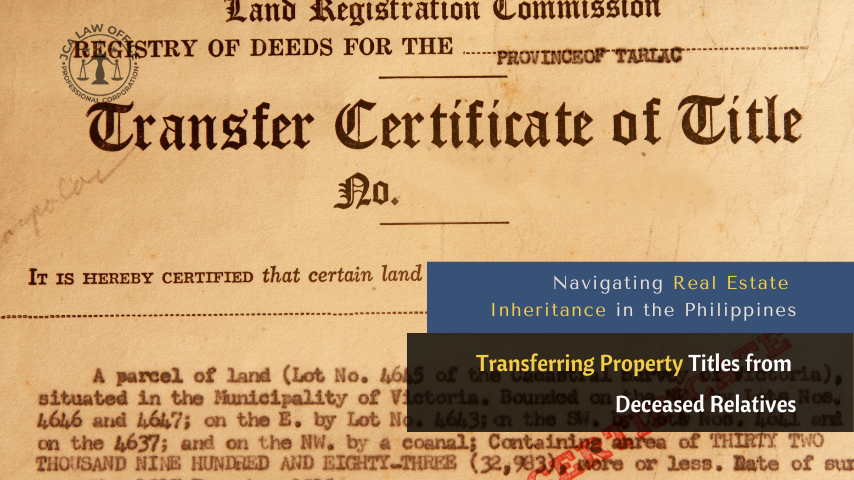
  • Navigating Real Estate Inheritance in the Philippines: Transferring Property Titles from Deceased Relatives

    Navigating Real Estate Inheritance in the Philippines: Transferring Property Titles from Deceased Relatives

    Navigating Real Estate Inheritance in the Philippines: Transferring Property Titles from Deceased Relatives

    A comprehensive guide for Filipino-Canadian heirs on how to transfer property titles from deceased relatives in the Philippines, including legal requirements, tax obligations, and step-by-step procedures.

    In the Philippines, a common occurrence is finding a property that remains titled under the name of a deceased relative, usually a parent or grandparent. Despite the death of the original owner, these properties often continue to be utilized, maintained, or even transacted by surviving heirs without the legal paperwork having been updated. This situation can create legal and financial complexities that may potentially jeopardize ownership rights and the value of the property.

    If you are an heir to such a property, it is crucial to transfer the title officially to avoid future legal disputes and to ensure the proper valuation of your inheritance. Here, we will discuss the process, requirements, and potential challenges involved in transferring real estate titles in the Philippines from deceased relatives to their living heirs.


    Understanding the Importance of Title Transfers

    Property titles in the Philippines are legal documents that prove ownership over a piece of land or a building. When the owner of a property dies, the title does not automatically pass on to the heirs. Instead, it remains in the name of the deceased until the legal process of transfer is completed. This delay can lead to several problems:

    1. Potential for Disputes: The property might be subject to inheritance disputes among the potential heirs, which could lead to lengthy legal battles.
    2. Inability to Transact: The heirs may not be able to sell, mortgage, or lease the property since the title is still under the deceased’s name.
    3. Tax Liabilities: The property may incur estate taxes and penalties that could diminish the value of the inheritance.

    The Transfer Process: From Estate Tax Clearance to Title Transfer

    The process of transferring a title from a deceased person to the living heirs involves several legal and administrative steps. These steps are generally as follows:

    Step 1: Secure a Death Certificate

    Obtain a certified copy of the death certificate from the local civil registry or the Philippine Statistics Authority (PSA).

    Step 2: Probate of Will or Declaration of Heirs

    If the deceased left a will, it must be probated, i.e., approved by the court. If there is no will, the court will have to issue a Declaration of Heirs.

    Step 3: Payment of Estate Taxes

    Calculate the estate tax due based on the value of the estate at the time of the owner’s death and pay this to the Bureau of Internal Revenue (BIR). This step involves filing the estate tax return and submitting the necessary documents.

    Step 4: Secure a Tax Clearance

    After paying the estate tax, secure a Certificate of Tax Clearance from the BIR, indicating that the estate tax has been fully paid.

    Step 5: Judicial Partition or Extrajudicial Settlement of Estate

    If the heirs cannot amicably decide on the distribution of the property, a court-supervised partition is necessary. If they agree, they can execute an Extrajudicial Settlement of Estate among themselves.

    Step 6: Transfer of Title

    Once the property has been properly partitioned or settled, the title can be transferred to the heirs. This requires filing a Deed of Adjudication with the Registry of Deeds, paying the corresponding transfer taxes, and obtaining the new titles under the heirs’ names.


    Conclusion

    Transferring a property title from a deceased relative in the Philippines to living heirs might appear to be a daunting task due to the number of steps and legal complexities involved. However, it is a critical process to prevent disputes and protect the value of your inheritance. It is advisable to seek legal counsel to help navigate through this process to ensure you adhere to all the requirements of the law, thereby ensuring a smooth and successful transfer.

    Need Help with Philippine Property Inheritance?

    JCA Law Office assists Filipino-Canadians with estate settlement, property title transfers, and extrajudicial settlements in the Philippines. Contact us for a consultation.

    204-2323 Yonge St, Toronto | 1-855-522-5290

  • Navigating the Filing of Estate Tax Return in the Philippines and the Implications of the Estate Tax Amnesty Act

    Navigating the Filing of Estate Tax Return in the Philippines and the Implications of the Estate Tax Amnesty Act

    Navigating the Filing of Estate Tax Return in the Philippines

    A comprehensive guide to estate tax filing requirements and the Estate Tax Amnesty Act

    The Estate Tax is a tax imposed on the transfer of the estate of a deceased individual to their heirs. In the Philippines, the process of filing an estate tax return can be complex and time-consuming. However, the introduction of the Estate Tax Amnesty Act has brought significant changes that can benefit taxpayers. This article provides a comprehensive guide to filing an estate tax return in the Philippines and discusses the implications of the Estate Tax Amnesty Act.

    I. Filing the Estate Tax Return in the Philippines

    1. Determining the Taxable Estate

    The first step is to determine the gross estate, which includes all the properties, rights, and interests of the deceased at the time of their death. This can be further categorized into real estate, personal properties, and intangible assets. After identifying the gross estate, certain deductions are allowed by law, such as:

    • Ordinary deductions: Funeral expenses, judicial expenses, and medical expenses.
    • Special deductions: Family home, standard deduction, and the share of the surviving spouse.

    2. Tax Rates and Exemptions

    The Tax Reform for Acceleration and Inclusion (TRAIN) Law sets the estate tax rate at 6% of the net estate value exceeding PHP 5,000,000. Estates worth PHP 5,000,000 or below are exempt from the tax.

    3. Filing the Estate Tax Return

    The estate tax return must be filed with the Bureau of Internal Revenue (BIR) within one year from the date of the decedent’s death. To do so, the following documents must be prepared:

    • BIR Form 1801: Estate Tax Return
    • Death certificate of the decedent
    • Notice of death filed with the BIR
    • List of properties and their respective values
    • Proof of claimed deductions
    • Tax Identification Number (TIN) of the decedent and the executor or administrator

    4. Payment of the Estate Tax

    The payment of the estate tax is due at the time of filing the return. It can be paid in full or by installment, depending on the circumstances of the estate.


    II. The Estate Tax Amnesty Act

    The Estate Tax Amnesty Act (Republic Act No. 11213) was signed into law in 2019, providing a one-time opportunity for taxpayers to settle outstanding estate tax liabilities at a reduced rate. The key features of the Act are:

    1. Amnesty Coverage

    The Act covers estate tax liabilities for decedents who passed away on or before December 31, 2017, with or without pending audit or investigation.

    2. Amnesty Rate

    The Act allows the payment of a 6% amnesty tax on the net estate, which is significantly lower than the previous estate tax rates of up to 20%.

    3. Immunities and Privileges

    Taxpayers who avail of the estate tax amnesty will be immune from payment of estate tax, civil, criminal, and administrative penalties. Additionally, they will not be subject to any further audit or investigation related to the estate tax liabilities.

    4. Amnesty Period

    The estate tax amnesty was initially available for two years from the effectivity of the Implementing Rules and Regulations (IRR). However, the government has extended the deadline due to the COVID-19 pandemic. Taxpayers should consult the BIR for the latest deadline.


    Conclusion

    The filing of an estate tax return in the Philippines can be a complex process, but understanding the requirements and procedures can help taxpayers efficiently navigate the system. The introduction of the Estate Tax Amnesty Act has provided a unique opportunity for taxpayers to settle their estate tax liabilities at a reduced rate and with significant immunities and privileges. It is crucial to consult tax professionals and the BIR for guidance on availing of the estate tax amnesty and ensuring compliance with the applicable laws and regulations.

    In summary, dealing with estate tax returns and the Estate Tax Amnesty Act in the Philippines requires a thorough understanding of the process and the related laws. By staying informed and seeking professional advice, taxpayers can maximize the benefits and minimize the risks associated with managing estate tax obligations in the country.

    Need Help With Estate Tax Filing?

    Our team can assist with estate tax matters, extrajudicial settlements, and Philippine legal requirements.