Changes in NOC and Its Effect on Express Entry System
How the NOC 2021 update replaces the four-category skill structure with a six-category TEER system, adds 16 new eligible occupations, and introduces five-digit codification.
How It Will Affect Canada’s Express Entry Program
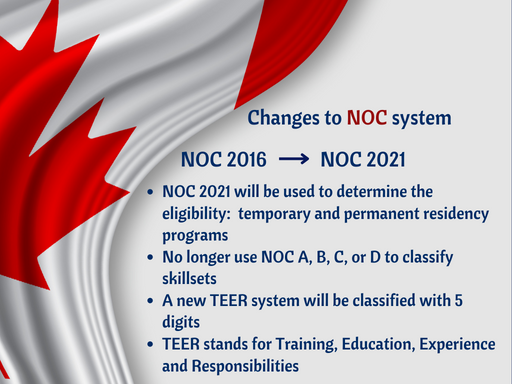
Beginning November 2022, the National Occupational Classification (NOC) 2021 version will be used by the Immigration, Refugees and Citizenship Canada (IRCC) to determine the eligibility of occupations under both temporary and permanent residency programs.
The changes will reflect the following:
- Four-category skill level structure replaced by six-category level under the new TEER system
- Sixteen additional eligible occupations for Express Entry
- Five-digit codification system to replace the current four-digit system
Changes in the Four-Category Skill Structure
The current four-category NOC skill level structure will be replaced by a six-category level that will show the required Training, Education, Experience, and Responsibilities (TEER) for every occupation. The TEER system will assess the level of training, of formal education, of experience required to gain entry into each occupation, and the responsibilities associated to it which is more precise than simply assessing the level of skills.
| NOC 2016 | NOC 2021 | ||
|---|---|---|---|
| Skill Type 0 | Management occupations | TEER 0 | Management jobs (usually require a degree) |
| Skill Type A | Usually require university education | TEER 1 | University degree (bachelor’s, master’s, or doctorate); or several years of experience from TEER 2 |
| Skill Type B | Usually require college education, specialized training or apprenticeship | TEER 2 | Post-secondary 2-3 years; or apprenticeship 2-5 years; or supervisory/safety roles; or experience from TEER 3 |
| TEER 3 | Post-secondary <2 years; or apprenticeship <2 years; or 6+ months on-the-job training; or experience from TEER 4 | ||
| Skill Type C | Usually require secondary school and/or occupation-specific training | TEER 4 | Secondary school completion; or several weeks on-the-job training; or experience from TEER 5 |
| Skill Type D | On-the-job training is usually provided | TEER 5 | Short work demonstration and no formal educational requirements |
Changes in Occupational Eligibility
With the implementation of NOC 2021, Express Entry Cut Off will be TEER 3. A total of sixteen (16) new occupations will become eligible for Express Entry:
16 New Eligible Occupations
- Payroll administrators
- Dental assistants and dental laboratory assistants
- Nurse aides, orderlies and patient service associates
- Pharmacy technical assistants and pharmacy assistants
- Elementary and secondary school teacher assistants
- Sheriffs and bailiffs
- Correctional service officers
- By-law enforcement and other regulatory officers
- Estheticians, electrologists, and related occupations
- Residential and commercial installers and servicers
- Pest controllers and fumigators
- Other repairers and servicers
- Transport truck drivers
- Bus drivers, subway operators, and other transit operators
- Heavy equipment operators
- Aircraft assemblers and aircraft assembly inspectors
On the other hand, three (3) occupations will become ineligible: a) other performers; b) program leaders and instructors in recreation, sport, and fitness; and c) tailors, dressmakers, furriers, and milliners. These occupations may still be eligible for programs with broader eligibility criteria and possible streams under the Provincial Nominee Program.
For the Atlantic Immigration Program (AIP), it is currently open to occupations categorized as Skill Level C or above. For NOC 2021, TEER 4 will be the cut-off for its Express Entry.
Twelve occupations will become ineligible for the AIP: Pet Groomers and animal care workers, Other support occupations in personal services, Longshore workers, Material handlers, Taxi and limousine drivers and chauffeurs, Delivery service drivers and door-to-door distributors, Boat and cable ferry operators and related occupations, Livestock labourers, Nursery and greenhouse labourers, Trappers and hunters, Food and beverage servers, Labourers in textile processing and cutting.
Changes in NOC Codification
NOC 2021 will use the new five-digit codification system as follows:
| Hierarchy | Digit Order | Definition |
|---|---|---|
| Broad Category | 1st Digit X | Occupational categorization |
| Major Group | 2nd Digit XX | TEER categorization |
| Sub-Major Group | XX.X | Top level of the Sub-Major Group |
| Minor Group | XX.XX | Hierarchy within the Sub-Major Group |
| Unit Group | XX.XXX | Hierarchy within the Minor Group |
The new codification system will be more flexible as it allows for the incorporation of many new unit groups in the future, as needed. With the changes, new unit groups were created for emerging occupations such as Data scientists and Cybersecurity specialists. Moreover, some occupations were considered statistically sufficient to have their own unit group, such as Financial advisors and Police investigators, and the three distinct unit groups created for Software developers and programmers.
References
- NOC 2016 Matrix Source — noc.esdc.gc.ca
- NOC 2016 to NOC 2021 Concordance — statcan.gc.ca
- Changes in NOC Versions — noc.esdc.gc.ca
For all your legal and immigration matters, our team at JCA LAW is always ready to help. Call us at 1-855-522-5290 or visit our immigration page.


Leave a Reply to Lizeth Cancel reply