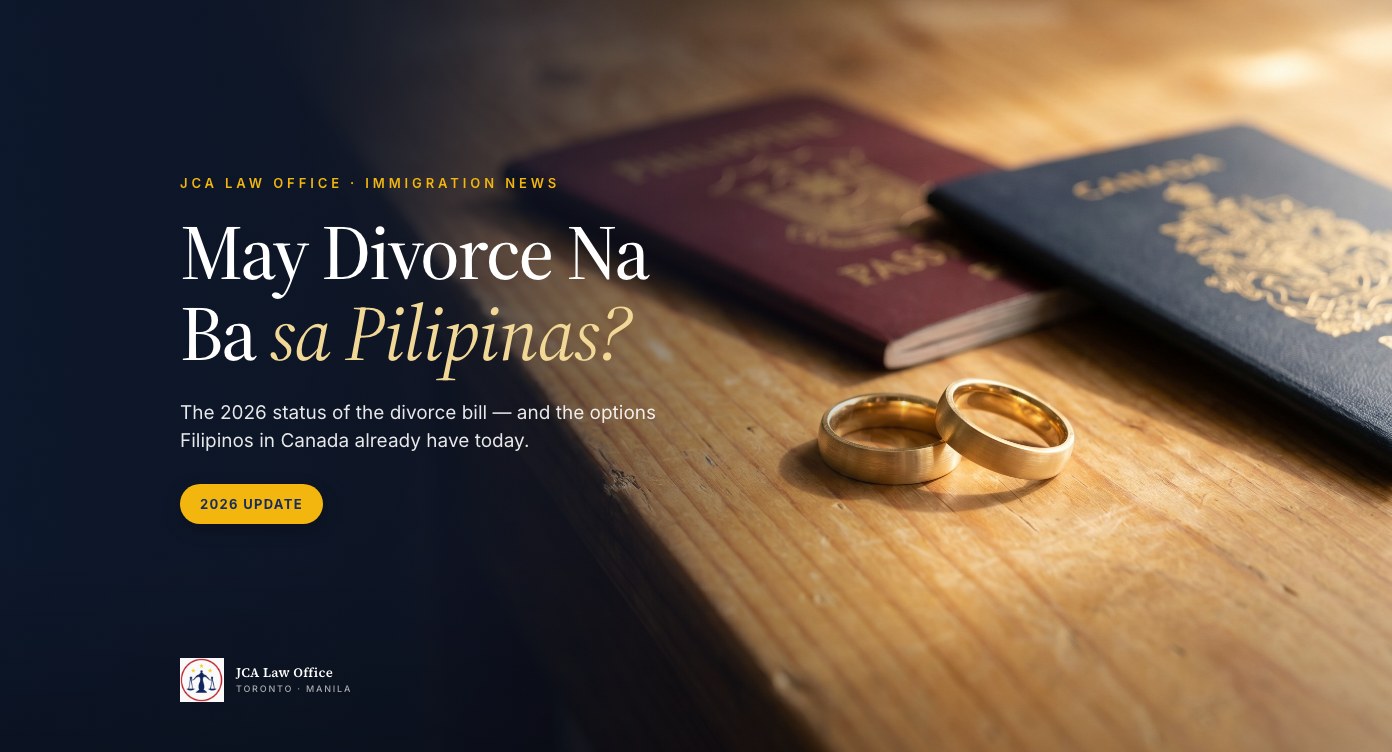
The short answer: wala pa. As of July 2026, the Philippines still has no divorce law for the general population — we remain the only country in the world, aside from Vatican City, without one. (Muslim Filipinos are the exception: divorce has long been available under Presidential Decree 1083, the Code of Muslim Personal Laws.)
But if you’ve been seeing headlines and asking “totoo ba?” — here’s exactly where things stand, and more importantly, what your real options are today if you’re a Filipino in Canada whose marriage has ended in everything but paperwork.
What actually happened to the divorce bill
In May 2024, history was made: the House of Representatives passed House Bill 9349, the Absolute Divorce Act, on third and final reading — by a razor-thin 131–109 vote. It was the first time a divorce bill ever got that far.
Then it hit the Senate. And there it sat — until the 19th Congress ended in June 2025 without a Senate vote. Under Philippine legislative rules, that means HB 9349 is dead. It didn’t carry over; it lapsed.
In the 20th Congress, which opened July 2025, divorce advocates started over. Several measures have been refiled — including House Bill 108 and House Bill 210 — but as of this writing, none has passed either chamber. Lawmakers have been trying since 2005. It may pass someday. It has not passed yet.
Ang ibig sabihin: kung may nagsabi sa’yo na “pwede ka nang mag-divorce sa Pilipinas” — hindi pa po totoo. Anyone charging you fees for a “Philippine divorce” today is selling something that does not exist.
But here’s what many Filipinos in Canada don’t realize
If you live in Canada, you don’t have to wait for the Philippine Congress. Canadian law already gives you options — and for many of our kababayan, the wait for a PH divorce law was never actually necessary.
1. You can divorce in Canada — even if you married in the Philippines
Canadian courts can dissolve your marriage if you or your spouse has been habitually resident in a province for at least one year — regardless of where you married, and regardless of your citizenship. Permanent residents, work permit holders, even those without status can qualify on residence.
Two things surprise people the most:
- You do not need your spouse’s consent or cooperation. The most common ground is simply having lived separate and apart for one year. Your spouse refusing to “sign” does not stop a Canadian divorce. (Hindi hostage ang divorce mo sa pirma ng asawa mo.)
- The divorce is fully valid in Canada — for remarriage in Canada, for your will and property here, and for immigration purposes.
We wrote a full guide here: What Filipinos Need to Know About Divorce in Canada, and our family law team’s services are here: Family Law Services in Ontario.
2. Will the Philippines recognize your Canadian divorce? It depends on citizenship — and this is the trap
Under Article 26(2) of the Family Code, a divorce validly obtained abroad can be recognized in the Philippines — but only where the marriage involves a foreign citizen. The Supreme Court has made this doctrine more generous over the years:
- Republic v. Orbecido (2005): citizenship is counted at the time of the divorce, not at the wedding. So if you married as two Filipinos, but your spouse later became a Canadian citizen before the divorce, Article 26(2) can apply.
- Republic v. Manalo (2018): it no longer matters who filed the divorce. Even if the Filipino spouse was the one who went to court abroad, the foreign divorce can be recognized.
The trap: if both of you were still Filipino citizens when the Canadian divorce was granted — say, two permanent residents who haven’t taken Canadian citizenship — the Philippines does not recognize that divorce. In Canada you’re divorced; in the PSA’s records, kasal pa rin kayo. That mismatch has real consequences: you can’t remarry in the Philippines (remarrying there could even expose you to a bigamy case), and it complicates property, inheritance, and benefit claims back home.
And one more step people skip: even when Article 26(2) applies, PH recognition is not automatic. You need a judicial recognition of foreign divorce case in a Philippine court, then annotation of your PSA marriage certificate. Until that’s done, Philippine agencies still see you as married.
3. The immigration angle: sponsoring a new partner
This is where the divorce question and the immigration question meet — the situation we see weekly in consultations.
- To sponsor a new spouse, your previous marriage must have been legally dissolved by a divorce that’s valid where it was granted. A Canadian divorce does this job for Canadian immigration purposes.
- Can’t remarry yet? The common-law route exists. Canadian immigration law recognizes a common-law partner: someone you’ve cohabited with in a conjugal relationship for at least one year. And notably, IRCC’s own sponsorship guide accepts that you can be in a common-law relationship even while still legally married to someone else — you’ll need to prove the marriage broke down, that you’ve lived separate and apart from your spouse for at least a year, and only cohabitation after that separation counts toward the 12 months.
Start here: Spousal Sponsorship Canada — Complete Guide for Filipinos · sa Tagalog · Inland vs. Outland — which is right for Filipino couples?
4. What about annulment, nullity, or legal separation in the Philippines?
Those remain the domestic PH routes: declaration of nullity (marriage void from the start), annulment (voidable marriages), and legal separation — which, importantly, does not allow remarriage; it only lets you live apart. Which route makes sense (and whether a Canadian divorce plus PH recognition is faster for your situation) is exactly the kind of cross-border question worth mapping out with a lawyer who works on both sides.
Sa madaling salita 🇵🇭
- Wala pa ring divorce law sa Pilipinas (July 2026). Namatay ang HB 9349 sa Senado; nag-file ulit sa bagong Kongreso, pero wala pang naipapasa.
- Pwede kang mag-divorce sa Canada kahit sa Pilipinas kayo kinasal — isang taon na paninirahan sa province ang kailangan, at hindi kailangan ng pirma o pahintulot ng asawa mo.
- Ang recognition sa Pilipinas ay depende sa citizenship sa panahon ng divorce. Kung parehong Pilipino pa kayo — hindi kikilalanin ng PH ang Canadian divorce; kailangan ng ibang strategy.
- Puwedeng mag-sponsor ng bagong partner — bilang asawa (kung may valid divorce) o bilang common-law partner (12 buwang pagsasama, kahit hindi pa tapos ang dating kasal, basta patunayan ang paghihiwalay).
- Bawat sitwasyon ay iba — kumonsulta bago gumalaw.
💬 Nasa ganitong sitwasyon ka ba?
Every case turns on citizenship, timing, and where you plan to remarry or sponsor. Book a consultation with our team and map out your options: jcalaw.ca/book-appointment.
What we’re watching
This is a developing story. Our team monitors the 20th Congress divorce bills, IRCC policy, and Philippine Supreme Court rulings on foreign divorce — we’ll update this article as things move, and we take up reader questions in our regular Facebook live Q&As. Sundan niyo kami — many of you found us through our videos on exactly this topic, and your questions in the comments shape what we write next.
Atty. Josef-Jake Camacho Aguilar is the principal lawyer of JCA Law Office Professional Corporation in Toronto, and is licensed as a lawyer in both Ontario, Canada and the Philippines — one of the few practitioners advising on both sides of the exact cross-border questions in this article.
This article is general legal information for the Filipino community, not legal advice for your specific situation. For advice about your case, book a consultation with our team.

Leave a Reply