Last updated: November 18, 2026 | Who qualifies, what your employer has to do, what it costs, and why this work permit is not a shortcut to permanent residence.
Many people in the Filipino-Canadian community have heard that “a little French” can get you a Canadian work permit without an LMIA. The program behind that is the Francophone Mobility work permit (Mobilité Francophone, LMIA exemption code C16). It exists, and the language bar is lower than most people expect. It also gets misunderstood. Some articles online still describe the pre-2023 rules, and some suggest the permit leads to permanent residence. It does not, at least not automatically.
This guide explains how C16 works today, using IRCC’s own pages. It also covers the gap that matters most if your long-term goal is PR. The work permit needs intermediate French in two skills. The French route to PR through Express Entry needs a higher level in all four.
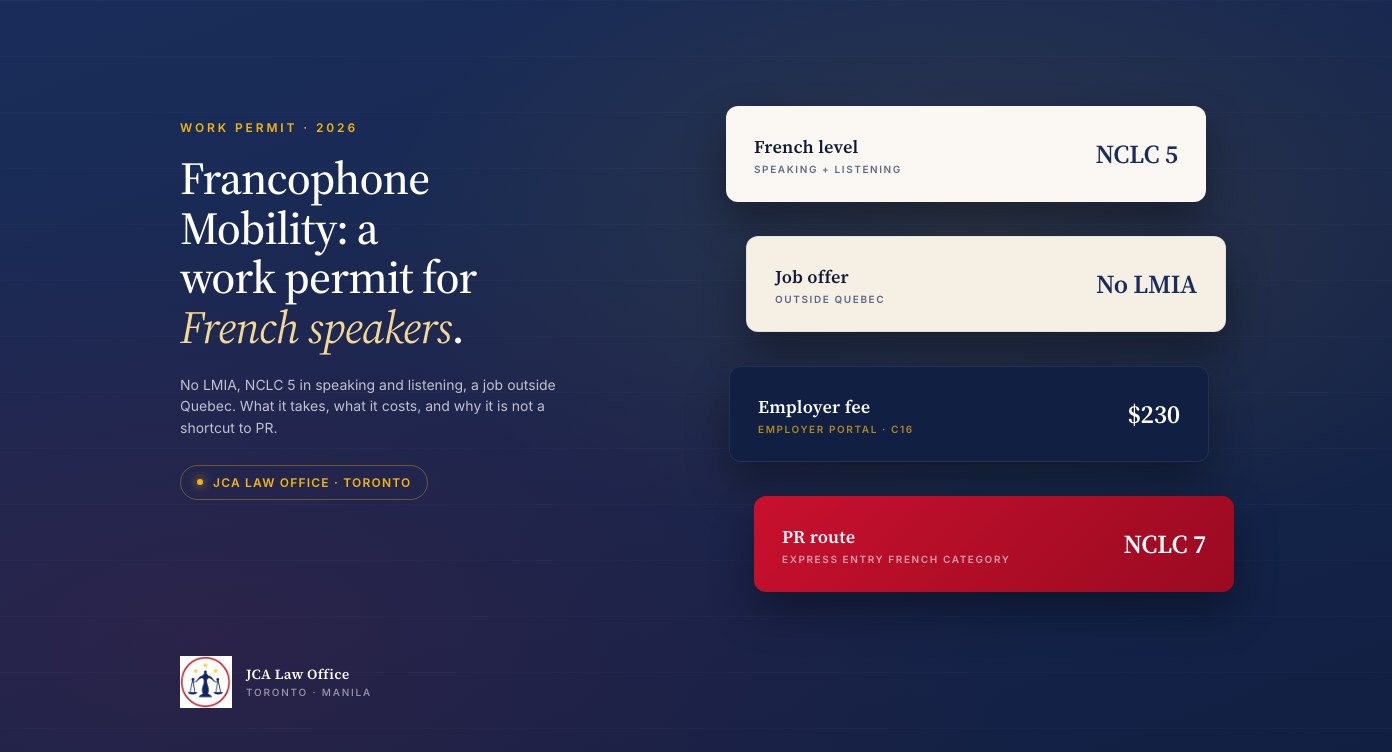
Francophone Mobility (C16) at a glance
- French needed: NCLC 5 or higher in speaking and listening only. You don’t need to prove reading or writing.
- Where: a job in any province or territory outside Quebec
- Which jobs: any TEER category, except primary agriculture jobs in TEER 4 and 5
- No LMIA: the employer submits the offer in the IRCC Employer Portal under code C16 and pays a $230 employer compliance fee
- Not PR: it is a temporary work permit. The French-language Express Entry category needs NCLC 7 in all four abilities.
What is the Francophone Mobility work permit?
Francophone Mobility is part of Canada’s International Mobility Program. Under it, a Canadian employer outside Quebec can hire a French-speaking foreign worker without a Labour Market Impact Assessment (LMIA). IRCC issues it under the public-policy provision of the immigration regulations (subparagraph 205(c)(ii) of the Immigration and Refugee Protection Regulations). Officers and employers know it by its exemption code, C16.
A few points are often misunderstood:
- The job does not have to be in French. IRCC’s instructions to officers say the language of work does not need to be French. The program rewards your French ability, not a French-speaking workplace.
- It is employer-specific. The permit rests on one employer’s offer of employment. If you want to change employers, the new employer generally has to submit its own C16 offer, and you apply for a new permit before you start the new job.
- It is not an open work permit. You need a real job offer first.
- Quebec is excluded. Quebec runs its own immigration selection, so C16 jobs must be in one of the other 9 provinces or 3 territories.
If LMIA-exempt permits are new to you, our guide Work Permit vs LMIA: What Filipino Workers Need to Know explains the difference.
Francophone Mobility eligibility requirements
For applications submitted on or after June 15, 2023, IRCC lists these requirements:
| Requirement | What IRCC asks for |
|---|---|
| French ability | Intermediate speaking and listening, at level 5 or higher on the Niveaux de compétence linguistique canadiens (NCLC) scale. Reading and writing are not assessed. |
| Location | You must live and work in a province or territory outside Quebec. |
| Job offer | A job in any TEER category of the National Occupational Classification (NOC) |
| Exclusion | Primary agriculture occupations in TEER 4 and 5 do not qualify. |
| Employer steps | The employer submits the offer under code C16 in the Employer Portal and pays the employer compliance fee. |
| General requirements | You must meet the general eligibility requirements for any work permit, such as admissibility and documents. |
Reading older articles? The rules changed in June 2023
If you have seen “NCLC 7” or “skilled jobs only” in connection with Francophone Mobility, that article describes the old program. IRCC still publishes both versions:
| Applied before June 15, 2023 | Applied on or after June 15, 2023 (current) | |
|---|---|---|
| French level | NCLC 7 (officer had to be satisfied you could reach it) | NCLC 5 in speaking and listening |
| Eligible jobs | TEER 0, 1, 2 or 3 only | Any TEER, except primary agriculture in TEER 4 and 5 |
| Location | Outside Quebec | Outside Quebec |
How to prove your French
IRCC accepts any of these as proof of NCLC 5 or higher in speaking and listening:
- Test results: the speaking and listening results of the Test d’évaluation de français (TEF) or the Test de connaissance du français (TCF)
- Education: a written confirmation from a college or university of a program in French
- Other documents that show you were educated in French
For most Filipino applicants, a test will be the practical route, because few of us studied in French. If you think you will later use the same test for Express Entry, check the requirements first. Express Entry accepts only TEF Canada and TCF Canada, requires all four abilities, and accepts results only if they are less than two years old. Our French Language Proficiency Express Entry guide covers the tests in detail.
What the employer has to do (no LMIA required)
The employer’s part is short compared with an LMIA, but it is mandatory. IRCC sets out three steps:
- Confirm the candidate is eligible. That means French at NCLC 5 in speaking and listening, a job outside Quebec, and a job that is not excluded.
- Submit the offer of employment in the IRCC Employer Portal using exemption code C16 (Mobilité Francophone), and pay the $230 employer compliance fee.
- Give the worker what they need to apply: the 7-digit offer of employment number and the signed offer of employment.
Once the offer is submitted, the employer must follow the conditions in section 209.2 of the regulations, which apply to employers of LMIA-exempt workers who hold an offer. In summary, the employer must:
- employ you in the same occupation as the offer, with wages and working conditions that are substantially the same as, and not less favourable than, the offer
- stay actively engaged in the business the offer was made for
- make reasonable efforts to provide a workplace free of abuse
- keep documents showing compliance for six years from the start of your employment
- answer questions, provide documents and attend inspections if IRCC verifies compliance. Verification can happen on suspicion, because of past non-compliance, or through random selection.
If you are an employer thinking about hiring a French-speaking worker, our LMIA employer guide covers the broader hiring rules.
How to apply for the Francophone Mobility work permit
- Build your French first. Reach NCLC 5 in speaking and listening and get proof, usually TEF or TCF results.
- Secure a job offer from an employer outside Quebec, in an eligible occupation.
- Get the employer to submit the offer under C16 in the Employer Portal and pay the compliance fee. Then get the 7-digit offer number and the signed offer from them.
- Apply online through your IRCC account. Get your document checklist, fill out the forms, upload documents and pay the fees.
- Give biometrics if IRCC asks for them. IRCC checks that the application is complete, including biometrics, and may return an incomplete application without processing it.
- After approval: if you applied from outside Canada, you get a port of entry letter of introduction. This is not the permit itself. The permit is issued at the port of entry on the day you arrive. If you applied from inside Canada, IRCC says you can start working once you receive its approval notification, without waiting for the permit to arrive in the mail.
Fees
| Fee | Amount (CAD) | Who pays |
|---|---|---|
| Work permit processing fee | $155 per person | Worker |
| Biometrics, if required | $85 per person ($170 maximum for a family of 2 or more applying together) | Worker |
| Employer compliance fee | $230 | Employer |
Processing times change often, so check IRCC’s processing-times tool for your country of application instead of relying on a number in an article.
Can my spouse and children come with me?
IRCC says the spouse or common-law partner and dependent children of a Francophone Mobility worker may be able to get an open work permit, and that your children can attend school while you work. Whether your spouse qualifies is decided by IRCC’s general family open work permit rules. They are not specific to C16, and they were tightened on January 21, 2025. Under the current rules:
- If you are not yet on a PR pathway, your spouse can generally get an open work permit only if you work in a TEER 0 or 1 occupation or one of IRCC’s listed TEER 2 or 3 occupations, and your permit is valid for at least 16 months after IRCC receives your spouse’s application.
- Under that same measure, dependent children are no longer eligible for open work permits.
- If you work in TEER 4 or 5 and are not on an eligible PR pathway, your family members cannot get an open work permit under these rules.
- Different rules can apply once you have applied for PR through an eligible economic program, or if a free trade agreement covers you.
Many Filipino families plan to come together, so check this before you accept a TEER 4 or 5 offer or a short contract.
From C16 to permanent residence: the realistic picture
This is the most important section of this guide. A Francophone Mobility work permit does not lead to permanent residence on its own. It gives you lawful work in Canada and a chance to build Canadian experience. PR still requires you to qualify, and usually compete, under a separate program.
The French gap: NCLC 5 for the permit, NCLC 7 for the PR advantage
The reason French is attractive for PR is Express Entry’s French-language proficiency category. That category needs NCLC 7 in all four abilities: speaking, listening, reading and writing. C16 needs NCLC 5 in two.
| Francophone Mobility (C16) | Express Entry French category | |
|---|---|---|
| What it gives you | Temporary, employer-specific work permit | A chance to be invited to apply for PR |
| French needed | NCLC 5, speaking and listening only | NCLC 7 in all four abilities |
| Accepted proof | TEF/TCF results, or education in French | TEF Canada or TCF Canada results under 2 years old |
| Other requirements | Job offer outside Quebec | Must also qualify for an Express Entry program, then be invited in a draw |
French also adds points to your Comprehensive Ranking System (CRS) score. With NCLC 7 or higher in all four French abilities, you get 50 extra points if you also have CLB 5 or higher in all four English abilities, or 25 points if your English is CLB 4 or lower or you didn’t take an English test.
The category has been active. According to IRCC’s published rounds data, IRCC held 12 French-language proficiency rounds in 2026 through October 27, issuing 60,500 invitations with cut-off scores between 382 and 435. The most recent, on October 27, 2026, invited 5,000 candidates at a cut-off of 407. Cut-offs change with every draw, and past draws do not promise future ones. See our overview of Express Entry’s French category.
How long does it take to go from zero to NCLC 7?
Be realistic here. As a general estimate, an adult starting French from zero and studying alongside full-time work may need one to two years or more to reach NCLC 7 in all four skills. Reading and especially writing usually take longer than conversation. Your pace depends on how many hours you put in, your instruction, and whether you already speak Spanish or another Romance language. Treat NCLC 5 for C16 as a first milestone, not the finish line.
Canadian experience: TEER matters
C16 lets you work in any TEER category, but the Canadian Experience Class counts only work in TEER 0, 1, 2 or 3: at least one year (1,560 hours) in the three years before you apply. A TEER 4 or 5 C16 job is lawful work, but it will not build CEC eligibility. Other routes may still be available, such as provincial programs or the Francophone Community Immigration Pilot (FCIP). Note that the FCIP also needs NCLC 5 in all four abilities, not just the two C16 tests.
Common mistakes to avoid
- Relying on old articles that quote NCLC 7 and TEER 0–3 for C16
- Accepting a job in Quebec, which C16 does not cover
- Accepting a primary agriculture job in TEER 4 or 5, which is excluded
- Applying before the employer has submitted the offer. You need the 7-digit offer number.
- Assuming your spouse will automatically get an open work permit. Check your TEER and how long your permit is valid.
- Assuming C16 means PR. Plan the French study and the PR program from the start.
- Working for a different employer without a new offer and a new permit
Frequently asked questions
Do I need to be fluent in French?
No. C16 needs intermediate speaking and listening, at NCLC 5 or higher. You don’t need to prove reading or writing for the work permit.
Does my job have to be in French?
No. IRCC’s officer instructions say the language of work does not need to be French. The job does have to be outside Quebec.
Can I apply from the Philippines?
Yes. You apply online. If you are approved from outside Canada, you get a port of entry letter, and the permit is issued when you arrive. You still need an employer in Canada to submit a C16 offer first.
Can I use C16 if I am already working in Canada on another permit?
Possibly. If you meet the French and job requirements and an eligible employer submits a C16 offer, you can apply from inside Canada. Check how the timing fits with your current permit’s expiry. Our article on what to do when your work permit is expiring may help.
Will C16 get me permanent residence?
Not by itself. It is a temporary work permit. For PR, you would need to qualify under a program such as Express Entry, where the French category needs NCLC 7 in all four abilities, or a provincial or pilot program, each with its own rules.
Who pays the $230 fee?
IRCC’s employer instructions say the employer pays the $230 employer compliance fee when submitting the offer. The worker pays the work permit fee and, if required, biometrics.
How JCA Law Office can help
We work with workers and employers in the Filipino-Canadian community. For workers, we look at whether C16 fits your offer and occupation, prepare the work permit application, and map a realistic PR plan, including where French at NCLC 7 fits. For employers, we explain the Employer Portal submission and the compliance obligations that follow. Book a consultation, or contact our team to find the right service for your situation.
Related resources
- French Language Proficiency Express Entry: Complete Guide for Filipinos
- Express Entry’s French Proficiency Category: What It Is and How to Qualify
- Canada Launches New Immigration Pilot Programs: RCIP and FCIP
- Work Permit vs LMIA: What Filipino Workers Need to Know
- Filipino Immigrant Guide to Canada: From Visa to PR
- IRCC: Francophone Mobility work permit (official program page)
- IRCC: Hire a French-speaking or bilingual worker outside Quebec (employers)
- IRCC: Fee list
General information, not legal advice. IRCC changes program rules, fees and draw practice without notice. The figures above come from IRCC pages checked on November 18, 2026. Confirm them on canada.ca before you rely on them, and get advice on your own situation.

Leave a Reply