What Filipinos Need to Know About Divorce in Canada
For most Filipinos, divorce is not an option. The Philippines is one of only two countries in the world that does not allow divorce. Learn how the Canadian divorce process works, how it compares to Philippine annulment, and what your options are.
Marriage is “forever” for most Filipinos. Divorce is not an option. The Philippines is one of only two countries in the world that do not allow divorce. The other is Vatican City. Thus, Filipinos who are separated from their spouses can only apply for divorce abroad. In Canada, home to close to a million Filipino expatriates, the divorce process is clear and simple. In contrast, getting an annulment in the Philippines is complicated and results are uncertain.
The grounds for the annulment of marriage in the Philippines are strict and must exist at the time of marriage. However, relationship breakdowns naturally happen after marriage. This is the reason most marriage breakdowns do not qualify for an annulment in the Philippines. Legal separation is a remedy but that is another topic for discussion. If you’re Filipino (or born Filipino) and are considering applying for a divorce in Canada, continue reading to know more.
What is divorce?
Divorce is the legal dissolution of a marriage by a court or other competent body. This means marriage no longer has an effect and a person with a “divorced” status can remarry as if their status is “single”. Many Filipinos are naturally confused by this because the concept is completely foreign to them. In the Philippines, marriage continues to have legal consequences even if the couple is in fact already separated. Filipinos have a Tagalog saying “ang kasal ay hindi parang mainit na kanin na pag napaso ka, iluluwa mo na”. Translate that into English and write your comments below. It is surprising for some Filipinos to learn that, outside the Philippines, divorce is allowed in every country except the Vatican.
What is an annulment of marriage?
Annulment is the declaration by a court that the marriage is null and void. Like divorce, this also means that the marriage is no longer in effect. However, unlike divorce, an annulled marriage is usually considered null and void from the beginning (at the start of marriage), not just when the annulment was granted. This is because the grounds for annulment must exist at the time of marriage.
What’s the difference between Divorce in Canada and Annulment in the Philippines?
The grounds for divorce in Canada are the following:
being separated for at least one year;
adultery; and
physical or mental cruelty.
Some grounds for annulment of marriage in the Philippines are the following:
marriage between minors;
marriage solemnized without a marriage license;
marriage solemnized by a person not authorized;
psychological incapacity;
lack of parental consent;
consent obtained by fraud, force, intimidation, or undue influence;
either party was physically incapable of consummating the marriage with the other; and
either party was afflicted with a sexually transmissible disease.
The most important distinction between the grounds for annulment or divorce is the timing.
For divorce, the grounds can happen after the marriage. For annulment, the grounds must exist at the time of marriage. This explains why the effect of an annulment is that the marriage is void or without effect from the beginning. Also, note that being separated in fact for at least one year is sufficient grounds for divorce. It does not matter what caused the separation. In Canada, a married person can decide to separate for any reason. There is no need to explain or give reasons.
Looking For Advice About Divorce
If you need further advice and assistance on how to get a divorce in Canada, you may give us a call at 1-855-522-5290 or send us a direct message on our Facebook Page.
Can I get divorced in Canada even if I’m not a Canadian citizen?
Yes. You may apply for a divorce order even if you’re not a Canadian citizen. Permanent and temporary residents including foreign students, workers, or visitors, may apply for a divorce if all other requirements are met.
Can I get a divorce in Canada even if I’m only a visitor?
Yes. A foreign visitor may apply for a divorce in Canada. The minimum requirement is that the applicant has been a resident of Canada for a least one year.
Do I need a lawyer to file an application for divorce?
No. Hiring a lawyer is not mandatory but is recommended if you are not familiar with the rules.
Can I hire someone else, not a lawyer, to help me with the divorce application?
No. Only licensed lawyers are allowed to advise and represent you for the divorce application.
How long does it take to get a divorce?
It used to take only a few months (less than a year) to get a divorce order (pre-COVID) but this can vary depending on many factors.
What can cause a delay in getting a divorce?
One of the most common causes of delay is the service of documents, especially if the respondent (your ex-spouse) lives outside of Canada. “Service” means providing a copy of your divorce application documents to the respondent. This is an essential part of the process and will cause a delay if not done according to the rules. Another cause of delay is if no reasonable arrangements have been made for the support of any children of the marriage.
Do I have to be present in court for the divorce application?
No. Generally, you do not need to attend court particularly if the divorce is uncontested. Uncontested means that your divorce application is not being opposed by the respondent.
Do I need to get divorced if I’m applying for permanent residency in Canada and am already separated from my spouse in the Philippines?
No. However, getting a divorce order can be useful in case you are applying to become a permanent resident in Canada and are already separated from your spouse. A divorce certificate is proof that you are no longer married to your ex-spouse and you need not included him or her in your application. It is recommended that you seek the advice of a qualified lawyer for a full discussion.
Can I be charged with bigamy in the Philippines if I get married after a divorce?
It depends. Since the Philippines has no divorce law, a second marriage can be considered bigamous even after getting divorced abroad. Your divorce order (which is a foreign judgment) may need to be recognized by a Philippine court. It is recommended that you seek the advice of a qualified lawyer for a full discussion.
Will my divorce in Canada be recognized in the Philippines?
It depends. Since there is no divorce law in the Philippines, divorce is recognized only for non-Filipino citizens. Your divorce may be recognized in the Philippines if you are no longer a Filipino citizen. This is a complicated topic involving conflicts of international laws. It is recommended that you seek the advice of a qualified lawyer for a full discussion.
Is it cheaper to get a divorce in Canada than to get an annulment in the Philippines?
Generally, yes. While costs vary depending on several factors such as your choice of lawyer, getting a divorce order in Canada is relatively inexpensive.
Do I need to get divorced before I can be in another relationship?
No. Getting separated from a spouse or being in another relationship is a personal decision. It is not affected by whether you are divorced.
Related Topics
Five Things You Need To Know About Divorce In Canada
The uncomplicated guide on how to divorce your spouse learn more…. Read More
Everything you need to know about this essential document for Filipino minors travelling abroad
If you recently applied through any of the pathways for permanent residency in Canada and have minor child(ren) included in your application, you probably need a notarized and authenticated Affidavit of Support and Consent if the said child(ren) will travel unaccompanied by a parent or legal guardian.
So, what is an “Affidavit of Support and Consent?”
An “Affidavit of Support and Consent” is one of the requirements in the Philippines whenever a minor child is applying for a passport or travel document without a parent or legal guardian. Another required document is a Special Power of Attorney.
The affidavit must be sworn before a notary public and contain the following statements:
Your relationship to the child(ren)
Basic information about the child(ren) such as name, birthdate, place of birth, etc.
Name of authorized person who will apply for the child(ren)’s passport or travel document
Name of authorized person who will accompany the child(ren) for the travel abroad
Express consent for the child(ren) to travel with the authorized person
Statement of support for the child(ren) while in the foreign country
Any other statements to support your affidavit
How do you prepare the Affidavit of Support and Consent?
1) SELF-PREPARE
You can do it yourself (DIY) if you know how to prepare an affidavit. Ensure that it is in the proper form and contains all the statements above. Be aware that an affidavit becomes a legal document once executed, so be careful. This option may not be suitable for everyone.
2) FILL OUT THE FORM
Fill out the sample forms available through the following government websites:
Disclaimer: JCA Law is not associated with the Government of the Republic of the Philippines or any of its departments, agencies, or bureaus. These links are for reference only and are not endorsed. If you have any questions about these forms, contact the nearest Philippine consulate office or embassy in your area. If you need legal advice, consult with a licensed professional in your Province.
3) JCA LAW TEAM ASSIST
JCA Law can help you prepare the Affidavit of Support and Consent. If you need assistance, message us on Facebook Messenger or book an appointment any time. We will respond within the next business day.
If the matter is urgent, call 855-522-5290 during office hours.
Why is an Affidavit of Support and Consent required?
An Affidavit of Support and Consent is just one of the requirements for securing a travel clearance from the DSWD.
Below is a list of all requirements for a travel clearance for a minor child. Click on the option that applies to you:
For minors travelling alone to a foreign country for the first time
Duly accomplished DSWD Travel Clearance application form
Photocopy of either Birth Certificate or passport of the minor
Written consent of both parents or the solo parent or the legal guardian permitting the minor to travel alone to a foreign country
Proof of the consenting parent’s relation to the child, in one of the following forms:
(married parents) a photocopy of the marriage certificate of the minor’s parents
(legal guardian) a photocopy of the certificate of legal guardianship of the minor
(solo parent) a photocopy of the solo parent identification card from the Municipal Social Welfare and Development Office, a Local Social Welfare and Development Office, Tallaq or Faskh certification from the Shariah court or any Muslim Barangay or religious leader
(if child is illegitimate) a Certificate of No Marriage (CENOMAR) issued by the National Statistics Office (NSO)
(if parents are deceased) a photocopy of the death certificate
Two colored passport size photos of the minor taken within the last six (6) months
The DSWD social worker may require additional documentary requirements during the assessment of the Travel Clearance application to make sure that no child shall be trafficked and that the child’s best interest and welfare is ensured.
For minors travelling for the first time with a person other than the parents or legal guardian
Duly accomplished DSWD Travel Clearance application form
A photocopy of the birth certificate of minor
A written consent of both parents or the solo parent or the legal guardian permitting the minor to travel to a foreign country with a specific person other than them
As appropriate, a photocopy of the marriage certificate of the minor’s parents or a certificate of legal guardianship of the minor or in the case of solo parents, a solo parent identification card from the Municipal Social Welfare and Development Office or a certification from the Local Social Welfare and Development Office of being a solo parent or a court decree of separation, annulment or divorce, or Tallaq or Fasakh certification from the Shariah court or any muslim barangay or religious leader or in the case of an illegitimate minor, a certificate of no marriage (CENOMAR) from the National Statistics Office or in the case of a deceased parent, a photocopy of the death certificate
Two colored passport photos of the minor taken within the last 6 months.
Photocopy of the passport of the travelling companion
For minor illegitimate children travelling abroad with the biological father
A minor illegitimate child who is travelling abroad accompanied by the biological father is required to secure a travel clearance certificate as parental authority is vested only to the mother of the child, per Article 176 of the Family Code of the Philippines.
Aside from the DSWD, who else requires the Affidavit of Support and Consent?
The Department of Foreign Affairs (DFA) of the Republic of the Philippines requires a minor applicant to submit an Affidavit of Support and Consent if the child is not accompanied by a parent or legal guardian during the passport application process. Thus, both the DFA and DSWD require the Affidavit of Support and Consent if the child will not be accompanied by a parent or legal guardian during his or her travel abroad.
A valid passport is of course required for anyone to travel abroad. The DFA issues passports for Filipino citizens. As noted above, the DFA will require an Affidavit of Support and Consent in at least two (2) situations. Therefore, even if the child will be accompanied by a parent or legal guardian for the travel abroad, the Affidavit of Support and Consent will still be required if there is no parent or legal guardian during the passport application. Another required document is a Special Power of Attorney (SPA).
Does the Affidavit of Support and Consent have to be notarized?
Yes. An affidavit is a sworn statement which means that it must be signed or executed before a notary public. Contact us if you need a notary public in Ontario, Canada.
Can I sign the Affidavit of Support and Consent in Canada?
Yes. You can sign or execute the Affidavit of Support and Consent in Canada. However, the said Affidavit needs to be authenticated or “consularized” before sending it to the Philippines. Contact us if you need assistance with getting your legal documents authenticated. Our office is conveniently located near the Philippine Consulate in Toronto.
Is the notary and authentication of an Affidavit the same? What is the difference?
Notary and authentication are not the same. You must go to a notary public to have your document notarized. For authentication, you must go to the Philippine Consulate General near you or the Philippine Embassy in Ottawa.
Everyone needs to adapt in an ever-changing world, and that includes lawyers, notary public, oath commissioners and licensed immigration consultants… Read More
If you are one of the people who always get confused as to what kind of documents must undergo consular notarization and authentication here in Canada so it may be used in the Philippines… Read More
Need an Affidavit of Support and Consent?
Our team can prepare, notarize, and assist with authentication of your documents.
If you are confused about whether to hire a lawyer, this post is for you.
“If you think it’s expensive to hire a professional to do the job, wait until you hire an amateur.” – Red Adair
3 REASONS WHY YOU NEED TO HIRE A LAWYER
Reason No. 1: You do not know what to do with your legal matter
Legal matters can have long, unexpected, and unwanted consequences.
Get the information you need from a trusted and reliable source. Lawyers are expected to maintain professional standards involving competence and ethics. In Ontario, practicing lawyers are covered by professional liability insurance up to $1,000,000 or more.
Unless you know what you are doing or the matter is inconsequential, seeking legal advice from a professional will probably create the best value for your time and money. Avoid getting “free” legal advice from family or friends especially for matters that you deem important. First, they may cause more harm than good if they are not competent to provide such advice. Second, they may be biased or have a self-interest in the matter. Ironically, what many consider “free” are usually the ones that cost the most.
Some lawyers are better suited for your needs in terms of expertise, schedule, communication, and fees. Finding the right lawyer can be challenging, but whether you need one is probably the first decision you must make. Even if you do not get the solution to your legal matter right away, you are on the right track. A good lawyer should guide you with the process, lay out your options, and recommend your next steps. Moreover, such a lawyer is well connected and may refer you to another professional who is better able to meet your needs.
Reason No. 2: You do not have the time
Time is money or time is gold, so they say. Do you believe this? Of course!
Yes, you can spend your own time and do it yourself. There is no harm in trying if you know what you are doing (see Reason No. 1 above). However, specialists like lawyers are expected to do their job much better and a lot faster. Consider how that will translate to cost savings for you. They say practice makes perfect and anyone doing something repeatedly will naturally become proficient at it. Lawyers become experts in legal matters through years of education, training, and experience.
If you would rather spend your time doing something else, then hiring a professional is the right choice. Spend your time doing what you do best and let lawyers do what they do best. Does this make sense? We think it does! While lawyers charge at an hourly rate much higher than the minimum wage, the value of their service is usually more than its cost. In fact, some highly rated lawyers deliver value many times over what they charge. What this mean is that in some cases, the lawyers that cost more are the ones who can deliver more value. Consider what you will gain compared to what it will cost.
As with making any decision, be adequately informed before making one. As mentioned above, there are lawyers better suited to your needs than others. Find the right one for you to get the most out of your time and money. Do not get intimidated by the initial cost. Instead, try to understand you will get out of it. Do your searches and ask the right questions.
More experienced lawyers are expected to charge higher hourly rates for good reasons. Such lawyers are relatively in high-demand which allows them to increase their rates. As you can imagine, a lawyer’s availability in terms of time is limited. Hence, lawyers whose services are highly sought after will tend to charge higher fees so that their time will be devoted only to serious clients who recognize their value.
Reason No. 3: Your judgement is clouded
There are matters better left to be handled by someone else even if you have the knowledge and the time for them. This applies if you are emotionally attached to the matter at hand because it will affect your judgment. Worse, the matter can lead to anxiety and leave you emotionally drained. Examples are those involving sensitive family law matters, civil litigation and criminal charges.
The best judgments are usually made with reasons and not emotions. This holds true in complex or complicated situations including legal settings. This is where professionals such as lawyers can reach their true potential. They can set aside their personal view and handle the matter objectively to get optimal results.
Believe me when I say that even lawyers sometimes need other lawyers.
KEY TAKEAWAYS:
Do-it-yourself (DIY) is made available to the masses in this age of information which is a good thing. Social media, crowdsourcing, and highly efficient search engines allow anyone to obtain the right information at the right time at a minimal cost. Nothing can be better than that.
However, there are times when things are better left to the professionals. For some legal matters, the first step is usually to decide whether you need to hire a lawyer. As with almost everything else, there are trade-offs to your decisions and only you can know which is best for you. If any of the 3 reasons apply to you, strongly consider getting help from a lawyer. Depending on a lawyer’s policy, you may or may not be charged for the initial consultation.
Please message us for your comments and suggestions.
Our package includes a free consultation with our lawyer and the full preparation of your Will, Power of Attorney for Property, and Power of Attorney for Personal Care with Health Directive.
Promo Packages
Save when you bundle. Each package includes a free consultation.
Regular rates apply if availed individually, scheduled on regular days by appointment.
Simple Will Only
$399 +HST
Regular: $499.00 +HST
Power of Attorney Only
$249 +HST
Regular: $299.00 +HST
Health Directive Only
$99 +HST
Promo Mechanics
Wills Day is every 2nd Friday of the month.
A client may cancel seven (7) days prior to Wills Day without a cancellation fee.
Booking fee of $50.00 (tax inclusive) for each appointment slot. Couples booking one slot pay only $50.00.
Booking fee of $50.00 will be forfeited for cancellations made three (3) days or less prior to Wills Day.
Credit card details are required for appointment booking.
Required Basic Information
Name of executor(s) — maximum of three (3)
Name of beneficiaries
Required Documents
Client Form
Two valid IDs
When is the best time to make a last will?
There is no “right time” to create a last will. But not having one is worse — the people you care about most will face more difficulties if that happens.
Five Things You Need To Know About Divorce In Canada
An uncomplicated guide on how to file for divorce and legally end your marriage in Canada.
“For most couples, the love that they started with is not gone, but buried under years of anger, misunderstandings and resentment”
Joel Osteen
There’s this old proverb “Love makes the world go round”, but what if you feel that you have no more love for your partner yet you still want your world to revolve? And what about the legal issues related to it? Things can get very complicated when the topic is about love and emotions. Adding the legal implications can make it nastier.
The Uncomplicated Guide on How to Divorce Your Spouse
By: Gin Aguilar
I don’t want to sound so cynical but, based on the facts and the thousands of divorce cases being filed every year in North America, marriage is just not for everyone. Not sure about you, but I hate confrontations, especially the drama and the emotional toil that goes with it. Thus, to make your life easier, I’ve compiled and listed out a guide on how to file for divorce and legally end your marriage in the most uncomplicated way:
Five Things You Need To Know About Divorce Today
1. Physically and emotionally separate from your spouse for at least a year
In Canada, the only ground for divorce in the Divorce Act is marriage breakdown. The law says you can prove your marriage has been an epic failure if any ONE of the following criteria applies to you:
You have been living apart for one year or more
Your spouse has been physically or mentally cruel to you
Your spouse has committed adultery
Most divorce applications are filed based on the one-year separation period. The other grounds for divorce, adultery, and cruelty, requires more solid evidence to prove the claims. Therefore, if you really feel that it’s over and done, it is best that you physically and emotionally separate from your wife/husband as soon as possible to establish the “one-year time apart” right away.
You can still physically live in the same house as long as you are staying in separate rooms (which means there should be no rebound sex), you do not share or eat meals together (even if the other person agrees to pay in half), you do not watch a Raptors game in the living room together, etc. – you get the point.
2. Acquire and fill out the right divorce application forms
Obtain and properly fill out the right divorce application forms. In Ontario, there are 2 Family Law Divorce Forms that you can choose from in order to file your divorce in court. You may use the form for (1) Divorce only, or for (2) Divorce and other claims such as custody, access, child support, spousal support, or dividing property.
You can get both forms from the nearest courthouse or download from the Ontario court website the correct court forms. These forms are available in both English and French.
Upon filling out the form, keep in mind that since you are the person filing for divorce on the court, you are labeled as the “applicant”. Your spouse, on the other hand, will be called the “respondent” since he/she will be required to respond to your claim.
3. Take and file your complete divorce application form to the court
Once the right divorce form has been properly filled out, take and file your divorce application at the family courthouse that is associated with your address, or your spouse’s address, whatever floats your boat. You may check out the nearest court location from your place (or your estranged spouse’s place) on this url Ontario Court Addresses. Note that when you file for divorce, you also need to pay for the appropriate court fees. Make sure that you bring cash with you as they only accept cash, cheque or money order payable to the Minister of Finance.
4. Provide a copy of your divorce application to your estranged spouse
Provide a copy of your divorce application form to your soon-to-be ex-spouse. The law uses the term “serve” upon doing this (which I personally believe sounds a little ironic, I mean, you are trying to end your marriage yet you still need to serve him/her!!). You need to serve your partner within six months of getting your divorce application issued. Otherwise, the court may close your file.
5. Get your divorce order
Once you submit the final documents to the courthouse, you will wait for the decision on your file. A Judge will either grant your divorce or reject your application due to some error made. The decision usually takes about 6 to 8 weeks from the time you file your final documents. A copy of the divorce order will arrive directly to your mailing address.
Do I need a divorce lawyer to file for a divorce?
This decision is entirely up to you. If you feel that you need assistance and legal advice from a divorce lawyer especially with regards to custody, financial support and/or visitation rights if you and your spouse have kids, then it might be best to consult with a family lawyer. Your lawyer will help you with the court process and may also help you in filing out your divorce papers, ensuring that you have filled out the right divorce forms and there are no mistakes/errors in the divorce forms for filing.
You can be sure that our trusted and knowledgeable lawyers here at JCA LAW OFFICE will handle your divorce and family matters with importance and confidentiality.
I remember when I was still a little kid, whenever my kindergarten teacher asked our class to draw during art time, I would always draw a house with a small picket fence, protecting the colorful flowers and grass, a big tree and probably a car. These images come to us as distant fantasies, usually at young tender ages, still untouched by the realities of the world. Innocent and filled with hope, we dream of our futures, bright-eyed and excited. As we grow older, we strive to get that dream job, buy that dream car, stroll around with that one true love and of course, purchase and own that dream house that we used to draw when we were young.
For most people, this will be one of the biggest decisions of their lives. Here in Toronto, purchasing a house will most likely be the most significant (and most expensive) decision you will ever make in your lifetime. There’s a lot of money on the line, not to mention the documents and legal papers that come with it.
It is therefore crucial that all bases are covered. This includes a basic understanding of real estate law and why real estate lawyers are needed in real estate transactions.
Real Estate Law Defined
The legal definition of real estate law, otherwise understood as real property, resides in the understanding of the land itself. This historic notion of property and law dates back to our earliest settlers and their desires to socially construct their settlements and the necessary divisions amongst inhabitants (arguably not much has changed). The real property extends also to what sits on the land, such as the house. Many factors are involved regarding the transferability of property. This is where it can get a little tricky and oftentimes necessary to have a lawyer by your side. Quite frankly, we cannot always trust who we are engaging with or take things as important as property/real estate, at face value. Lawyers can ensure that all loopholes are covered and that all details are agreed upon and communicated clearly to you.
Understanding The Real Estate Closing Process
Closing on property deals is the most crucial event in the purchase and sale transaction of real estate property, as this can be very confusing and complex both to the buyer and seller. It must be ensured that the deed and other closing papers are accurately prepared by someone who is knowledgeable and familiar with real estate closing law. This is a very detailed process and one cannot afford to miss any details.
Initially, I found it strange whenever I heard that people who were in the process of either buying, or selling real estate property here in Canada, were in need of a credible real estate lawyer. Back in my native country, the Philippines, lawyers are not really needed when you buy or sell a house. People would depend more on their real estate broker/agent/bank, and usually, the people involved (buyer and seller) know and have already met each other in person. The legal aspects are not given that much weight. Unlike here in Canada, people live in a fast-paced environment, all those involved in real-estate transactions know that it is important to ensure that all the financial decisions and monetary transactions are protected. This can all be found in the legal agreement.
Titles pass from seller to buyer, who then pays the balance of the purchase price. Usually, this balance is paid in part from the proceeds of a mortgage loan. A closing statement must be prepared prior to the closing, indicating the debits and credits to the buyer and seller. A real estate lawyer is often necessary in order to help you understand the nature, amount, and fairness of closing costs.
At the end of the day, you want to make sure that the deed and mortgage documents you will be signing are properly executed, and that you’ll have peace of mind after the closing process has been completed.
JCA LAW OFFICE has dedicated and knowledgeable lawyers who will gladly help you in your real estate closings (purchase and sale) and refinancing transactions. You may visit our main office at 168B Eglinton Ave. East, Toronto, ON M4P 1A6. We have another location right within the Philippine Consulate building at 160 Eglinton Ave. East, Suite 406, Toronto, ON M4P 3B5.
IMMIGRANTS IN CANADA WILL CONTINUE TO BOOST REAL ESTATE MARKET IN THE NEXT 5 YEARS
BY: GIN AGUILAR
Every year, more than 200,000 immigrants from different countries around the globe are being admitted and welcomed as new immigrants by the government of Canada. It should come as no surprise then that if the current international migration level remains the same, immigrants in Canada will continually boost the real estate market and are projected to acquire 680,000 homes over the next five years.
According to the Newcomer 2019 survey done by Royal LePage real estate company, newcomers to Canada make up 21 percent of homebuyers. For the said survey, “newcomers” have been described as persons who relocated to Canada within the last 10 years. Respondents consist of immigrants, refugees and people with a student or working visa. The average time spent in Canada by respondents is four years.
President and CEO of Royal LePage Phil Soper mentioned in a news interview with CBC’s Radio-Canada that “In addition to supporting Canada’s economic growth, newcomers to Canada are vital to the health of our national real estate market”. Soper also said that new immigrants represent between 2 to 3 million people, while the total Canadian population is approximately 37 million. “What was remarkable to us is just how many newcomers coming to Canada are focused on owning a home. Depending on the region of the country, almost all newcomers arrive with the necessary funds to purchase a home,” Soper further added.
The survey revealed that 86 percent of newcomers see real estate as a good investment. “It is not surprising that immigrants view owning a home in Canada as a good investment. Having lived abroad myself, I have seen first-hand the challenges of relocating a family to a different country. It takes courage and commitment. Newcomers are doing more than investing in Canadian real estate, they are investing in their family’s future,” Soper continued.
It is also important to note from the survey that upon arriving in Canada, 64 percent of newcomers prefer to rent, while 18 percent opt to live with family or friends to avoid high rental costs, and 15 percent purchase their own homes.
Recently, Canada has been ranked as the country with the highest quality of life and has always been included as one of the best countries in the world. The maple-leaf country is also known to have one of the most tolerant immigration policies in the world. It is, therefore, no wonder that most of the immigrants arrive with the needed knowledge, skills and capital because Canada is one of the top choices for skilled and capable people to live and settle with their families.
JCA LAW OFFICE has dedicated and competent Filipino-Canadian lawyers who will gladly help and ensure that your real estate closings (purchase and sale) and refinancing transactions will be smooth and stress-free. You may visit us at 168B Eglinton Ave. East, Toronto, ON M4P 1A6. We also have a satellite office conveniently located at 4th Floor Suite 406 of 160 Eglinton Ave. East, the same building where our Philippine Consulate office is currently located. We likewise have capable and hardworking licensed Immigration consultants to assist you regarding your immigration matters.
CANADA IMMIGRATION POLICIES: WHAT TO EXPECT AFTER THE RECENT 2019 CANADIAN FEDERAL ELECTION
By Gin Aguilar
Now that the Liberal Party has been confirmed as the official winning party in the recently concluded 2019 Canadian federal election, this means that the current immigration policies in Canada will most likely remain unchanged.
Despite winning a minority victory and getting fewer seats in the parliament, reports indicate that Liberals may still proceed with their plan to increase immigration population as long as they get the support of 1 of the other 3 political parties who also have similar views on Canada immigration policies.
Citizenship and Immigration Canada (CIC) further reported that Liberals will only need the support of one of the other three political parties who already have somewhat similar views on the subject.
Under the Liberals’ existing plan, the targeted number of immigrants will increase from 330,800 in 2019 to 350,000 by 2021, and their election platform displayed that this pattern would continue if they reached a new mandate.
We can expect immigration targets to increase to an average of 10,000 immigrants per year in the next two years beyond 2021, or an estimate of 370,000 newcomers by 2023, given the incremental approach employed by the Liberals in recent years.
Approximately 60% of newcomers will be admitted through Canada’s Economic Class immigration programs and based on the Liberals’ election platform, they will continue to focus on getting “highly skilled people who can help build a stronger Canada.”
Will there be any changes to Canada’s Express Entry system?
Canada’s Express Entry system, which was introduced in 2015 by the Conservatives to manage the pool of candidates for Canada’s main economic immigration programs – the Federal Skilled Worker Class, Canadian Experience Class and Federal Skilled Trades Class – is expected not to have any major changes from the Liberals.
The points-based system assigns eligible candidates a score based on several factors such as their age, education level, skilled work experience and proficiency in English or French. A set number of the highest-ranked candidates are then invited to apply for Canadian permanent residence through regular draws from the Express Entry pool. The Liberals reduced the number of points awarded for a job offer from 600 to a maximum of 200 in 2016 to ensure that those invited to apply for permanent residence are highly skilled and more likely to find economic success in Canada.
What will happen to the Immigration Pilot Programs?
The Liberal government under PM Justin Trudeau launched several economic class immigration pilot programs during the first term. The most notable among these was the Atlantic Immigration Pilot (AIP), a partnership between Canada’s government and provinces in the Atlantic region to bring in immigrants with various skill sets to work in the area. The fast-track program allows employers in Canada’s four Atlantic provinces — Nova Scotia, New Brunswick, Newfoundland and Labrador and Prince Edward Island — to hire foreign nationals for jobs they haven’t been able to fill locally. Now that the Liberals have earned another mandate, they have pledged to make the said program permanent.
However, it has been noted that the immigrants largely chose to settle in the larger cities leaving other parts of the country with a serious shortage of skilled labor. In order to address this challenge, the Liberal government plans to launch the Municipal Nominee Program (MNP), which will allow and ensure local communities of all sizes around Canada are able to attract and support skilled foreign workers and their families. Few details about the proposed program have emerged, but it is sure to gather national interest given the challenges that most cities across Canada face in attracting immigrants. The MNP’s selection criteria will most probably be modelled after the AIP and Rural Northern Immigration Pilot (RNIP), which was also launched by the Liberals. This means the MNP will enable employers in municipalities designated by the federal government to support the immigration applications of newcomers who meet their labour needs.
The Liberal government also pledged to waive fees for those planning to apply for citizenship saying that the “process of granting citizenship is a government service, not something that should be paid for with a user fee”, therefore making applying for Canadian citizenship free very soon.
If you need help or assistance regarding your immigration matter, JCA LAW OFFICE have approachable and knowledgeable Filipino-Canadian Immigration lawyers and consultants who can help and assist you, please feel free to drop by our office or schedule an appointment with us.
Our main office is located at 168B Eglinton Ave. East, Toronto, ON M4P 1A6. We have another location right within the Philippine Consulate building at 160 Eglinton Ave. East, Suite 406, Toronto, ON M4P 3B5.
Power Of Attorney (POA): Everything You Need To Know
Gin Aguilar
Power of attorney (POA) – one way or the other you may have been asked to either make one or get one. But what is this legal document all about? What is its purpose and why do we need it?
Get your Power Of Attorney now!
A Power Of Attorney is a legal document in which you give a trusted individual (who is referred to as the “attorney” but does not need to be a lawyer) the right or the authority to handle your affairs and do the decision-making on your behalf if you are unable to handle matters on your own. Therefore, a power of attorney is distinct from a will in that it is used to safeguard your wishes and requests while you are alive; on the other hand, a will is a document that takes effect right after your death.
TYPES OF POWER OF ATTORNEY (POA)
There are two types of power of attorney:
Continuing Power of Attorney for Property and
Power of Attorney for Personal Care.
A continuing power of attorney for property authorizes your attorney (the trusted person that you name in the document) to handle your finances, including your property, investments and bank accounts even if you become mentally incapable. Your attorney will have broad authority to deal with all your financial matters which includes paying your bills, submitting your tax returns, collecting claims and benefits, managing your investments, settling of any liabilities you owed or owed to you, and even selling your property on your behalf if you are incapable to make your own financial decisions. It can also be used in instances where you still have the mental ability, but due to sickness or ailment you need assistance to look after your financial matter.
On the other hand, the power of attorney for personal care is the authorization that enables your attorney to make choices about your medical care, where you should reside, and other aspects of your personal life, including food, safety, hygiene as well as social activities that you may attend. You may also want to include an advance directive as part of your power of attorney for personal care. This is a document that informs others what you want to happen if you need medical care and whether you will consent or refuse treatment, or decision whether or not you will be using life support or life-saving treatment should the situation happen. This will not come into force until you lack the capacity to make your own decisions about your health care, welfare and treatment.
WHO SHOULD I CHOOSE AS MY “ATTORNEY”?
When you are choosing the person that you will appoint as your “attorney”, you should choose someone whom you trust and who has a genuine concern for your welfare. You may consider choosing a trusted family member or a very close friend who you know truly cares for you. The person you choose as your attorney for personal care must be at least 16 years of age, while a power of attorney for property, your appointed person must at least be 18 years old.
Do not appoint any of the following individuals as your attorney for personal care if they are paid to provide services to you unless that person is also a family member:
Your landlord or any person who provides care for you in the place where you reside
Your social worker or counsellor
Your doctor, nurse, therapist or other health care provider
Again, keep in mind that your appointed attorney need not be a lawyer but must be considered mentally capable when appointed. You may appoint the same person as your attorney for property and personal care. Another option is to use a trust-company to act as your attorney. The trust company will charge you fees but will be impartial and professional in handling your matter.
Please take note that POA’s must be witnessed and signed by two people who are eligible to serve as a witness. Your spouse/partner and your children are NOT allowed to serve as witness.
AM I REQUIRED TO HAVE MY OWN POA’s?
You are not required to make your powers of attorney for property and health care, and no one can force you to create one. If something happens to you and you don’t have one, other arrangements will have to be made.
Without a power of attorney for property, your family will not be able to get access to your funds or assets should the need arises. For instance, unless your bank accounts are in joint names with your spouse, the bank may freeze your accounts and not allow anyone, including your spouse and children, to access them until there is an alternative form of authority. The government may have to step in, and the Office of the Public Guardian and Trustee will become your statutory guardian. Although under the Substitute Decisions Act, there is a process that enables the spouse/partner, or other family member of an incapable person to apply to take over from the Public Guardian and Trustee the statutory guardianship of the property and be authorized to act on the incapable person’s behalf. But you need to take note that this is a very lengthy and costly process. In addition, the family member applying may not be the same person that you would have appointed. It’s a lot easier to already have a power of attorney for property in place should you need one in the future.
The rules and processes applicable to replacing decision-making for personal care are distinct from those that apply to a property. The Health Care Consent Act defines a hierarchy as to who can act as a substitute decision-maker on your behalf should you be considered incapable: first is your spouse or partner, then your parent, then your sibling, and finally, any other relative. Again, the family member entitled to act based on this hierarchy may not be the person you would have assigned as your attorney. You may prevent this from happening by making sure that a power of attorney for personal care is in place. This ensures that if anything happens to you in the future, those you trust and care about will have the power to look after you and make decisions the way you like.
Our cordial and approachable Filipino-Canadian lawyers at JCA LAW OFFICE can help and assist you in preparing your Powers of Attorney. You may visit our office at 168B Eglinton Ave. East, Toronto, ON M4P 1A6.
Canada wants 1 million more immigrants over the next 3 years
By Mariana Teixeira
Canada, a country well-known for its diversity and mixed culture, has been taking in many immigrants from all across the world for the past hundred years. In fact, there are four categories of immigrants:
Family-class (closely related persons of Canadian residents living in Canada)
Economic immigrants (skilled workers and business people)
Refugees (people who are escaping persecution, war, torture or cruel and unusual punishment)
Humanitarian and other categories (people accepted as immigrants for humanitarian or compassionate reasons).
All these types of people come to Canada for better jobs, higher education and better lifestyle choices. Canada is a very welcoming and multicultural country, but it also comes with its own perks. In order to stay in Canada, you have to apply as a permanent resident (PR). Permanent residency is a person’s resident status in a country of which they are not citizens and this is usually for a permanent period.
Once you have applied as a permanent resident and you have been living in Canada for 3-5 years, you may eventually apply to become a Canadian citizen. Being a Canadian citizen is such a wonderful thing because that means you get to stay in Canada without any problems, plus you get to enjoy all the healthcare benefits being provided by the Government. Another option for you to legally stay in Canada is to get a visa. A visa is a temporary authorization for a person to live in or visit a country. It is reported that there are over 38,000 immigrants in Canada since early 2017. Many people who came here are always saying that they are going to go back to their home country because they miss it but in the end, they get used to staying in Canada and simply enjoy living here so they decide not to leave.
Canada is such a welcoming and multicultural country that it is impossible to leave. Canada is known for accepting everyone regardless of their race or background. If you come to Canada as a skilled immigrant, you and your family will benefit from world-class education and a high quality of life. Canada is a diverse and multicultural country with plenty of support to help you and your family achieve success once you’ve settled in. Canada is a great place to live and work. In fact, Canada is ranked as the second-best country in the world behind Germany, from a list of 60 countries for overall sustainability, cultural influence, entrepreneurship, economic influence and most importantly, quality of life.
Coming to Canada is such a great experience for everyone and people migrating to this beautiful country makes it a wonderful place to live in. No wonder Canada wants one million more immigrants over the next 3 years or until 2021.
So seize this opportunity, come and visit JCA LAW OFFICE to speak to one of our immigration lawyers and qualified consultants. Our main office is located at 168B Eglinton Ave. East, Toronto, ON M4P 1A6. We have another location right within the Philippine Consulate building at 160 Eglinton Ave. East, Suite 406, Toronto, ON M4P 3B5.
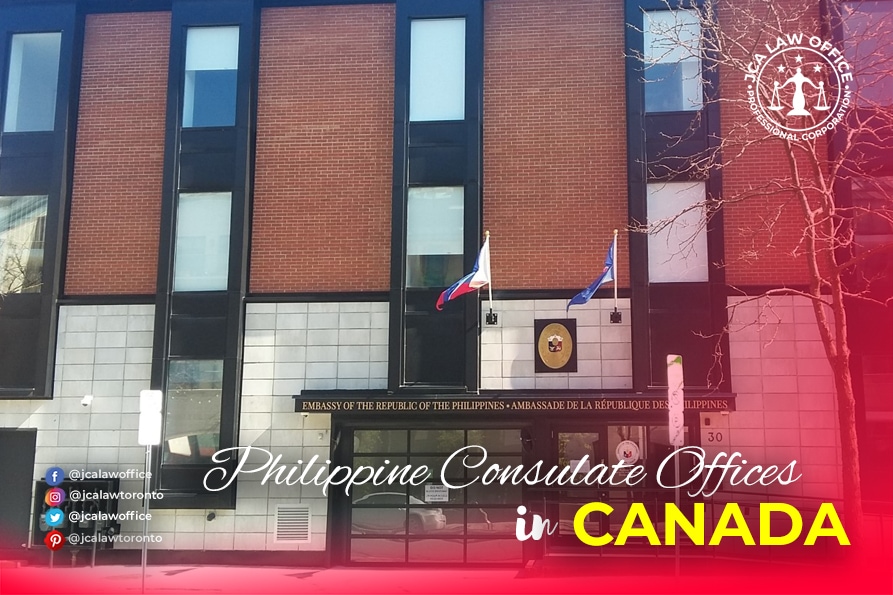
LEARN MORE ABOUT OUR PHILIPPINE CONSULATE OFFICES in CANADA
By Gin Aguilar
Undeniably, there are lots of Filipinos currently in Canada. Our fellow kababayans are all over the country in different provinces – some as Canadian citizens, some are permanent residents, others are under work or student permit, or simply visiting their families and friends. Based on the census done by the government in 2016, Filipino and Filipino-Canadian population in Canada are concentrated mainly in four Canadian provinces – Ontario, Alberta, British Columbia, and Manitoba – as more than 90% of them reside and work in those provinces.
To cater to the needs of Filipinos in Canada, the Philippine Government has established its embassy in Ottawa and consulate offices in Toronto, ON, Vancouver, BC and Calgary, AB.
These consular offices have various government services, most common are:
(1) Application and renewal of Philippine passports
Requirements:
Current or latest Philippine Passport
Completed Passport Application Form No. 2
Photocopy of passport’s data page (page showing holder’s picture and personal details)
Original Valid Permanent Resident (PR) Card, Work Permit, Study Permit or Visit Visa
Photocopy of the front of Valid PR Card, Work Permit, Study Permit or Visit Visa
For married female applicants who wish to change their last name to their husband’s: Original and 1 photocopy of Marriage Certificate issued by the National Statistics Office/Philippine Statistics Authority (NSO/PSA)
NOTE: Beginning January 1st 2018, the Philippine Consulate offices will issue regular/ordinary passports with a validity of 10 years for Filipino citizens who are 18 years old & above, and regular/ordinary passports with a validity of 5 years for those below eighteen years old.
(2) Processing of dual citizenship
Requirements:
Completed and signed dual citizenship application form;
Original Philippine Birth Certificate issued by the National Statistics Office (NSO)/Philippine Statistics Authority (PSA) or the Local Civil Registrar of the municipality where the applicant was born, plus 3 (three) photocopies
If available, most recent Philippine passport, and 3 (three) photocopies of its data page (page showing photo and personal details)
For married female applicants: Original Marriage Certificate and 3 (three) photocopies;
If applicable, Original Death Certificate of the spouse, plus 3 (three) photocopies;
If applicable, Original Divorce Decree or Court Order on the Annulment of Marriage, plus 3 (three) photocopies
3 (Three) recent 2″ x 2″ ID colored photos with white background
Canadian passport, plus 3 (three) photocopies;
Original Certificate of Oath-Taking as a Canadian Citizen, along with 3 (three) photocopies
(3) Legalization of documents such as affidavits and Special Power of Attorney (SPA’s)
You are required to appear in person and sign the documents at the Consulate General if you are executing an affidavit or other legal documents requiring oath such as Special Power of Attorney, General Power of Attorney, Affidavit, Certification, Deed of Donation, Deed of Sale, Extra-judicial Settlement of Estate, which are to be sent and used in the Philippines.
Requirements:
Original document for notarization/authentication together with any valid IDs such as Philippine passport, Canadian citizenship card or Canadian passport, Driver’s license, PR card, Ontario Photo card.
An extra set/copy of the document to be notarized/authenticated with a photocopy of the valid ID’s for the Consulate’s file.
Kindly take note that if the individual who executes the legal document is unable to personally appear at the Consulate, the document should be notarized by a duly commissioned and authorized lawyer or notary public. For Toronto Consulate office, these documents should be submitted to Official Documents Services (ODS) in Jarvis St. in downtown Toronto for certification of the signature and authority of the lawyer/notary public. Once this has been done, the client may proceed to the Philippine Consulate General for authentication. For consulate offices other than Toronto, check on this link to find where to submit the documents: https://ottawape.dfa.gov.ph/index.php/2016-04-12-08-36-34/2016-04-13-03-10-46/legalization-of-documents
Processing time for consulate offices is usually after 1 working day upon submission of the legal documents with the requirements. The duly notarized/authenticated document will be released the next working day (after 1 working day) between 2:00pm and 4:00pm.
In case the applicant will be unable to personally pick-up the document, a letter of authorization from the applicant indicating the name of the authorized representative should be provided along with valid ID.
(4) NBI Clearance
You can actually apply for your NBI Clearance in any of the consulate offices in Canada. For First-time applicants, or for those who do not have their old NBI Clearance certificates any longer, or those whose NBI clearance has been issued prior to 2014, requirements are as follows:
Duly accomplished NBI form No. 5 (consular staff will take the fingerprints of the applicants) – this form will be released the same day (NOTE: once reviewed and notarized, It’s ONLY the NBI Form No. 5 that will be released by the Consulate AND NOT the clearance)
Photocopy of valid passport (original passport to be presented)
2″ x 2″ colored photo with white background taken within three (3) months prior to application
Payment of CAD $36.25** (**most current fee as of September 2019)
If the applicant is applying only for NBI Clearance Renewal and has a copy of his old NBI clearance (2014 to present) and there is no correction in his name, status or place and date of birth, the applicant does not need to provide fingerprints. A duly accomplished NBI Form No. 5, with a photocopy of the old NBI clearance (2014 to present), a photocopy of valid passport and 2″ x 2″ colored photo with white background needs to be submitted/sent over by the applicant to NBI in the Philippines through international courier of the applicant’s choice. Keep in mind that it is the applicant’s responsibility to send over all the requirements to the NBI Office in the Philippines and not the Consulate office, which will usually take weeks (or even months, depending if there is no problem or “hit” on your name). You may also send your requirements to your representative in the Philippines, which can be your relative or friend, by providing him/her your authorization letter.
A more convenient and hassle-free option is to get the services of JCA LAW Office to get your NBI Clearance. Kindly take note though that JCA is not related in any other way to any of the Philippine Consulate Offices and the applicant always has a choice on where to get and apply for his/her NBI clearance.
Please take note that the Consulate accepts ONLY Cash, Bank Draft, Money Orders or Certified Cheques (Debit or credit cards and personal cheques are NOT accepted).
Listed below are the addresses and office hours of the Embassy of the Republic of the Philippines and different Philippine Consulate Offices in Canada:
OTTAWA – EMBASSY OF THE REPUBLIC OF THE PHILIPPINES, OTTAWA
H.E. (Ms.) Petronila P. Garcia, Ambassador Extraordinary and Plenipotentiary
Suite 920, 571 10th Avenue South West Calgary, AB T2R 0A8, Canada Tel. No.: (587) 577-1524 Passport Appointment: (403) 455-9346 Passport matters: (403) 455-9343 Notarials ATN / Duty Phone: (587) 572-4996 RA9225: (403) 455-9483 Email: calgary.pcg@dfa.gov.ph
JCA LAW OFFICE have dedicated and amicable Filipino-Canadian lawyers who can provide notarial services and we have professional and friendly Filipino-Canadian staff who can also assist you in drafting of your legal documents such as affidavits and SPA’s, as well as in processing of your NBI and Police Clearance.
You may visit us at: 160 Eglinton Ave East, Suite 406 (4th Floor), Toronto, ON M4P 3B5 (same building as the Philippine Consulate in Toronto).
Immigration Pilot Project in Canada for Sponsorship of Undeclared Family Members is Now Open
By Gin Aguilar
A new immigration pilot project to sponsor undeclared family members has recently been opened in Canada last September 9th, 2019, giving a chance for eligible candidates to be with their loved ones again.
Immigration, Refugees and Citizenship Canada (IRCC) states that “for various reasons, including lack of awareness or lack of knowledge of a family member’s whereabouts in a conflict situation, many newcomers failed to declare some family members on their application. By not including these family members, applicants made them ineligible from being sponsored to come to Canada for life.”
People who apply for permanent residency in Canada are required to declare all their family members on their application (spouse, common-law partner, dependent children) – including those who are not accompanying them. Failure to declare a family member in your application results in a lifetime ban on the principal applicant being able to sponsor the undeclared family member in the future.
In order to address this concern, Minister Ahmed Hussen of Immigration, Refugees and Citizenship Canada (IRCC) issued a public policy last July 5th 2019 stating whereby a resettled refugee, a person conferred refugee protection in Canada, or a person who was sponsored as a spouse, partner or dependent child themselves, will be able to sponsor undeclared immediate family members (a spouse, partner or dependent child). The pilot program began on September 9, 2019, and will run for 2 years. It will facilitate family reunification and ensure that dependants who were not declared or stated in their family member’s immigration application are not further penalized and barred from coming to Canada. It will also enable some newcomers to sponsor undeclared family members.
There is no special process for sponsoring family members under the pilot project. You will still apply using the normal process to sponsor your spouse, partner or child, but applicants must still meet all eligibility requirements and prove that they are legally allowed to enter Canada.
Keep in mind that this public policy may be canceled anytime so do not miss your chance to get reunited with your loved ones. To find out whether you are eligible or not for this pilot program, book your appointment now with our Immigration lawyers and consultants here at JCA LAW OFFICE – we are more than happy to assist you and address your questions and concerns. You may visit our office at 168B Eglinton Ave. East, Toronto, ON.
First-Time Home Buyer Programs in Ontario: Complete 2026 Guide for Filipino Newcomers
Last updated: February 7, 2026
Introduction: Why This Guide Matters for Filipino Newcomers
Buying your first home in Canada is one of the most exciting milestones for Filipino newcomers. After years of hard work, whether as a caregiver, healthcare professional, IT specialist, or in any other field, owning a home in Ontario represents stability and a brighter future for your family.
But the process can feel overwhelming. Between unfamiliar tax programs, complicated mortgage rules, and the sheer cost of housing in the Greater Toronto Area (GTA), many Filipino first-time buyers miss out on thousands of dollars in government incentives simply because they do not know what is available.
This guide breaks down every major program and incentive available to first-time home buyers in Ontario in 2026, with practical advice tailored specifically for Filipino newcomers. As of January 2026, the average home price in the GTA has dipped below million to ,289, making homeownership more accessible than it has been since 2021.
Quick Summary of Savings: A first-time buyer in Toronto purchasing a ,000 home could save a combined ,000 to ,000+ through the programs listed below, depending on eligibility. Read on to learn how to claim every dollar you are entitled to.
1. First Home Savings Account (FHSA) — The Newest Program
The First Home Savings Account (FHSA) is Canada’s newest tool for first-time home buyers, launched in April 2023. It combines the best features of an RRSP and a TFSA: your contributions are tax-deductible (like an RRSP), and your withdrawals for a home purchase are completely tax-free (like a TFSA).
How the FHSA Works
Feature
Details
Annual Contribution Limit
,000 per year
Lifetime Contribution Limit
,000
Carry-Forward Room
Up to ,000 of unused room carries to the next year
Tax Deduction
Contributions reduce your taxable income
Withdrawals for Home Purchase
100% tax-free (no repayment required)
Account Duration
Must close by the 15th anniversary of opening, or age 71, whichever comes first
Eligibility
Canadian resident, age 18+, first-time home buyer (not owned a home in the past 4 years)
Why This Matters for Filipino Newcomers
If you arrived in Canada recently, opening an FHSA should be one of your first financial steps. Even if you are not ready to buy a home yet, starting to contribute now means:
Immediate tax savings — every ,000 you contribute reduces your taxable income, saving you ,200 to ,000+ in taxes depending on your bracket
Tax-free investment growth — your money grows inside the account without any tax
Can be combined with the Home Buyers’ Plan (HBP) — use both FHSA and HBP for maximum savings
Pro Tip: If you opened your FHSA in 2025 but did not contribute the full ,000, you can carry forward up to ,000 of unused room to 2026. That means you could contribute up to ,000 in 2026 and claim a significant tax deduction.
2. Home Buyers’ Plan (HBP) — Withdraw from Your RRSP Tax-Free
The Home Buyers’ Plan (HBP) allows first-time home buyers to withdraw up to ,000 from their RRSPs to purchase or build a qualifying home, without paying tax on the withdrawal. If you are buying with a spouse or partner who also qualifies, you can each withdraw ,000 for a combined total of ,000.
Key HBP Rules for 2026
Feature
Details
Maximum Withdrawal
,000 per person (,000 per couple)
Repayment Period
15 years (starts 5th year after first withdrawal for 2022–2025 withdrawals)
Annual Repayment
1/15th of the total amount withdrawn each year
Eligibility
Canadian resident, first-time buyer (not owned a home in the past 4 years)
RRSP Holding Period
Funds must be in your RRSP for at least 90 days before withdrawal
Important: Unlike the FHSA, HBP withdrawals must be repaid to your RRSP over 15 years. If you miss a repayment, that amount is added to your taxable income for the year. Plan your repayments carefully.
FHSA + HBP: The Power Combination
You can use both the FHSA and the HBP for the same home purchase. Here is how a Filipino couple could maximize their savings:
Source
Person 1
Person 2
Total
FHSA (max over time)
,000
,000
,000
HBP (RRSP withdrawal)
,000
,000
,000
Combined Total
,000
,000
,000
That is up to ,000 in tax-advantaged funds for your down payment. For many Filipino families, this could cover a 20% down payment and avoid costly mortgage insurance entirely.
3. First-Time Home Buyers’ Tax Credit (HBTC)
The Home Buyers’ Tax Credit (HBTC) is a non-refundable federal tax credit that provides up to ,500 back when you file your taxes in the year you purchase your first home.
How It Works
Claim ,000 on line 31270 of your tax return
The credit is calculated at the lowest personal tax rate (15%), giving you up to ,500
You must be a first-time home buyer (have not owned a home in the past 4 years)
The home must be registered in your name (or your spouse’s name) and located in Canada
You must intend to occupy the home as your principal residence within one year of purchase
Easy to Claim: This credit is straightforward. When you file your taxes after buying your home, simply enter ,000 on line 31270. Your tax software will calculate the credit automatically. Do not forget this free ,500!
4. Ontario Land Transfer Tax Refund for First-Time Buyers
When you buy property in Ontario, you pay a provincial Land Transfer Tax (LTT) at closing. First-time home buyers can get a refund of up to ,000.
Ontario LTT Rates (2026)
Purchase Price Portion
Tax Rate
First ,000
0.5%
,001 to ,000
1.0%
,001 to ,000
1.5%
,001 to ,000,000
2.0%
Over ,000,000
2.5%
First-Time Buyer Refund
Maximum refund: ,000 (covers full LTT on homes up to ,000)
For homes over ,000: you still receive the full ,000 refund but pay the remaining LTT
Eligibility: Must be at least 18, a Canadian citizen or permanent resident, must move into the home within 9 months, and must never have owned a home anywhere in the world
How to apply: Your real estate lawyer applies for the refund at the time of closing
Example: Ontario LTT on a ,000 Home
Portion
Rate
Tax
First ,000
0.5%
,001–,000
1.0%
,950
,001–,000
1.5%
,250
,001–,000
2.0%
,000
Total Ontario LTT
,475
First-Time Buyer Refund
-,000
Net Ontario LTT Payable
,475
5. Toronto Municipal Land Transfer Tax Rebate
If you are buying in the City of Toronto, you pay an additional Municipal Land Transfer Tax (MLTT) on top of the provincial LTT. This effectively doubles your land transfer tax costs. However, first-time buyers can claim a rebate.
Current Toronto MLTT Rebate (2026)
Maximum rebate: ,475 (covers full MLTT on homes up to ,000)
For homes over ,000: you receive the ,475 rebate and pay the remaining MLTT
March 2026 Update — Expanded Rebate: Toronto City Council has approved an expansion of the first-time buyer MLTT rebate. Effective March 1, 2026, the rebate will provide the equivalent of a full rebate for first-time purchasers of residential properties valued up to ,000 (previously ,000). This is a major improvement that will save Toronto first-time buyers thousands of additional dollars.
Combined LTT Savings in Toronto (First-Time Buyer)
Tax/Rebate
,000 Home (Before March 2026)
,000 Home (After March 1, 2026)
Ontario Provincial LTT
,475
,475
Ontario First-Time Refund
-,000
-,000
Toronto MLTT
~,475
~,475
Toronto First-Time Rebate
-,475
-,475 (expanded)
Total LTT Payable
~,475
~,475
Total Savings from Rebates
,475
,475
Important for Toronto Buyers: If you are planning to purchase in Toronto, waiting until after March 1, 2026 to close could save you thousands in MLTT thanks to the expanded rebate. Talk to your real estate lawyer about timing your transaction.
6. GST/HST New Housing Rebate
If you are buying a newly built home (from a builder, not a resale home), you may be eligible for a GST/HST rebate. There are two programs to be aware of:
Existing GST/HST New Housing Rebate
Federal portion: Rebate of 36% of the GST paid, up to a maximum of ,300
Full rebate available for homes priced up to ,000
Rebate phases out between ,000 and ,000
No rebate for homes priced above ,000
Ontario portion: Additional rebate of 75% of the provincial portion of HST, up to ,000
NEW: First-Time Home Buyer GST/HST Rebate (Proposed)
Major New Incentive: The federal government has proposed a first-time home buyer GST/HST rebate that would eliminate the entire 5% federal GST on new homes valued up to million. This could mean savings of up to ,000 on a new build. The rebate phases out linearly between million and .5 million. This applies to agreements of purchase and sale entered into on or after May 27, 2025.
Note: The first-time home buyer GST/HST rebate is proposed legislation and has not yet received Royal Assent. The CRA will not process claims until the legislation is passed. However, if you are buying a new-build home, this is something to discuss with your lawyer.
7. CMHC Insured Mortgage — Buy with Just 5% Down
Many Filipino newcomers assume they need a 20% down payment to buy a home. That is not true. With a CMHC-insured mortgage, you can buy with as little as 5% down.
Minimum Down Payment Requirements (2026)
Purchase Price
Minimum Down Payment
,000 or less
5% of purchase price
,001 to ,499,999
5% of first ,000 + 10% of the remainder
,500,000 or more
20% (no CMHC insurance available)
Down Payment Examples
Home Price
Minimum Down Payment
Amount
,000
5%
,000
,000
5% + 10%
,000
,000
5% + 10%
,000
,289 (GTA avg.)
5% + 10%
,329
Key Benefits for First-Time Buyers in 2026
30-year amortization: First-time home buyers can now amortize their mortgage over 30 years (instead of the standard 25 years), lowering monthly payments
Insured mortgage price cap raised to .5 million: You can now use CMHC insurance for homes up to .5 million (previously million)
Lower stress test qualification: Insured mortgages often come with slightly lower interest rates
Did You Know? CMHC mortgage insurance is added to your mortgage balance and paid over the life of the loan. It is not an upfront out-of-pocket cost. This makes it much easier for newcomers to get into the market sooner.
8. Special Mortgage Programs for Newcomers
Canadian banks offer special mortgage programs designed specifically for newcomers who may not have an established Canadian credit history. As a Filipino newcomer, you should explore these programs:
Major Bank Newcomer Mortgage Programs (2026)
Bank
Program
Eligibility Window
Key Features
RBC
Newcomer Mortgage
PR within 12 months; Work Permit within 48 months
As low as 5% down; limited credit history OK; foreign income considered
TD
New to Canada Mortgage
PR within 5 years; Work Permit within 2 years
3+ months Canadian employment; flexible credit requirements
CIBC
Newcomer Mortgage
PR within 5 years; Work Permit 12+ months
Limited credit history OK; Canadian income required
Scotiabank
StartRight Program
PR or Temporary Resident within 5 years
Down payment must be from own funds (no gifts); credit building tools
BMO
NewStart Program
PR within 5 years; Work Permit holders
130-day rate hold (longest among big banks); flexible qualifications
Tips for Filipino Newcomers Applying for a Mortgage
Get pre-approved early: Even before you start house hunting, get a mortgage pre-approval. This tells you exactly how much you can afford.
Build Canadian credit fast: Get a secured credit card, use it for small purchases, and pay it off in full every month. Even 3–6 months of credit history helps.
Gather your documents: Have your employment letter, pay stubs, bank statements, and proof of down payment ready. If you have a 35%+ down payment, you may qualify without Canadian credit history.
Consider bringing 35% down: With a 35% down payment, RBC and other banks may approve your mortgage with minimal Canadian credit or employment history. This is especially useful if you are transferring savings from the Philippines.
Shop around: Do not just go to one bank. Compare rates from at least 3 lenders, including a mortgage broker who can access rates from multiple lenders.
9. Step-by-Step: Buying Your First Home in Ontario
Here is a simplified roadmap for Filipino first-time home buyers in Ontario:
Step 1: Get Your Finances in Order
Open an FHSA and start contributing
Build your credit score (aim for 650+)
Save for your down payment (minimum 5%, ideally 20%)
Budget for closing costs (typically 1.5–4% of the purchase price)
Step 2: Get Mortgage Pre-Approval
Visit your bank or a mortgage broker
Ask about newcomer mortgage programs
Get a pre-approval letter (typically valid for 90–130 days)
Step 3: Find a Real Estate Agent
Choose an agent familiar with your target neighbourhoods
Filipino-speaking agents may help with communication if needed
Your agent will help you search, negotiate, and submit offers
Step 4: Make an Offer and Negotiate
Submit an Agreement of Purchase and Sale (APS)
Include conditions: financing, home inspection, lawyer review
Pay a deposit (typically 5% of the purchase price, held in trust)
Step 5: Hire a Real Estate Lawyer
Your lawyer reviews the Agreement of Purchase and Sale
Conducts title search and ensures the property is free of liens
Handles land transfer tax payments and applies for first-time buyer refunds
Registers the property in your name on closing day
Step 6: Fulfill Conditions
Complete home inspection
Finalize mortgage approval with your lender
Arrange home insurance (required by your lender)
Waive conditions once everything is satisfactory
Step 7: Closing Day
Your lawyer handles the transfer of funds and documents
You sign mortgage documents and title transfer
Pay closing costs (land transfer tax minus rebates, legal fees, adjustments)
Receive your keys
Typical Closing Costs Breakdown
Cost Item
Estimated Amount
Land Transfer Tax (Ontario)
Varies (see calculator above)
Toronto MLTT (if in Toronto)
Varies (see calculator above)
Legal Fees
,500–,500
Title Insurance
–
Home Inspection
–
Appraisal Fee
– (sometimes covered by lender)
Property Tax Adjustment
Depends on closing date
Utility Connection Fees
–
Moving Costs
–,000
10. Common Mistakes Filipino Newcomers Make When Buying a Home
After helping many Filipino clients with their real estate transactions, we have seen some common mistakes that first-time buyers should avoid:
Mistake 1: Not Opening an FHSA Right Away
Many newcomers do not know about the FHSA or delay opening one. Every year you wait is ,000 in tax-deductible contribution room you cannot get back. Open an FHSA as soon as you arrive in Canada, even if buying a home is years away.
Mistake 2: Not Claiming the Ontario LTT Refund
Some buyers do not realize they qualify for the ,000 provincial refund (and the ,475+ Toronto rebate). Your real estate lawyer should handle this at closing, but make sure you confirm it. At JCA Law Office, we always ensure our clients receive every rebate they are entitled to.
Mistake 3: Sending Money from the Philippines Without Proper Documentation
If family members in the Philippines are gifting you money for your down payment, you need a signed gift letter confirming the funds are a gift (not a loan). Your lender will also want to see the paper trail of funds entering Canada. Keep all wire transfer receipts and bank statements.
Mistake 4: Buying More Home Than You Can Afford
Just because the bank pre-approves you for a certain amount does not mean you should spend that much. Factor in property taxes, utilities, maintenance, and your existing obligations (such as sending money to family in the Philippines). A general rule: your total housing costs should not exceed 30–35% of your gross household income.
Mistake 5: Skipping the Home Inspection
In competitive markets, some buyers waive the home inspection to make their offer more attractive. This is risky. A inspection could save you tens of thousands in unexpected repairs. Always include an inspection condition in your offer if possible.
Mistake 6: Not Hiring a Real Estate Lawyer Early Enough
In Ontario, you must have a lawyer to complete a real estate transaction. Do not wait until the last minute to find one. Engage your lawyer before you start making offers so they can review your Agreement of Purchase and Sale and advise you on any red flags.
Mistake 7: Not Understanding the Difference Between Freehold and Condo
Many Filipino newcomers come from the Philippines where condominiums are popular but work differently. In Ontario, condo ownership means paying monthly maintenance fees on top of your mortgage. These fees can be –,000+ per month. Always factor condo fees into your budget and review the condo’s status certificate before purchasing.
11. Complete Summary: All First-Time Buyer Incentives at a Glance
12. How JCA Law Office Can Help with Your Real Estate Closing
JCA Law Office Professional Corporation has extensive experience helping Filipino newcomers complete their real estate transactions in Ontario. As a firm that understands the unique needs of the Filipino-Canadian community, we provide:
Complete real estate closing services — from reviewing your Agreement of Purchase and Sale to handing you your keys
Land transfer tax rebate applications — we ensure you receive every dollar of the Ontario and Toronto first-time buyer refunds
Title search and insurance — protecting your investment from title defects and fraud
Mortgage documentation — coordinating with your lender to ensure a smooth closing
Guidance on all first-time buyer programs — we help you understand which incentives you qualify for
Tagalog and English service — clear communication in the language you are most comfortable with
Ready to Buy Your First Home in Ontario?
JCA Law Office Professional Corporation is here to guide you through every step of your real estate closing. We proudly serve the Filipino-Canadian community across the Greater Toronto Area.
Call us today: (647) 243-2286 Email: info@jcalaw.ca Office: Scarborough, Ontario (serving all of the GTA)
Yes. You can withdraw from both your FHSA and your RRSP (through the Home Buyers’ Plan) for the same home purchase. This gives you access to up to ,000 per person (,000 per couple) in tax-advantaged funds.
I just arrived in Canada. Do I qualify as a first-time home buyer?
Generally, yes. Most programs define a first-time buyer as someone who has not owned a home (or had a spouse/partner who owned a home) in the past 4 years. If you never owned property in Canada, you likely qualify. However, the Ontario LTT refund requires that you have never owned a home anywhere in the world. If you owned property in the Philippines, you may not qualify for the Ontario LTT refund, though you may still qualify for other programs.
Can I use money from the Philippines as my down payment?
Yes, but you need to properly document the source of funds. Keep records of wire transfers, bank statements showing the funds in your Philippine account, and a gift letter if the money is from family. Your lender will want a clear 90-day paper trail of where the funds came from.
Do I need a lawyer to buy a home in Ontario?
Yes. Unlike some countries, Ontario requires a lawyer to complete real estate transactions. Your lawyer handles the title search, land transfer tax, mortgage registration, and transfer of funds. This is not optional — it is a legal requirement.
What credit score do I need to buy a home?
Most lenders require a minimum credit score of 600–650 for insured mortgages. However, newcomer mortgage programs from major banks (RBC, TD, CIBC, etc.) may be more flexible if you have been in Canada for less than 5 years. If you have a 35% down payment, some lenders will approve you with minimal credit history.
How much are closing costs in Ontario?
Budget for approximately 1.5% to 4% of the purchase price for closing costs. This includes land transfer tax (minus any rebates), legal fees (,500–,500), title insurance (–), and other adjustments. For a ,000 home, expect ,000 to ,000 in closing costs after first-time buyer rebates.
This guide is for informational purposes only and does not constitute legal advice. Tax laws and government programs are subject to change. Please consult with a qualified lawyer and financial advisor for advice specific to your situation. Information is current as of February 2026.
Ontario Immigrant Nominee Program (OINP) Employer Job Offer: Foreign Worker Stream Now Accepting Applications
By Gin Aguilar
The Government of Ontario recently announced last August 27th that they are now accepting applications to the Employer Job Offer: Foreign Worker Stream, which simply means that Ontario employers now have the ability to support foreign workers applying for a provincial nomination and permanent residence via a job offer in Ontario.
In order to be nominated for permanent residency by the Ontario government, applicants must ensure that all mandatory requirements are met prior to applying online. All the needed supporting documents must be on hand and ready for submission to OINP via the e-Filing Portal, including an Employer Form and job offer letter completed by the employer to prove that all eligibility requirements are met.
A Nomination Approval Letter and an OINP Certificate of Nomination will be sent out to you if you are successful in your application. Once you are nominated, your next step is to apply to the federal government through Immigration, Refugees and Citizenship Canada (IRCC). They make the final decision on who among the applicants becomes a permanent resident.
Provincial nominee program in Canada: how does this work?
By Gin Aguilar
After recently spending a week in the Maritime provinces of Canada this summer, I can honestly tell you that the idea of living in the Canadian Maritimes is so inviting I might consider packing my bags and live in these hidden gems in the future. If you are someone who loves going to the beach in the summer, sit by the waterfront to eat fresh lobsters while drinking wine and munching on your potato wedges after a hard days’ work, or enjoy a big scoop of ice cream on a lazy weekend while watching the leaves change into a spectrum of colors during fall, or to just delightfully play in a sea of snow and enjoy endless tobogganing* during winter, the Maritimes might be the right place for you.
If this kind of life seems very enticing for you and your family, then the Canada provincial nominee program (PNP) might be the best option for you to come to work and live in Canada.
Understanding the Provincial Nominee Program (PNP) in Canada
In order for you to immigrate to Canada via the Provincial Nominee Program (PNP), a Canadian province or territory must nominate you. The first thing you need to do is apply to the PNP in the province or territory where you want to settle – (such as the Maritime provinces). To qualify, you must have the skills, education and work experience needed to live in Canada and support yourself and your family. They will make the assessment whether you meet their economic and labor market needs and will inform you as to how long it will take to process your application.
Once your application has been approved by the province or territory you are applying for, the next thing you need to do is to apply for permanent residence within the time period that the province or territory have provided and they will inform you whether you must apply through the Express Entry system or through regular application process. As part of the process, you will also need to pass a medical exam and provide a police check clearance or certificate. All applicants must provide these checks, no matter where they plan to settle in Canada.
List of Provinces and Territories you may select from:
Prairie Provinces
Alberta
Saskatchewan
Manitoba
Maritime Provinces
New Brunswick
Prince Edward Island
Nova Scotia
Newfoundland and Labrador
Territories
Yukon
Northwest Territories
British Columbia
Ontario
If you are open to change and would want to experience living in the beautiful provinces of Canada, our Immigration lawyers and immigration consultant may help you.
INDEX: *tobogganing – A Canadian winter activity of sliding downhill over snow on a long flat-bottomed light sled made usually of thin boards that is very popular with the kids
Why last will, power of attorney for property & personal care and health care directive (living will) matters?
By Gin Aguilar
It can be the untimely death of someone famous that triggered it. Or, perhaps a feeling of heartburn in the middle of the night, mistaking it for signs of a heart attack. Or simply feeling emotional after bidding goodbye to your child this morning, watching him walk with his friends on the way to school. Whatever the reason may be, at the back of your mind, you are thinking of the possible things that might happen in case you unexpectedly get into an accident, or suddenly get a virus that will make you gravely ill, and face an untimely death.
The Importance Of Last Will, Power Of Attorney For Property, Power Of Attorney For Personal Care & Health Care Directive (Living Will)
Having a heart-to-heart talk about your wishes with loved ones in case of untimely sickness or death is truly important. Yet we rarely discuss them – it’s the elephant in the room. So how do we prepare for crisis and unfortunate life events?
You may start by getting more familiar with the following important legal documents that you may need in order to be prepared for any critical situations in life:
(1) Last Will & Testament
This is a legal document that states how your assets will be distributed after your death. As defined by the Ontario Ministry of the Attorney General, “(a) person’s will is a written document that sets out the person’s wishes about how his or her estate should be taken care of and distributed after death. It takes effect when the person dies.” A recent survey on Wills released in the media suggests that majority (< 55%) of Canadian adults do not have signed & legal Wills. Based on the survey, the reason why Canadians do not have one is because: (1) they do not know how to get started, (2) they believe they are too young to have one and (3) they think they do not have enough properties or finances to distribute anyway.
What will happen if you die and you do not have a will?
Death may happen when you least expect it. It’s a sad reality that we need to keep in mind. When you die without a will, you are said to die “intestate”. This basically means that the Succession Law Reform Act sets out how the estate is distributed, which unfortunately may cause more problems, delays and additional unnecessary costs.
(2) Power of Attorney (POA)
A Power of Attorney is a legal document that appoints a specific person you trust (also known as your “attorney”, not necessarily your lawyer) to act and make decisions on your behalf if you are unable to look after matters on your own. It is in effect while you are still alive, unlike a will, which only takes effect upon your death.
Types of Power of Attorney:
Power of Attorney for Property – as defined by the Ministry of Attorney General in Ontario, an attorney for property is the person you name who can make decisions about your financial affairs (including paying your bills, collecting money owed to you, maintaining or selling your house, or managing your investments).**
Power of Attorney for Personal Care – the person you name as attorney for personal care will have the legal authority to make decisions about your personal care, including medical and health care, nutrition (meals), shelter (housing), clothing, hygiene, and safety, should you become mentally incapable of making these decisions.
(3) Health Care Directive
A health care directive is a document that provides your direction and wishes with regard to specific issues concerning your personal care, including medical issues, such as taking pain medication when needed, and whether or not you would want to get some medical treatment involving “heroic” measures to artificially prolong your life (or more known as “life support”).
Sometimes, people refer to this as the “living will”. Please take note though that Ontario law in Canada does not use the term “living will”. A will is a document about the distribution of your estate or properties after death, thus, if it is “living” then a power of attorney should suffice.
WHEN is THE RIGHT TIME TO MAKE A LAST WILL?
The truth of the matter is, there is no right time to create all these will and legal documents. Thinking about your future death or illness and making all these legal documents is no fun. But not having one is worse. The people you care the most will have to face more difficulties and challenges in the future if that happens. Dying without a will may cost your family thousands of dollars in legal bills and might end up in bitter family disputes due to legal battles between your children and/or siblings. All of this would be avoided with the drafting of a proper will and creation of these legal documents.
Let JCA LAW OFFICE assist you in finding solutions to all those dreaded “what if’s”. We have dedicated lawyers who will help you in preparing all these legal documents.
Being a Canadian Citizen is something to be proud of. Along with being a part of a country that is very welcoming and multicultural, there are also many other perks to being a Canadian Citizen that some people may not know about. When you become a Canadian Citizen, doors are opened to bigger opportunities, such as access to restricted jobs. Some jobs in Canada require you to have Canadian citizenship, such as government jobs or work at the federal level which requires a security clearance. If you have been living in Canada for quite some time, chances are you have an opinion on how the country, province or city should be run. By having Canadian citizenship, you have the privileges of voting in federal, provincial and municipal elections, and even run for public office.
Becoming a Canadian also means that you will be issued a Canadian passport, which happens to be one of the best and most powerful passports in the world. Holding a Canadian passport means that you may travel visa-free to 166 countries* and it also allows you to exit and re-enter Canada freely without any trouble. When you are a Canadian citizen, you never have to worry about losing status, unlike if you are a permanent resident, you will need to comply to some residency requirements.
If ever you are convicted of a crime in Canada as a citizen, you will not lose your citizenship, but if you are a permanent resident, you might face deportation. You also do not have to worry about renewing your immigration documents because once you gain your citizenship, it stays with you forever. The only document you need to renew every ten years is your Canadian passport.
Aside from these great benefits, being able to call yourself a Canadian citizen hold much more value – it means you have access to freedom, rights, and equality. Canada is an amazing, welcoming and multicultural country and I know you will be proud to call yourself a Canadian citizen because I am proud to be one.
Requirements for Becoming a Canadian Citizen:
After reading the above benefits, you are now fully convinced that you truly wanted to become a Canuck (a slang term for Canadians… don’t worry the article about Canadian slangs will be posted soon!!). But how do you become one?
The following are the requirements to be qualified to apply for Canadian Citizenship:
You must have a Permanent Resident (PR) status in Canada. Regardless of age, if you are applying for citizenship, you must have a PR status in Canada, which also signifies that you must NOT:
be under review for immigration or fraud reasons
be requested by Canadian officials to leave Canada (removal order)
have unfulfilled conditions related to your PR status, such as medical screening
Have lived in Canada for at least 3 years (out of the last 5 years). You need to ensure that you have been physically present in Canada for at least 1095 days (or 3 years) during the last five years from the date you submitted your application.
You have filed your Income Taxes, as needed
Proven Language Skills in English or French
If you’re 18 to 54 years of age on the day you sign and submit your application, you must prove that you can speak and listen at the Canadian Language Benchmarks (CLB) Level 4 or higher in either English or French (which is Canada’s 2 official languages). Certificates, Diplomas or tests that prove your language skills may be submitted along with your application.
Show how well you know about Canada by passing the citizenship test
If you’re 18 to 54 years of age on the day you sign and submit your application, you need to take the citizenship test. You’ll need to answer questions about the rights and responsibilities of Canadians and Canada’s (a) history, (b) geography, (c) economy, (d) government, (e) laws, etc.
The test may be taken in either English or French and consists of 20 multiple-choice and true-or-false questions. It is based on the official citizenship guide (Discover Canada) and you need to get a passing rate of at least 75% (or 15 correct answers out of 20).
Ready to take that leap of faith? JCA Law office can help you get started by assisting you in getting that Permanent Resident status.
The Citizenship & Immigration Canada announced reforms to the traditional Live-In Caregiver Program (LCP). The old live in caregiver program policy allowed Canadian employers to hire foreign nationals to live and work in their homes to provide domestic help for seniors, people with disabilities, and childcare. After completing the two years of work, these caregivers can apply for permanent residency.
Citizenship and Immigration Canada has announced changes to the current caregiving program. Listed below are the positive changes under this program.
The LIVE-IN REQUIREMENT IS JUST A CHOICE.
The new caregiver program is no longer a requirement for caregivers to live with their employers. The old policy is just placing them into stressful situations, including overwork with uncompensated overtime, poor workings conditions and worse, until their permanent residence status has been granted by the CIC.
Both employer and caregiver should agree to this arrangement. In these cases, the employer will need to resubmit to the Labour Market Impact Assessment (LMIA) about the live-in arrangement and an employer will no longer deduct the boarding accommodation from the caregiver’s wages.
PERMANENT RESIDENCE PATHWAYS
There are pathways for permanent residency that has been introduced for caregivers last November 30, 2014. These pathways will be assessed within 6months of application and an annual cap of 2, 750 application each and a total of 5,500 applications excluding the spouses and dependents. Citizenship and Immigration Canada admitted a total of 17,500 caregivers in 2014 and 30,000 in 2015 (including spouses and dependents).
The pathways of permanent residence described in details below:
Children Care Pathway
Two years of full-time work experience in Canada as a child care provider within the past four years.
A minimum language requirement or Canadian Language Benchmark (CLB) mark of 5 in an accredited third-party language test or assessment centers.
Or, a Canadian post-secondary education credential of at least one year or an equivalent foreign credential supported by Educational Credential Assessment (EDC)
People with high medical needs or disabilities
Two years of full-time work experience in Canada as an in-home caregiver or providing in-home care for the elderly or persons with disabilities in a health facility.
They are licensed to practice in Canada, if applicable.
A minimum language requirement or Canadian Language Benchmark (CLB) mark of 7 (if applying for a registered nurse, or psychiatric nurse). Or a mark of 5 in any other qualifying occupation in an accredited third-party language test or assessment centers.
Or, a Canadian post-secondary education credential of at least one year or an equivalent foreign credential supported by Educational Credential Assessment (EDC)
There are multiple steps in the home selling process and I will give you 6 steps to do so. Whether it’s a for sale by owner or you are about to hire a listing agent. Certain steps can vary from province to province, but this article will be a general guide. Be sure to check in with a local professional to confirm if any specific requirements apply to your area.
Here are some steps that will help with selling a house
STEP 1: find out how much your home is worth.
A big mistake that sellers make is often overpricing their home. Make sure to put it up for a reasonable price and consider whether the offer is hot, cold, or just right. Keep it in line with the older homes that have been sold in a comparative market analysis report.
STEP 2: Choose a listing agent.
A listing agent is a real estate broker who will represent you in the sale of your home. They will give you information on how to sell your house and will look out for your best interests. Try to hire experience.
STEP 3: Get your home ready.
Prepare your home for sale by decluttering and cleaning it. Think about hiring a professional to prepare your home for house showings or you could ask your agent for help. You could rent some new furniture, or you could just use your own. Remember that you only got one chance to make a good first impression, so be presentable.
STEP 4: Market your home.
You and your agent should decide the best way to advertise your home. Approve of your agent’s marketing strategy or figure out how to advertise and sell your home yourself. Hire a professional to take pictures of your house, or put up a virtual tour online for other people to see.
STEP 5: Show your home.
Remember that your house will be better to show if you sell during the warm weather rather than winter. Selling your home during the holidays will likely result in a lower sales price. Be ready for an open house and ask for feedback, you could then adjust the price, condition, and the marketing if needed.
STEP 6: Offers and negotiation.
Be prepared to have a lot of offers if your home is at a reasonable price. Don’t ignore any offers, even the lowball offers. Instead, negotiate using a counter offer. A real estate counteroffer occurs when a home seller and the buyer comes to terms that are not agreeable.
These are just some ways that will bring you one step closer to selling your house.
For more information about real estate, JCA Law Office can help.
“Life is a series of natural and spontaneous changes. Don’t resist them; that only creates sorrow. Let reality be a reality. Let things flow naturally forward in whatever way they like.” -Lao Tzu
6 Things that change forever when immigrating to Canada
Immigrating to Canada and starting over is one of the most terrifying yet one of the most exciting adventures ever. Life as you know it will eventually change and you will have to get used to accepting the fact that what is in the past is in the past. Transition is not easy and as a migrating to Canada is not a guarantee of your success but it is up to you how you could handle your future. Let me say, hard works, patience, perseverance, and building up connections are the keys to achieve it.
You will be part of two different worlds, one world that will start to become more of a blur over time, and one that you will get more familiar with. It doesn’t necessarily mean that it’s over, it’s more of an experience and growing more as a person.
Little by little, you get used to what the Canadians are doing, and you eventually learn from it. You will step outside your comfort zone and try out new things. You will be part of a new culture and it’s a fantastic feeling.
You get wiser as time goes by. Moving away and leaving the people you care about is hard. You will quickly realize what stays and what goes in life. There will be people whom you will get closer with, and there will be people who will distance themselves. Try to figure out what you want and what you have outgrown.
Things will happen that is out of your control, and life goes on with or without you. Exciting things will happen to your friends, and you will miss out on family events. You will probably miss out on many things that are happening back at your old home. It’s hard to accept, but we all have to go through that change.
You are going to lose most of your friends after moving to another country like Canada. You could always try to keep in touch, but eventually, you will realize that it is not the same as before and the conversation becomes flat, and relationships become loose. You will feel a bit lonely moving into your new place. Don’t let those feelings get too deep; try to remember why you moved in the first place.
New opportunities. This will be the best part of the whole process. Moving to a new country is your new chance. Another chance to create or even start over your life. A new opportunity to meet different people, find interesting jobs, get involved with the community, and try out unique food. The process will be exciting, and maybe even hard but it will all be worth it. You will finally understand that the little things you used to stressed about was all for nothing. You will become happier and stronger.
It becomes challenging to figure out where home is, as it will change over time. Sometimes, it’s where you spent your childhood memories or where you lived during a significant life event. Sometimes, it is where your heart is.
For more information about immigrating to Canada, JCA Law Office can help.