Apostille in Canada: Speed & Savings for Filipinos
Canada’s accession to the Hague Apostille Convention means faster, cheaper document authentication for Filipinos — no more embassy legalization required for documents destined for the Philippines and 124 other member countries.
Table of Contents
Canada’s Journey to the Apostille Convention
Implications for Filipinos in Canada
Practical Steps for Availing Apostille Services
Why Choose JCA Law Office?
1. Canada’s Journey to the Apostille Convention
Canada’s decision to join the Hague Apostille Convention represents a significant shift in its approach to document legalization. Historically, the process of authenticating Canadian public documents for international use involved a series of complex steps, often requiring multiple authentications and legalizations by different authorities, including foreign consulates or embassies in Canada.
Historical Context
Before the Apostille Convention, Canadians faced a cumbersome process to have their public documents such as birth certificates, marriage certificates, and educational documents recognized in other countries. Each document required verification by Canada’s foreign affairs department and then further legalization by the consulate or embassy of the destination country. This process was not only time-consuming but also costly.
Global Affairs Canada’s Announcement
On May 16, 2023, Global Affairs Canada formally announced Canada’s accession to the Apostille Convention. This move was aimed at simplifying the authentication of Canadian public documents for use abroad. The convention came into effect in Canada on January 11, 2024.
The Apostille Convention allows for a standardized certificate, known as an ‘apostille’, to authenticate public documents. This certificate makes Canadian documents acceptable in any of the 124 member countries of the convention. The Philippines became a party to the Apostille Convention on May 14, 2019. This change promised a more cost-effective and streamlined method for Canadian citizens and businesses, with over 200,000 Canadian public documents being authenticated annually.
Reasons Behind the Adoption
The Government of Canada’s decision to join the Hague Apostille Convention was driven by a desire to provide a more efficient and cost-effective method for legalizing documents for international use. This was in response to the growing need for global legal cooperation and the increased mobility of citizens and businesses.
Decentralizing Authentication Services
A significant aspect of this transition was the decentralization of the authentication process. Starting January 11, 2024, provinces such as Alberta, British Columbia, Ontario, Quebec, and Saskatchewan took responsibility for issuing apostilles for documents issued or notarized within their jurisdictions. Global Affairs Canada continued to issue apostilles for documents from the remaining provinces, the territories, and the Government of Canada itself.
The Impact of the Change
This change in the authentication process in Canada is a reflection of the country’s commitment to aligning with global practices for legal cooperation. It not only simplifies the process for Canadians but also aligns Canada with international standards in document legalization.
2. Implications for Filipinos in Canada
Here are some specific examples illustrating how the new system benefits Filipinos in Canada:
Handling Property Transactions in the Philippines
Scenario: Elena, a Filipino-Canadian in British Columbia, plans to sell her inherited property in the Philippines. She needs to authenticate legal documents, including a Deed of Sale, a Special Power of Attorney, and a Deed of Extrajudicial Settlement.
Before: Elena would have required multiple authentications — first from Canadian authorities, then further legalization by the Philippine embassy or consulate in Canada.
After: Elena simply submits her documents to the relevant authority in British Columbia for an apostille. The apostilled documents are then recognized in the Philippines without additional embassy legalization.
Family Reunification
Scenario: Ana, a Filipino permanent resident in Canada, is sponsoring her husband from the Philippines for Canadian residency. She needs to authenticate her marriage certificate and other personal documents.
Before: The process involved multiple steps including authentication by Canadian authorities and possible additional verification by the Philippine embassy in Canada.
After: Ana gets an apostille for her marriage certificate, which simplifies the document verification process for her husband’s residency application.
Student Applying for Study Abroad
Scenario: Maria, a Filipino student in Canada, plans to pursue further studies in Spain, a member of the Apostille Convention. She needs to authenticate her Canadian university transcripts and diploma.
Before: Maria would have needed documents authenticated by Canadian authorities and then go through the Spanish consulate for further legalization.
After: Maria simply submits her documents to the relevant Canadian authority, which issues an apostille. The apostilled documents are readily accepted in Spain.
Entrepreneur Establishing a Business Overseas
Scenario: Carlos, a Filipino entrepreneur in Ontario, is expanding his business to the Philippines. He needs to authenticate his business incorporation documents, corporate powers of attorney, and other legal documents.
Before: Carlos would have had to go through a lengthy process of authentication by Canadian authorities, followed by legalization at the Philippine embassy or consulate.
After: Carlos obtains an apostille for his documents, which are then immediately valid for use in the Philippines, streamlining his business expansion.
Professional Credentials Recognition
Scenario: Jose, a Filipino nurse working in Canada, wants to apply for a job in France. He needs to authenticate his Canadian nursing degree and professional certifications.
Before: This would involve several steps of authentication and legalization through both Canadian and French authorities.
After: Jose gets his documents apostilled in Canada, which are then readily accepted in France, facilitating his job application.
Documents Commonly Eligible for Apostille
Birth Certificates — Vital for proving identity, applying for passports, and other legal processes
Marriage Certificates — Essential for spousal sponsorship, immigration, and legal recognition of marital status
Death Certificates — Necessary for estate settlements, insurance claims, and legal matters involving the deceased
Diplomas and Degrees — Crucial for employment or further education abroad
Transcripts and Academic Records — Often required for admission into educational institutions or job applications
3. Practical Steps for Availing Apostille Services
The documents for apostille should be sent to the proper authority. The following is a guide on where to bring your documents for apostille services:
Global Affairs Canada
Global Affairs Canada (GAC) is responsible for issuing apostilles for documents originating from the Government of Canada (federal level) or for documents issued or notarized in:
Manitoba
New Brunswick
Newfoundland and Labrador
Northwest Territories
Nova Scotia
Nunavut
Prince Edward Island
Yukon
Provincial Governments
Each province may have its own procedure for issuing apostilles. The primary offices responsible are usually the ones that handle notarizations and official records:
British Columbia: BC Notaries Public or the Society of Notaries Public of British Columbia.
Alberta: Specific process through the Ministry of Justice and Solicitor General.
Quebec: Chambre des notaires du Québec or OTTIAQ for certain types of documents.
Saskatchewan: The Ministry of Justice handles the apostille process.
4. Why Choose JCA Law Office?
Since 2016, JCA Law Office Professional Corporation has specialized in providing comprehensive authentication services for documents destined for use in the Philippines. This longstanding expertise underscores our firm’s commitment to delivering high-quality legal support tailored to the specific needs of those requiring authenticated documents.
Document Review & Consultation Thorough document review to ensure all documents meet the criteria for the apostille process, minimizing rejections or delays.
Legal Advice on Authentication Expert legal advice on requirements and procedures under the new apostille system, particularly for complex or unusual documents.
Application Assistance Help completing and submitting apostille applications, ensuring compliance with all requirements.
Notarization Services If documents require notarization before the apostille process, we provide a convenient one-stop solution.
Liaising with Government Bodies Professional handling of communications and follow-ups during the apostille process.
Cultural Understanding Deep understanding of both Canadian and Filipino cultures and legal systems, ensuring culturally relevant advice.
Language Support Services available in Tagalog and other Filipino regional languages, breaking down language barriers.
Philippines-Specific Guidance Specific guidance for documents intended for use in the Philippines, considering local legal requirements and practices.
Community Outreach & Education Dedicated to providing the Filipino community with current and relevant information about the Apostille Convention.
Get Your Documents Apostilled Today
Contact JCA Law Office for expert apostille and document authentication services.
Planning to study in Canada? This comprehensive guide covers everything Filipino students need to know about the 2026 study permit requirements, including updated financial thresholds, the new Provincial Attestation Letter (PAL) system, the study permit cap, and Post-Graduation Work Permit (PGWP) eligibility changes.
Canada remains one of the top destinations for Filipino international students, offering world-class education, a pathway to permanent residence, and a welcoming Filipino community. However, the rules have changed significantly since 2024. This guide reflects the latest requirements as of 2026 so you can plan your application with confidence.
Overview of 2026 Study Permit Requirements
The Canadian government has introduced major changes to the international student program over 2024–2026. Here is a summary of the most important updates Filipino students should be aware of:
Requirement
2026 Status
Study Permit Cap
408,000 total permits (155,000 new + 253,000 extensions)
Financial Requirement (Single)
CAD $22,895 for living expenses + first year tuition
Provincial Attestation Letter (PAL)
Required for most applicants; master’s/doctoral exempt at public DLIs
Student Direct Stream (SDS)
Ended November 8, 2024 — all applications now through regular stream
PGWP Language Requirement
CLB 7 (university degrees) or CLB 5 (college programs)
Application Fee
CAD $150 + $85 biometrics
Processing Time (Philippines)
Approximately 7–12 weeks
Important: The Student Direct Stream (SDS), which previously offered faster processing for Filipino applicants, was permanently closed on November 8, 2024. All study permit applications from the Philippines are now processed through the regular stream.
Financial Requirements (Updated for 2026)
One of the biggest changes in recent years is the increase in the financial proof required for study permit applications. As of September 1, 2025, IRCC raised the minimum cost-of-living requirement by approximately 11%.
What You Need to Show
Study permit applicants must demonstrate they have enough funds to cover:
First year of tuition — as stated in your acceptance letter
Living expenses — minimum amounts set by IRCC (see table below)
Return transportation — funds for travel back to the Philippines
2026 Living Expense Requirements (Excluding Tuition and Transportation)
Number of Family Members
Amount Required (CAD)
1 (student alone)
$22,895
2 members
$28,502
3 members
$35,040
4 members
$42,543
5 members
$48,252
6 members
$54,420
7 members
$60,589
Each additional
+$6,170
Example: If your first-year tuition is CAD $18,000 and you are applying alone, you must show at least CAD $40,895 ($18,000 tuition + $22,895 living expenses), plus return airfare funds.
Acceptable Proof of Funds
Guaranteed Investment Certificate (GIC) from a participating Canadian financial institution — the most common method for Filipino students
Canadian bank account statement in your name showing transferred funds
Bank statements from your Philippine bank (covering 4–6 months of history)
A letter from a bank or financial institution confirming available funds
Proof of a scholarship, bursary, or Canadian-funded educational funding
A letter from the person or institution providing you with money (if being sponsored by a family member)
Tip for Filipino Students: A GIC is highly recommended as it clearly demonstrates you have the required funds deposited in a Canadian bank. Major banks offering GICs for international students include Scotiabank, CIBC, BMO, and RBC. The GIC locks your funds and releases them monthly after you arrive in Canada to help with living expenses.
Provincial Attestation Letter (PAL)
Since January 22, 2024, most study permit applicants must include a Provincial Attestation Letter (PAL) or Territorial Attestation Letter (TAL) with their application. This letter confirms that your application counts toward the province’s share of the national study permit cap.
Who Needs a PAL in 2026?
Most international students applying for a new study permit need a PAL. This includes:
Undergraduate students at colleges and universities
Graduate diploma and certificate students
Students at private designated learning institutions (DLIs)
Language program students (including ESL prerequisite courses)
Who Is Exempt from the PAL Requirement?
Starting January 1, 2026, the following groups do not need a PAL:
Master’s and doctoral students enrolled in degree-granting programs at a public DLI
Primary and secondary school (K–12) students
Students already in Canada extending their study permit at the same DLI and level of study
Exchange program students not paying tuition to a Canadian institution
Global Affairs Canada scholarship recipients
Protected persons or those eligible to apply for permanent residence in Canada
How to Get a PAL
Apply to your school first. You must have an acceptance letter from a designated learning institution (DLI).
Contact your school’s international student office. The DLI applies to the province on your behalf.
The province issues the PAL to you through the school, provided the provincial allocation has not been filled.
Include the PAL with your study permit application to IRCC.
Important: PALs issued in 2026 are only valid until December 31, 2026. You cannot use a PAL from a previous year. If your application is refused or you change schools, you will need a new PAL.
2026 Study Permit Cap by Province
Canada will issue up to 408,000 study permits in 2026 (down 7% from 437,000 in 2025). Of these, approximately 180,000 are allocated to applicants who require a PAL, distributed across provinces. The total number of application spaces accepted for processing is 309,670.
Ontario receives the largest share with 104,780 application spaces and a target of 70,074 issued permits for PAL-required students. This matters for Filipino students, as most Filipino-Canadians live in the Greater Toronto Area and many Filipino students apply to Ontario institutions.
Academic Requirements
Acceptance Letter from a DLI
You must have a valid letter of acceptance from a designated learning institution (DLI). The letter must show:
Transcript of Records (TOR) from your Philippine college or university
Diploma or certificate of your highest completed education
A credential evaluation (such as WES or IQAS) may be required by your Canadian school — check with the institution
If your documents are not in English, obtain certified translations
Language Requirements
While IRCC does not set a specific language test score for the study permit itself, your school sets admission requirements that typically include a language proficiency test. Additionally, if you plan to apply for a Post-Graduation Work Permit (PGWP) after your studies, you will need to meet specific language benchmarks (see PGWP section below).
Accepted Language Tests
Test
Typical Minimum (Undergraduate)
Typical Minimum (Graduate)
IELTS Academic
Overall 6.0–6.5 (no band below 5.5–6.0)
Overall 6.5–7.0 (no band below 6.0)
TOEFL iBT
79–89
90–100+
PTE Academic
56–65
65–73
CAEL
60–70
70+
CELPIP General
7–8
8–9
Advantage for Filipino Students: English is widely spoken in the Philippines, giving many Filipino applicants a natural advantage in meeting language requirements. However, always take the required test — self-assessed English proficiency is not accepted.
Medical Exam and Police Certificates
Immigration Medical Exam (IME)
All study permit applicants from the Philippines must complete an immigration medical exam (IME) conducted by a panel physician designated by IRCC. The exam includes:
Physical examination
Chest X-ray (to screen for tuberculosis)
Blood tests (for syphilis and HIV)
Urinalysis
The medical exam must be completed by a designated panel physician — regular doctors’ reports are not accepted. You can find a panel physician in the Philippines using the IRCC Panel Physician Finder. The cost is approximately PHP 8,000–15,000 (roughly CAD $200–$400) depending on the physician and location.
Police Certificates
You may be asked to provide a police clearance certificate from countries where you have lived for 6 months or more since turning 18. For Filipino applicants, this typically means:
NBI Clearance from the National Bureau of Investigation (Philippines)
Police certificates from any other country where you have lived
Here is the complete process for applying for a Canadian study permit from the Philippines:
Step 1: Get Accepted by a DLI
Research and apply to a designated learning institution. Once accepted, you will receive a letter of acceptance with your school’s DLI number.
Step 2: Obtain a Provincial Attestation Letter (PAL)
Contact your school’s international student office to request a PAL. The school applies to the province on your behalf. If you are enrolling in a master’s or doctoral program at a public DLI, you are exempt from this requirement as of January 1, 2026.
Step 3: Prepare Your Financial Proof
Arrange your GIC (recommended) or prepare bank statements showing you have at least CAD $22,895 (for a single applicant) plus your first year of tuition. If you are being financially supported by a family member, prepare a clear financial support letter along with their bank statements.
Step 4: Take Your Language Test
Complete an approved English language test (IELTS Academic, TOEFL iBT, PTE Academic, CAEL, or CELPIP) and ensure your scores meet your school’s requirements. Keep in mind the PGWP language requirements if you plan to work in Canada after graduation.
Step 5: Complete Your Medical Exam
Book an appointment with a designated panel physician in the Philippines. Medical results are typically sent directly to IRCC. Complete this early, as the results are valid for 12 months.
Step 6: Gather Your Documents
Compile all required documents:
Valid Philippine passport (valid for the duration of your studies)
Letter of acceptance from your DLI
Provincial Attestation Letter (if required)
Proof of financial support (CAD $22,895+ living expenses + tuition)
Language test results
Immigration medical exam results
NBI clearance and/or police certificates
Two passport-size photographs (meeting IRCC specifications)
Statement of purpose / letter of intent
Proof of ties to the Philippines (property, employment, family obligations)
Step 7: Create Your IRCC Account and Apply Online
Create an account on the IRCC online portal. Complete the application forms, upload all documents, and pay the application fee (CAD $150) and biometrics fee (CAD $85).
Step 8: Provide Biometrics
After submitting your application, you will receive a biometrics instruction letter. Visit a designated Visa Application Centre (VAC) in the Philippines to provide your fingerprints and photo. In Manila, the VAC is operated by VFS Global.
Step 9: Wait for a Decision
IRCC will process your application and may request additional documents. Once approved, you will receive a letter of introduction (to present at the Canadian port of entry) and, if required, a Temporary Resident Visa (TRV) sticker in your passport.
Processing Times and Fees
Current Processing Times
Processing times for study permit applications from the Philippines vary depending on the time of year and completeness of your application:
Season
Estimated Processing Time
Off-peak (October–March)
5–7 weeks
Peak (April–August)
8–12 weeks
Plan Ahead: Submit your application at least 3–4 months before your program start date. Incomplete applications or requests for additional documents can significantly extend processing times.
Fee Breakdown
Fee
Amount (CAD)
Study permit application
$150
Biometrics (per person)
$85
Medical exam (approximate, paid to panel physician)
$200–$450
Total government fees
$235
VAC service charge (if applicable)
Varies
Note: All IRCC fees are non-refundable, even if your application is refused. The medical exam fee is paid directly to the panel physician and varies by clinic.
Post-Graduation Work Permit (PGWP) Eligibility
One of the biggest advantages of studying in Canada is the Post-Graduation Work Permit (PGWP), which allows graduates to work in Canada after completing their studies. However, the rules have changed significantly — here is what you need to know for 2026.
PGWP Duration
Program Length
PGWP Duration
Less than 8 months
Not eligible
8 months to less than 2 years
Same length as program
2 years or more
Up to 3 years
Master’s degree (8+ months, as of Feb 15, 2024)
Up to 3 years
New Language Requirements (Since November 1, 2024)
All PGWP applicants must now submit proof of language proficiency. The required level depends on your program:
Graduate Type
Required Level
IELTS Equivalent (All Bands)
University degree (Bachelor’s, Master’s, PhD)
CLB 7 in all 4 skills
6.0 in each band
College diploma/certificate
CLB 5 in all 4 skills
5.0 in each band
Field of Study Requirements (2026)
Effective November 1, 2024, PGWP eligibility for college graduates now depends on what you study, not just where you study:
University degree graduates (Bachelor’s, Master’s, PhD): Any field of study qualifies for PGWP
College diploma and certificate graduates: Must graduate from a program linked to an approved Classification of Instructional Programs (CIP) code on IRCC’s eligible fields list
In January 2026, IRCC announced that the eligible fields of study list will be frozen for all of 2026 — no programs will be added or removed during the year. This provides stability for students planning their programs.
Critical Advice: If you are considering a college diploma program, verify that your program’s CIP code is on the IRCC eligible fields of study listbefore you enrol. Choosing an ineligible program means you will not qualify for a PGWP after graduation.
PGWP Application Timeline
You must apply within 180 days of receiving your final marks or transcript
Your study permit must still be valid (or you must have maintained status)
Apply online through your IRCC account
Tips for Filipino Students
Based on our experience helping Filipino students and families, here are practical tips to strengthen your application:
1. Start Saving Early and Document Everything
The CAD $22,895 living expense requirement (plus tuition) is a significant amount. Start saving well in advance and keep your bank statements organized. IRCC wants to see a consistent savings history, not a sudden large deposit. If family members are helping fund your studies, prepare a clear financial support letter with their bank statements.
2. Choose Your Program Strategically
If your goal is to eventually immigrate to Canada, choose a program that:
Is at a public DLI (better PGWP and immigration outcomes)
Is in an eligible field of study for PGWP (if a college program)
Is at least 2 years in duration (for a 3-year PGWP)
Aligns with in-demand occupations in your province (helps with Express Entry and PNP)
3. Demonstrate Ties to the Philippines
IRCC officers want to see that you are a genuine student who will comply with your permit conditions. Include evidence of ties to the Philippines, such as:
Family in the Philippines who depend on you
Property or assets in the Philippines
A career plan that shows how your Canadian education benefits your future
4. Write a Strong Statement of Purpose
Your statement of purpose (letter of intent) should clearly explain:
Why you chose this specific program and school
How the program connects to your previous education or work
Your career goals and how this program supports them
Why Canada (and not the Philippines or another country)
5. Apply Early and During Off-Peak Periods
Applications submitted during peak periods (April–August) take longer to process. If possible, submit your application during off-peak months to benefit from shorter processing times. Always apply at least 3–4 months before your program starts.
6. Understand the Pathway to Permanent Residence
Many Filipino students come to Canada with the long-term goal of becoming permanent residents. The most common pathway is:
Study permit — Complete your program
PGWP — Gain Canadian work experience
Express Entry (CEC) or Provincial Nominee Program (PNP) — Apply for permanent residence
Understanding why study permits are refused can help you avoid common mistakes:
Insufficient financial proof — Not meeting the CAD $22,895+ living expense threshold, or showing funds that appear to be recently deposited without a clear source
Lack of genuine student intent — The officer is not convinced you will leave Canada after your studies
Weak statement of purpose — Failure to explain why you chose this specific program and school
Incomplete documentation — Missing PAL, medical exam, or other required documents
Inadmissibility — Medical conditions, criminal history, or previous immigration violations
Program does not match your background — Choosing a program that does not logically follow from your previous education or career
Frequently Asked Questions
How much money do I need to show for a Canadian study permit in 2026?
For a single applicant studying outside Quebec, you must demonstrate at least CAD $22,895 for living expenses, plus your first year of tuition and return transportation costs. For a family of two, the living expense requirement increases to CAD $28,502.
Is the Student Direct Stream (SDS) still available for Filipino applicants?
No. The SDS was permanently closed on November 8, 2024. All study permit applications from the Philippines are now processed through the regular stream. The regular stream accepts GICs as proof of financial support.
What is a Provincial Attestation Letter (PAL) and do I need one?
A PAL is a letter from the province confirming that your study permit application counts toward the provincial allocation under the national cap. Most new study permit applicants need a PAL. Exemptions include master’s and doctoral students at public DLIs (as of January 1, 2026), K–12 students, and existing study permit holders extending at the same school and level.
Can I work while studying in Canada?
Yes. Study permit holders can generally work up to 20 hours per week during regular academic sessions and full-time during scheduled breaks (such as winter and summer holidays). You may also be eligible for co-op work permits if your program includes a mandatory work placement.
What happens if my study permit application is refused?
If your application is refused, you will receive a refusal letter explaining the reasons. You can address the issues and reapply, or in some cases, you may be able to request judicial review. Working with an immigration lawyer can help identify weaknesses in your application and improve your chances on a subsequent application.
How long does it take to process a study permit from the Philippines?
Processing times from the Philippines typically range from 5–7 weeks during off-peak periods to 8–12 weeks during peak season (April–August). Always check the IRCC processing times page for the most current estimates.
Can I bring my spouse or children with me on a study permit?
Your spouse or common-law partner may be eligible for an open work permit if you are studying at a public post-secondary DLI in a program of 8 months or more (subject to current eligibility rules). Your dependent children may also accompany you. You will need to show additional financial resources for each accompanying family member (see the financial requirements table above).
How JCA Law Office Can Help
At JCA Law Office Professional Corporation, we understand the unique challenges Filipino students face when applying for Canadian study permits. Our team provides personalized assistance with:
Application review and preparation — ensuring your documents are complete and meet IRCC standards
Statement of purpose drafting — crafting a compelling letter that addresses officer concerns
Financial documentation guidance — helping you organize and present your proof of funds effectively
PAL navigation — understanding provincial requirements and timelines
Refusal response — if your application was previously refused, we can identify the issues and prepare a stronger reapplication
PGWP and immigration planning — helping you plan your study-to-PR pathway from the beginning
Ready to Apply for Your Canadian Study Permit?
Our immigration team has helped hundreds of Filipino students successfully obtain their study permits. Book a consultation today to discuss your situation.
Last updated: February 8, 2026. This guide is for informational purposes only and does not constitute legal advice. Immigration rules change frequently — always verify current requirements on the IRCC website or consult with a licensed immigration professional.
Empowering the Filipino community through legal representation, diversity, and equitable access to justice.
At JCA Law Office Professional Corporation, we believe in the power of diversity and inclusivity. As a law firm dedicated to supporting equity-seeking groups across Canada, we are proud to celebrate Filipino Heritage Month. This annual observance provides us with a unique opportunity to honor the rich cultural heritage of the Filipino community while shedding light on the need for increased legal representation within this vibrant group.
The Filipino Community: A Pillar of Canadian Society
Filipino Heritage Month is a time to recognize and appreciate the significant contributions of the Filipino community to the cultural, social, and economic fabric of Canada. With a long history of immigration to Canada, Filipinos have made Canada their home and continue to enrich the nation with their talents, skills, and vibrant traditions.
Challenges in Legal Representation
However, despite their growing numbers and undeniable impact, the Filipino community faces certain challenges, particularly when it comes to legal representation. The latest report from the Law Society of Ontario reveals that the Filipino community has the lowest ratio of lawyers to the population in Ontario. This disparity highlights the urgent need for increased support, access, and opportunities within the legal profession for aspiring Filipino lawyers.
Empowering the Filipino Community
At JCA Law Office, we are committed to promoting diversity and equality within the legal field. We recognize that diverse legal representation is essential for a fair and just society, and we strive to bridge the gap by empowering the Filipino community through legal services and advocacy.
Our Dedication to Equity
As part of our ongoing commitment to supporting equity-seeking groups, we actively seek to increase the representation of Filipino lawyers in our firm. By providing mentorship, guidance, and professional development opportunities, we aim to create a more inclusive legal profession that reflects the diversity of the communities we serve.
Building Stronger Communities
By celebrating Filipino Heritage Month, we hope to raise awareness about the importance of equitable representation within the legal system. Our efforts extend beyond providing legal services; we actively collaborate with community organizations, host educational events, and engage in outreach initiatives to empower and uplift the Filipino community.
Join Us in Celebrating Filipino Heritage Month
During Filipino Heritage Month, we invite everyone to join us in celebrating the rich culture, history, and achievements of the Filipino community in Canada. Together, we can work towards fostering a more inclusive and equitable society, where every individual, regardless of their background, has access to fair legal representation.
Contact JCA Law Office
If you are a member of the Filipino community and seeking legal assistance, or if you aspire to pursue a career in law, we encourage you to reach out to JCA Law Office Professional Corporation. Our team is here to support you and provide the guidance you need.
Filipino Heritage Month is a time to honor the invaluable contributions of the Filipino community to Canada while acknowledging the need for increased legal representation. At JCA Law Office Professional Corporation, we are dedicated to empowering the Filipino community through our commitment to diversity, equity, and justice. Together, let us celebrate the Filipino heritage and work towards creating a more inclusive legal profession and society for all.
Need Legal Assistance?
JCA Law Office Professional Corporation is committed to serving the Filipino community with culturally sensitive legal representation in immigration, family law, real estate, and more.
A Gateway to Canada Opens for Filipinos: Visa-Free Air Travel Now a Reality
June 6, 2023, Winnipeg — Canada expands the Electronic Travel Authorization (eTA) program to include the Philippines, enabling visa-free air travel for eligible Filipino travelers.
The dream of visiting Canada has just become more accessible for millions of Filipinos. Canada, a beloved destination for tourism, business, and family reunions, has made a significant move towards making its immigration services more user-friendly and equitable for people around the world.
Today, The Honourable Sean Fraser, Minister of Immigration, Refugees and Citizenship, announced the expansion of the Electronic Travel Authorization (eTA) program to include 13 more countries, with the Philippines featured prominently on that list. This milestone means that eligible Filipino travelers, alongside those from 12 other nations, can now embark on their dream journey to Canada without the traditional visa constraints.
Who Is Eligible?
Effective immediately, Filipino travelers who meet either of these criteria can apply for an eTA when travelling to Canada by air:
Have held a Canadian visa in the past ten years
Currently hold a valid United States non-immigrant visa
Eligible travelers can stay in Canada for up to six months for business or leisure purposes.
“The exciting development means that more Filipinos can now embark on unforgettable adventures, explore our diverse landscapes, reunite with family and friends, and immerse themselves in our vibrant culture without the hurdle of visa requirements.”
The Honourable Sean Fraser, Minister of Immigration, Refugees and Citizenship
Economic Impact
Canada is well-loved by Filipinos for its stunning landscapes, welcoming communities, and abundant opportunities. This eTA expansion is expected to boost Canada’s economy by stimulating travel, tourism, and international business. It is also hoped that it will foster stronger relationships between Canada and the Philippines.
Over the next decade, the anticipated increase in Filipino tourism could generate nearly $160 million in additional revenue for Canada.
“Expanding the eTA for Canada is a major step toward helping our tourism industry soar to new heights. It’s not just about attracting visitors; it’s about showcasing the breathtaking landscapes, diverse cultures, and warm hospitality that define Canada.”
The Honourable Randy Boissonnault, Minister of Tourism and Associate Minister of Finance
Important Notes
Individuals with an existing valid visa can still use it for travel to Canada. Those ineligible for an eTA or those travelling to Canada by means other than air will still require a visitor visa.
To check eTA eligibility and application procedures, travelers can visit: Canada.ca/eTA
The eTA expansion is a testament to the strong ties between Canada and the Philippines. It signifies a new chapter in our shared history, reinforcing the cultural exchange and mutual respect that underpin our countries’ relationship. It is now time for more Filipinos to make their Canadian dreams come true and contribute to the multicultural tapestry that makes Canada so unique.
Planning to visit Canada? JCA Law Office can help you with your eTA application or visitor visa needs.
Canadian Immigration Minister Sean Fraser Talks About Leaning into AI and Advanced Analytics
How IRCC is modernizing immigration processing with artificial intelligence while keeping humans in control of final decisions.
Modernizing Immigration Processes
Canada’s immigration system has made significant strides in embracing technology, aiming to improve efficiency and decision-making. In a recent press conference, Canada’s Immigration Minister Sean Fraser detailed how Immigration, Refugees and Citizenship Canada (IRCC) is deploying advanced technology and analytics to streamline processes, particularly for those waiting for permanent residency under family class sponsorship programs.
In 2022, IRCC made over five million final decisions on applications across all their lines of business. This impressive feat, double the number of decisions made in 2021, was made possible due to the increased use of Artificial Intelligence (AI) and advanced data analytics, modernizing Canada’s immigration system. Fraser reiterated though that even if there is an increase in usage of AI, a human being is still responsible for every final decision in immigration applications.
Key Statistics
5 million+ final decisions made in 2022
2x increase from 2021 decision volume
98% of spousal TRV applications processed via advanced analytics
30 days expected processing time for new spousal TRV applicants
Speed and Efficiency through Digitization
Digitizing the system has brought about a new era of efficiency and effectiveness in immigration processes. Advanced analytics have contributed to processing 98% of spousal Temporary Residency Visa (TRV) applications. New applicants can now expect a processing time of just 30 days, reflecting the massive productivity gains as a result of these technological advancements.
The Role of AI in Immigration
AI and advanced analytics aid IRCC in automating positive eligibility determinations, distributing applications between officers based on the characteristics of the application, identifying applications that may require additional verification, workload distribution, and assessing biometrics, amongst other aspects.
Humans Make Final Decisions
However, despite these advancements, there is a crucial human touch to every decision made. A clear assertion by Minister Fraser is that AI is not making any final decisions. There are no algorithms that will unilaterally accept or reject an applicant. Every final decision, be it approval or denial of an application, still comes down to a human officer’s evaluation. This is in place to protect the integrity of the process.
Addressing Concerns about AI and Bias
As this advanced technology is increasingly used to expedite and optimize the immigration process, concerns have been raised regarding potential biases and lack of transparency in decision-making. The Treasury Board Directive on Automated Decision-Making warns that algorithms based on historical data could inadvertently amplify race, class, gender, and other inequalities. To mitigate such risks, the government has imposed requirements for clear explanations of how administrative decisions are made. The federal government must provide reasonable and understandable explanations for individuals denied services or benefits, going beyond merely stating that a decision was made by a computer.
The Role of “Chinook” in Decision Making
One of the tools used by IRCC officers, “Chinook,” simplifies the visual representation of a client’s information. Despite concerns, the department clarified that Chinook does not use AI or advanced analytics for decision-making. It lacks built-in decision-making algorithms, underscoring the department’s commitment to human oversight in all decision-making processes.
Ensuring Equality and Transparency in Algorithm Development
To ensure equality and prevent discrimination, IRCC abides by the Directive in the Canadian Charter of Human Rights and Freedoms when developing algorithms. Each new algorithm must pass the Algorithmic Impact Assessment (AIA), a mandatory risk assessment tool measuring risk areas, mitigation, and the impact of the proposed algorithms. IRCC was one of the first government departments to use AIAs, highlighting its commitment to transparency and accountability.
Reactions to the New System
The changes and use of AI and advanced analytics have received mixed reactions. Some critics argue that long processing times are still a concern despite these advancements. However, others see these changes as a positive shake-up. There is still a need for a deeper understanding of how these new technologies could potentially introduce biases or discrepancies.
Balancing Technology and Human Decisions
The IRCC is committed to maintaining the human touch in the final decisions on applications while embracing the benefits of advanced technology. The goal is to meet the needs of both clients and Canada and to welcome the highest number of newcomers in the coming years, with the assurance that every final decision is made in the interest of the individual and the nation.
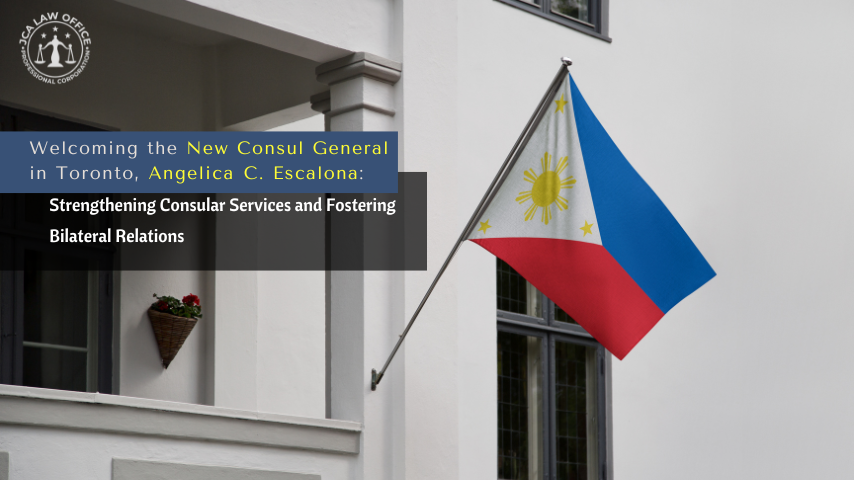
Welcoming Angelica C. Escalona as the New Consul General of the Philippines in Toronto
Strengthening consular services and fostering bilateral relations between the Philippines and Canada.
JCA Law Office Professional Corporation takes great pleasure in announcing and extending a warm welcome to the Hon. Angelica C. Escalona, the newly appointed Consul General of the Philippines in Toronto. She assumed her position on May 17, 2023. With a strong background in consular affairs and a Master of Arts degree in Foreign Affairs and Trade, Consul General Escalona brings a wealth of experience and expertise to her role. Her focus on enhancing consular services, engaging with the Filipino community, and promoting bilateral relations reflects her commitment to serving her fellow Filipinos and fostering strong ties between the Philippines and Canada.
Hon. Angelica C. Escalona has had an extensive career in the Department of Foreign Affairs since 1996. Her service within the geographic offices at the home office and in the Philippine Embassies in Jakarta and Tokyo has provided her with a broad understanding of diplomatic operations and international relations. Consul General Escalona’s experience in various diplomatic assignments has equipped her with the skills necessary to effectively navigate the complexities of consular affairs and bilateral engagements.
Academic Achievement
In addition to her remarkable professional experience, Consul General Escalona has pursued higher education to deepen her knowledge in the field of foreign affairs. She obtained a Master of Arts degree in Foreign Affairs and Trade from Monash University in Australia while serving in the Foreign Service. This academic achievement has enriched her understanding of international relations, trade dynamics, and the multifaceted nature of diplomatic engagements.
Enhancing Consular Services
With her background and expertise in consular affairs, Consul General Escalona is dedicated to improving consular services for Filipino citizens in Toronto. Her experience within the Office of Consular Affairs will enable her to implement measures to streamline processes, enhance accessibility, and provide efficient assistance to the Filipino community. Consul General Escalona’s extensive training and knowledge in foreign affairs will contribute to the development of innovative solutions and the implementation of best practices in consular operations.
Engaging with the Filipino Community
Consul General Escalona recognizes the importance of engaging with the Filipino community in Toronto. Her experience in various diplomatic assignments and her understanding of cultural sensitivities will enable her to connect with community members, listen to their concerns, and develop initiatives that address their needs. By fostering meaningful dialogue and collaboration, she aims to build strong relationships within the Filipino community and empower individuals and organizations to contribute to its growth and prosperity.
Promoting Bilateral Relations
With her strong background in foreign affairs and trade, Consul General Escalona is well-positioned to promote bilateral relations between the Philippines and Canada. Her diplomatic experience and training will enable her to engage effectively with the government and people of Canada, identify opportunities for collaboration, and advocate for the interests of the Philippines. Consul General Escalona’s expertise in trade dynamics and her understanding of international relations will contribute to the development of strategic partnerships and the facilitation of mutually beneficial initiatives.
JCA Law Office Professional Corporation celebrates the appointment of Hon. Angelica C. Escalona as the Consul General of the Philippines in Toronto. Her extensive experience in consular affairs, combined with her academic achievement and training in foreign affairs, makes her exceptionally qualified for the role. We commend her focus on enhancing consular services, engaging with the Filipino community, and promoting bilateral relations. Working collaboratively, we can support Consul General Escalona’s efforts to provide efficient consular services, empower the Filipino community, and strengthen the bond between the Philippines and Canada.
Navigating Real Estate Inheritance in the Philippines: Transferring Property Titles from Deceased Relatives
A comprehensive guide for Filipino-Canadian heirs on how to transfer property titles from deceased relatives in the Philippines, including legal requirements, tax obligations, and step-by-step procedures.
In the Philippines, a common occurrence is finding a property that remains titled under the name of a deceased relative, usually a parent or grandparent. Despite the death of the original owner, these properties often continue to be utilized, maintained, or even transacted by surviving heirs without the legal paperwork having been updated. This situation can create legal and financial complexities that may potentially jeopardize ownership rights and the value of the property.
If you are an heir to such a property, it is crucial to transfer the title officially to avoid future legal disputes and to ensure the proper valuation of your inheritance. Here, we will discuss the process, requirements, and potential challenges involved in transferring real estate titles in the Philippines from deceased relatives to their living heirs.
Understanding the Importance of Title Transfers
Property titles in the Philippines are legal documents that prove ownership over a piece of land or a building. When the owner of a property dies, the title does not automatically pass on to the heirs. Instead, it remains in the name of the deceased until the legal process of transfer is completed. This delay can lead to several problems:
Potential for Disputes: The property might be subject to inheritance disputes among the potential heirs, which could lead to lengthy legal battles.
Inability to Transact: The heirs may not be able to sell, mortgage, or lease the property since the title is still under the deceased’s name.
Tax Liabilities: The property may incur estate taxes and penalties that could diminish the value of the inheritance.
The Transfer Process: From Estate Tax Clearance to Title Transfer
The process of transferring a title from a deceased person to the living heirs involves several legal and administrative steps. These steps are generally as follows:
Step 1: Secure a Death Certificate
Obtain a certified copy of the death certificate from the local civil registry or the Philippine Statistics Authority (PSA).
Step 2: Probate of Will or Declaration of Heirs
If the deceased left a will, it must be probated, i.e., approved by the court. If there is no will, the court will have to issue a Declaration of Heirs.
Step 3: Payment of Estate Taxes
Calculate the estate tax due based on the value of the estate at the time of the owner’s death and pay this to the Bureau of Internal Revenue (BIR). This step involves filing the estate tax return and submitting the necessary documents.
Step 4: Secure a Tax Clearance
After paying the estate tax, secure a Certificate of Tax Clearance from the BIR, indicating that the estate tax has been fully paid.
Step 5: Judicial Partition or Extrajudicial Settlement of Estate
If the heirs cannot amicably decide on the distribution of the property, a court-supervised partition is necessary. If they agree, they can execute an Extrajudicial Settlement of Estate among themselves.
Step 6: Transfer of Title
Once the property has been properly partitioned or settled, the title can be transferred to the heirs. This requires filing a Deed of Adjudication with the Registry of Deeds, paying the corresponding transfer taxes, and obtaining the new titles under the heirs’ names.
Conclusion
Transferring a property title from a deceased relative in the Philippines to living heirs might appear to be a daunting task due to the number of steps and legal complexities involved. However, it is a critical process to prevent disputes and protect the value of your inheritance. It is advisable to seek legal counsel to help navigate through this process to ensure you adhere to all the requirements of the law, thereby ensuring a smooth and successful transfer.
Need Help with Philippine Property Inheritance?
JCA Law Office assists Filipino-Canadians with estate settlement, property title transfers, and extrajudicial settlements in the Philippines. Contact us for a consultation.
A Guide for Filipinos Who Want to Work or Live in Canada
Everything you need to know about immigrating to Canada — from eligibility and documents to finding a job and embracing a new culture.
Canada is known for its quality of life, excellent healthcare, and welcoming society. If you’re a Filipino who wants to work or live in Canada, there are several things you need to know before you make the move. Here’s a guide to help you navigate the process:
1. Check Your Eligibility for Immigration to Canada
The first step in moving to Canada is to determine your eligibility for immigration. There are several immigration programs you can apply for, including the Federal Skilled Worker Program, the Canadian Experience Class, and the Provincial Nominee Program. Each program has its own set of requirements, so make sure you do your research and find the one that best fits your qualifications.
2. Gather All the Necessary Documents
Once you’ve determined your eligibility for immigration, the next step is to gather all the necessary documents. These include your passport, birth certificate, educational credentials, work experience, language test results, and police clearance certificates. Make sure all your documents are up-to-date and translated into English or French if necessary.
3. Learn English or French
English and French are the two official languages in Canada, and being proficient in either one of them can increase your chances of finding work and settling into Canadian society. You’ll also need to take a language test to prove your proficiency in English or French when you apply for immigration. There are many language schools and courses you can take to improve your language skills.
4. Find a Job in Canada
If you’re planning to work in Canada, it’s a good idea to start looking for a job before you move. You can use job search websites like Job Bank or Indeed to find job openings in your field. You can also network with people in your industry or attend job fairs and recruitment events. Make sure your resume is updated and tailored to Canadian standards.
5. Prepare for the Cost of Living
Canada is a relatively expensive country to live in, especially in major cities like Toronto and Vancouver. Make sure you have enough savings to cover your living expenses for the first few months while you look for a job. You should also research the cost of housing, food, transportation, and healthcare in the city or province you plan to live in.
6. Embrace Canadian Culture
Canada is a multicultural country, and Filipinos are one of the largest visible minority groups in the country. However, Canadian culture is different from Filipino culture, and it’s important to be open-minded and respectful of Canadian customs and traditions. Embrace the differences and learn from them. Joining Filipino community organizations can also help you stay connected with your culture and make new friends.
Conclusion
Moving to Canada as a Filipino can be an exciting and rewarding experience. By checking your eligibility for immigration, gathering all the necessary documents, learning English or French, finding a job in Canada, preparing for the cost of living, and embracing Canadian culture, you can successfully work and live in Canada. Good luck!
Need Help With Your Immigration to Canada?
Our immigration lawyers can guide you through the process. Contact us today for a consultation.
A pathway to reunification for Filipino families through Canada’s family sponsorship immigration program.
Family sponsorship in Canada has been a long-standing tradition, allowing families to reunite and start a new life in the country. For the Filipino community, this program has been an invaluable opportunity for countless individuals and families seeking a better future together. In this article, we will explore the process of family sponsorship in Canada, with a subtle focus on the unique experiences and needs of the Filipino community.
Understanding Family Sponsorship in Canada
Family sponsorship in Canada is a program that enables Canadian citizens and permanent residents to sponsor their eligible family members, such as spouses, partners, children, parents, and grandparents, to come and live in Canada as permanent residents. This program aims to help families reunite and maintain strong family bonds even as they start a new life in a foreign country.
The Filipino Connection
The Filipino community has been one of the largest immigrant groups in Canada, with their numbers consistently growing over the years. Due to the shared values of family-oriented culture and the warm, welcoming nature of Canadians, many Filipinos have chosen Canada as their new home. Family sponsorship in Canada has played a vital role in the growth of the Filipino community, allowing families to stay together and support one another in their pursuit of a better life.
Eligibility Criteria and Application Process
To apply for family sponsorship in Canada, the sponsor must be a Canadian citizen or permanent resident who is at least 18 years old. They should also be financially capable of supporting their sponsored family members upon their arrival in Canada. In addition, the family members to be sponsored must meet certain eligibility criteria, such as being a spouse, common-law partner, conjugal partner, dependent child, parent, or grandparent.
For the Filipino community, the application process can be initiated either online or by mail. It involves submitting the necessary forms, documents, and fees to Immigration, Refugees and Citizenship Canada (IRCC). It is crucial to provide accurate and complete information to avoid delays or the rejection of the application.
Note for Filipino Applicants: Some potential challenges may include obtaining documents from the Philippines, such as birth certificates and marriage certificates, or navigating language barriers during the application process. It is advisable to consult with an immigration consultant or lawyer familiar with Filipino culture and the nuances of the family sponsorship process to ensure a smooth application journey.
Settlement and Integration
Once the sponsored family members arrive in Canada, they will be granted permanent residency, allowing them to work, study, and access various social benefits. The Filipino community in Canada has a strong presence, with numerous cultural organizations and support networks in place to assist newcomers with their integration into Canadian society.
Many cities in Canada have thriving Filipino communities, offering familiar foods, cultural events, and social connections. This makes the transition to life in Canada a more comfortable experience for Filipino newcomers, providing a sense of belonging and familiarity amidst the new environment.
Conclusion
Family sponsorship in Canada has been a life-changing opportunity for many Filipino families, enabling them to reunite and start anew in a welcoming and diverse country. By understanding the process and addressing potential challenges, Filipino sponsors and their families can successfully navigate the path to family reunification in Canada, strengthening both their familial bonds and the diverse fabric of Canadian society.
Need Help with Family Sponsorship?
JCA Law Office Professional Corporation specializes in helping Filipino families navigate the family sponsorship process in Canada, from eligibility assessment to application submission.
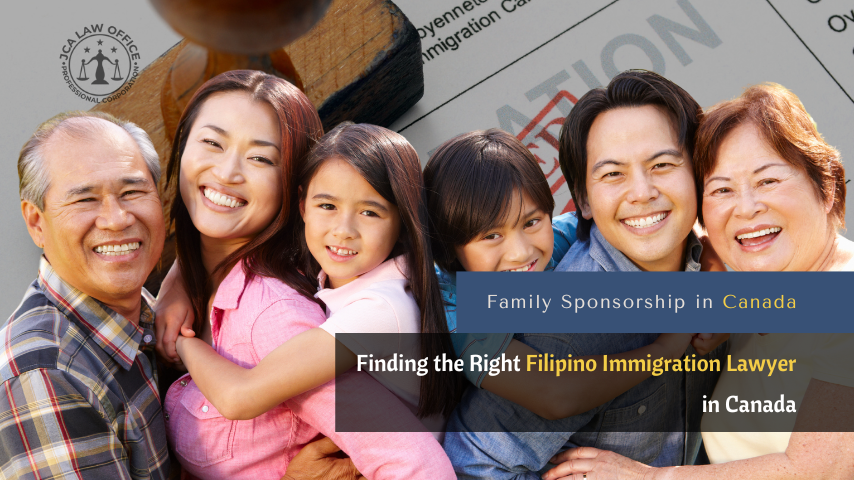
Finding the Right Filipino Immigration Lawyer in Canada: A Comprehensive Guide
What to look for when choosing a culturally sensitive immigration lawyer who understands both Philippine and Canadian law.
Are You Looking for a Filipino Immigration Lawyer in Canada?
You’re in the right place. This article aims to provide a comprehensive guide to help you find the right legal representation for your specific needs. With an increasing number of Filipino immigrants in Canada, having a knowledgeable and culturally sensitive lawyer is essential. The right Filipino immigration lawyer can help make your journey to Canada more manageable, ensuring your legal needs are addressed while respecting your cultural values.
Why Choose a Filipino Immigration Lawyer in Canada?
Key Advantages
Cultural Understanding — A Filipino immigration lawyer understands the unique cultural nuances and values of the Filipino community. This understanding helps build trust and rapport, ensuring a more seamless legal process.
Language Bridge — Having a lawyer who speaks both English and Filipino (Tagalog) significantly helps in bridging communication gaps, ensuring you fully understand your rights, options, and obligations during the immigration process.
Dual Legal Knowledge — A Filipino immigration lawyer in Canada is familiar with both Philippine and Canadian laws, allowing them to provide accurate advice and representation tailored to your specific needs.
How to Find a Filipino Immigration Lawyer in Canada
a. Personal Recommendations
Start by asking friends, family, or acquaintances who have immigrated to Canada if they can recommend a Filipino immigration lawyer. Word-of-mouth referrals are a valuable resource, as they provide firsthand experience and insight into the lawyer’s quality of service.
b. Online Directories and Reviews
Search for Filipino immigration lawyers in Canada using online directories, such as the Canadian Bar Association’s directory or Filipino community websites. Additionally, explore online reviews and testimonials from previous clients to gain insights into the lawyer’s expertise and client satisfaction.
c. Local Filipino Community Centers and Associations
Filipino community centers, associations, and cultural organizations can be excellent resources for finding a Filipino immigration lawyer in Canada. They often have connections to professionals in the community and may offer referrals or recommendations.
Things to Consider When Choosing a Filipino Immigration Lawyer
Important Selection Criteria
Expertise — Ensure the lawyer specializes in immigration law and has experience handling cases similar to yours. Check their credentials, certifications, and any professional affiliations.
Communication — Choose a lawyer who is responsive, attentive, and dedicated to your case. Good communication ensures you fully understand the process and that your concerns are addressed promptly.
Fees and Transparency — Before signing a retainer agreement, inquire about the fee structure and any additional expenses. Transparency in fees is crucial to avoid surprises.
Success Rate — While no outcome can be guaranteed, inquire about the lawyer’s success rate with cases similar to yours. A successful track record indicates expertise and competence.
Get the Right Filipino Immigration Lawyer
Finding the right Filipino immigration lawyer in Canada is crucial for a successful immigration process. By considering factors such as cultural understanding, language capabilities, expertise, and success rate, you can make an informed decision and secure the best possible legal representation. With the right Filipino immigration lawyer by your side, you can confidently navigate the complex world of Canadian immigration and start your new life in Canada.
A comprehensive guide covering job search, visa process, credentials, and more for Filipino workers coming to Canada.
If you are from the Philippines and considering working in Canada, it’s essential to be well-prepared and informed. Here are some tips to help you in this process:
Essential Tips for Working in Canada
Research job opportunities: Familiarize yourself with the Canadian job market, especially in your field of expertise. Visit job portals such as Job Bank, company websites, and LinkedIn to get a sense of available opportunities and requirements.
Understand the visa process: Determine the appropriate type of visa or work permit you will need. The Temporary Foreign Worker Program (TFWP) and the International Mobility Program (IMP) are two popular pathways. Additionally, the Express Entry system is an option for skilled immigrants seeking permanent residency.
Assess your qualifications: Evaluate how your education, work experience, and skills align with Canadian standards. You may need to have your credentials assessed through organizations like World Education Services (WES) or the International Credential Assessment Service (ICAS).
Improve language proficiency: Strong English or French language skills are essential for working in Canada. Consider taking language courses or exams like IELTS (International English Language Testing System) or TEF (Test d’évaluation de français) to prove your proficiency.
Network: Connect with other Filipino professionals working in Canada through online platforms, social media, or local organizations like the Philippine Embassy, as they may offer valuable insights and support.
Prepare your job application: Tailor your CV and cover letter to match Canadian expectations and the specific job requirements. Highlight your skills, qualifications, and experiences relevant to the position.
Research Canadian culture and workplace norms: Understanding Canadian culture, customs, and workplace expectations can help you integrate more effectively into your new work environment.
Seek professional assistance: Consider hiring an immigration consultant or lawyer who specializes in Canadian immigration to help guide you through the process.
Save money: Moving to another country can be expensive, so start saving early to cover expenses such as visa fees, credential assessments, language tests, and relocation costs.
Be patient and persistent: The process of finding a job and immigrating to Canada can be lengthy and challenging. Stay focused, keep learning, and don’t give up.
Remember
Each individual’s circumstances and the specific requirements of their chosen immigration pathway may vary, so always do thorough research and seek professional advice when necessary.
Navigating the Filing of Estate Tax Return in the Philippines
A comprehensive guide to estate tax filing requirements and the Estate Tax Amnesty Act
The Estate Tax is a tax imposed on the transfer of the estate of a deceased individual to their heirs. In the Philippines, the process of filing an estate tax return can be complex and time-consuming. However, the introduction of the Estate Tax Amnesty Act has brought significant changes that can benefit taxpayers. This article provides a comprehensive guide to filing an estate tax return in the Philippines and discusses the implications of the Estate Tax Amnesty Act.
I. Filing the Estate Tax Return in the Philippines
1. Determining the Taxable Estate
The first step is to determine the gross estate, which includes all the properties, rights, and interests of the deceased at the time of their death. This can be further categorized into real estate, personal properties, and intangible assets. After identifying the gross estate, certain deductions are allowed by law, such as:
Ordinary deductions: Funeral expenses, judicial expenses, and medical expenses.
Special deductions: Family home, standard deduction, and the share of the surviving spouse.
2. Tax Rates and Exemptions
The Tax Reform for Acceleration and Inclusion (TRAIN) Law sets the estate tax rate at 6% of the net estate value exceeding PHP 5,000,000. Estates worth PHP 5,000,000 or below are exempt from the tax.
3. Filing the Estate Tax Return
The estate tax return must be filed with the Bureau of Internal Revenue (BIR) within one year from the date of the decedent’s death. To do so, the following documents must be prepared:
BIR Form 1801: Estate Tax Return
Death certificate of the decedent
Notice of death filed with the BIR
List of properties and their respective values
Proof of claimed deductions
Tax Identification Number (TIN) of the decedent and the executor or administrator
4. Payment of the Estate Tax
The payment of the estate tax is due at the time of filing the return. It can be paid in full or by installment, depending on the circumstances of the estate.
II. The Estate Tax Amnesty Act
The Estate Tax Amnesty Act (Republic Act No. 11213) was signed into law in 2019, providing a one-time opportunity for taxpayers to settle outstanding estate tax liabilities at a reduced rate. The key features of the Act are:
1. Amnesty Coverage
The Act covers estate tax liabilities for decedents who passed away on or before December 31, 2017, with or without pending audit or investigation.
2. Amnesty Rate
The Act allows the payment of a 6% amnesty tax on the net estate, which is significantly lower than the previous estate tax rates of up to 20%.
3. Immunities and Privileges
Taxpayers who avail of the estate tax amnesty will be immune from payment of estate tax, civil, criminal, and administrative penalties. Additionally, they will not be subject to any further audit or investigation related to the estate tax liabilities.
4. Amnesty Period
The estate tax amnesty was initially available for two years from the effectivity of the Implementing Rules and Regulations (IRR). However, the government has extended the deadline due to the COVID-19 pandemic. Taxpayers should consult the BIR for the latest deadline.
Conclusion
The filing of an estate tax return in the Philippines can be a complex process, but understanding the requirements and procedures can help taxpayers efficiently navigate the system. The introduction of the Estate Tax Amnesty Act has provided a unique opportunity for taxpayers to settle their estate tax liabilities at a reduced rate and with significant immunities and privileges. It is crucial to consult tax professionals and the BIR for guidance on availing of the estate tax amnesty and ensuring compliance with the applicable laws and regulations.
In summary, dealing with estate tax returns and the Estate Tax Amnesty Act in the Philippines requires a thorough understanding of the process and the related laws. By staying informed and seeking professional advice, taxpayers can maximize the benefits and minimize the risks associated with managing estate tax obligations in the country.
Need Help With Estate Tax Filing?
Our team can assist with estate tax matters, extrajudicial settlements, and Philippine legal requirements.
10 Tips para sa mga Pilipinong Nagpaplanong Magtrabaho sa Canada
Isang komprehensibong gabay para sa mga Pilipinong nais magtrabaho sa Canada — mula sa job search hanggang immigration.
Kung ikaw ay nais magtrabaho sa Canada, mahalaga na maging handa at well-informed ka. Narito ang ilang tips upang matulungan ka sa prosesong ito:
Mga Mahahalagang Tips
Alamin ang mga job opportunities: Kilalanin ang job market ng Canada, lalo na sa iyong larangan ng kahusayan. Bisitahin ang job portals tulad ng Job Bank, company websites, at LinkedIn upang malaman ang mga oportunidad at requirements na available.
Unawain ang proseso ng visa: Alamin ang tamang uri ng visa o work permit na kailangan mo. Ang Temporary Foreign Worker Program (TFWP) at International Mobility Program (IMP) ay dalawang popular na pathway. Bukod dito, ang Express Entry system ay isa pang opsyon para sa skilled immigrants na naghahanap ng permanent residency.
I-assess ang iyong mga kwalipikasyon: Pag-aralan kung paano ang iyong edukasyon, work experience, at skills ay tumutugma sa mga pamantayan ng Canada. Maaaring kailanganin mong ipa-assess ang iyong mga credentials sa mga organisasyon tulad ng World Education Services (WES) o International Credential Assessment Service (ICAS).
Pagbutihin ang language proficiency: Ang malakas na English o French language skills ay mahalaga sa pagtatrabaho sa Canada. Kumuha ng language courses o exams tulad ng IELTS (International English Language Testing System) o TEF (Test d’évaluation de français) upang patunayan ang iyong kakayahan sa wika.
Mag-network: Kumuha ng koneksyon sa iba pang Filipino professionals na nagtatrabaho sa Canada sa pamamagitan ng online platforms, social media, o local organizations tulad ng Philippine Embassy, dahil maaaring magbigay sila ng mahalagang impormasyon at suporta.
Ihanda ang iyong job application: I-customize ang iyong CV at cover letter upang maging akma sa mga inaasahan ng Canada at sa partikular na trabahong inaapplyan. Ipakita ang iyong mga kasanayan, kwalipikasyon, at karanasan na may kinalaman sa posisyon.
Alamin ang Canadian culture at workplace norms: Ang pag-unawa sa kultura, mga kaugalian, at workplace expectations ng Canada ay makakatulong sa iyo na mas mabilis na makapag-adjust sa iyong bagong work environment.
Humingi ng professional assistance: Isaalang-alang ang pagkuha ng immigration consultant o abogado na may espesyalisasyon sa Canadian immigration upang gabayan ka sa proseso.
Mag-ipon ng pera: Ang paglipat sa ibang bansa ay maaaring magastos, kaya magsimulang mag-ipon ng maaga para sa mga gastusin tulad ng visa fees, credential assessments, language tests, at relocation costs.
Maging matiyaga at determinado: Ang proseso ng paghahanap ng trabaho at pagi-immigrate sa Canada ay maaaring mahaba at mahirap. Manatiling nakatuon, patuloy na matuto, at huwag sumuko.
Tandaan
Ang sitwasyon ng bawat indibidwal at ang partikular na mga kinakailangan ng kanilang napiling immigration pathway ay maaaring magkakaiba, kaya laging magsaliksik at humingi ng propesyonal na payo kung kinakailangan. Sundin ang mga tips na ito upang mapadali ang iyong pagtahak sa landas patungo sa iyong pangarap na trabaho sa Canada at maging matagumpay sa iyong bagong kabanata ng buhay.
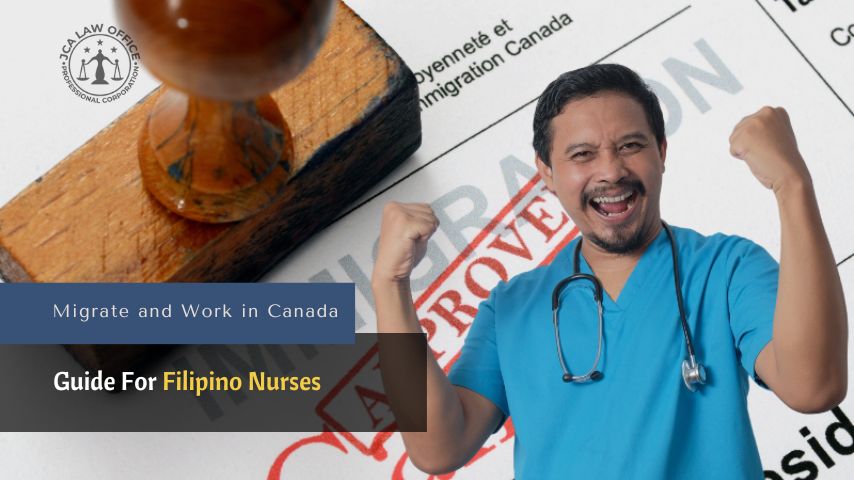
Migrate and Work in Canada: A Comprehensive Guide for Filipino Nurses
A step-by-step guide for Filipino nurses on qualifications, licensing, immigration pathways, and job search in Canada.
At JCA Law Office Professional Corporation, we understand the aspirations of Filipino nurses seeking to work and migrate to Canada. We provide expert assistance to help you navigate the process and ensure a successful transition.
Follow Our Step-by-Step Guide
1. Understand Canadian Requirements for Internationally Educated Nurses (IENs)
Different provinces in Canada have specific requirements for IENs. Visit the official websites of the nursing regulatory bodies in your desired province to familiarize yourself with these requirements.
2. Assess Your Nursing Qualifications and Experience
Before applying, ensure your qualifications and experience meet Canada’s minimum requirements. Credential evaluations are often conducted by the National Nursing Assessment Service (NNAS) or the nursing regulatory body in your chosen province.
3. Demonstrate Language Proficiency
Canada requires IENs to be proficient in either English or French. Take a language proficiency test like IELTS, CELBAN, or TEF to meet the requirements.
4. Register with the Nursing Regulatory Body
Register with the nursing regulatory body in your chosen province. You may need to pass a nursing competency examination, such as the NCLEX-RN or CPNRE.
Ready to Take the First Step?
Contact us today and let us help you navigate the immigration process. Our team is here to assist you every step of the way.
Choose from several pathways to immigrate to Canada, including:
Express Entry — A federal immigration program for skilled workers
Provincial Nominee Program (PNP) — Province-specific immigration programs
Atlantic Immigration Pilot Program (AIPP) — An employer-driven program for the Atlantic provinces
6. Search for Job Opportunities
Utilize job search engines, nursing job boards, and healthcare organizations’ websites to find employment opportunities in Canada.
7. Plan Your Move to Canada
Once you’ve secured a job and the necessary permits or visas, start planning your move. Research living costs, housing options, and local customs for a smooth transition.
At JCA Law Office Professional Corporation, we’re dedicated to helping Filipino nurses successfully work and migrate to Canada. Contact us today to discuss your options and start your journey.
Express Entry Canada 2026: Comprehensive Guide for Filipino Immigrants
Last Updated: February 2026 | Express Entry remains the fastest and most popular pathway to Canadian permanent residence. If you are a Filipino professional, tradesperson, or international graduate looking to immigrate to Canada, this comprehensive guide covers everything you need to know about Express Entry in 2026 — from CRS scoring and category-based draws to the latest fee changes and Filipino-specific strategies.
At JCA Law Office Professional Corporation, we have helped hundreds of Filipino families navigate Express Entry successfully. This guide reflects the latest IRCC policies, draw results, and the 2026-2028 Immigration Levels Plan.
What Is Express Entry?
Express Entry is Canada s flagship immigration management system, introduced in 2015. It is not a visa or immigration program itself — rather, it is an online system that manages applications for three federal economic immigration programs. Candidates create an online profile, receive a Comprehensive Ranking System (CRS) score, and enter a pool of candidates. The highest-ranking candidates receive Invitations to Apply (ITAs) for permanent residence through regular draws conducted by Immigration, Refugees and Citizenship Canada (IRCC).
In 2025, IRCC issued a total of 114,102 Invitations to Apply — and the 2026-2028 Levels Plan targets approximately 380,000 new permanent residents per year, with economic immigration (including Express Entry) making up 64% of admissions by 2027-2028.
The Three Express Entry Programs
Express Entry manages applications for three distinct federal programs. Each has different eligibility requirements:
1. Federal Skilled Worker Program (FSWP)
The FSWP is designed for skilled workers with foreign work experience who want to immigrate to Canada permanently. This is the most common pathway for Filipino applicants applying from outside Canada.
Key Requirements:
At least 1 year of continuous full-time skilled work experience (NOC TEER 0, 1, 2, or 3) within the last 10 years
Language proficiency: Minimum CLB 7 in all four abilities (speaking, listening, reading, writing) in English or French
Education: Canadian secondary or post-secondary credential, OR foreign credential with an Educational Credential Assessment (ECA)
Proof of settlement funds (unless you have a valid job offer or are already authorized to work in Canada)
Must score at least 67 out of 100 on the FSW points grid (separate from CRS)
2. Canadian Experience Class (CEC)
The CEC is for candidates who already have skilled work experience in Canada. This pathway has become increasingly important, as IRCC held 15 CEC-specific draws in 2025, reflecting the government s priority for in-Canada candidates.
Key Requirements:
At least 1 year of skilled work experience in Canada (NOC TEER 0, 1, 2, or 3) within the last 3 years
Language proficiency: Minimum CLB 7 for NOC TEER 0 or 1 jobs; CLB 5 for NOC TEER 2 or 3 jobs
No education requirement (but education boosts your CRS score)
No proof of funds requirement
3. Federal Skilled Trades Program (FSTP)
The FSTP targets workers in skilled trades such as electricians, plumbers, welders, and heavy equipment operators. Filipino tradespeople with Canadian experience or a valid job offer should strongly consider this pathway.
Key Requirements:
At least 2 years of full-time skilled trade work experience (NOC groups under TEER 2 or 3) within the last 5 years
Language proficiency: Minimum CLB 5 for speaking and listening; CLB 4 for reading and writing
A valid job offer of at least 1 year OR a certificate of qualification from a Canadian provincial or territorial authority
No education requirement (but education boosts your CRS score)
Program Comparison Table
Factor
Federal Skilled Worker (FSW)
Canadian Experience Class (CEC)
Federal Skilled Trades (FSTP)
Work Experience
1 year foreign skilled work (last 10 years)
1 year Canadian skilled work (last 3 years)
2 years skilled trade work (last 5 years)
Language (English)
CLB 7 minimum
CLB 5-7 depending on NOC TEER
CLB 4-5 depending on ability
Education
Required (with ECA for foreign)
Not required
Not required
Proof of Funds
Required
Not required
Required
Job Offer
Not required
Not required
Required OR certificate of qualification
Best For
Filipino professionals abroad
Filipino workers already in Canada
Filipino tradespeople
Comprehensive Ranking System (CRS) Scoring Breakdown
Every Express Entry candidate receives a CRS score out of a maximum of 1,200 points. Your CRS score determines your rank in the Express Entry pool and whether you will receive an Invitation to Apply. The CRS evaluates four main categories:
CRS Score Components
Component
With Spouse (Max)
Without Spouse (Max)
A. Core / Human Capital
460 points
500 points
— Age
100
110
— Education
140
150
— Language (1st official)
128
136
— Language (2nd official)
22
24
— Canadian Work Experience
70
80
B. Spouse/Partner Factors
40 points
N/A
C. Skill Transferability
100 points (max)
— Education + Language
50
— Education + Canadian Work Exp.
50
— Foreign Work Exp. + Language
50
— Foreign + Canadian Work Exp.
50
— Certificate of Qualification + Language
50
D. Additional Points
600 points (max)
— Provincial Nomination (PNP)
600
— French language proficiency (NCLC 7+)
25-50
— Canadian education
15-30
— Sibling in Canada (PR/citizen)
15
TOTAL MAXIMUM
1,200 points
Important 2025 Change — Arranged Employment Points Removed: As of March 25, 2025, IRCC removed the 50-200 bonus CRS points previously awarded for having a valid job offer supported by an LMIA. This was a temporary measure to address fraud in the LMIA system. While having a job offer may still be required for eligibility under certain programs (e.g., FSTP), it no longer adds CRS points. IRCC has not announced when this measure will end.
Age Points Breakdown
Age
Points (Without Spouse)
Points (With Spouse)
17 or under
0
0
18
99
90
19
105
95
20-29
110
100
30
105
95
31
99
90
32
94
85
33
88
80
34
83
75
35
77
70
36
72
65
37
66
60
38
61
55
39
55
50
40
50
45
41
39
35
42
28
25
43
17
15
44
6
5
45+
0
0
Category-Based Selection Draws (2025-2026)
Since 2023, IRCC has conducted category-based selection draws that target candidates with specific attributes or work experience aligned with Canada s economic priorities. These draws are in addition to general, CEC, and PNP draws. In 2025, category-based draws accounted for approximately 59% of all ITAs issued.
Current Categories for 2026
IRCC has confirmed the following seven categories for Express Entry in 2026:
Category
Description
2025 Draw Activity
Typical CRS Range
French-Language Proficiency
Candidates with strong French skills (NCLC 7+ in all abilities)
High — multiple draws, large ITAs
379-446
Healthcare and Social Services
Nurses, physicians, medical technologists, social workers, and related occupations
High — multiple draws
462-510
STEM Occupations
Science, technology, engineering, and math professionals
No draws held in 2025
N/A (expected 480-520)
Trades Occupations
Electricians, plumbers, welders, heavy equipment operators, etc.
1 draw (September 2025)
~505
Agriculture and Agri-Food
Butchers and related agri-food workers
No draws held in 2025
N/A
Education Occupations
Teachers, early childhood educators (added Feb 2025)
Minimal draws
~480-510
Physicians (NEW)
Physicians with 12+ months Canadian work experience (added Dec 2025)
Draws expected to begin early 2026
TBD
Why This Matters for Filipinos: Category-based draws for healthcare and French language consistently have the lowest CRS cutoffs. Filipino nurses, medical technologists, and caregivers who qualify under the healthcare category have a significant advantage. Similarly, Filipino professionals who invest in French language training can dramatically lower their required CRS score — with cutoffs as low as 379 points for French-language draws in 2025.
Key Changes to Categories in 2025
Transportation category removed (February 2025)
Education category added with 5 eligible occupations (February 2025)
Healthcare expanded to include social services occupations
Trades expanded with additional NOC codes
Agriculture narrowed from 3 occupations to 1 (Butchers — retail and wholesale, NOC 63201)
Physicians category introduced (December 2025) — requires 12+ months Canadian work experience in one of three eligible NOCs
Latest Express Entry Draw Results (2025-2026)
The following table shows recent Express Entry draws from late 2025 through early 2026. Note the significant variation in CRS cutoffs depending on the draw type:
Date
Draw Type
ITAs Issued
CRS Cutoff
February 3, 2026
Provincial Nominee Program (PNP)
423
749
January 21, 2026
Canadian Experience Class (CEC)
6,000
509
January 20, 2026
Provincial Nominee Program (PNP)
681
746
January 7, 2026
Provincial Nominee Program (PNP)
423
711
January 6, 2026
Canadian Experience Class (CEC)
8,000
511
January 3, 2026
Provincial Nominee Program (PNP)
574
739
December 17, 2025
French Language Proficiency
6,000
399
December 3, 2025
Provincial Nominee Program (PNP)
1,123
729
December 2, 2025
Canadian Experience Class (CEC)
5,000
515
September 2025
Trades Occupations
1,250
505
2026 Trend: IRCC has focused heavily on in-Canada candidates in early 2026, with large CEC draws (8,000 and 6,000 ITAs) and steady PNP draws. The CEC cutoff dropped to 509 — the lowest in over a year. This is excellent news for Filipino workers and graduates already in Canada.
2025 Year in Review
Total ITAs issued in 2025: 114,102
Category-based draws: ~59% of all ITAs
CEC draws: ~26% (15 draws total)
PNP draws: Regular, consistent draws throughout the year
No general (all-program) draws: The last general draw was April 23, 2024
No STEM or Agriculture draws were held in 2025
Largest single-month issuance: December 2025 (17% of all 2025 ITAs)
How to Improve Your CRS Score
Many Filipino applicants find their CRS score falls just below the cutoff. Here are proven strategies to boost your score by 30-100+ points:
1. Improve Your Language Scores (Up to 80+ Additional Points)
Language proficiency is the single biggest factor you can control. Retaking your IELTS or CELPIP test to achieve higher scores can yield dramatic CRS improvements.
CLB Level Improvement
Approximate CRS Gain
CLB 7 to CLB 8 (in all abilities)
+20 to +30 points
CLB 8 to CLB 9 (in all abilities)
+30 to +50 points
CLB 9 to CLB 10+ (in all abilities)
+15 to +25 points
Filipino-specific tip: Many Filipinos score well on IELTS reading and listening but lose points on writing and speaking. Invest in an IELTS preparation course that focuses on these two modules. Even a 0.5-band improvement in writing (e.g., 6.5 to 7.0) can add meaningful CRS points.
2. Learn French (25-50 Additional Points + Category Access)
This is one of the most powerful strategies available in 2026. Achieving NCLC 7+ in French gives you:
25 bonus CRS points for French proficiency with English CLB 4 or lower
50 bonus CRS points for French proficiency with English CLB 5+
Access to French-language category draws with CRS cutoffs as low as 379
French-language draws consistently have the lowest CRS cutoffs of any draw type. IRCC targets Francophone admissions of 9% in 2026, 9.5% in 2027, and 10.5% in 2028 outside Quebec, making this an increasingly valuable pathway.
3. Obtain a Canadian Education Credential (15-30 Points)
1- or 2-year diploma/certificate: +15 CRS points
3+ year degree or graduate degree: +30 CRS points
Also boosts your Skill Transferability cross-factor points
4. Gain Canadian Work Experience (Up to 80 Points)
Canadian work experience is heavily weighted in the CRS. Each additional year (up to 5 years) adds significant points:
Canadian Work Experience
Points (Without Spouse)
Points (With Spouse)
1 year
40
35
2 years
53
46
3 years
64
56
4 years
72
63
5+ years
80
70
5. Get a Provincial Nomination (+600 Points)
A Provincial Nominee Program (PNP) nomination adds 600 CRS points to your profile, virtually guaranteeing an ITA regardless of your base score. PNP draws in 2026 have had CRS cutoffs of 711-749, meaning even candidates with base scores as low as 111-149 can receive an ITA with a nomination.
Provincial Immigration Guides: Learn about specific PNP pathways in our comprehensive guides:
Provincial Nomination Through Express Entry (+600 Points)
A provincial nomination is the most impactful way to receive an Express Entry ITA. With +600 CRS points, it effectively guarantees you will be invited in the next PNP draw.
How PNP Works with Express Entry
Create your Express Entry profile and enter the pool
Apply to a province through their PNP Express Entry stream (or receive a Notification of Interest from a province)
If nominated, accept the nomination in your Express Entry profile
Receive +600 CRS points, boosting your score well above any cutoff
Receive your ITA in the next PNP-specific draw
Best PNP Options for Filipino Immigrants
Province
Key Streams
Filipino-Friendly Features
Ontario (OINP)
Human Capital Priorities, Skilled Trades, French-Speaking
Largest Filipino community; GTA job market; healthcare demand
British Columbia (BC PNP)
Skills Immigration, Express Entry BC
Strong tech and healthcare sectors; Metro Vancouver Filipino community
Alberta (AAIP)
Alberta Express Entry
Lower cost of living; strong trade and healthcare demand
Manitoba (MPNP)
Skilled Workers Overseas, Skilled Workers in Manitoba
Large established Filipino community in Winnipeg
Saskatchewan (SINP)
International Skilled Worker, Express Entry
In-demand occupations list favors Filipino skill sets
Step-by-Step Express Entry Application Process
Step 1: Determine Your Eligibility
Before creating a profile, confirm you meet the minimum requirements for at least one of the three Express Entry programs (FSW, CEC, or FSTP). Use the IRCC Come to Canada tool for a preliminary assessment.
Step 2: Prepare Your Documents
Gather all required documents before creating your profile:
Language test results: IELTS General Training or CELPIP-General (English); TEF Canada or TCF Canada (French). Results must be less than 2 years old.
Educational Credential Assessment (ECA): Required for foreign education. Use a designated organization such as WES (World Education Services). For Philippine degrees, WES typically requires authenticated documents from CHED and DFA. Allow 4-8 weeks.
Passport: Valid Philippine passport
Work experience documentation: Reference letters from employers detailing job title, duties, dates of employment, hours per week, and salary
Proof of funds: Bank statements or investment records (for FSW and FSTP applicants)
Step 3: Create Your Express Entry Profile
Create an account on the IRCC website and complete your Express Entry profile. Your profile includes information about your:
Skills, work experience, language ability, and education
Family members (spouse/partner, dependent children)
Job offer details (if applicable)
Provincial nomination (if applicable)
Once submitted, you receive your CRS score and enter the Express Entry pool. Your profile remains active for 12 months.
Step 4: Receive an Invitation to Apply (ITA)
If your CRS score is above the cutoff in a draw, you receive an ITA. You then have 60 days to submit a complete application for permanent residence.
Step 5: Submit Your PR Application
After receiving your ITA, submit your full application online with:
All supporting documents (identity, education, work experience, language)
Police clearance certificates — including NBI Clearance from the Philippines
Medical examination from an IRCC-designated panel physician
Application fees (see fee breakdown below)
Proof of funds (if required)
Photos meeting IRCC specifications
Need NBI Clearance? Filipino applicants need an NBI (National Bureau of Investigation) clearance as part of their police clearance requirements. Learn about the process in our NBI Clearance Guide.
Step 6: Wait for Processing and Decision
IRCC processes your application. During this time, they may request additional documents or schedule an interview. If approved, you receive your Confirmation of Permanent Residence (COPR) and permanent resident visa.
Processing Times and Fees (2026)
Current Processing Times
IRCC s service standard for Express Entry applications is 6 months (80% of cases). However, actual processing times vary:
Program
Service Standard
Typical Processing Time (2025-2026)
Federal Skilled Worker (FSW)
6 months
5-8 months
Canadian Experience Class (CEC)
6 months
4-6 months
Federal Skilled Trades (FSTP)
6 months
5-7 months
Processing times can be longer if IRCC requests additional documents, medical re-examination, or enhanced background checks.
Fee Breakdown (as of 2026)
Fee Type
Primary Applicant
Spouse/Partner
Dependent Child
PR Application Processing Fee
Right of Permanent Residence Fee (RPRF)
N/A
Biometrics
(if 14-79)
Total per Adult
,610
,610
–
Fee Increase Alert: IRCC reviews and increases PR application fees periodically. The current processing fee took effect in 2025 (up from ). The next fee adjustment is expected April 30, 2026. We recommend submitting your application before this date to lock in current fees.
Additional Costs to Budget For
Item
Approximate Cost
IELTS General Training test
–
CELPIP-General test
–
TEF/TCF French test
–
Educational Credential Assessment (WES)
– (plus authentication fees)
Medical exam (IRCC panel physician)
– per person
NBI Clearance (Philippines)
PHP 155-580 (~- CAD)
Police clearance (other countries)
Varies by country
Document translation and notarization
– per document
Photos (IRCC specifications)
–
Total estimated cost for a single applicant: ,500-,200 CAD (including all fees, tests, and documents)
Proof of Settlement Funds (2025-2026)
FSW and FSTP applicants must demonstrate they have enough funds to support themselves and their family in Canada. These amounts are based on 50% of the Low-Income Cut-Off (LICO) and are updated annually (most recently July 2025):
Family Size
Minimum Funds Required (CAD)
1 member (single applicant)
,263
2 members
,005
3 members
,370
4 members
,362
5 members
,164
6 members
,276
7 members
,392
Each additional member
+,112
CEC applicants do not need to show proof of funds. FSW applicants with a valid Canadian job offer are also exempt.
2026-2028 Immigration Levels Plan: Impact on Express Entry
Canada s 2026-2028 Immigration Levels Plan sets the framework for permanent resident admissions over the next three years. Here is what it means for Express Entry applicants:
Key Numbers
Year
Total PR Target
Economic Immigration
EE Share of Economic
2026
380,000
239,800
~85,000-122,000
2027
380,000
244,700
~85,000-122,000
2028
380,000
244,700
~85,000-122,000
What This Means for Filipino Applicants
Stable admissions: The plan holds total PR admissions steady at 380,000 per year (down from the previous plan s 500,000 target), providing more predictability
Economic immigration is the priority: Economic class makes up 64% of admissions by 2027-2028, meaning Express Entry and PNP remain the primary pathways
Temporary to permanent transitions: IRCC plans to accelerate the transition of up to 33,000 temporary workers to PR in 2026 and 2027 — excellent news for Filipino workers on work permits in Canada
Francophone targets increasing: 9% (2026) to 9.5% (2027) to 10.5% (2028) of admissions outside Quebec must be French-speaking, meaning more French-language draws at lower CRS cutoffs
CRS scores may fluctuate: With lower overall targets but consistent category-based draws, CRS cutoffs for general/CEC draws may remain in the 500-530 range, while category-based draws will likely stay lower
Tips for Filipino Express Entry Applicants
As lawyers who serve the Filipino-Canadian community, we have identified the most effective strategies for Filipino applicants:
1. Start Your ECA Early
The Educational Credential Assessment process for Philippine degrees involves multiple steps: DFA authentication (red ribbon), CHED authentication, and then submission to WES or another designated organization. The entire process can take 2-4 months. Start this immediately — do not wait until you are ready to create your profile.
2. Maximize Your IELTS Score
Filipino applicants typically have strong English foundations but often score lower on IELTS Writing (especially Task 1 — the letter/report). A score of CLB 9 (IELTS 7.0 in each band) versus CLB 7 (IELTS 6.0) can mean a difference of 50-80 CRS points. Invest in a 4-8 week IELTS preparation course, particularly for Writing and Speaking.
3. Consider French as a Strategic Advantage
With French-language draw cutoffs as low as 379 CRS points compared to 509+ for CEC draws, learning French is one of the most impactful investments you can make. Many Filipino professionals can achieve TEF/TCF B2 (NCLC 7) within 6-12 months of dedicated study. Alliance Francaise centres in Manila and online French courses through platforms like TV5Monde are good starting points.
4. Filipino Healthcare Workers: Leverage Category-Based Draws
If you are a nurse, medical technologist, physiotherapist, occupational therapist, or social worker, you may qualify for healthcare and social services category-based draws. These draws have CRS cutoffs of 462-510 — significantly lower than CEC draws. Ensure your NOC code matches the eligible occupations list.
5. Work in Canada First (If Possible)
Canadian work experience is one of the most valuable CRS factors. If you can obtain a work permit (e.g., through an LMIA employer, post-graduation work permit, or IEC), even 1 year of Canadian experience can boost your score by 40-80 points and make you eligible for CEC draws, which have lower cutoffs than general draws.
6. Explore Provincial Nomination
If your CRS score is below the cutoff for direct Express Entry draws, a PNP nomination adds 600 points and guarantees an invitation. Provinces like Manitoba, Saskatchewan, and Alberta have streams that are particularly accessible for Filipino applicants. Our Filipino Immigrant Guide to Canada provides detailed information about each province s PNP programs.
7. Keep Your Profile Updated
Your Express Entry profile is valid for 12 months. During that time, update it whenever your circumstances change: new language test scores, additional work experience, new education, or a provincial nomination. Each update recalculates your CRS score and could push you above the cutoff.
8. Apply to Multiple Provinces Simultaneously
There is no rule against having both an Express Entry profile and applications to multiple Provincial Nominee Programs. Cast a wide net — apply to 2-3 provinces while maintaining your federal Express Entry profile.
Frequently Asked Questions (FAQ)
What CRS score do I need to get an ITA in 2026?
It depends on the draw type. In early 2026, CEC draws have required CRS scores of 509-511, PNP draws require 711-749 (which includes the 600-point PNP bonus), and category-based draws (French, healthcare) can be as low as 379-510. There have been no general all-program draws since April 2024.
Can I apply to Express Entry from the Philippines?
Yes. Express Entry is an online system, and you can create your profile and submit your application from anywhere in the world. However, note that IRCC has heavily favored in-Canada candidates (through CEC draws) in 2025-2026. Candidates outside Canada are primarily invited through category-based draws (French, healthcare, STEM, trades) or through PNP nominations.
How long does the entire Express Entry process take?
Profile creation and time in pool: Varies (could be days to months)
After ITA: 60 days to submit full application
Processing: 4-8 months
Total estimate: 8-16 months from first steps to COPR
Do I still get CRS points for a job offer?
No. As of March 25, 2025, IRCC removed the 50-200 bonus CRS points for arranged employment (LMIA-supported job offers). This was a temporary measure to combat LMIA fraud. However, having a valid job offer is still required for eligibility under the Federal Skilled Trades Program, and you should still list any job offers in your profile.
What happens if my CRS score is too low?
If your score is below recent cutoffs, you have several options: (1) improve your language test scores, (2) gain Canadian work experience, (3) learn French, (4) pursue additional education, (5) apply for a Provincial Nominee Program nomination (+600 points), or (6) wait for category-based draws that match your occupation. Your profile stays in the pool for 12 months and can be renewed.
Can my spouse or common-law partner be included in my application?
Yes. Your spouse or common-law partner and dependent children (under 22 and unmarried) can be included in your PR application. Note that having a spouse may reduce your CRS score slightly (because points are shared between human capital factors), but if your spouse has strong language scores, education, or Canadian work experience, they can add points to your total CRS.
Is Express Entry still worth it with lower immigration targets?
Absolutely. While the 2026-2028 plan reduced total PR targets to 380,000 (from a planned 500,000), economic immigration — which includes Express Entry — now represents 64% of all admissions. Express Entry remains the fastest, most efficient pathway to Canadian permanent residence, with processing times of 6 months or less for most applicants.
Do I need a lawyer for Express Entry?
While Express Entry can be done independently, working with an experienced immigration lawyer significantly reduces the risk of errors that can lead to refusals or delays. Common issues include: incorrect NOC code selection, inadequate reference letters, incomplete proof of funds documentation, and missed deadlines. An immigration lawyer ensures your application is complete, accurate, and optimized for success.
How JCA Law Office Can Help
JCA Law Office Professional Corporation is a Toronto-based law firm that specializes in serving the Filipino-Canadian community. Our immigration team provides comprehensive Express Entry services:
Free initial assessment of your Express Entry eligibility and CRS score
Profile optimization — strategies to maximize your CRS score
Provincial Nominee Program applications to secure the +600 point boost
Complete application preparation and submission after receiving your ITA
Category-based draw strategy — identifying which category draws you qualify for and optimizing your profile accordingly
Post-ITA support — medical exams, police clearances (including NBI), and final submission
We understand the unique challenges Filipino applicants face, from Philippine document authentication (DFA red ribbon, CHED, PSA) to NBI clearance requirements. Our team communicates in English, Filipino, and Tagalog.
Ready to Start Your Express Entry Journey?
Book a consultation with our immigration team to assess your eligibility, calculate your CRS score, and develop a personalized strategy for permanent residence in Canada.
Disclaimer: This guide is for informational purposes only and does not constitute legal advice. Immigration laws and policies change frequently. For advice specific to your situation, please book a consultation with our immigration team. Information is current as of February 2026.
Canadian Immigration Programs for Filipino Caregivers: Opportunities and Pathways
Explore the key pathways for Filipino caregivers to work and obtain permanent residency in Canada.
Canada has long been a popular destination for Filipino caregivers seeking better opportunities and a higher quality of life. The Canadian government recognizes the significant contribution of these caregivers to the economy and society and has established several immigration programs to help them find employment and eventually obtain permanent residency. This article outlines some of the key Canadian immigration programs available for Filipino caregivers, detailing the requirements, application processes, and benefits of each program.
1. Home Child Care Provider and Home Support Worker Pilot Programs
These two five-year pilot programs, launched in 2019, aim to provide a direct pathway for eligible caregivers to secure permanent residency in Canada. The Home Child Care Provider Pilot targets caregivers providing in-home childcare, while the Home Support Worker Pilot focuses on those offering care to the elderly or those with disabilities.
Key Features
Both programs allow caregivers to bring their families with them to Canada.
Applicants must have a valid job offer from a Canadian employer.
Caregivers receive an occupation-restricted open work permit, which allows them to switch employers without obtaining a new work permit.
After completing 24 months (recently reduced to 12 months) of work experience within a 36-month period, caregivers can apply for permanent residency.
Eligibility Requirements
A genuine job offer from a Canadian employer in the relevant occupation.
At least one year of post-secondary education, equivalent to Canadian education standards.
Sufficient proficiency in English or French (minimum CLB/NCLC 5).
Eligible work experience may be required, depending on the program.
2. Live-in Caregiver Program (LCP)
The Live-in Caregiver Program (LCP), although closed to new applicants since 2014, still allows those who are already working in Canada as live-in caregivers to apply for permanent residency.
Eligibility Requirements
Must have entered Canada through the LCP and currently working as a live-in caregiver.
Must have completed 24 months of authorized full-time employment as a live-in caregiver within four years of arrival in Canada.
3. Provincial Nominee Programs (PNPs)
Many Canadian provinces and territories offer Provincial Nominee Programs (PNPs) with streams specifically designed for caregivers. These programs allow provinces to nominate candidates for permanent residency based on their specific labor market needs. Some popular PNPs for caregivers include:
Provincial Caregiver Programs
British Columbia: The BC PNP offers the Skills Immigration – Health Professional category for eligible healthcare professionals, including registered nurses, psychiatric nurses, and nurse practitioners.
Alberta: The Alberta Immigrant Nominee Program (AINP) offers the Alberta Opportunity Stream, which targets workers in certain in-demand occupations, including nurse aides and orderlies.
Eligibility requirements and application processes vary depending on the specific PNP stream. Caregivers interested in these programs should consult the official websites of the relevant provinces for more information.
Conclusion
Canada offers a variety of immigration programs for Filipino caregivers, providing them with opportunities to work, reunite with their families, and eventually become permanent residents. By understanding the different pathways available and their respective requirements, Filipino caregivers can make informed decisions about which program best suits their needs and goals.
Need Help with Your Caregiver Immigration?
Call us at 1-855-522-5290 or reach out online. Our immigration lawyers specialize in caregiver programs.
Mortgage Refinancing Guide for Filipino Homeowners in Ontario
Benefits, factors to consider, and how to get started with refinancing your Ontario mortgage.
Mabuhay, mga kababayan! For many Filipinos in Ontario, owning a home represents the achievement of a lifelong dream. As a homeowner, it’s essential to make informed decisions about managing your mortgage. Mortgage refinancing is one such option that can provide significant benefits, such as lower interest rates, reduced monthly payments, or debt consolidation. This guide will discuss mortgage refinancing for Filipino homeowners in Ontario and how to determine if it’s the right choice for you.
What is Mortgage Refinancing?
Mortgage refinancing involves replacing your existing mortgage with a new one, typically with more favorable terms. It’s an opportunity to renegotiate the interest rate, loan term, and other conditions of your mortgage, which can potentially save you money and make managing your finances easier.
Benefits of Mortgage Refinancing
Key Benefits
Lower Interest Rates — Refinancing may enable you to secure a lower interest rate, potentially saving you thousands of dollars in interest payments over the life of your mortgage.
Reduced Monthly Payments — With a lower interest rate, your monthly mortgage payments may decrease, allowing you to free up cash for other expenses.
Debt Consolidation — If you have high-interest debts, such as credit cards or personal loans, refinancing can help you consolidate them into a single, lower-interest mortgage payment.
Switching Mortgage Types — You may wish to change from a variable-rate mortgage to a fixed-rate mortgage, or vice versa, depending on your financial goals and market conditions.
Access Home Equity — Refinancing can enable you to tap into your home’s equity for expenses like home renovations, investments, or education costs.
Factors to Consider
Important Considerations
Closing Costs — Refinancing your mortgage comes with closing costs, such as legal fees, appraisal fees, and title insurance. Ensure you can recoup these costs through savings from refinancing before proceeding.
Prepayment Penalties — Some lenders charge prepayment penalties if you pay off your mortgage early. Check your mortgage contract and weigh these potential costs against potential savings.
Break-even Point — Calculate how long it will take to recoup the costs of refinancing through reduced monthly payments. Ensure the break-even point is within your intended time frame for staying in the home.
How to Get Started
Assess Your Financial Situation — Review your current mortgage terms, interest rate, and remaining balance. Determine your financial goals and consider how refinancing can help you achieve them.
Research Lenders — Shop around for lenders with competitive rates and terms. As a Filipino homeowner, you may want to consider working with lenders who understand and cater to the needs of the Filipino community.
Gather Documentation — Prepare the necessary documents, such as proof of income, credit reports, and home appraisal, to facilitate the refinancing process.
Consult a Mortgage Broker — A mortgage broker can help you navigate the refinancing process and find the best deal for your specific situation.
Conclusion
Mortgage refinancing can be an advantageous tool for Filipino homeowners in Ontario, offering the potential for savings and improved financial management. However, it’s essential to carefully weigh the benefits and costs before proceeding. By doing a thorough research and consulting with a mortgage broker, you can make an informed decision that best aligns with your financial goals.
Considering Mortgage Refinancing?
Our real estate lawyers can guide you through the refinancing process and protect your interests.
Why Canada is a Popular Destination Among Filipino Immigrants
Understanding the factors that make Canada the top choice for Filipino families seeking a better life abroad
Canada has been a popular destination for immigrants from all over the world, including the Philippines. According to the 2021 Census, there are approximately .96 million Filipinos living in Canada, making them one of the largest immigrant groups in the country. In this article, we will explore some of the reasons why Canada is among the top choice for Filipino immigrants.
Statistics Canada
Economic Opportunities in Canada for Filipino Immigrants
Canada’s robust economy is a primary magnet for Filipino immigrants seeking better livelihoods. As a member of the G7—an elite group representing seven of the world’s most advanced economies—Canada boasts a formidable economic status. This North American nation is renowned for its diverse and strong economy, offering a plethora of job opportunities in various sectors. Notably, sectors such as accommodation and food services, construction, and food manufacturing are thriving, presenting numerous prospects for skilled workers.
Moreover, Canada’s commendable low unemployment rate underscores the consistent demand for skilled labor across multiple industries. This demand is a significant draw for Filipinos who are increasingly choosing Canada as their new home. The promise of economic stability and the opportunity to secure a prosperous future for their families are key factors driving their migration. By relocating to Canada, Filipino immigrants are positioned to significantly improve their living standards and achieve their career aspirations.
Canada’s High Quality of Life and Stable Political Climate
Canada is globally recognized for its exceptional quality of life, a factor that significantly contributes to its appeal among Filipino immigrants. The nation’s cities, particularly Toronto and Vancouver, are frequently celebrated in the top 10 rankings of the world’s best places to live. This high standard of living is supported by Canada’s stable political environment, ensuring safety and consistency for its residents.
Moreover, Canada is distinguished by its top-tier healthcare and education systems, which are pivotal in providing a nurturing and progressive environment for families. The commitment to maintaining a clean and sustainable environment further amplifies Canada’s attractiveness as a destination. These elements collectively make Canada an ideal choice for Filipinos who are in pursuit of enhanced living conditions and a promising future for themselves and their families.
Ready To Take The First Step Towards Your Canadian Dream?
Contact us today and let us help you navigate the immigration process. Our team is here to assist you every step of the way.
Embracing Safety and Security in Canada: A Haven for Filipino Families
In the hearts of Filipinos seeking a serene and secure life abroad, Canada emerges as a beacon of safety and tranquility. Renowned for its impressively low crime rate, Canada represents not just a place but a promise—a promise of a nurturing environment where families can flourish without worry. The Canadian government’s steadfast commitment to safeguarding its citizens and residents plays a pivotal role in cultivating one of the safest havens on the global stage.
For Filipinos, the sense of security in Canada transcends mere statistics; it is felt in the peaceful streets, the friendly neighborhoods, and the respectful, law-abiding communities. This profound peace of mind allows Filipino families in Canada to focus on what truly matters—nurturing relationships, fostering dreams, and building a future filled with hope and stability.
Canada’s Embrace of Diversity: A Multicultural Home for Filipino Immigrants
In the vibrant mosaic that is Canada, diversity and multiculturalism are not just policies but the very fabric of society. This great nation warmly opens its arms to immigrants from every corner of the globe, cherishing and celebrating the rich tapestry of cultures they bring. Filipinos, in particular, find a special sense of belonging in Canada’s inclusive atmosphere, where maintaining one’s cultural heritage is not just accepted but encouraged.
The Canadian government’s proactive stance on diversity and inclusion fosters a society where every individual is valued and respected. This commitment to creating a harmonious and welcoming environment allows Filipinos to transition seamlessly into their new life, surrounded by communities that resonate with the warmth of their culture and traditions. In Canada, Filipinos can truly feel at home, empowered to be their authentic selves and enrich the multicultural landscape with their unique heritage.
Canada’s Welcoming Immigration Policy: A Gateway for Filipino Immigrants
Canada stands out on the global stage with one of the most open and accommodating immigration policies in the world, a policy that not only enriches its cultural tapestry but also bolsters its economy and societal strength. Acknowledging the profound contributions of immigrants, the Canadian government has established multiple pathways, including the Express Entry system, Provincial Nominee Programs, and Family Sponsorship, thereby simplifying the process for Filipinos to start their new journey in Canada.
Central to Canada’s immigration framework is the points-based Express Entry Program, meticulously designed to evaluate candidates on critical factors such as education, work experience, language proficiency, and age. This systematic approach ensures that talents and skills are recognized and rewarded, paving a smoother path for Filipinos who aspire to build their future in Canada. With these well-structured programs, reuniting with family or starting afresh in Canada is not just a dream but a tangible reality for many Filipinos.
The Heartbeat of Canada: A Strong and Vibrant Filipino Community
Within the multicultural mosaic of Canada thrives a strong and vibrant Filipino community, a testament to the country’s welcoming spirit and inclusive ethos. Boasting a population of over 900,000, the Filipino community in Canada is a cornerstone of cultural richness and mutual support. For newly arrived Filipino immigrants, this thriving community offers an instant connection to fellow countrymen and a wealth of resources to ease their transition into their new home.
The Filipino community in Canada is celebrated for actively preserving and promoting the rich tapestry of Filipino culture and traditions. Through various cultural events and festivals, the community ensures that the essence of the Philippines continues to resonate, providing a sense of home and familiarity amidst new surroundings.
In conclusion, Canada represents an ideal destination for Filipino immigrants, attributing its appeal to a combination of factors: a welcoming immigration policy, a robust and resilient economy, an unparalleled quality of life, and a rich tapestry of diversity and multiculturalism. At the heart of this allure lies the strong Filipino community, a vital link that connects the past, present, and future, making Canada a prime choice for those seeking a new beginning.
Start Your Canadian Journey Today
Our immigration team is ready to help you explore pathways to Canada.
Bakit Sikat ang Canada sa mga Pilipino na Gusto Mag Abroad?
Mga dahilan kung bakit ang Canada ay isa sa mga pangunahing destinasyon ng mga migranteng Pilipino.
Ang Canada ay kilalang destinasyon para sa mga migrante sa buong mundo, kasama dito ang mga Pilipino. Ayon sa census ng Canada noong 2021, nasa .96 milyong Pilipino ang nakatira sa Canada, sapat para mabilang ito sa mga pinakamalaking kumunidad ng mga imigrante sa bansa. Talakayin natin ang mga dahilan kung bakit ang Canada ay isa sa mga pangunahing destinasyon ng mga migranteng Pilipino.
Statistics Canada
Malakas na Ekonomiya at Oportunidad sa Trabaho
Ang malakas na ekonomiya ng Canada ay isa sa mga pangunahing dahilan kung bakit maraming migranteng Pilipino ang nais dumayo dito. Kabilang ang Canada sa G7, ang samahan ng pitong nangungunang ekonomiya sa mundo. Isa ang Canada sa may pinaka-maunlad na ekononmiya sa mundo at dahil dito, maraming oportunidad para sa mga gustong magtrabaho dito.
Maayos na Pamumuhay
Laging nangunguna ang Canada sa listahan ng mga bansang may pinaka mataas na kalidad ng pamumuhay. Dalawa sa mga lungsod nito, ang Toronto at Vancouver, taon-taon ay nasa listahan ng 10 pinaka magandang lugar para manirahan saan man sa mundo. Ang politika sa Canada ay balanse, mapayapa, at progresibo. Ang mga pulitiko ay mas madalas na nakikipagtulungan ibis na manira. Bukod dito, ang Canada ay mapag alaga sa kalikasan at ang sistema para sa edukasyon at kalusugan ay kinaiingitan pati na ng ibang mauunlad na bansa. Ang lahat ng ito ay dahilan para makaakit ang Canada ng mga Pilipinong naghahanap ng maayos na pamumuhay para sa kanilang mga sarili at pamilya.
Kaligtasan at Seguridad
Kilala ang Canada sa pagkakaroon ng mababang antas ng krimen at ligtas na pamayanan, mga bagay na mahalaga para sa pagbuo ng isang maayos na pamilya. Ang gubyerno ng Canada ay gumagawa ng mga hakbang para pangalagaan ang kaligtasan ng mga mamamayan at residente nito kaya kilala ito na isa sa mga pinaka ligtas na bansa sa buong mundo. Ramdam ng mga Pilipinong naninirahan sa Canada na sila ay ligtas at makakapamuo ng pamilya ng walang takot.
Lipunan ng Iba’t ibang Kultura
Ang Canada ay kilala sa pagkakaroon ng lipunan na kinabibilangan ng mga kultura mula sa iba’t ibang panig ng mundo. Malugod ang pagtanggap ng Canada sa mga imigrante at hinihikayat nito na panatilihin ang kanilang mga nakasanayan habang sila ay nakikisama sa lipunan ng Canada. Maigting na pinapatupad ng gubyerno ng Canada ang pagkakaiba-iba at pagsasama sa lipunan. Ito ay naglilikha ng isang mapagtanggap na kapaligiran para sa mga imigrante kung saan hindi nila ramdan ang pagiging dayuhan sa ibang bayan. “Feeling at home” ang mga Pilipino sa Canada dahil madali sila makahanap ng mga komunidad na may katulad na kultura at tradisyon na nakaka tulong sa pag handa sa buhay sa ibang bansa.
Patakaran ng Canada sa Imigrasyon
Ang Canada ay isa sa may pinaka mapagtanggap na patakaran sa imigrasyon sa buong mundo. Mas madali para sa isang dayuhan Pilipino ang maging imigrante o mamayan sa Canada. Aktibong hinihikayat ng gubyerno ng Canada ang imigrasyon bilang kasangkapan sa pagpapatatag ng kanilang ekonomiya at lipunan. Nagaalok ang bansa nang iba’t-ibang programa para sa pagpunta at pagtira sa Canada tulad ng Express Entry system, Provincial Nominee Programs, at Family Sponsorship. Ang Family Sponsorship Program ay nagpapadali para sa mga Pilipino na makarating sa Canada para makasama ang kanilang mga pamilya na naroroon na.
“Point-based system” ang pinatutupad ng Canada para sa kanilang pangunahing programa na Express Entry Program kung saan sinusuri ang bawat taong nais makapunta sa Canada base sa kanilang edukasyon, karanasan sa trabaho, kasanayan sa wikang Ingles o Pranses, edad, at iba pa. Ang mga Pilipino na kayang tugunan ang mga pamantayang ito ay kuwalipikado para dumayo sa Canada.
Matatag na Pamayanan ng mga Pilipino
Ang Canada ay may matatag at masiglang pamayanan ng mga Pilipino na ngayon ay umaabot sa mahigit 950,000 na nakatira sa bansa. Ang bagong dating na Pilipino sa Canada ay madaling makakapagugnayan sa iba pang mga Pilipino para makakuha ng suporta. Maraming kaganapan at pagdiriwang ang inihahanda ng iba’t ibang Pilipinong organisasyon taon-taon para mapangalagaan ang tradisyon at kultura ng mga Pilipino.
Sa konklusyon, ang Canada ay kaakit-akit na destinasyon para sa mga Pilipinong imigrante dahil sa mapagtanggap na patakaran nito sa imigrasyon, matatag na ekonomiya, mataas na kalidad ng buhay, multikultural na lipunan, at matatag na pamayanang Pilipino. Ito ang mga kadahilanan upang ang Canada ay maging mahusay na pagpipilian para sa mga Pilipinong gusto mag panibagong buhay sa ibang bayan.
Gusto Mo Bang Lumipat sa Canada?
Makakatulong ang aming mga immigration lawyers sa iyong aplikasyon. Makipag-ugnayan sa amin ngayon.
Disclaimer: This article is not intended to provide any legal advice. If you need legal advice, consult with a legal professional such as a lawyer licensed to practice in your jurisdiction.
THE SITUATION
Did a Deceased Relative Leave You Assets in the Philippines?
For Filipinos who have assets and properties in the Philippines, understanding the process of transferring and distributing these assets after a loved one’s passing is crucial. One of the most common methods for handling the inheritance of properties in the Philippines is through a Deed of Extrajudicial Settlement of Estate.
BACKGROUND
What is a Will and Why is it Important?
A will is a legal document that controls how your property will be distributed after your death. It also names an executor (also called an administrator or trustee), who will be in charge of carrying out the instructions in the will.
A will can help you avoid costly and time-consuming court battles by specifying who gets what, as well as how to distribute your assets or other valuable items.
Important: If you die without a will, your assets will be governed by the law of intestate succession. This means the assets will be transferred according to applicable law at the time of your death, which may not be in line with your wishes.
DEFINITION
What is an Extrajudicial Settlement of Estate?
An Extrajudicial Settlement of Estate is a legal process involving surviving heirs of a deceased person to distribute the deceased person’s property. The surviving heirs of the deceased will sign a document called “Deed of Extrajudicial Settlement of Estate”.
Executing one’s last will is not a common practice in the Philippines. Most people die without a will. An Extrajudicial Settlement of Estate is the legal process available for the heirs and beneficiaries to manage and distribute the properties left behind by the deceased.
Key Benefit: This process does not involve the court (extrajudicial means “out-of-court”). It is essential that all heirs agree on the distribution of assets and sign the deed in front of a notary public.
CHECKLIST
Requirements for Extrajudicial Settlement
1. The deceased left no will and no debts.
2. All legal heirs must be of legal age (or minors have legal representatives).
3. All heirs must agree on the division of assets.
4. Settlement made in a public instrument (notarized).
5. Fact of settlement published in a newspaper of general circulation.
6. A bond is filed with the Register of Deeds.
FOR OVERSEAS FILIPINOS
What If You Live Abroad?
If you do not intend to travel and personally process the distribution or transfer of assets in the Philippines, consider executing a “Special Power of Attorney” (SPA). An SPA is a legal document that authorizes someone to act on your behalf, usually required when dealing with government offices.
Important: Have your SPA authenticated (also called “consularized” or “red ribbon”) if you live outside the Philippines. This ensures your document executed abroad is valid for use in the Philippines.
Certified true copy of the deceased’s death certificate
Notarized Deed of Extrajudicial Settlement of Estate, signed by all legal heirs
Proof of publication of the notice
Tax Identification Numbers (TIN) of the deceased and the heirs
Other relevant documents (land titles, tax declarations)
2File with the Bureau of Internal Revenue (BIR)
File the Deed and other required documents with the BIR in the Philippines.
3Pay the Estate Tax
The BIR will assess the estate tax, which heirs need to pay within six months from the date of death. Penalties and interest may apply for late payment.
Obtain the CAR from the BIR after paying the estate tax.
5Register the Properties
Register with the appropriate government agency (e.g., Register of Deeds for land titles) and have property titles transferred to the heirs’ names.
6Pay Transfer Taxes
Pay the corresponding transfer taxes and documentary stamp taxes to the local government and the BIR.
EXPERT GUIDANCE
Why Obtain Legal Counsel?
The Philippines has a rich and diverse legal system influenced by the old Spanish Civil Code and the United States Code. The Philippine legal system is complex.
Obtaining legal counsel is recommended and can be especially important if you are living abroad or if your country has different laws than where you currently live. Seek out services of a professional that specializes in law so they can offer you their opinion and help you make informed decisions.
Understanding the Deed of Extrajudicial Settlement of Estate in the Philippines is essential for Filipinos with assets and properties back home. This process allows for a more straightforward, efficient, and cost-effective method of transferring and distributing a deceased person’s estate among their legal heirs.
Since an Extrajudicial Settlement of Estate is a legally binding document that needs to be signed before a notary public, it is best to have one prepared by a competent legal professional such as our lawyers here at JCA Law Office.
GET STARTED
Have Questions About EJS?
Don’t hesitate to reach out. Our team can help you navigate the process.