Author: Cathrina Maulion

  • OINP Shifts to Employer-Led Process for Job Offer Streams: What Applicants Need to Know

    OINP Shifts to Employer-Led Process for Job Offer Streams: What Applicants Need to Know

    Starting July 2, 2025, the Ontario Immigrant Nominee Program (OINP) is introducing major changes to how applications are submitted under its Employer Job Offer streams—a key pathway to permanent residency (PR) for many workers and international graduates in the province. Under the new system, it is now the employer, not the candidate, who must initiate the application process.

    This shift affects those applying under the following Ontario Immigrant Nominee Program (OINP) streams:

    • Employer Job Offer: Foreign Worker

    • Employer Job Offer: International Student

    • Employer Job Offer: In-Demand Skills

    Here’s a clear breakdown of what’s changing, why it matters, and how to prepare.


    What’s Changing?

    Previously, candidates could start the process by submitting an Expression of Interest (EOI) on their own, then ask their employer to complete a supporting form. This will no longer be allowed.

    Starting July 2, employers must first register the job offer through a new OINP Employer Portal. Only once this is completed can a candidate submit their EOI using the employer-provided details.

    Importantly, any EOIs already submitted before June 21–22 will be automatically withdrawn. Candidates will need to re-register using the new employer-led process.


    Timeline of Changes

    • June 20 to July 2: No new EOIs accepted under any Employer Job Offer streams

    • June 21–22: All existing EOIs will be withdrawn from the system

    • June 27 5pm – June 29: OINP’s portal will be closed entirely.

    • July 2: New OINP Employer Portal will go live.

    This phased transition means that applicants and employers need to act quickly to stay on track for future PR applications.


    Why This Matters

    The Employer Job Offer streams are some of the most accessible PR pathways for those working or studying in Ontario who may not qualify under Express Entry. These include individuals working in skilled trades, healthcare, food service, and other in-demand sectors.

    Key implications:

    • Applicants can no longer apply independently. Coordination with an employer is now required from the outset.

    • Delays are likely if employers are unaware of or unfamiliar with the new process.

    • Candidates must take initiative to inform their employers and prepare early.


    What You Should Do

    Inform your employer. Let them know about the new process and portal launching July 2.
    Prepare your documents. Be ready to submit your EOI once the employer has registered the job offer.
    Track official updates. More guidance from the Ontario government is expected soon.
    Seek legal assistance if needed. This change adds a layer of complexity, especially for first-time applicants or employers.


    Background: What is OINP and How Does the PNP Work?

    The Ontario Immigrant Nominee Program (OINP) is Ontario’s provincial stream under Canada’s Provincial Nominee Program (PNP). It allows the province to nominate individuals for permanent residency based on local labor market needs.

    There are two main types of PNP streams:

    • Enhanced streams that align with Express Entry (offering 600 extra CRS points)

    • Base streams that involve a direct PR application outside Express Entry

    The Employer Job Offer streams are base streams, making them ideal for applicants who are not in the Express Entry pool or who have lower CRS scores.

    Through these streams, candidates with valid job offers can apply for a nomination and ultimately secure PR—provided their employer meets specific requirements, such as business operation history and compliance with employment standards.


    This transition to an employer-led model is more than an administrative change, it significantly impacts how candidates prepare, communicate, and apply.

    Whether you’re a worker, graduate, or employer, staying informed and acting early is the best way to avoid delays and seize upcoming Permanent Residency opportunities.

    Need help navigating these changes? JCA Law Office can assist with eligibility assessments, employer registration, and application filing. Book a consultation to discuss your case and next steps.

    Source:
    Ontario Website
  • Breaking: OINP Draws Issue 3,000+ Invitations to Key Occupations Across Ontario

    Breaking: OINP Draws Issue 3,000+ Invitations to Key Occupations Across Ontario

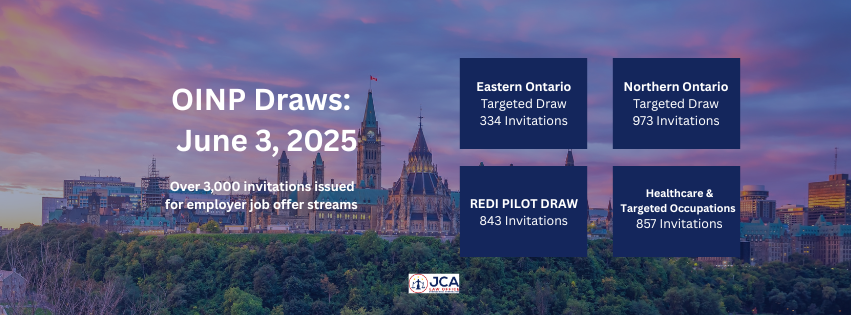
    Ontario issued over 3,000 targeted invitations to apply (ITAs) under various streams of the Employer Job Offer category. These draws aim to support regional economic development, fill labour shortages, and prioritize key sectors like healthcare.

    Key Highlights of the June 3, 2025 Draws

    1. Eastern Ontario Targeted Draw – 334 Invitations

    Ontario invited candidates with job offers in Eastern Ontario regions such as Ottawa, Leeds and Grenville, Lanark, Frontenac, Peterborough, Hastings, Stormont, Dundas and Glengarry, Renfrew, Kawartha Lakes, Northumberland, Prescott and Russell, Lennox and Addington, Prince Edward. Eligible candidates included those under the:

    • Foreign Worker Stream

    • International Student Stream

    • In-Demand Skills Stream

    Candidates must also be residing in Canada and holding a Bachelor’s degree or higher

    2. Northern Ontario Targeted Draw – 973 Invitations

    A large round of invitations targeted candidates working or holding job offers in Northern Ontario, including areas like Muskoka Haliburton, Nipissing, Parry Sound, Manitoulin, Sudbury, Greater Sudbury/Grand Sudbury, Timiskaming, Cochrane, Algoma, Thunder Bay Rainy River and Kenora. The same three streams applied.

    Candidates should also have a Bachelor’s degree or higher, and must reside in Canada.

     3. REDI Pilot Draw – 843 Invitations

    Candidates qualifying under the Regional Economic Development through Immigration (REDI) initiative received invitations under the Employer Job Offer streams. This pilot supports smaller communities in attracting and retaining skilled workers.

    Eligibility: Candidates living in Canada with job offers in REDI-participating communities

    4. Healthcare Occupations Draw – Targeted NOC Codes

    A separate draw invited candidates working in priority healthcare occupations such as:

    NOC Code Occupation
    31101 Specialists in surgery
    31102 General practitioners and family physicians
    31300 Nursing co-ordinators and supervisors
    31301 Registered nurses and registered psychiatric nurses
    31302 Nurse practitioners
    31303 Physician assistants, midwives and allied health professionals
    32101 Licensed practical nurses
    33102 Nurse aides, orderlies and patient service associates
    44101 Home support workers, housekeepers and related occupations

    Cut-off Scores:

    • Foreign Worker/International Student Stream: 68+

    • In-Demand Skills Stream: 34+

    5. Targeted Occupation: Career Development Practitioners – NOC 41321

    Ontario issued invitations to applicants with job offers in NOC 41321 – Career Development Practitioners and Career Counsellors. Only those with scores of 45 and above received invitations.


    Important Reminder for All Streams

    Since April 10, 2024, applicants must submit the updated “Application for Approval of Employment Position (Employer Form)”. Using the outdated version will result in a returned application and a refund of fees.

    How to Apply If You Were Invited

    1. Log in to the OINP e-Filing Portal

    2. Access your newly assigned application file number (starts with JOXX)

    3. Review your stream-specific requirements and document checklist

    4. Submit your complete application before the deadline

    Note: You do not need to contact the OINP if you received an invitation.


    Why This Matters

    Ontario’s Employer Job Offer streams remain a critical pathway to permanent residency for skilled workers and international graduates already in Canada. With targeted draws focusing on regional needs, labour market shortages, and high-demand occupations such as healthcare and skilled trades, applicants who meet the criteria have a strong chance of securing a Provincial Nomination. This nomination adds 600 points to their Express Entry profile, significantly boosting their chances for an Invitation to Apply, or leads to a base stream nomination for direct PR application through the Ontario Immigrant Nominee Program.


    Need Help Navigating the OINP?

    At JCA Law, we guide Filipinos in Canada through every step of the Ontario Immigrant Nominee Program (OINP), especially the Employer Job Offer streams. Whether you’re applying as a foreign worker, international student, or in-demand skilled worker, we help you understand your options, prepare a strong application, and avoid costly mistakes. If you received an invitation to apply in the latest OINP draw or want to check if you’re eligible, we’re here to support you.

    Message us today if you received an invitation or want to check if you’re eligible.

    Email: immigration@jcalaw.ca
    Call: +1 855 522 5290
    Facebook: https://www.facebook.com/JCALawOffice

    Reference:

    https://www.ontario.ca/page/2025-ontario-immigrant-nominee-program-updates


  • Expiring Work Permit? Here’s what you can do

    expiring work permit

    If your Canadian work permit is expiring soon, you may be wondering what to do next. For many foreign workers, including Filipinos, this situation can feel overwhelming. Fortunately, there are still legal pathways and practical solutions available. 

    Why This Issue Matters Right Now

    In recent months, Canada has introduced significant changes to its immigration policies. These updates have tightened eligibility and reduced access to common pathways for foreign workers. Stricter approvals for Labour Market Impact Assessments (LMIAs) have made it harder for employers to support foreign hires. At the same time, eligibility for Post-Graduation Work Permits (PGWPs) has been reduced, particularly for students graduating from private colleges. Additionally, fewer invitations to apply for permanent residency are being issued through Express Entry, and the Provincial Nominee Program (PNP) allocations have been lowered in several provinces. Because of these policy shifts, many workers are now facing expiring permits with fewer backup options. But the good news is, you’re not out of choices yet.

    Common Scenarios Workers Face

    Many individuals find themselves in one of the following situations:

    • A closed work permit is expiring, and the employer did not or were not able to renew their LMIA 
    • A PGWP is ending, and the worker hasn’t yet received an Invitation to Apply (ITA) for PR 
    • A PR application is still pending, but the current permit is about to expire 
    • The worker has already lost their status and isn’t sure how to regain it 

    These are common, and they each come with specific options and timelines to consider.

    Your Five Main Options

    1. Apply for a Work Permit Extension
      If you receive a new job offer from an employer with an approved LMIA, you can apply for a work permit extension. You can also extend your status if you’re eligible for an open work permit—for example, as the spouse of a PR applicant or international student. If you apply before your permit expires, you may benefit from implied status, which allows you to stay and continue working while your application is processed.
    2. Switch to a Different Status
      If an extension isn’t possible, you can apply to change your status to a visitor. This won’t allow you to work, but it will help you stay in Canada legally while you consider your next step. Another option is to apply for a study permit, particularly if you plan to pursue a program that could lead to permanent residency later.
    3. Apply for Permanent Residency
      Even with an expiring permit, you may qualify for PR through:
    • Express Entry (especially if you have Canadian work experience) 
    • Provincial Nominee Programs (PNPs) 
    • Francophone mobility streams for French-speaking applicants 
    • Immigration Pilot Programs (For caregivers, Construction Workers, etc)

    Each program has its own criteria for language, education, and job experience. It’s important to review them carefully and see which ones apply to you.

    1. Restore Your Status
      If your work permit expired less than 90 days ago, you can apply to restore your status as a worker, student, or visitor. However, while waiting for approval, you won’t be allowed to work. You must submit a complete application with the right documents, including proof that you qualify for the new status you’re requesting.
    2. Leave and Reapply from Outside Canada
      In some cases, the best option is to leave Canada and reapply from abroad. This may apply if you’re beyond the 90-day restoration period or if no in-Canada pathways are currently available to you. Reapplying from outside Canada can offer a fresh start, but it also comes with delays and no guarantee of approval.

    Special Programs That May Help

    Aside from the main pathways, several special programs may help certain applicants:

    • Francophone Mobility Program – Offers LMIA-exempt open work permits for French-speaking applicants working outside Quebec. To qualify, you have to have NCLC Level 5 for speaking and listening.  
    • Out-of-Status Caregiver Stream (HCWIP) – Available to caregivers who entered Canada on or before December 16, 2021. This stream opened and closed on March 31 2025. It’s important to wait for updates for this program and maybe there’s a chance to apply again.  
    • Out-of-Status Construction Workers – The IRCC has announced that it intends to introduce measures to support Canada’s construction industry and that includes a regularization pathway for out-of-status construction workers, and support for foreign apprentices. Be sure to watch out for news on this pathway.   

    Canada occasionally introduces new public policies in response to labour shortages or humanitarian needs. Staying informed can open unexpected doors.

    With this, if your work permit is expiring, do not panic, but don’t delay either. You have options, but most of them depend on timing, preparation, and documentation.

    Be sure to track your expiration date. Explore your eligibility for other programs. Keep your documents up to date. And when in doubt, seek guidance from reliable sources or licensed professionals.

    By taking action early, you can protect your future in Canada and continue building the life you’ve started.

    For assistance on your permit or to book a consultation, reach out to JCA LAW—your trusted Filipino legal experts in Canada.


    Contact us for a consultation

    Visit our website to learn more

    Email us at immigration@jcalaw.ca for more details

  • IRCC Announces Major Change to Express Entry: No More CRS Points for Job Offers

    IRCC Announces Major Change to Express Entry: No More CRS Points for Job Offers

    Effective today, March 25, 2025, job offers will no longer contribute additional Comprehensive Ranking System (CRS) points to candidates in the Express Entry pool — a change expected to reshape how applicants plan their path to permanent residency. This change follows IRCC’s December 23, 2024 announcement aimed at curbing fraud related to job offers and LMIAs.

    The measure specifically targets the misuse of Labour Market Impact Assessments (LMIAs) and arranged employment offers, which have increasingly been subject to fraudulent practices. By removing the incentive to purchase fake or unverifiable job offers, IRCC aims to uphold the integrity of the immigration process and ensure that only legitimate candidates are rewarded.

    The policy will affect:

    • Current Express Entry candidates with valid job offers: Points associated with their arranged employment will be deducted from their CRS score starting March 25. The update may take a few days to reflect in the profile.
    • Future applicants: As of the effective date, new profiles will no longer receive CRS points for job offers.
    • Candidates without qualifying job offers: No additional points will be awarded moving forward.

    However, applicants with an active Invitation To Apply or ITA that has not expired or been declined will not be affected by the change. Their invitation remains valid for that specific round.

    Job Offers Still Matter

    While job offers will no longer affect CRS scores, they remain relevant for other federal and provincial immigration programs. IRCC clarified that arranged employment will still play a role in:

    • The Federal Skilled Worker Program (as part of its selection grid),
    • The Federal Skilled Trades Program, and
    • Provincial Nominee Programs (PNPs), where a valid job offer can be a key criterion for eligibility or selection.

    Express Entry profiles should still include any valid job offer details to maintain eligibility for these streams.

    For many Filipinos in Canada, particularly temporary foreign workers and international students hoping to transition to permanent residency, this represents a paradigm shift. With job offers becoming a less influential factor, candidates must now invest more effort in improving their core profile.

    While this update may seem discouraging to some, it ultimately aims to protect the integrity of Canada’s immigration system. Fraudulent practices involving job offers not only undermine fairness but also put genuine applicants at risk.

    For more information on Canadian immigration programs or to book a consultation, reach out to JCA LAW—your trusted Filipino legal experts in Canada!

    Contact us for a consultation
    Visit our website to learn more

    Email us at immigration@jcalaw.ca for more details

    Source:
    IRCC

    Note: Immigration policies and procedures are subject to change. It’s advisable to consult the official IRCC website or seek professional advice for the most current information.


  • Canada to Accept 10,000 Applications Under 2025 Parents and Grandparents Sponsorship Program

    Canada to Accept 10,000 Applications Under 2025 Parents and Grandparents Sponsorship Program

    Ottawa, March 7, 2025 – Immigration, Refugees and Citizenship Canada (IRCC) has announced it will accept up to 10,000 sponsorship applications under the 2025 Parents and Grandparents Program (PGP). Invitations to apply will be issued to potential sponsors from the 2020 pool, following the same approach used since 2020. Processing times are approximately 24 months for most applications, but 48 months for those destined for Quebec.

    The PGP allows Canadian citizens and permanent residents to sponsor their parents and grandparents for permanent residency, facilitating family reunification. Since its inception, the program has faced high demand, often exceeding available spots, prompting the use of a lottery-style system to invite applicants. The program aims to strengthen family ties and provide stability for sponsored parents and grandparents in Canada.

    In recent years, IRCC has increased focus on improving processing times and transparency in the PGP. The inclusion of the Super Visa option, which allows parents and grandparents to visit their families for five years at a time, with multiple entries for up to 10 years, has provided families with more flexibility while waiting for sponsorship approval. To qualify, applicants must have health insurance and meet certain income requirements. Just recently, the IRCC has announced changes to the health insurance requirement to make it more accessible.

    The 2025 PGP reflects the Canadian government’s efforts to balance the need for family reunification with the realities of immigration system capacity. While demand for the program remains high, the availability of the Super Visa provides an alternative for families seeking to stay connected while waiting for sponsorship approval. The government plans to monitor processing times and adjust future intake limits based on demand and system capacity.

    Source:

    IRCC

  • Canada Announces New PR Pathway for Construction Workers

    Construction WorkerCanada is opening new permanent residency (PR) pathways for construction workers, a move aimed at tackling labor shortages and supporting the country’s growing housing needs. The initiative, announced by Immigration, Refugees and Citizenship Canada (IRCC), includes a significant provision: out-of-status construction workers may also be eligible to apply.
    Many out-of-status construction workers have been living and working in Canada for years, helping to build much-needed housing. Under this new pathway, they will now have the opportunity to regularize their status and stay in the country legally. According to the statement released by the IRCC, “These undocumented migrants are already living and working in Canada, and are contributing to the sector, and this pathway will keep them here legally so that they can continue to build the homes our economy and communities need with the proper protections.”

    In addition to supporting out-of-status workers, the government is also making it easier for foreign apprentices to complete their training in Canada. In the same news release, the IRCC stated, “to support foreign apprentices in construction programs and to address the current labour market needs in the construction sector, we are also introducing a temporary measure to allow foreign apprentices to complete their studies without a study permit, effective today. By removing this administrative barrier, apprentices will be able to gain the valuable skills they need to contribute to infrastructure projects more quickly.”

    The new immigration measures reflect Canada’s urgent need for skilled labor to meet the country’s growing housing demands. In addition to these new pathways, the government will form an advisory council with officials, industry employers, and union representatives to ensure fair wages and better protections for workers in the construction sector.

    How to Apply?

    More details on eligibility and the application process will be released soon. Construction workers and apprentices seeking legal guidance are encouraged to seek professional assistance.

    Contact us for a consultation
    Visit our website to learn more

    Email us at immigration@jcalaw.ca for more details

  • IRCC announces major updates on the Express Entry Category-Based Draws

    Express Entry UpdatesThe Immigration, Refugees and Citizenship Canada (IRCC) has recently announced significant updates to the Express Entry category-based selection, a move that will impact thousands of skilled workers, including Filipinos in Canada. These changes aim to align Canada’s immigration system with current labor market demands. The most significant updates include:



    • Education professionals are now prioritized – More teaching and support roles added.
    • Healthcare occupations expanded – Additional medical and social service jobs included.
    • Trades category grows – More construction, skilled trades, and food service jobs now eligible.
    • Transport category removed – No more priority for truck drivers and related jobs.
    • STEM occupations cut back – Nineteen occupations removed, leaving a smaller list.
    📘 Comprehensive Guide: For a complete overview of all Canadian immigration pathways for Filipinos, including Express Entry, PNP, Family Sponsorship, and more, read our Filipino Immigrant Guide to Canada – From Visa to PR (2026).

    For Filipinos in Canada, these updates present new opportunities and challenges. To qualify for an Express Entry category-based draw, candidates must meet the following requirements:

    • You must have at least 6 months of full-time, continuous work experience (or an equal amount of part-time work) within the last 3 years.
    • Your work experience must be in one occupation from the list of eligible NOC codes below.
    • Your experience can be gained in Canada or abroad.

    If you meet these requirements, and your job falls under one of the priority categories, you may have a higher chance of receiving an Invitation to Apply (ITA) for permanent residency under the category-based Express Entry draws.

    Education Category Added – More Opportunities for Filipino Teachers and Assistants

    For the first time, education professionals have been added to Express Entry’s category-based draws. This means teachers, assistants, and special education instructors now have a higher chance of being invited for permanent residency.

    Who Qualifies?

    The following National Occupational Classification (NOC) codes are now eligible:

    Job Title NOC Code TEER Level
    Elementary and secondary school teacher assistants 43100 3
    Instructors of persons with disabilities 42203 2
    Early childhood educators and assistants 42202 2
    Elementary school and kindergarten teachers 41221 1
    Secondary school teachers 41220 1


    Many Filipinos work as early childhood educators and teacher assistants across Canada. If you are already in this field or planning to apply, now is a great time to update your Express Entry profile and ensure you meet the requirements.

    Healthcare Category Expanded – More Jobs for Medical and Social Services Workers

    Canada continues to prioritize healthcare occupations, adding more roles to Express Entry. Below is the full list of eligible healthcare jobs under the category-based draws for 2025.

    Full List of Healthcare Jobs Eligible for Express Entry (2025):

    Job Title NOC Code TEER Level
    Animal health technologists and veterinary technicians 32104 2
    Audiologists and speech language pathologists 31112 1
    Cardiology technologists and electrophysiological techs 32123 2
    Chiropractors 31201 1
    Dental hygienists and dental therapists 32111 2
    Dentists 31110 1
    Dieticians and nutritionists 31121 1
    General practitioners and family physicians 31102 1
    Licensed practical nurses 32101 2
    Massage therapists 32201 2
    Medical laboratory assistants and related techs 33101 3
    Medical laboratory technologists 32120 2
    Medical radiation technologists 32121 2
    Medical sonographers 32122 2
    Nurse aides, orderlies, and patient service associates 33102 3
    Nurse practitioners 31302 1
    Nursing coordinators and supervisors 31300 1
    Occupational therapists 31203 1
    Optometrists 31111 1
    Other medical technologists and technicians 32129 2
    Other professional occupations in health diagnosing & treating 31209 1
    Other technical occupations in therapy and assessment 32109 2
    Paramedical occupations 32102 2
    Pharmacists 31120 1
    Pharmacy technical assistants and pharmacy assistants 33103 3
    Pharmacy technicians 32124 2
    Physician assistants, midwives, and allied health pros 31303 1
    Physiotherapists 31202 1
    Psychologists 31200 1
    Registered nurses and registered psychiatric nurses 31301 1
    Respiratory therapists, clinical perfusionists & cardiopulmonary technologists 32103 2
    Social and community service workers 42201 2
    Social workers 41300 1
    Specialists in clinical and laboratory medicine 31100 1
    Specialists in surgery 31101 1
    Therapists in counseling & specialized therapies 41301 1
    Veterinarians 31103 1

    Trades Category Expanded – Cooks and More Jobs Added

    Canada has expanded its trades category, adding cooks and other skilled workers to support infrastructure and food service demands.

    Full List of Eligible Trades in Express Entry (2025):

    Here is the table for the eligible occupations with their 2021 NOC codes and TEER categories:

    Occupation 2021 NOC Code 2021 TEER Category
    Contractors and supervisors, oil and gas drilling and services 82021 2
    Floor covering installers 73113 3
    Painters and decorators (except interior decorators) 73112 3
    Roofers and shinglers 73110 3
    Concrete finishers 73100 3
    Other technical trades and related occupations 72999 2
    Water well drillers 72501 2
    Electrical mechanics 72422 2
    Heating, refrigeration, and air conditioning mechanics 72402 2
    Heavy-duty equipment mechanics 72401 2
    Construction millwrights and industrial mechanics 72400 2
    Bricklayers 72320 2
    Cabinetmakers 72311 2
    Carpenters 72310 2
    Gas fitters 72302 2
    Plumbers 72300 2
    Industrial electricians 72201 2
    Electricians (except industrial and power system) 72200 2
    Welders and related machine operators 72106 2
    Sheet metal workers 72102 2
    Machinists and machining and tooling inspectors 72100 2
    Home building and renovation managers 70011 0
    Construction managers 70010 0
    Cooks 63200 3
    Construction estimators 22303 2


    Transport Category Removed – What This Means for Workers

    The transport category has been completely removed from Express Entry. Truck drivers and other transport workers will no longer receive priority.

    Alternative Pathways:

    • Check Provincial Nominee Programs (PNPs) (e.g., Manitoba and Saskatchewan still prioritize transport workers).
    • Look for employer-sponsored PR options.
    • Increase CRS score to compete in the general Express Entry pool.

    STEM Category Reduced – Fewer Opportunities for Tech and Engineering Jobs

    Canada has removed 19 STEM (Science, Technology, Engineering, and Math) occupations from Express Entry. Below is the remaining list of STEM jobs still eligible.

    Remaining STEM Occupations in Express Entry (2025):

    Job Title NOC Code TEER Level
    Architecture and science managers 20011 0
    Civil engineering technologists and technicians 22300 2
    Civil Engineers 21300 1
    Cybersecurity specialists 21220 1
    Electrical and electronics engineering technologists and technicians 22310 2
    Electrical and electronics engineers 21310 1
    Geological Engineers 21331 1
    Industrial and manufacturing engineers 21321 1
    Insurance agents and brokers 63100 3
    Mechanical engineering technologists and technicians 22301 2
    Mechanical Engineers 21301 1

    What to Prepare If You Are in a Newly Added NOC Code

    • Update your Express Entry profile with your correct NOC code.
    • Prepare work experience letters, education credentials, and language test results.
      .

    Need Help? JCA LAW Can Assist You!

    Book a consultation with JCA LAW today! Canada’s immigration system is changing fast—don’t miss your opportunity for PR.


    Sources:

    IRCC

  • IRCC Announces Key Updates to Home Care Worker Immigration Pilots

    Home Care Worker Immigration Pilot
    Home Care Worker Immigration Pilot

    Ottawa, Canada – Immigration, Refugees and Citizenship Canada (IRCC) has released significant updates to the Home Care Worker Immigration Pilot Programs, including new eligibility requirements and a revised processing timeline. 

    Two Streams Introduced

    IRCC has confirmed that the pilot program will now be divided into two separate streams:

    1. Workers in Canada Stream – This stream will officially start processing applications on March 31, 2025 and is designed for those already working in Canada.
    2. Applicants Not Working in Canada Stream – This stream is set to open in the coming months for applicants outside Canada or those not currently employed in the country.

    New Eligibility Criteria: No Canadian Work Experience Required

    One of the most significant changes in the program is the removal of the previous requirement for Canadian work experience in a caregiving occupation. Instead, applicants must meet the following:

    • A full-time job offer in home care within Canada, and 
    • Recent and relevant work experience, or Completion of at least six months of home care-related training

    Where Can Home Care Workers Be Employed?

    Under the new guidelines, home care workers can be employed in various settings, including:

    • Private households
    • Home health care service providers
    • Home care support service providers
    • Direct care agencies
    • Pediatric home health care service providers
    • Personal care services in residential settings

    However, recruitment or placement agencies will not be eligible to provide job offers under this program.

    Important Requirements for Caregivers Currently in Canada

    If you are already working in Canada and plan to apply under the Workers in Canada Stream, make sure to have the following documents ready:

    • Language test – Minimum CLB 4 (Canadian Language Benchmark)
    • Educational Credential Assessment (ECA) – Minimum of high school equivalent to Canadian standards

    What’s Next?

    These changes mark a significant shift in how caregivers can qualify for permanent residency, making the program more accessible to those with relevant training and experience. With the Workers in Canada Stream opening on March 31, 2025, eligible applicants are encouraged to prepare their documents early to ensure a smooth application process.

    For expert assistance with your application, JCA LAW is ready to help caregivers navigate these updates and secure their pathway to permanent residency.

    Contact us for a consultation
    Visit our website to learn more

    Email us at immigration@jcalaw.ca for more details


  • Express Entry’s French Proficiency Category: What It Is and How to Qualify

    This Guide Has Moved

    We’ve published a more comprehensive, updated version of this guide.

    Read the Updated French Express Entry Guide

    You will be redirected automatically.

  • 7 Common Reasons for Visa Refusal & How to Avoid Them

    Reasons for Visa Refusal
    Reasons for Visa Refusal

    Applying for a Canadian visa is exciting, but the risk of visa refusal can make the process stressful. Many refusals happen because of common mistakes that could have been avoided with better preparation. To improve your chances of approval, it’s important to understand why visa refusals happen and how to strengthen your application. Here are some of the most common reasons visas get denied, and how to avoid them:

    1. Insufficient Proof of Ties to Your Home Country

    Visa officers want to be sure that you intend to return home after your stay in Canada. If they are not convinced, your application may be refused.

    How to Strengthen Your Application:

    • Submit proof of employment, such as a letter from your employer confirming your leave and expected return.
    • Provide property documents, business ownership records, or family ties that show strong reasons for returning home.
    • If you are a student, include enrollment documents and a letter from your school confirming your academic status.

    2. Lack of Adequate Financial Proof

    You must prove that you have enough money to support yourself and any dependents while in Canada. If your financial documents don’t demonstrate this, your application may be denied.

    How to Strengthen Your Application:

    • Provide bank statements showing a stable and sufficient balance for at least the last 4-6 months.
    • If someone is sponsoring you, include a notarized letter of financial support along with their financial records.
    • Ensure all financial documents are clear, official, and verifiable.

    3. Unclear Purpose of Visit

    Your reason for traveling to Canada must be clear and well-documented. A vague or inconsistent purpose can lead to refusal.

    How to Strengthen Your Application:

    • Submit a well-structured itinerary outlining your travel dates, activities, and accommodations.
    • If visiting family, include an invitation letter detailing your host’s status in Canada and their willingness to accommodate you.
    • Study permit applicants should write a clear Statement of Purpose (SOP) explaining how their chosen program aligns with their career goals.

    4. Incomplete Documents

    Failure to provide all required documents can result in immediate refusal.

    How to Strengthen Your Application:

    • Carefully review the official IRCC checklist for your visa type.
    • Ensure documents are complete, properly formatted, and translated into English or French if necessary.
    • Include any additional supporting documents that reinforce your case.

    5. Misrepresentation or Inconsistent Information

    Providing false or misleading details, even unintentionally, can lead to a refusal or even a five-year ban from applying for a Canadian visa.

    How to Strengthen Your Application:

    • Double-check that all information is accurate and consistent across documents.
    • If you made an error in a previous application, explain it in a cover letter and provide supporting documents.
    • Never submit fake or altered documents.

    6. Criminal Inadmissibility

    Having a criminal record, even for minor offenses, can make you ineligible for a Canadian visa.

    How to Strengthen Your Application:

    • If applicable, apply for criminal rehabilitation before submitting your visa application.
    • For minor offenses, consider applying for a Temporary Resident Permit (TRP) if you have a valid reason to visit Canada.

    7. What to Do If Your Visa Is Refused?

    If your application gets denied, don’t lose hope. You have options:

    1. Request GCMS Notes – This document provides a detailed explanation of why your visa was refused.
    2. Review the Refusal Letter – Carefully go through the officer’s concerns and determine what needs improvement.
    3. Improve Your Application – Address the reasons for refusal by strengthening your documents.
    4. Consider Reapplying or Appealing – Depending on the reason, you can submit a stronger reapplication or seek legal advice for an appeal.

    A visa refusal does not mean the end of your plans to visit or move to Canada. By understanding common pitfalls and preparing a thorough application, you can improve your chances of approval. Always refer to the official IRCC website for the most accurate and updated visa guidelines.

    For more information, visit the official IRCC website for details on visa applications and refusal reasons.

    Need expert guidance on your visa application? JCA LAW is here to help!

    Contact us for a consultation
    Visit our website to learn more

    Email us at immigration@jcalaw.ca for more details


    Sources:
    https://www.canada.ca/en/immigration-refugees-citizenship/corporate/publications-manuals/operational-bulletins-manuals/temporary-residents/visitors/refusals-overview.html


  • Filipinos in Canada: Why You Need a Will (and How to Get One at a Discount!)

    Will in Canada for Filipinos

    For many Filipinos, writing a Last Will and Testament isn’t something we usually think about. Back home, families often assume that when a loved one passes away, everything will naturally go to their spouse or children. But in Canada, the laws work differently—if you don’t have a will, the government decides who gets your assets, and the process can be long, costly, and stressful for your family.

    That’s why having a will is essential. And to make it easier and more affordable, JCA Law is offering exclusive promo rates for Filipinos in Canada to get their wills done the right way.

    What Happens If You Die Without a Will?

    Dying without a will is called dying intestate, and when this happens, your assets are distributed according to provincial intestacy laws, not necessarily according to your wishes. Here’s what that could mean for your loved ones:

    Your spouse and kids may not receive what you intended.

    Under Ontario’s Succession Law Reform Act (SLRA) and similar laws in other provinces, if you pass away without a will and have a spouse and children, your estate is divided based on a set formula—not necessarily in the way you would have wanted. Your spouse may only receive a portion of your estate, while the rest is divided among your children.

    This could create financial difficulties for your surviving spouse, especially if they were depending on your full estate.

    Common-law partners may not inherit anything at all.

    Unlike in the Philippines, where informal partnerships may still be recognized by families, Canada does not automatically recognize common-law spouses for inheritance purposes.

    If you are not legally married and die without a will, your common-law partner may receive nothing—even if you’ve been together for years. They may have to go to court to claim dependent support, which is expensive and stressful.

    Minor children’s inheritance could be controlled by the government.

    If you have minor children, their share of your estate will likely be placed under government control until they reach the age of majority (18 or 19, depending on the province). This means your spouse or relatives won’t have direct access to the funds unless they apply through a legal process.

    By having a will, you can set up a trusted guardian and trustee to manage your children’s inheritance.

    Your family may have to go through a long, costly legal process.

    Without a will, your estate will have to go through the court process of estate administration. This can be:

    • Time-consuming – It can take months or even years to finalize.
    • Expensive – Legal fees, court costs, and administrative expenses add up.
    • Emotionally draining – Family disputes over inheritance can arise, especially if there are disagreements about who should receive what.

    The best way to avoid these problems is to have a legally binding will in place.

    JCA Law’s Wills Promo – Exclusive Discounts for Filipinos

    We know that legal fees can be overwhelming, but we want to make sure every Filipino in Canada has the chance to protect their loved ones. That’s why JCA Law offers special promo rates every 2nd Friday of the month.

    Individual Will Package – Wills Day Promo

    Promo Price: $449 (Regular Price: $599 – Save 25%)

    • Includes:
      • Consultation with our lawyer
      • Preparation of 3 essential legal documents:
        • Simple Last Will – Clearly states how your assets will be distributed.
        • Power of Attorney for Property – Appoints someone to manage your finances if you become incapacitated.
        • Power of Attorney for Personal Care – Allows someone to make healthcare decisions for you (includes a Health Directive).

    Couple Wills Package – Wills Day Promo

    Promo Price: $749 (Regular Price: $999 – Save 25%)

    • Both individuals get a full set of 3 legal documents each.

    Other Discounted Services

    • Simple Will Only – $399 (Regular Price: $499 – Save 20%)
    • Power of Attorney (Each POA) – $249 (Regular Price: $299)
    • Health Care Directive Only – $99

    Why Take Advantage of This Promo?

    • Save up to 25 percent compared to regular rates.
    • Get professional legal guidance from a Filipino lawyer who understands your concerns.
    • The process is hassle-free—our team will guide you every step of the way.
    • Secure your legacy and protect your family’s future.

    Don’t wait until it’s too late. Book your Wills Day appointment with JCA Law today.

    Book your appointment now by calling 1-855-522-5290 or email us at immigration@jcalaw.ca 

    Contact us for a consultation. Visit our website to learn more.

    Sources:

    Canada

    What to do when someone days – Ontario


  • Provincial Nominee Program (PNP) Under Express Entry: A Pathway to Canadian PR for Filipinos

    PNP Express Entry PR

    Canada remains a sought-after destination for skilled workers worldwide, including many Filipinos looking for better opportunities. One of the ways to get permanent residency in Canada is through the Provincial Nominee Program (PNP), integrated within the Express Entry system. This program empowers provinces and territories to nominate those who can significantly contribute to their local economies.

    📘 Complete Immigration Guide: PNP is just one of many pathways to Canadian PR. For a comprehensive overview of all immigration options for Filipinos, including Express Entry, Family Sponsorship, Caregiver Programs, and more, read our Filipino Immigrant Guide to Canada – From Visa to PR (2026).

    Understanding the Provincial Nominee Program (PNP)

    PNP allows Canadian provinces and territories to nominate individuals who:

    • Possess the skills, education, and work experience to bolster their economy.
    • Intend to reside in that particular province or territory.
    • Aspire to become permanent residents of Canada.

    Each province and territory has its own “streams” or immigration programs targeting specific groups. For example, certain streams may focus on:

    • Students
    • Business professionals
    • Skilled workers
    • Semi-skilled workers

    The Express Entry System

    Express Entry is an online system that manages applications for three federal economic immigration programs:

    1. Federal Skilled Worker Program (FSWP)
    2. Federal Skilled Trades Program (FSTP)
    3. Canadian Experience Class (CEC)

    Provinces and territories can nominate candidates through Express Entry by selecting individuals from the pool who meet their specific labor market needs.

    How Does the PNP Work with Express Entry?

    There are two primary pathways to apply:

    1. Express Entry Process

    Step 1: Check Your Eligibility. Ensure you qualify for both:

    • The PNP of the desired province or territory.
    • One of the three federal programs managed through Express Entry.

    Step 2: Obtain a Nomination

    • Direct Application. Contact the province or territory directly and apply for a nomination.
    • Express Entry Profile. Create an Express Entry profile and indicate your interest in specific provinces or territories. If a province or territory sends a “notification of interest” to your account, you can then apply for a nomination.

    Step 3: Update Your Profile. If nominated, update your Express Entry profile to reflect this. A provincial nomination adds 600 points to your Comprehensive Ranking System (CRS) score, significantly enhancing your chances of receiving an invitation to apply for permanent residence.

    Step 4: Apply for Permanent Residence. Upon receiving an invitation, submit your application for permanent residence online.

    2. Non-Express Entry Process

    Step 1: Check Your Eligibility. Confirm you meet the criteria for the PNP of your chosen province or territory.

    Step 2: Obtain a Nomination. Apply directly to the province or territory for a nomination.

    Step 3: Apply for Permanent Residence. After securing a nomination, apply for permanent residence through the non-Express Entry process.

    Choosing a Province or Territory

    Each province and territory (except Nunavut and Quebec) has its own PNP with specific streams and criteria. It’s essential to research and select the one that aligns with your qualifications and aspirations. Here are some provinces and their respective immigration websites:

    Benefits for Filipinos

    For Filipinos aiming to establish a life in Canada, the Provincial Nominee Program (PNP) offers several advantages. Many provinces have immigration streams tailored to specific skills and experiences that align with common Filipino professions, making it easier to qualify for nomination. Additionally, various provinces have thriving Filipino communities that could provide a supportive environment. Most importantly, securing a provincial nomination significantly boosts an applicant’s Comprehensive Ranking System (CRS) score, greatly increasing their chances of receiving an Invitation to Apply (ITA) for permanent residence through the Express Entry system.

    The Provincial Nominee Program, in conjunction with the Express Entry system, provides a viable pathway for Filipinos to achieve permanent residency in Canada. By understanding the processes and applying to the appropriate provincial immigration programs, you may have a better chance at PR.

    For personalized assistance and to navigate the complexities of the application process, consider reaching out to immigration professionals or legal experts familiar with Canadian immigration laws.

    Note: Immigration policies and procedures are subject to change. It’s advisable to consult the official IRCC website or seek professional advice for the most current information.

    Sources:

    https://www.canada.ca/en/immigration-refugees-citizenship/services/immigrate-canada/provincial-nominees.html

    https://www.canada.ca/en/immigration-refugees-citizenship/services/immigrate-canada/provincial-nominees/express-entry.html

    https://www.canada.ca/en/immigration-refugees-citizenship/services/immigrate-canada/provincial-nominees/non-express-entry.html


  • Canadian Experience Class (CEC): Your Pathway to PR in Canada

    Canada offers various immigration pathways for skilled workers, and one of the fastest and most accessible options is the Canadian Experience Class (CEC). This program is designed for individuals who have gained skilled work experience in Canada and wish to transition to permanent residency.

    What is the Canadian Experience Class (CEC)?

    The Canadian Experience Class is an immigration program under the Express Entry system. It allows skilled workers who have already gained professional work experience in Canada to apply for permanent residence. The program is ideal for temporary foreign workers and international graduates who have accumulated at least one year of work experience in Canada.

    Who is Eligible to Apply?

    To qualify for the Canadian Experience Class, applicants must meet the following criteria:

    1. Work Experience

    • Applicants must have at least one year of full-time (or equivalent part-time) skilled work experience in Canada within the last three years.
    • The work must be in one or more of these job categories under the National Occupational Classification (NOC):
      • TEER 0: Managerial jobs (e.g., project managers, marketing managers)
      • TEER 1: Professional jobs requiring a degree (e.g., engineers, accountants, doctors)
      • TEER 2 & 3: Skilled trades and technical jobs (e.g., electricians, chefs, IT specialists)
    • The work experience must have been gained legally while on a valid work permit.

    2. Language Proficiency

    • Applicants must meet the Canadian Language Benchmark (CLB) levels:
      • CLB 7 for NOC TEER 0 and TEER 1 jobs
      • CLB 5 for NOC TEER 2 and TEER 3 jobs
    • Accepted language tests include IELTS, CELPIP (for English), TEF, or TCF (for French).

    3. Residency Requirement

    • Applicants must plan to live outside Quebec, as Quebec has its own immigration programs.

    4. Education (Optional but Beneficial)

    • There is no education requirement for CEC. However, holding a Canadian degree, diploma, or an Educational Credential Assessment (ECA) for foreign education can improve the Comprehensive Ranking System (CRS) score in Express Entry.

    Benefits of the Canadian Experience Class

    • Applications are usually processed within six months under the Express Entry system, making it one of the fastest routes to permanent residency.
    • Unlike other Express Entry programs, CEC applicants do not need to provide proof of settlement funds.
    • Applicants with Canadian work experience receive higher CRS scores, increasing their chances of receiving an Invitation to Apply (ITA) for permanent residency.

    How to Apply for the Canadian Experience Class

    1. Check Your Eligibility. Ensure you meet the work experience, language, and residency requirements.
    2. Create an Express Entry Profile. Submit details about your work experience, education, and language test results.
    3. Receive an Invitation to Apply (ITA). If your CRS score is high enough, you will be invited to apply for permanent residence.
    4. Submit a Complete Application. Provide documents such as work reference letters, language test results, and medical and police clearances.
    5. Wait for Processing. Most applications are processed within six months.
    6. Receive Confirmation of Permanent Residence (COPR). If approved, you can transition to permanent resident status in Canada.

    How JCA Law Can Help

    If you are a Filipino in Canada with skilled work experience and are considering permanent residency, JCA Law can assist you in:

    • Evaluating your eligibility for the Canadian Experience Class
    • Preparing a strong Express Entry profile
    • Ensuring your application is complete and error-free
    • Guiding you through the next steps after receiving permanent residence

    Applying for permanent residency can be complex, but with expert legal guidance, you can avoid mistakes and maximize your chances of success.

    The Canadian Experience Class is one of the best pathways to permanent residency for skilled workers already in Canada. If you meet the requirements, applying through Express Entry can be your ticket to building a future in Canada.

    Need help with your immigration application? Contact JCA Law today for expert assistance!

    Sources:
    IRCC

  • Home Care Worker Immigration Pilots Set to Launch on March 31, 2025

    home care immigration pilot programCanada continues to recognize the important role that home care workers or caregivers play in supporting families, seniors, and individuals with disabilities. In line with this, Immigration, Refugees and Citizenship Canada (IRCC) has announced two new Home Care Worker Immigration Pilots, which will officially open on March 31, 2025. These pilot programs are set to replace the previous programs for caregivers which already closed.


    📘 Complete Immigration Guide: The caregiver pathway is one of several routes to Canadian PR. For a complete overview of all immigration options for Filipinos, including Express Entry, PNP, and Family Sponsorship, read our Filipino Immigrant Guide to Canada – From Visa to PR (2026).

    This new initiative aims to make it easier for home care workers to obtain permanent residence (PR) while addressing Canada’s growing demand for in-home caregiving services. Here’s what we know so far about the program and how it may benefit Filipino caregivers and their families in Canada.

    What Are the Home Care Worker Immigration Pilots?

    The Home Care Worker Immigration Pilots are designed to streamline the PR process for foreign caregivers seeking to work and settle in Canada. The new pilots will:

    • Offer permanent residency (PR) upon arrival to eligible caregivers, eliminating the need for them to first work under temporary status before applying for PR.
    • Provide a clearer and faster pathway for home care workers to immigrate.
    • Help address labor shortages in Canada’s home care sector, particularly for seniors and people with disabilities.

    Who Can Apply?

    While full details are expected closer to the launch date, eligible applicants will likely need to meet the following:

    • Work Experience: Relevant experience in caregiving, such as caring for children, the elderly, or individuals with disabilities.
    • Job Offer: A valid job offer from an eligible Canadian home care organization.
    • Language Requirement: Meet the minimum language proficiency in English or French.
    • Education: Completion of at least a high school diploma or equivalent.
    • Admissibility: Must pass standard medical, security, and background checks for Canadian immigration.

    These requirements are expected to be more flexible compared to previous programs, ensuring more caregivers can qualify.

    Next Steps

    Many Filipino caregivers are already working in Canada under temporary work permits, often facing uncertainty in securing PR due to employer dependency and changing immigration policies. With the March 31, 2025 launch approaching, here’s what caregivers and aspiring applicants should do:

    • Stay Updated – Follow IRCC announcements and consult licensed immigration professionals to ensure compliance with program requirements.
    • Prepare Documents Early – Those interested should start gathering required documents, including proof of work experience, education credentials, and language test results (IELTS/CELPIP).
    • Explore Job Opportunities – Look for job offers from authorized home care agencies in Canada.

    For more information on Canadian immigration programs or to book a consultation, reach out to JCA LAW—your trusted Filipino legal experts in Canada!

    Contact us for a consultation
    Visit our website to learn more

    Email us at info@filipinolawyer.ca for more details

    Sources:

    https://www.canada.ca/en/immigration-refugees-citizenship/news/2024/06/canada-announces-new-pilot-programs-to-support-caregivers-and-canadian-families.html

  • Canada Launches New Immigration Pilot Programs: RCIP and FCIP

    Canada Launches New Immigration Pilot Programs: RCIP and FCIP

    The Immigration, Refugees and Citizenship Canada (IRCC) has launched two new programs to help smaller communities attract skilled workers and French speakers. The Rural Community Immigration Pilot (RCIP) and the Francophone Community Immigration Pilot (FCIP) provide pathways to permanent residency (PR) for eligible individuals.

    What Are These New Immigration Programs?

    1. Rural Community Immigration Pilot (RCIP)

    This program connects skilled workers with rural communities in need of labor for essential jobs. If you have the right skills, you may qualify for permanent residency.

    Participating communities include:

    • Ontario: North Bay, Sudbury, Timmins, Sault Ste. Marie, Thunder Bay
    • Manitoba: Steinbach, Altona/Rhineland, Brandon
    • Saskatchewan: Moose Jaw
    • Alberta: Claresholm
    • British Columbia: West Kootenay, North Okanagan Shuswap, Peace Liard
    • Nova Scotia: Pictou County

    Eligibility Criteria for RCIP: To be eligible for the RCIP, applicants must have a valid job offer from an employer located in one of the participating communities. They must meet the minimum educational requirements, which typically include having at least a high school diploma. Additionally, candidates must demonstrate sufficient language proficiency in either English or French, at a level of CLB/NCLC 4 or higher. Financial stability is also necessary, as applicants must show they have enough funds to support themselves and their family if applicable. Lastly, they must have a genuine intention to reside in the community that extends the job offer.

    Job Offer Requirements for RCIP: The job offer under RCIP must be full-time, non-seasonal, and permanent. It must meet the wage standards set by the province where the community is located. Additionally, the employer providing the job offer must be approved by the local economic development organization in that community to ensure reliability and sustainability.

    2. Francophone Community Immigration Pilot (FCIP)

    The FCIP is designed for French-speaking immigrants who want to settle outside Quebec. If you speak French or are willing to improve your French skills, this program could be an excellent opportunity.

    Participating communities include:

    • New Brunswick: Acadian Peninsula
    • Ontario: Sudbury, Timmins, Superior East Region
    • Manitoba: St. Pierre Jolys
    • British Columbia: Kelowna

    Eligibility Criteria for FCIP: To be eligible for the FCIP, applicants must be French-speaking and demonstrate a minimum proficiency of CLB/NCLC 5 or higher. They must have a valid job offer from an employer in one of the participating communities and must intend to live in that community. In addition to language requirements, applicants must also meet educational and work experience qualifications as outlined by IRCC.

    Job Offer Requirements for FCIP: A qualifying job offer under FCIP must be full-time, non-seasonal, and permanent. The employer providing the job offer must be recognized by the local economic development organization to ensure compliance with program standards. These job offers are designed to support labor market needs in Francophone minority communities outside Quebec.

    How Do These Programs Work?

    For Interested Employers

    Employers in participating communities can support the RCIP and FCIP by hiring skilled workers to fill essential job vacancies. To participate, they must offer full-time, non-seasonal jobs with competitive wages that meet provincial standards. They must also work with their local economic development organization to obtain a designation, ensuring that job offers align with community labor needs and program requirements.

    Employer Training and Support

    To assist employers in the hiring process, the Government of Canada provides training and resources on recruitment, onboarding, and retention of skilled workers through RCIP and FCIP. Employers receive guidance on program requirements, compliance with labor standards, and best practices for integrating newcomers into their workforce. This training ensures that both employers and employees benefit from a smooth transition and long-term employment success. More details on training opportunities and employer support services will be provided by local economic development organizations in each participating community.

    Once designated, employers can actively recruit skilled workers to fill essential positions in their communities. This process includes submitting documentation to verify compliance with labor standards, confirming the job offer’s long-term nature, and demonstrating its contribution to local economic growth. By participating in RCIP and FCIP, employers help address labor shortages while providing newcomers with stable employment opportunities in Canada.

    Why Consider These Immigration Pathways?

    • Easier access to permanent residency: Designed to fill labor shortages, these programs may offer faster processing times.
    • Welcoming communities: Enjoy a lower cost of living and better work-life balance in smaller towns.
    • High-demand jobs: Opportunities in healthcare, construction, hospitality, and other sectors.
    • French language advantage: The Francophone pilot opens doors for French-speaking immigrants.

    JCA Law Can Assist You

    At JCA Law, we provide expert guidance for both skilled workers and employers interested in the RCIP and FCIP programs. For prospective applicants, we assist in assessing eligibility, gathering required documents, and ensuring a strong application for permanent residency.

    For employers, we offer support in understanding the designation process and meeting program requirements. We help businesses comply with immigration regulations while finding qualified employees who contribute to community growth. 

    Whether you are a worker looking for a new opportunity or an employer seeking to fill labor shortages, JCA Law is here to guide you every step of the way.

    Contact us for a consultation
    Visit our website to learn more

    Email us at info@filipinolawyer.ca for more details

    Explore your options today!

    Sources: 

  • Latest Express Entry Draw: Minimum CRS Score Set at 527

    January 23 2025 Express Entry
    January 23 2025 Express Entry

    On January 23, 2025, Immigration, Refugees and Citizenship Canada (IRCC) held the latest Canadian Experience Class (CEC) draw, inviting candidates with a Comprehensive Ranking System (CRS) score of 527 or higher to apply for permanent residency (PR) in Canada. A total of 4,000 Invitations to Apply (ITAs) were issued.

    The CEC program provides a pathway for skilled workers already in Canada who wish to transition to PR. To be eligible, applicants must have at least one year of skilled work experience in Canada within the last three years, gained under a valid work permit. They must also meet the required language proficiency levels in English or French and plan to live outside of Quebec. Unlike other Express Entry programs, the CEC does not require proof of settlement funds, making it an attractive option for those already working in Canada. 

    If you have Canadian work experience and meet the eligibility criteria, this could be your opportunity to secure permanent status in the country.

    At JCA Law, we help skilled workers navigate Express Entry applications, improve CRS scores, and provide immigration consultations. If you received an ITA or want to know your chances in future draws, contact us for guidance!

    Contact us for a consultation
    Visit our website to learn more

    Email us at info@filipinolawyer.ca for more details

    Don’t miss this opportunity—your pathway to Canadian PR starts now!