Home > Special Power of Attorney > SPA Validity, Expiration & Revocation
Philippine Legal Guide
SPA Validity, Expiration & Revocation Under Philippine Law
When does a Special Power of Attorney expire? How do you revoke one from Canada? This guide explains the seven ways an SPA terminates under the Philippine Civil Code — and what Filipino-Canadians need to know to protect their interests.
Introduction: Does a Philippine SPA Expire?
One of the most common questions Filipino-Canadians ask us at JCA Law Office is: “Does my SPA expire?” You may have executed a Special Power of Attorney years ago to authorize a relative to manage property in the Philippines, sell a vehicle, or settle an estate. Now you are wondering whether that document is still valid — or whether you need to execute a new one.
The short answer is that Philippine law does not impose a fixed expiration date on a Special Power of Attorney. Under the Civil Code of the Philippines, an SPA remains in effect until it is terminated by one of the specific grounds enumerated in Article 1919. However, the legal answer and the practical answer are not always the same. Banks, the Registry of Deeds, and the Bureau of Internal Revenue (BIR) often impose their own internal policies that effectively limit how old an SPA can be before they will accept it.
This guide explains everything you need to know about SPA validity, termination, revocation from Canada, and the practical considerations that affect whether your SPA will actually be accepted in the Philippines. We cover the seven legal grounds for termination, the step-by-step process for revoking an SPA from abroad, and best practices to protect yourself and your property.
Does a Philippine SPA Have an Expiration Date?
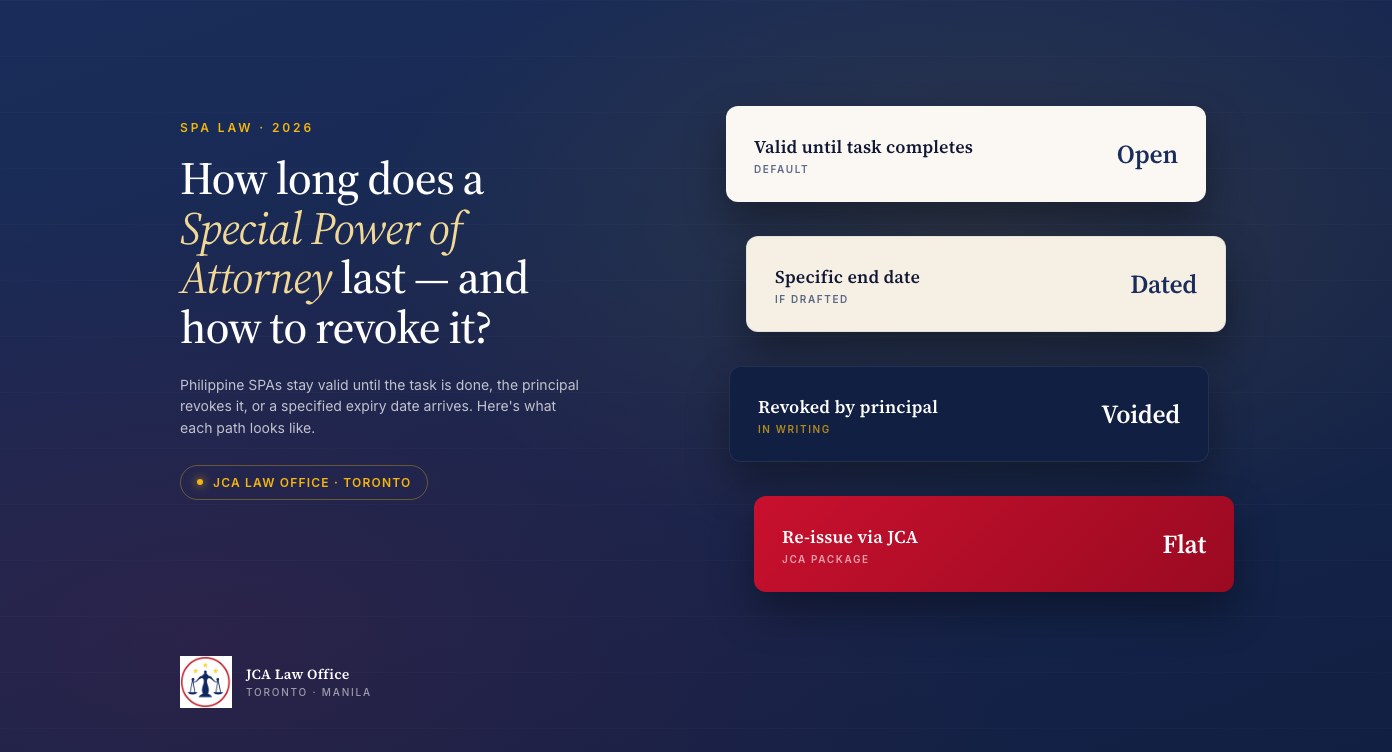
Under Article 1868 of the Civil Code of the Philippines, agency — the legal relationship created by an SPA — is a contract where one person (the principal) authorizes another (the agent or attorney-in-fact) to act on their behalf. The law does not prescribe a mandatory expiration period for this relationship. An SPA is valid for as long as the principal intends it to be, unless a specific duration is written into the document itself.
This means:
- If the SPA includes an expiration date (e.g., “valid for one year from execution”), it terminates automatically on that date under Article 1919(6).
- If the SPA does not state an expiration date, it remains legally effective until terminated by one of the other grounds under Article 1919.
- If the SPA is for a specific purpose (e.g., “to sell Lot No. 1234”), it terminates when that purpose is accomplished, even without an expiration date.
Practical Warning: Even though the law does not require an expiration date, many Philippine institutions have their own policies. Banks commonly require an SPA to be dated within the past one to two years. The Registry of Deeds and BIR may question SPAs that are more than 12 months old. If your SPA is several years old, you should verify with the specific institution before relying on it — or execute a fresh one.
7 Ways a Special Power of Attorney Terminates (Article 1919)
Article 1919 of the Civil Code enumerates the modes by which an agency — including an SPA — is extinguished. Understanding these grounds is essential for any Filipino-Canadian who has executed, or is about to execute, an SPA for use in the Philippines.
| # | Ground for Termination | Legal Basis | How It Works |
|---|---|---|---|
| 1 | Revocation by the principal | Art. 1919(1), Art. 1920 | The principal may revoke the SPA at any time, unless it is coupled with an interest or declared irrevocable for a valid reason. Revocation may be express (written notice) or implied (appointing a new agent for the same act). |
| 2 | Withdrawal of the agent | Art. 1919(2), Art. 1918 | The agent may renounce the agency by giving notice to the principal. If the renunciation is untimely or causes damage, the agent may be liable to the principal. |
| 3 | Death of the principal | Art. 1919(3) | The SPA is automatically extinguished upon the death of the principal. Acts performed by the agent after the principal’s death are generally void, subject to good-faith protections under Art. 1930-1931. |
| 4 | Death of the agent | Art. 1919(3) | If the attorney-in-fact dies, the agency is extinguished. The agent’s heirs must notify the principal and take measures to protect the principal’s interests in the interim. |
| 5 | Civil interdiction, insanity, or incapacity | Art. 1919(3) | If either the principal or the agent is declared civilly interdicted or becomes insane, the agency terminates. The person must lack legal capacity to maintain the relationship. |
| 6 | Insolvency of principal or agent | Art. 1919(3) | Insolvency of either party terminates the agency, as the insolvent person’s capacity to enter into legal acts is impaired. |
| 7 | Accomplishment of the purpose | Art. 1919(5) | When the specific task authorized by the SPA is completed — such as a property sale closing or an estate settlement being finalized — the SPA is automatically extinguished. |
Note that Article 1919 also includes a sixth ground: expiration of the period for which the agency was constituted. If the SPA states “valid until December 31, 2026,” it terminates on that date without any further action by either party.
Comprehensive Guide: For a complete overview of what an SPA is, when you need one, and how it works, read our Special Power of Attorney (SPA) for the Philippines hub page.
How to Revoke an SPA from Canada
Revocation is the most common way an SPA terminates. Under Article 1920, the principal may revoke the agency at will and compel the agent to return the document evidencing the agency. If you are a Filipino-Canadian who granted an SPA and now wants to revoke it — whether because the agent is no longer trusted, the purpose has changed, or you simply want to appoint someone else — here is the step-by-step process.
Step 1: Execute a Revocation Document
Prepare a formal document titled “Revocation of Special Power of Attorney.” The document should clearly identify the original SPA (date of execution, names of principal and agent, subject matter) and state unequivocally that the SPA is revoked and the agent’s authority is terminated effective immediately.
Step 2: Notarize in Canada
Have the revocation document notarized by a Canadian notary public (in Ontario, a notary public or a commissioner for taking affidavits). The document must bear the notary’s seal, signature, and commission details.
Step 3: Obtain an Apostille
Since the Philippines is a party to the Hague Apostille Convention, apostilled Canadian documents are accepted in the Philippines without further authentication. In Ontario, you can obtain an apostille through Global Affairs Canada. Alternatively, you may have the revocation document acknowledged at the Philippine Consulate General in Toronto, which is treated as if notarized in the Philippines.
Step 4: Send to the Philippines
Courier the authenticated revocation document to the Philippines. Send it to both your agent (the person whose authority is being revoked) and, if applicable, to any government agencies or private institutions that have a copy of the original SPA on file.
Step 5: Notify the Agent and Third Parties
This step is critical. Under Philippine law, a revocation is not effective against third parties who dealt with the agent in good faith and without knowledge of the revocation. You must give actual notice to:
- The agent (attorney-in-fact) — in writing
- Any banks, developers, or government agencies that relied on the original SPA
- The Registry of Deeds, if the SPA was annotated on a land title
Step 6: Register the Revocation (If Applicable)
If the original SPA was registered or annotated on a Transfer Certificate of Title (TCT) at the Registry of Deeds, you should register the revocation on the same title. This creates a public record that the agent no longer has authority over the property, protecting you against unauthorized transactions.
Important: Until third parties receive actual notice of the revocation, they may continue to rely on the SPA in good faith. If your agent enters into a transaction with a third party who has no knowledge of the revocation, that transaction may still be binding on you. Act promptly and document every notification.
What Happens When the Principal Dies?
Under Article 1919(3), the death of the principal automatically terminates the SPA. This is one of the most consequential — and most misunderstood — rules in Philippine agency law. It has several important implications for Filipino-Canadian families:
Automatic Termination
The moment the principal dies, the agent’s authority ceases — even if neither the agent nor third parties are aware of the death. There is no need for a formal revocation or court order. The agency is extinguished by operation of law.
Acts After Death Are Generally Void
Any act performed by the agent after the principal’s death is, as a general rule, void and without legal effect. If an agent sells property after the principal has died, the sale can be annulled. This is a common source of legal disputes in the Philippines, particularly when there is a delay in communicating the death to parties overseas.
Good-Faith Protection (Article 1930-1931)
The law provides limited protection for good-faith transactions. Under Article 1931, anything done by the agent without knowledge of the principal’s death is valid with respect to third persons who contracted with the agent in good faith. This means if the agent genuinely did not know the principal had died, and the third party (such as a buyer) also acted in good faith, the transaction may be upheld. However, this is a narrow exception and should not be relied upon as a planning strategy.
Practical Tip: If a Filipino-Canadian principal passes away and there are pending transactions in the Philippines that were being handled through an SPA, the heirs should immediately notify the agent and all relevant third parties of the death. Any remaining transactions will need to be handled through a new SPA executed by the heirs, or through estate settlement proceedings. See our guide on SPA in the Philippines: Requirements, Uses & Process.
Effect of Marriage and Separation on an SPA
A question we occasionally receive at JCA Law Office: “If I get divorced or separated, does my SPA automatically become void?”
The answer is no. Marriage, separation, annulment, or divorce does not automatically revoke an SPA under Philippine law. Article 1919 does not list changes in marital status as a ground for extinguishment of agency. If you previously granted an SPA to your spouse and you have since separated or divorced (in Canada), that SPA technically remains valid until you formally revoke it.
This is a critical point for Filipino-Canadians who may have executed an SPA in favour of a spouse before a relationship breakdown. If you no longer want your former spouse to act as your attorney-in-fact, you must take affirmative steps to revoke the SPA using the process described above. Do not assume that a Canadian divorce order automatically terminates a Philippine SPA — it does not.
Can Someone Challenge the Validity of an SPA?
Yes. An SPA can be challenged in court on several grounds. If a challenge succeeds, the SPA may be declared void or voidable, and all acts performed by the agent under it can be annulled. The most common grounds for challenging an SPA in the Philippines are:
1. Lack of Capacity
The principal must be at least 18 years old and of sound mind at the time of executing the SPA. An SPA signed by a minor or a person who was mentally incapacitated (e.g., suffering from dementia) is void or voidable. In cases involving elderly principals, the mental capacity of the principal at the time of signing is often contested by heirs or other interested parties.
2. Fraud, Undue Influence, or Intimidation
If the principal was tricked, pressured, or coerced into signing the SPA, it may be annulled. Fraud involves deliberate misrepresentation — for example, telling the principal the document is a simple authorization when it actually grants the power to sell real property. Undue influence occurs when a person in a position of trust or authority exploits that relationship to obtain the SPA.
3. Defective Notarization
An SPA that is not properly notarized — or that was notarized without the principal personally appearing before the notary public — is reduced from a public document to a mere private instrument. This strips the document of its presumption of regularity, meaning it can be more easily challenged in court. Common defects include the principal not being present during notarization, the use of a fake or expired notarial commission, or missing entries in the notary’s register.
4. Agent Exceeded Authority
Under Article 1878, certain acts — such as selling real property, mortgaging land, or making gifts — require a special power of attorney that specifically authorizes the act. If the agent performs an act that is not expressly covered by the SPA, the principal is not bound. For example, if the SPA authorizes the agent to “manage” a property but does not specifically authorize a sale, the agent cannot validly sell the property. Third parties who dealt with the agent bear the burden of verifying the scope of the SPA.
Best Practices for SPA Validity and Protection
Whether you are executing a new SPA or reviewing an existing one, the following best practices will help ensure your document remains legally effective and practically accepted in the Philippines.
| Best Practice | Why It Matters |
|---|---|
| Include a validity period — State an expiration date (e.g., “valid for two years from date of execution”) unless the SPA is for a one-time transaction. | Limits the window of exposure if the agent acts beyond your wishes. Reduces pushback from institutions that distrust undated SPAs. |
| Be specific about the powers granted — Enumerate each authorized act explicitly (sell, mortgage, lease, file taxes, etc.). | Article 1878 requires a special power for acts of strict dominion. Vague language like “do all acts” is rejected by banks, the BIR, and the Registry of Deeds. |
| Identify the property or transaction — Include the Transfer Certificate of Title (TCT) number, lot number, location, and any relevant case or account numbers. | The Registry of Deeds will not process a transfer if the SPA does not specifically identify the property. Banks require account numbers or branch details. |
| Execute the SPA close to the transaction date — Do not execute an SPA years in advance unless necessary. | Many Philippine institutions prefer SPAs dated within the last 12 months. A freshly executed SPA avoids questions and delays. |
| Keep a certified copy — Retain a notarized copy of the SPA, along with proof of apostille or consularization. | If a dispute arises, you need to prove the original contents and authentication. Also useful if the document is lost in transit. |
| Revoke promptly when the purpose is served — Do not leave an SPA outstanding after the transaction is complete. | An outstanding SPA could be misused. Formal revocation with notice to third parties protects you from unauthorized future transactions. |
Frequently Asked Questions
Can I revoke an SPA if the agent refuses to return the document?
Yes. Under Article 1920 of the Civil Code, the principal may revoke the agency at will and compel the agent to return the document. Even if the agent refuses to surrender the original SPA, the revocation is still legally effective once the agent receives notice. You should execute a formal Revocation of SPA, have it notarized and apostilled, and send it to the agent and all relevant third parties. If the agent refuses to cooperate, you can register the revocation with the Registry of Deeds (for property-related SPAs) to create a public record of the termination.
Is a 5-year-old SPA still valid in the Philippines?
Legally, yes — if none of the grounds under Article 1919 have occurred (death, revocation, accomplishment of purpose, etc.) and the SPA does not contain an expiration date. However, practically, many Philippine institutions will question or refuse to accept an SPA that is more than one to two years old. Banks are particularly strict. If you need to use a 5-year-old SPA, expect to be asked for a confirmation letter, a new SPA, or additional proof that the principal is still alive and has not revoked the authority.
Does a Canadian divorce automatically revoke an SPA granted to my spouse?
No. A Canadian divorce, legal separation, or annulment does not automatically terminate an SPA under Philippine law. Article 1919 does not include changes in marital status as a ground for extinguishment of agency. If you granted an SPA to your spouse and the relationship has ended, you must formally revoke the SPA. This is especially urgent if the SPA grants authority over real property in the Philippines, as the former spouse could technically still use it to sell or mortgage the property.
Can an SPA be made irrevocable?
In limited circumstances, yes. An agency (and therefore an SPA) may be made irrevocable when it is coupled with an interest — meaning the agent has a stake or beneficial interest in the subject matter of the SPA. For example, if the agent lent money to the principal and the SPA was granted as security for the loan, the principal cannot unilaterally revoke it without the agent’s consent. However, purely personal SPAs — such as those authorizing a relative to manage property — are always revocable at the will of the principal.
What should I do if my agent in the Philippines has passed away?
Under Article 1919(3), the death of the agent automatically terminates the SPA. You do not need to formally revoke it. However, you should take immediate steps to protect your interests: notify any institutions (banks, Registry of Deeds, developers) that previously dealt with the agent, and execute a new SPA appointing a replacement agent if transactions remain pending. At JCA Law Office, we can draft a new SPA and arrange notarization and apostille so you can resume your Philippines-based transactions as quickly as possible.
Related Resources
More from JCA Law Office:
- Special Power of Attorney (SPA) for the Philippines — Our comprehensive SPA hub page
- SPA in the Philippines: Requirements, Uses & Process — Full guide to Philippine SPA law
- Complete Guide to Extrajudicial Settlement of Estate — When an SPA terminates on death
- Transferring Property Titles from Deceased Relatives — Title transfer guide
- Book a Consultation — Speak with a JCA lawyer about your SPA
Need to Execute, Revoke, or Replace an SPA?
JCA Law Office drafts Special Powers of Attorney and Revocation documents for Filipino-Canadians across Canada. We handle notarization, apostille guidance, and coordination with your representative in the Philippines — so your authority is clear, current, and legally enforceable.
204-2323 Yonge Street, Toronto | Serving Filipino-Canadians Nationwide

Leave a Reply