← Back to Special Power of Attorney Guide
If you are a Filipino-Canadian who owns property in the Philippines but lives in Ontario or anywhere else in Canada, selling that property is not as simple as listing it and signing a deed. Philippine law requires you to be physically present—or to appoint someone to act on your behalf through a Special Power of Attorney (SPA).
This guide walks you through every step: the exact powers your SPA must contain, the documents you need to gather, the two-phase process from Canada to the Philippines, every tax you will owe, and the pitfalls that delay or derail transactions. Whether you are selling a family lot in the province or a condo in Metro Manila, this is the definitive resource for overseas Filipinos managing a Philippine property sale from Canada in 2026.
Why You Need an SPA to Sell Philippine Property from Canada
Under Article 1878 of the Philippine Civil Code, any sale of real property through an agent requires written authority—specifically, a Special Power of Attorney. Without it, the sale is void. A general power of attorney is not sufficient; Philippine law demands that the authority to sell immovable property be expressly and specifically stated in the instrument.
For Filipino-Canadians, this creates a practical challenge. You cannot fly to the Philippines every time a buyer makes an offer, every time a deed needs to be signed, or every time a tax payment is due at the BIR. The SPA solves this by legally empowering a trusted person in the Philippines—your attorney-in-fact—to handle the entire transaction on your behalf.
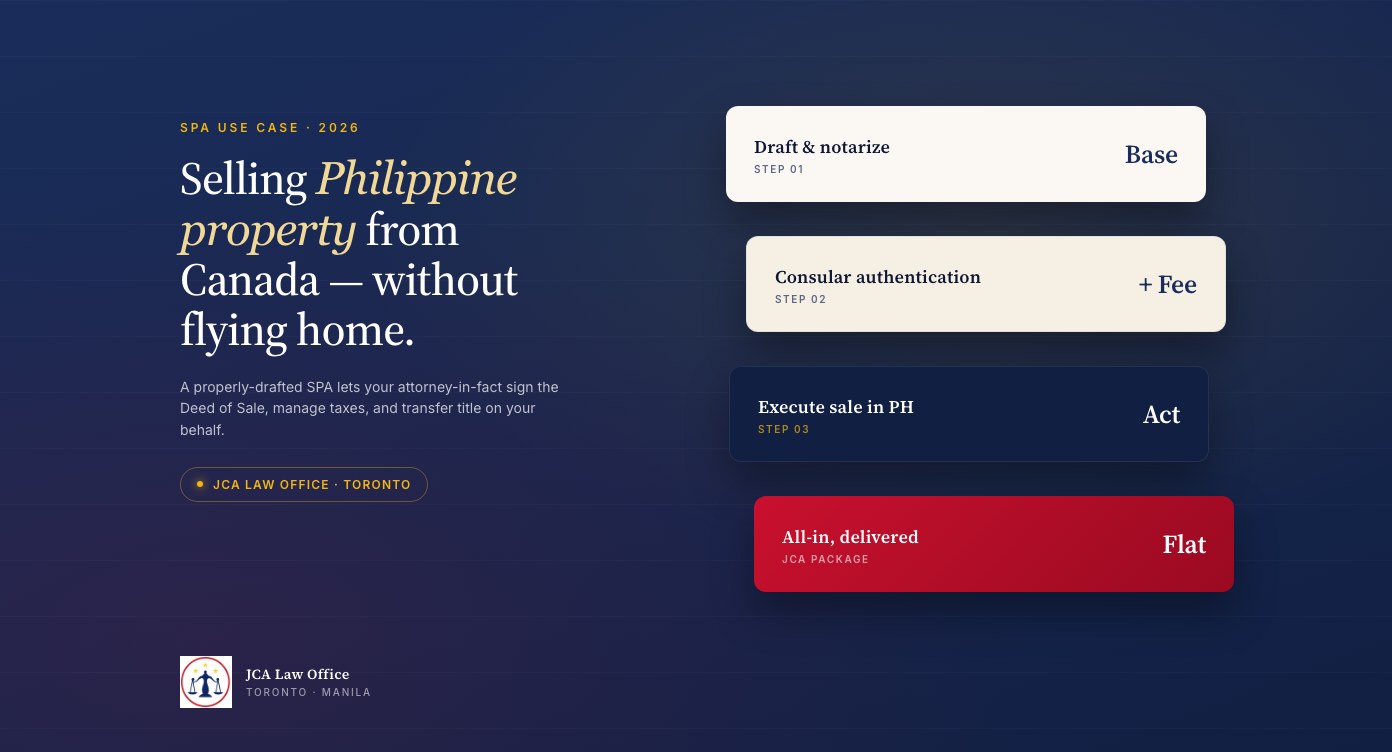
Since Canada joined the Hague Apostille Convention on January 11, 2024, the process has become significantly simpler. An SPA notarized in Canada and apostilled through Global Affairs Canada (or an authorized provincial authority) is now recognized directly in the Philippines—no more consular authentication required.
What Powers Must a Property Sale SPA Contain?
A property sale SPA is not a single-purpose document. Selling real estate in the Philippines involves multiple legal acts, and your SPA must grant authority for each one. If a power is missing, your attorney-in-fact will be stopped at that step—and you may need to execute and apostille a new SPA from Canada, costing weeks of delay.
A comprehensive property sale SPA should grant the following eight essential powers:
| # | Power Granted | Why It Is Required |
|---|---|---|
| 1 | Negotiate the sale price and terms | Allows your agent to entertain offers, counter-offer, and agree on a final price without consulting you for every negotiation round |
| 2 | Sign the Deed of Absolute Sale | The deed is the primary conveyance document; your agent must be authorized to execute it on your behalf (Art. 1878, Civil Code) |
| 3 | Appear before a notary public | The deed must be notarized in the Philippines to be valid; your agent needs authority to personally appear and acknowledge the document |
| 4 | Pay Capital Gains Tax (CGT) | The 6% CGT must be paid to the BIR within 30 days of notarization; your agent files BIR Form 1706 on your behalf |
| 5 | Pay Documentary Stamp Tax (DST) | The 1.5% DST must be paid for the deed to be registered; your agent handles this filing with the BIR |
| 6 | File documents with the BIR and obtain the eCAR | The electronic Certificate Authorizing Registration (eCAR) is mandatory before the title can be transferred; your agent secures it from the Revenue District Office |
| 7 | Register the sale with the Register of Deeds | Under PD 1529 (Property Registration Decree), the Deed of Absolute Sale and eCAR must be presented to the Register of Deeds for the new title to be issued |
| 8 | Receive payment and issue receipts | Your agent collects the sale proceeds on your behalf and issues acknowledgment of payment to the buyer |
Important: Philippine courts interpret SPAs strictly. Your attorney-in-fact can only do what the SPA expressly authorizes. A well-drafted SPA should also include a catch-all clause granting authority to “sign, execute, and deliver any and all documents, and perform any and all acts necessary or incidental to the sale” of the specific property.
Required Information to Draft Your SPA
Before your SPA can be drafted, you need to gather specific information about the property, yourself (the principal), and your chosen attorney-in-fact. Missing even one detail can result in the SPA being questioned or rejected in the Philippines.
Property Details
- Title number: Transfer Certificate of Title (TCT) number for land, or Condominium Certificate of Title (CCT) number for condo units
- Tax Declaration number from the local assessor’s office
- Lot number, block number, and plan number (from the title or survey plan)
- Complete property address including barangay, city/municipality, and province
- Total lot area (in square meters, as stated on the title)
- Condo-specific: Unit number, floor level, parking slot (if applicable), and building name
Principal (Property Owner) Details
- Full legal name (as it appears on the Philippine title)
- Civil status (single, married, widowed, separated)
- Citizenship (Filipino, dual citizen under RA 9225, or Canadian)
- Current Canadian address
- Valid government-issued ID (Canadian passport or Philippine passport)
- If married: spouse’s full name and consent (Philippine law requires spousal consent for property sales under the Family Code)
Attorney-in-Fact Details
- Full legal name
- Civil status and citizenship
- Complete Philippine address
- Valid Philippine government-issued ID
- Relationship to the principal (sibling, parent, trusted friend, etc.)
Tip: If you do not have a copy of your title, your attorney-in-fact in the Philippines can obtain a Certified True Copy from the Register of Deeds. However, you will need at minimum the TCT/CCT number and the property address to draft the SPA.
Step-by-Step Process: From Canada to Completed Sale
The property sale process has two distinct phases: the Canada Phase (preparing and authenticating your SPA) and the Philippines Phase (executing the actual sale). Understanding both phases helps you plan realistic timelines and avoid surprises.
Phase 1: Canada (1–2 Weeks)
This phase covers everything you need to do while in Canada before your attorney-in-fact can act in the Philippines.
Step 1: Gather your documents. Collect your property title details (TCT/CCT number, tax declaration), valid ID, and your attorney-in-fact’s information. If you are married, your spouse must also sign the SPA or provide a separate consent.
Step 2: Have the SPA professionally drafted. This is not a document to download from the internet. A property sale SPA must be tailored to your specific transaction, include all eight essential powers listed above, and comply with Philippine legal requirements. JCA Law Office drafts SPAs for Filipino-Canadians across Ontario and Canada for $257.64 CAD (complete package including notarization and apostille coordination).
Step 3: Notarize the SPA. You (and your spouse, if applicable) must personally appear before a Canadian notary public or commissioner of oaths to sign the SPA. This verifies your identity and confirms you are signing voluntarily.
Step 4: Apostille the SPA. Since Canada joined the Hague Apostille Convention in January 2024, you can have your notarized SPA apostilled through Global Affairs Canada or an authorized provincial authority in Ontario, British Columbia, Alberta, Quebec, or Saskatchewan. The apostille certificate makes your SPA legally valid in the Philippines without any additional authentication.
Step 5: Send the original SPA to the Philippines. Use a tracked courier service (FedEx, DHL, or similar) to send the original apostilled SPA to your attorney-in-fact. Keep a certified copy for your own records.
Phase 2: Philippines (4–8 Weeks)
Once your attorney-in-fact receives the original apostilled SPA, the sale process in the Philippines begins.
Step 6: Attorney-in-fact receives and verifies the SPA. Your agent should verify the SPA is intact, the apostille certificate is attached, and all details are correct before proceeding.
Step 7: Negotiate and finalize the sale. Your attorney-in-fact negotiates the sale price and terms with the buyer. Once both parties agree, a Contract to Sell may be executed, and earnest money may be collected.
Step 8: Execute the Deed of Absolute Sale. Your attorney-in-fact signs the Deed of Absolute Sale on your behalf, appearing before a Philippine notary public for notarization.
Step 9: Pay Capital Gains Tax (6%). Within 30 days of the deed’s notarization, your attorney-in-fact files BIR Form 1706 and pays the 6% CGT at the Revenue District Office (RDO) that has jurisdiction over the property.
Step 10: Pay Documentary Stamp Tax (1.5%). The DST is paid using BIR Form 2000-OT within 5 days after the close of the month when the deed was signed.
Step 11: Obtain the electronic Certificate Authorizing Registration (eCAR). After taxes are paid, your attorney-in-fact applies for the eCAR at the BIR’s ONETT (One-Time Transaction) section. Under RMO No. 12-2025, the eCAR must be issued within 7 working days of complete submission. The eCAR no longer has an expiration date (per RR 12-2024).
Step 12: Register at the Register of Deeds. Your attorney-in-fact presents the Deed of Absolute Sale, eCAR, tax clearance, and other required documents to the Register of Deeds. Registration fees are paid, and the old title (in your name) is cancelled. A new Transfer Certificate of Title (or Condominium Certificate of Title) is issued in the buyer’s name.
Step 13: Pay the local transfer tax. The transfer tax (0.5%–0.75% depending on the municipality) is paid at the local Treasurer’s Office.
Step 14: Update the Tax Declaration. The buyer (or your attorney-in-fact) files for a new Tax Declaration at the local Assessor’s Office, reflecting the change of ownership.
Tax Obligations When Selling Philippine Property
Philippine property sales involve multiple taxes and fees paid to different government agencies. As the seller, you are legally responsible for the Capital Gains Tax. The remaining taxes are conventionally the buyer’s responsibility, though this is often negotiated between the parties.
| Tax / Fee | Rate | Tax Base | Paid To | Who Pays |
|---|---|---|---|---|
| Capital Gains Tax (CGT) | 6% | Selling price, BIR zonal value, or assessed value—whichever is highest | BIR (Form 1706) | Seller |
| Documentary Stamp Tax (DST) | 1.5% | Selling price, BIR zonal value, or assessed value—whichever is highest | BIR (Form 2000-OT) | Buyer (negotiable) |
| Local Transfer Tax | 0.5%–0.75% | Selling price or fair market value—whichever is higher | Local Treasurer’s Office | Buyer (negotiable) |
| Registration Fee | ~0.25%–1% | Sliding scale based on property value (LRA fee table) | Register of Deeds | Buyer |
| Notarial Fees | 1%–2% | Selling price (varies by notary) | Notary Public | Negotiable |
| Real Property Tax (clearance) | Varies | Any unpaid annual real property taxes must be settled before transfer | Local Treasurer’s Office | Seller |
Sample Tax Computation
For a property with a selling price of PHP 5,000,000 (where the selling price is the highest value):
- CGT: PHP 5,000,000 × 6% = PHP 300,000
- DST: PHP 5,000,000 × 1.5% = PHP 75,000
- Transfer Tax (Metro Manila): PHP 5,000,000 × 0.75% = PHP 37,500
- Registration Fee: Approximately PHP 30,000–50,000 (per LRA schedule)
- Notarial Fee: Approximately PHP 50,000–100,000
- Estimated Total: PHP 492,500–562,500 (approximately CAD $12,300–$14,060 at PHP 40 = CAD 1)
Note: The CGT is computed on the highest of the selling price, BIR zonal value, or assessed value. In many cases, the BIR zonal value exceeds the actual selling price, which means your tax may be higher than expected. Always check the current BIR zonal values for your property’s location before setting a price.
Condo (CCT) vs. Land Title (TCT): Key Differences in the Sale Process
The sale process differs depending on whether you are selling a condominium unit (covered by a Condominium Certificate of Title or CCT) or a house-and-lot or vacant land (covered by a Transfer Certificate of Title or TCT). Understanding these differences is critical because missing a step unique to your property type can stall the entire transaction.
| Factor | Land / House and Lot (TCT) | Condominium Unit (CCT) |
|---|---|---|
| Title Type | Transfer Certificate of Title (TCT)—covers the land and any structures on it | Condominium Certificate of Title (CCT)—covers the unit’s airspace only, plus a proportionate share of common areas |
| Ownership Scope | Full ownership of land and improvements | Ownership of the unit only; shared ownership of common areas (hallways, elevators, amenities) |
| Management Clearance | Not required (unless in a subdivision with an HOA) | Required. You must obtain a Certificate of Management from the Condominium Corporation before the Register of Deeds will process the transfer |
| Purpose of Clearance | N/A | Confirms: (1) no outstanding association dues, (2) the 60% Filipino ownership cap in the condo is maintained, (3) no liens from the condo corporation |
| HOA / Condo Dues | May apply if in a gated subdivision | Monthly condo association dues are mandatory; must be current before sale |
| Foreign Buyer Restriction | Foreigners cannot own land in the Philippines (1987 Constitution) | Foreigners can own condo units, subject to the 40% foreign ownership limit per building |
| Additional Documents for SPA | Survey plan, lot/block details, total land area | Unit number, floor level, parking slot number (if applicable), building name, condo corporation name |
If you are selling a condo: Instruct your attorney-in-fact to request the Certificate of Management from the condo’s property management office early in the process. Some condominium corporations take 2–4 weeks to issue this certificate, and the Register of Deeds will not accept the transfer documents without it. Make sure all association dues, special assessments, and utility bills are fully settled before applying.
6 Common Pitfalls That Delay Philippine Property Sales
After helping hundreds of Filipino-Canadians with property transactions, we have seen the same mistakes cause delays repeatedly. Here are the six most common pitfalls and how to avoid them.
1. Using a Generic or Incomplete SPA
Downloading a template from the internet often results in an SPA that is missing critical powers—such as the authority to pay taxes or register the deed. The BIR or Register of Deeds will reject the submission, and you will need to execute, notarize, and apostille an entirely new SPA from Canada. This can set you back 2–4 weeks.
2. Incorrect Property Details on the SPA
If the TCT/CCT number, lot area, or property address on your SPA does not match the title exactly, the Register of Deeds will refuse to process the transfer. Always verify your property details against the actual title before drafting the SPA.
3. Missing Spousal Consent
Under the Philippine Family Code, if the property is part of the conjugal or community property, both spouses must consent to the sale. If you are married, your spouse should either co-sign the SPA or execute a separate Affidavit of Consent. Failing to obtain this can void the sale.
4. Unpaid Real Property Taxes
The local Treasurer’s Office will not issue a tax clearance if there are delinquent real property taxes. Some owners who have been abroad for years discover they owe several years of back taxes plus penalties. Have your attorney-in-fact check the status before listing the property for sale.
5. BIR Zonal Value Surprise
Many sellers are unaware that the Capital Gains Tax is based on the highest of three values: the selling price, the BIR zonal value, or the assessed value. In rapidly developing areas, the BIR zonal value can be significantly higher than your negotiated selling price, resulting in a much larger tax bill than expected.
6. Not Granting Authority to Receive Payment
Some SPAs authorize the agent to sell the property and handle the paperwork but forget to include authority to receive payment. This creates an impossible situation where the sale is complete but the proceeds cannot be collected. Always include explicit authority to receive and acknowledge payment.
Timeline and Cost Summary
The following table summarizes the expected timeline and costs for the entire process, from drafting the SPA in Canada to receiving the new title in the Philippines.
| Phase | Step | Timeline | Estimated Cost |
|---|---|---|---|
| Canada Phase | Document gathering | 1–3 days | — |
| SPA drafting, notarization, and apostille coordination | 3–7 business days | $257.64 CAD (JCA full package) | |
| Apostille processing (Global Affairs Canada) | 2–10 business days | $30 CAD (government fee) | |
| Courier to Philippines (FedEx/DHL) | 3–5 business days | $60–$100 CAD | |
| Philippines Phase | Negotiate sale and sign Deed of Absolute Sale | 1–4 weeks (depends on buyer) | Notarial fee: 1%–2% of price |
| Pay CGT (6%) and DST (1.5%) | Within 30 days of deed | 7.5% of highest value | |
| Obtain eCAR from BIR | 7 working days (per RMO 12-2025) | Included in BIR filing | |
| Register at Register of Deeds | 1–2 weeks | ~0.25%–1% registration fee | |
| Pay local transfer tax | 1–3 days | 0.5%–0.75% | |
| New title issued | 1–4 weeks | — | |
| Total | End to end | 5–14 weeks | $350–$390 CAD + ~10% of property value in PH taxes/fees |
Note on timelines: The Philippines Phase timeline assumes a cooperative buyer and no complications at the BIR or Register of Deeds. In practice, delays at the BIR are common, especially during the first and fourth quarters of the year when RDOs handle heavy filing volumes. Budget extra time if your transaction falls during these periods.
Frequently Asked Questions
Can I sell Philippine property if I am now a Canadian citizen and gave up my Philippine citizenship?
Yes, but with conditions. Former Filipino citizens retain certain property rights under Philippine law. If you reacquired Philippine citizenship under RA 9225 (the Dual Citizenship Act), you have the same rights as any Filipino. If you have not reacquired citizenship, you can still sell property you acquired before becoming a foreign citizen, or property you inherited. The SPA process is the same either way. However, to simplify future transactions and maintain full property rights, we recommend exploring dual citizenship reacquisition through the Philippine Consulate.
Can my attorney-in-fact set the selling price, or do I need to specify it in the SPA?
You have two options. You can either specify a minimum acceptable price in the SPA (e.g., “for a price of not less than PHP 5,000,000”) or grant broader authority to negotiate “at such price and under such terms and conditions as my attorney-in-fact may deem reasonable.” The first option gives you more control; the second gives your agent more flexibility. We generally recommend setting a minimum price to protect your interests while giving your agent room to negotiate upward.
How long is an SPA valid for property sales?
An SPA for property sale does not automatically expire unless you include an expiration date. However, we recommend including a reasonable validity period (typically 1–2 years) to prevent the SPA from being used long after you intended. You can revoke an SPA at any time by executing a Revocation of Power of Attorney, notarizing it, and registering it with the Register of Deeds where the property is located.
What if my name on the title is different from my current legal name?
This is common among Filipino women who changed their surname after marriage or among dual citizens whose names were anglicized. If there is a discrepancy, you may need to provide supporting documents such as your marriage certificate (authenticated or apostilled), a PSA-issued birth certificate, or a court order for name correction. Your SPA should reference both names (e.g., “Maria Santos, also known as Mary Santos-Garcia”) to establish the connection. In some cases, an Affidavit of One and the Same Person may be required.
Do I need to pay Canadian taxes on the sale of my Philippine property?
Yes. As a Canadian tax resident, you are required to report worldwide income, including proceeds from the sale of foreign real property. The gain (difference between your selling price and adjusted cost base) is subject to Canadian capital gains tax. However, Canada and the Philippines have a tax treaty that may allow you to claim a foreign tax credit for the Philippine CGT you already paid, reducing or eliminating double taxation. We strongly recommend consulting a Canadian tax professional to ensure proper reporting on your T1 return and to claim all available credits.
How JCA Law Office Can Help
At JCA Law Office Professional Corporation, we specialize in cross-border legal services for the Filipino-Canadian community. Our SPA Property Sale Package at $257.64 CAD includes:
- Custom-drafted SPA tailored to your specific property and transaction, with all eight essential powers
- Review of your property documents (title, tax declaration) to ensure accuracy
- Notarization at our office or via secure virtual appointment
- Apostille coordination with Global Affairs Canada or provincial authority
- Guidance on the Philippines-side process so your attorney-in-fact knows exactly what to do at each step
We serve Filipino-Canadians across Ontario and throughout Canada. Whether you are selling a family home in Pampanga, a condo in Makati, or agricultural land in the Visayas, we ensure your SPA is legally complete, properly authenticated, and ready for immediate use in the Philippines.
Book a consultation today or call us at (647) 367-1634 to get started. Most SPAs are completed within one week.
Related Resources
Official Government Resources:
- Bureau of Internal Revenue (BIR) — CGT, DST, and eCAR requirements
- Land Registration Authority (LRA) — Registration fees and title transfer
- Global Affairs Canada — Apostille Services
Last updated: February 2026. This guide is for informational purposes only and does not constitute legal advice. Philippine regulations, tax rates, and processing times are subject to change. Contact JCA Law Office for advice specific to your situation.

Leave a Reply