← Back to Special Power of Attorney Guide
Apostille vs Consularization: Which Path for Your Philippine SPA? (2026)
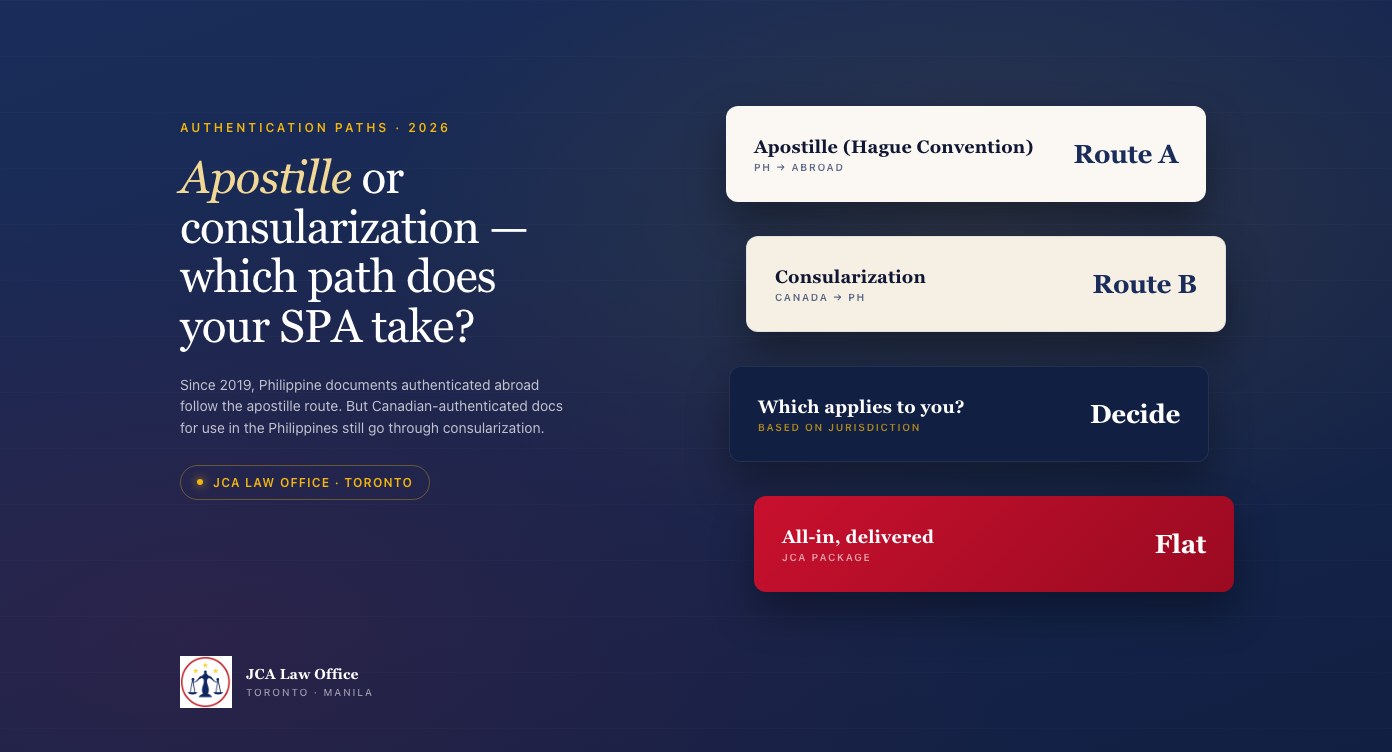
If you are a Filipino in Canada who needs a Special Power of Attorney (SPA) for a transaction in the Philippines, you now have two paths to get your document recognized: the apostille and the traditional consularization (red ribbon). Since Canada officially joined the Hague Apostille Convention on January 11, 2024, the process of authenticating Canadian legal documents for use in the Philippines has fundamentally changed.
But which path should you choose? The answer depends on your timeline, your location, and where in the Philippines your SPA will be used. This guide breaks down both options so you can make the right decision for your situation.
What Changed: The Hague Apostille Convention
The Hague Convention of 5 October 1961 Abolishing the Requirement of Legalisation for Foreign Public Documents — commonly called the Apostille Convention — is an international treaty that simplifies how countries verify each other’s legal documents. Instead of a multi-step chain of certifications, a single standardized certificate (the apostille) is attached to the document, and all member countries agree to accept it.
Two dates matter for Filipinos in Canada:
- May 14, 2019 — The Philippines became a member of the Apostille Convention.
- January 11, 2024 — Canada joined the Apostille Convention, making it the 125th member country.
Before January 2024, there was only one way to authenticate a Canadian SPA for use in the Philippines: the consularization process through the Philippine Consulate. Now, because both countries are members of the convention, the apostille path is a fully valid alternative.
Key Takeaway: Both the apostille and consularization produce a legally valid SPA for use in the Philippines. The apostille is not “better” or “worse” — it is simply a different, often faster route to the same legal recognition. For more background on this change, see our article on the Apostille Canada Update for Filipinos.
Path 1: The Apostille Process
The apostille process bypasses the Philippine Consulate entirely. Instead, a designated Canadian government authority (called the competent authority) verifies that the notary who signed your SPA is legitimate, and attaches an apostille certificate. Because the Philippines is a fellow member of the convention, Philippine agencies must accept the apostilled document without further authentication.
Step-by-Step: Apostille for Your SPA
- Draft the SPA — Work with a lawyer to prepare a Special Power of Attorney that complies with Philippine legal requirements and clearly identifies the property or transaction.
- Notarize the SPA — Have the document notarized by a notary public in Ontario (or your province). The notary must affix their official seal and signature.
- Submit to the competent authority — Send or bring the notarized SPA to your province’s designated apostille authority (see table below). In Ontario, this is the Ministry of Public and Business Service Delivery — Official Documents Services (ODS).
- Apostille certificate attached — The competent authority verifies the notary’s commission and attaches a standardized apostille certificate to the SPA.
- Send the apostilled SPA to the Philippines — Mail or have someone bring the apostilled document to your attorney-in-fact (agent) in the Philippines. No further authentication is required.
Ontario Tip: The Official Documents Services office is located in Toronto. In-person requests can be processed in approximately one hour. Mail-in requests take about 15 business days. See the Official Documents Services website for current fees.
Path 2: The Consularization (Red Ribbon) Process
Consularization is the traditional method that Filipinos overseas have used for decades. It involves authenticating your SPA through a government authority — the Official Documents Services (ODS) in Ontario or Global Affairs Canada (GAC) in other provinces — and then having it verified by the Philippine Consulate, which attaches the distinctive red ribbon seal. This process was the only option before January 2024, and it remains fully valid today.
Step-by-Step: Consularization for Your SPA
- Draft the SPA — Same as the apostille path: work with a lawyer to prepare a Philippine-compliant SPA.
- Notarize the SPA — Have the document notarized by a notary public in your province.
- Authenticate the document — In Ontario, submit the notarized SPA to the Official Documents Services (ODS) for authentication (15 business days by mail or ~1 hour in-person at ServiceOntario; see ODS website for current fees). In other provinces, submit to Global Affairs Canada (GAC) in Ottawa (free of charge, but can take 20 business days or more by mail). The authenticating authority verifies the notary’s credentials.
- Submit to the Philippine Consulate — Bring or mail the GAC-authenticated SPA to the nearest Philippine Consulate General (Toronto, Vancouver, or Calgary). The consulate verifies the GAC authentication and attaches the red ribbon seal.
- Pick up and send to the Philippines — The consularized SPA is typically released after 2 working days. Once you have it, send it to your agent in the Philippines.
Consularization Fee: See the Philippine Consulate’s notarial fees page for current rates. Payment can be made by cash, money order, bank draft, credit card, debit card, Apple Pay, or Google Pay. Personal cheques are not accepted.
Side-by-Side Comparison: Apostille vs Consularization
The following table compares both paths across nine important factors. Use it to determine which option makes the most sense for your situation.
| Feature | Apostille Path | Consularization (Red Ribbon) |
|---|---|---|
| Total Cost (Ontario) | See ODS website | See consulate fees; GAC is free |
| Estimated Timeline | 1 hour (in-person) to 15 business days (mail) | 20+ business days (GAC) + 2 days (consulate) |
| Number of Steps | 3 steps (draft, notarize, apostille) | 4 steps (draft, notarize, GAC, consulate) |
| Acceptance in the Philippines | Legally recognized under Apostille Convention | Universally recognized — decades of practice |
| Convenience | Can be done entirely by mail; no consulate visit | May require in-person consulate visit |
| Location Independence | Available from any province (by mail or in-person) | Must use Philippine Consulate (Toronto, Vancouver, Calgary) |
| Legal Basis | Hague Apostille Convention (1961) | Bilateral consular practice |
| Worldwide Recognition | Accepted in 125+ convention member countries | Specific to Canada-Philippines relationship |
| Process Simplicity | Single government authority handles it | Two separate agencies (GAC + consulate) |
When to Choose the Apostille
For most Filipino-Canadians in 2026, the apostille is the faster, cheaper, and more convenient option. Consider the apostille path when:
- You need the SPA quickly. In Ontario, in-person apostille processing takes about one hour. Even by mail, 15 business days is significantly faster than the consularization process.
- You want to save money. The apostille path is generally cheaper than consularization — and the preceding GAC step in the consularization process is an additional time cost even though it is free.
- You do not live near a Philippine Consulate. The apostille can be obtained entirely by mail from your province’s competent authority. You do not need to visit Toronto, Vancouver, or Calgary.
- Your transaction involves a major bank, Registry of Deeds, or government agency in Metro Manila or a major city. Major institutions in the Philippines are now well-accustomed to apostilled documents.
- You may also need the document recognized in other countries. An apostille is accepted in all 125+ convention member countries, making it useful if your SPA has cross-border implications.
When Consularization Still Makes Sense
While the apostille is the more modern and streamlined option, there are specific situations where the traditional consularization process may still be the better choice:
- Some provincial Philippine agencies are still unfamiliar with apostilles. In more remote provinces, particularly in the Visayas and Mindanao, smaller Registries of Deeds or local government offices may not yet be fully trained on accepting apostilled documents. A consularized SPA with the recognizable red ribbon may be processed more smoothly in these locations.
- Older property titles or ongoing proceedings. If you are dealing with an older property title and a series of documents in an ongoing legal proceeding where all previous documents were consularized, consistency may be preferred.
- You already have a consulate appointment. If you have already scheduled an appointment at the Philippine Consulate for other services (passport renewal, dual citizenship application under RA 9225, etc.), you can have your SPA consularized during the same visit.
- Your Philippine attorney specifically requests it. Some lawyers in the Philippines who have been practicing for many years may be more comfortable with consularized documents and may advise you to take this route.
Practical Advice: Before choosing a path, contact your attorney-in-fact or the specific agency in the Philippines that will receive the SPA. Ask them whether they accept apostilled documents. In our experience at JCA Law Office, most major institutions in the Philippines now accept apostilled SPAs without issue.
Provincial Competent Authorities for Apostille in Canada
Canada’s apostille system is decentralized. Five provinces have their own competent authorities, while Global Affairs Canada handles the remaining provinces and territories. The authority you use depends on where your SPA was notarized (not where you live).
| Province | Competent Authority | Processing Time |
|---|---|---|
| Ontario | Ministry of Public and Business Service Delivery — Official Documents Services (ODS) | ~1 hour in-person; 15 business days by mail |
| British Columbia | Ministry of the Attorney General — OIC Administration Office | 3–4 weeks by mail |
| Alberta | Ministry of Justice | Varies; online submission available |
| Saskatchewan | Ministry of Justice and Attorney General | Varies |
| Quebec | Ministry of Justice — Direction générale des registres et de la certification | ~10 business days + mail time |
| All Other Provinces & Territories | Global Affairs Canada (Ottawa) | ~20 business days by mail |
Fees vary by province — consult each competent authority’s official website for current rates.
Important Note on Jurisdiction: If your SPA was notarized in Alberta, Ontario, or Saskatchewan, you must use that province’s competent authority — even if you live somewhere else. For BC and Quebec, the competent authority can only apostille documents where the original document was also issued in the province. When in doubt, consult with our team about which authority to use.
JCA Law Office: Your SPA Handled from Start to Finish
At JCA Law Office, we understand that navigating document authentication can be confusing — especially when the rules have recently changed. That is why we offer three service options so you can choose the level of support that works for you.
| Service Option | What is Included | Best For |
|---|---|---|
| Option 1: SPA Drafting + Notarization | We draft a Philippine-compliant SPA tailored to your transaction, then notarize it at our Toronto office. | Clients who want to handle authentication themselves |
| Option 2: SPA + Apostille | Everything in Option 1, plus we submit the notarized SPA to the Official Documents Services on your behalf and obtain the apostille certificate. | Clients who want the fastest, most cost-effective path |
| Option 3: SPA + Consularization | Everything in Option 1, plus we handle the GAC authentication and Philippine Consulate submission on your behalf. | Clients whose Philippine transaction requires a consularized (red ribbon) document |
Our office is located at 204–2323 Yonge Street, Toronto M4P 2C9. Whether you choose the apostille or consularization path, we can handle the entire process so you do not have to take time off work or stand in line.
We also offer services for clients anywhere in Ontario. JCA Law drafts your SPA, handles in-person notarization at our Toronto office, and takes care of the ODS apostille submission and courier to the Philippines.
5 Common Mistakes to Avoid
We have helped hundreds of Filipino-Canadians prepare SPAs for Philippine transactions. These are the most common mistakes we see:
- Using a generic SPA template. Philippine agencies, banks, and Registries of Deeds often require specific language in the SPA depending on the transaction. A generic template downloaded from the internet may be rejected at the point of use, wasting weeks of processing time. Always have a lawyer draft or review your SPA.
- Missing the notarial block or seal. The competent authority (for apostille) and GAC (for consularization) both verify the notary’s credentials by checking the seal and signature. If the notarial block is missing or the seal is illegible, your document will be returned.
- Submitting to the wrong authority. If your SPA was notarized in Ontario, you must use Ontario’s Official Documents Services — not Global Affairs Canada, and not another province. Sending your document to the wrong authority will result in it being returned unprocessed.
- Assuming all Philippine offices accept apostilles. While acceptance is widespread, some local government units and smaller provincial offices may still be adjusting. Always confirm with the receiving party in the Philippines before choosing the apostille path.
- Not including the property details or transaction specifics. A Special Power of Attorney for property transactions must include the Transfer Certificate of Title (TCT) number, lot and block numbers, and a precise description of the powers being granted. Vague language will lead to rejection.
Costly Mistake Alert: We have seen clients lose months because their SPA was rejected by a Registry of Deeds in the Philippines due to incorrect wording. The cost of having a lawyer draft it correctly the first time is far less than the cost of repeating the entire authentication process.
Frequently Asked Questions
Can I use an apostilled SPA to sell property in the Philippines?
Yes. An apostilled SPA is legally valid for property transactions in the Philippines, including sales, transfers, and mortgage arrangements. The Philippines has been a member of the Hague Apostille Convention since May 14, 2019, which means Philippine government agencies and private institutions are required to accept apostilled foreign documents. However, we recommend confirming with the specific Registry of Deeds in advance, particularly in provincial areas.
Is an apostille the same as a red ribbon?
No, they are different forms of authentication. The red ribbon (consularization) is the Philippine Consulate’s seal, applied after Global Affairs Canada authenticates the document. The apostille is a standardized international certificate issued by a designated government authority under the Hague Convention. Both achieve the same legal result — making your Canadian SPA valid in the Philippines — but the processes and issuing bodies are different.
How long does the apostille process take in Ontario?
If you visit the Official Documents Services office in Toronto in person, your apostille can be processed in approximately one hour. If you submit by mail, expect processing to take about 15 business days, plus mailing time in both directions. At JCA Law Office, we can handle the in-person submission on your behalf as part of our SPA + Apostille service.
Do I still need to go to the Philippine Consulate if I get an apostille?
No. That is one of the primary advantages of the apostille path. Once the competent authority attaches the apostille to your notarized SPA, the document is ready for use in the Philippines. You do not need to visit the Philippine Consulate, and you do not need any additional authentication or red ribbon. You can send the apostilled SPA directly to your agent in the Philippines.
What if I live in Manitoba or another province without its own competent authority?
If you live in a province or territory that has not designated its own competent authority (Manitoba, New Brunswick, Newfoundland and Labrador, Nova Scotia, Prince Edward Island, Northwest Territories, Nunavut, or Yukon), your apostille is issued by Global Affairs Canada (GAC) in Ottawa. The good news is that GAC does not charge a fee for apostille services. However, processing times are typically around 20 business days by mail. Alternatively, you can have your SPA notarized in Ontario and use Ontario’s faster in-person service.
Get Your SPA Done Right the First Time
Whether you need an apostille or consularization, JCA Law Office can handle your Special Power of Attorney from drafting to authentication. Our team of Filipino-Canadian lawyers understands both the Canadian legal requirements and the practical realities of using documents in the Philippines.
Here is how to get started:
- Book a consultation — Call us at 1-855-JCA-LAW0 (1-855-522-5290) or schedule online.
- Tell us about your transaction — We will review the details and recommend the best authentication path.
- We handle the rest — From drafting and notarization to apostille or consularization, your SPA will be ready for use in the Philippines.
Ready to prepare your SPA?
Call 1-855-522-5290 or Book a Consultation Online
JCA Law Office Professional Corporation | 204-2323 Yonge Street, Toronto, ON M4P 2C9
Related Resources
- Special Power of Attorney Guide — Comprehensive overview of SPAs for Filipinos in Canada
- Special Power of Attorney in the Philippines — Philippine-specific SPA requirements and uses
- Documents Authentication Toronto — Our full authentication services for Philippine documents
- Apostille Canada Update — Background on Canada joining the Hague Convention

Leave a Reply