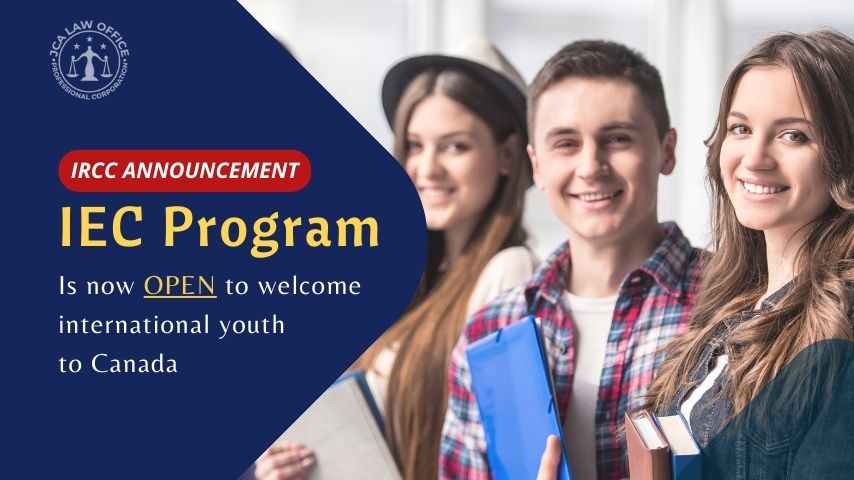
International Experience Canada Program Now Open For International Youth
Work, travel, and gain international experience in Canada through the IEC program for youth aged 18–35.
Immigration, Refugees and Citizenship Canada (IRCC) announced today, January 9th 2023, that the International Experience Canada (IEC) program is open to welcome international youth to Canada, providing an opportunity for them to live, work, and travel in the country. IEC allows young people from around the world to come to Canada and gain international experience through working holiday, internship, or co-op work terms.
The said program is open to citizens of certain countries who are aged 18 to 35. Participants can come to Canada on a working holiday visa, which allows them to work and travel in the country for up to two years. They can also come on an internship or co-op work term, which allows them to gain valuable work experience in their field of study or profession.
One of the benefits of participating in the IEC program is the opportunity to immerse oneself in Canadian culture and make connections with people from different countries. It is also a chance to improve language skills and build a global network of professional and personal contacts.
To participate in the IEC program, applicants must first create a profile on the International Experience Canada website and then apply for a visa. The application process can be competitive, as there are a limited number of spots available for each country. It is important for applicants to submit their application as early as possible and ensure that all required documents are included.
Once accepted into the IEC program, participants must meet certain requirements in order to maintain their visa status. These include having health insurance, maintaining a valid passport, and not engaging in illegal activities. Participants must also have enough money to support themselves during their stay in Canada.
Overall, the International Experience Canada program is a great opportunity for international youth to come to Canada and gain valuable work experience, make connections, and immerse themselves in Canadian culture. If you are interested in participating in the program, be sure to visit the International Experience Canada website for more information and to start your application.
Frequently Asked Questions
What countries are eligible to participate in the International Experience Canada program?
The International Experience Canada (IEC) program is open to citizens of 36 countries. Currently, the list of eligible countries includes Andorra, Australia, Austria, Belgium, Canada, Chile, Costa Rica, Croatia, Czech Republic, Denmark, Estonia, France, Germany, Greece, Hong Kong, Ireland, Italy, Japan, Korea, Rep., Latvia, Lithuania, Luxembourg, Mexico, Netherlands, New Zealand, Norway, Poland, Portugal, San Marino, Slovakia, Slovenia, Spain, Sweden, Switzerland, Taiwan, Ukraine, United Kingdom.
What is the International Experience Canada (IEC) program and who is it open to?
The International Experience Canada program is a government-run initiative that allows young people from around the world to come to Canada and gain international experience through working holidays, internships, or co-op work terms. It is open to citizens of certain countries who are aged 18 to 35. Participants can come to Canada on a working holiday visa, which allows them to work and travel in the country for up to two years, or on an internship or co-op work term, which allows them to gain valuable work experience in their field of study or profession.
How long can participants stay in Canada through the IEC program?
Participants in the IEC program can stay in Canada for up to two years on a working holiday visa, or for the duration of their internship or co-op work term, depending on the type of visa they obtain.
Can participants in the IEC program bring their family with them to Canada?
Participants in the IEC program are not permitted to bring their family with them to Canada. The program is intended for individuals to come and gain international experience on their own.
Are there any requirements that participants must meet in order to maintain their visa status through the IEC program?
In order to maintain their visa status through the IEC program, participants must meet certain requirements. These include having health insurance, maintaining a valid passport, and not engaging in illegal activities. Participants must also have enough money to support themselves during their stay in Canada.
If you need guidance on your legal and immigration matters, give us a call at 1-855-522-5290 during office hours. You may also send us your direct inquiries via our Facebook or Instagram Page, or by sending out a web form inquiry here on our website.
Interested in the IEC Program?
Our immigration lawyers can help you navigate the application process. Call us at 1-855-522-5290.
Tips for Applying to Scholarships as an International Student in Canada
A guide to government, non-government, and university scholarships available to international students studying in Canada.
Introduction
With Covid-19 restrictions easing up in Canada and the borders opening up to the world, more and more international students are getting encouraged to study abroad. However, the cost of attending a post-secondary education is no doubt expensive and this factor alone could be the reason why students will not pursue their studies abroad. If money is a huge obstacle in stopping you from getting an education outside of your home country, this article will guide and provide useful tips on getting a scholarship here in Canada as an International student.
For those who need an explanation of what a scholarship is: it is financial aid for students who were awarded for their academic standings and met any other criteria that was necessary. The awarded money is then used to pay for your education.
There are multiple ways to save and finance your money towards an education here in Canada, but it is more common for all students to apply for a scholarship. In Canada, there are three types of scholarships:
Three Types of Canadian Scholarships
Government Scholarships
Non-Government Scholarships
Canadian University/College Scholarships
Government Scholarships
International students who apply for this type of scholarship will be able to study in Canada at a reasonable price, while managing a good budget and healthy lifestyle. Global Affairs Canada is responsible for all major international scholarships and programs. You can check out their website to find various scholarship applications. You will also be able to plan your education and know the expenses of your program(s). Most of these types of scholarships offer assistance during your stay in Canada.
Non-Government Scholarships
These scholarships are not funded by the government and are owned by non-profit organizations or big corporations. They attract many international students because they could offer a lot of financial assistance depending on the type of career you want to pursue. You just need to invest a lot of time in researching and finding the legit organizations.
University/College Scholarships
Scholarships under this category are mostly merit-based, meaning a student is likely getting financial aid if they have an excellent academic, athletic, or artistic standings. If you have a high GPA and have a general idea of the career you want to pursue, it is recommended that you start researching for universities/colleges that have the programs you are interested in.
Tips for Applying Towards a Scholarship
To apply for scholarships in Canada, most organizations/schools will require an essay reflecting about your interest, work experiences and background, and of course getting impressive grades from your previous school. Depending on the scholarships, some will require additional responsibilities or duties to be eligible. All international students should utilize scholarship opportunities because managing school and a part-time job can really be stressful.
Tip 1: Apply for Scholarships That You Are Eligible For
There is no point in trying to apply for a scholarship that does not meet your or the scholarship’s requirements. Not only time and effort will be wasted in trying to apply, but you will also feel discouraged. It will take time looking for the right scholarship to apply for, so it is best to keep trying and be patient.
Tip 2: Get Letters of Recommendations
If possible, have teachers or professionals who share a strong relationship with you to write a letter of recommendation for your application. These people can vouch for you, your work/study ethics and explain your strengths and your ability to overcome your weaknesses. Ensure to provide additional information about yourself and the scholarship you are applying for to the recommender, so they can mention it in their letter. Give them at least two-weeks notice about the letter so they have time to write and figure out the right information they can provide in order to help you get that scholarship you are aiming for.
Need Immigration Services?
If you are an international student needing legal and immigration services, the Legal and Immigration Team of JCA LAW is ready to help you. Give us a call at 1-855-522-5290 during office hours, or send us a direct message on our Facebook or Instagram Page. You may also send your inquiries via our web form.
Have questions about studying in Canada? Our immigration team can help.
Post-Graduation Work Permit (PGWP) Canada 2026: Complete Guide for Filipino Students
If you are a Filipino student studying in Canada, the Post-Graduation Work Permit (PGWP) is your bridge between graduation and permanent residence. It allows you to stay and work in Canada with an open work permit after completing your studies at an eligible Canadian institution.
But the rules have changed significantly. Starting November 1, 2024, Immigration, Refugees and Citizenship Canada (IRCC) introduced new language requirements and field of study restrictions that affect who qualifies for a PGWP. For 2026, IRCC has also frozen the list of eligible programs, meaning no fields of study will be added or removed this year.
This guide covers everything Filipino students need to know about the PGWP in 2026, including the updated eligibility rules, new language requirements, application process, processing times, and the pathways from PGWP to permanent residence.
What Is a Post-Graduation Work Permit (PGWP)?
A Post-Graduation Work Permit is an open work permit issued to international students who have graduated from an eligible designated learning institution (DLI) in Canada. Unlike employer-specific work permits, a PGWP allows you to work for any employer in Canada, in any occupation, for the duration of the permit.
The PGWP is a one-time opportunity. You can only receive one PGWP in your lifetime. This makes it critically important to understand the rules before you apply and to use the work experience you gain strategically toward permanent residence.
Key Facts at a Glance:
Permit type: Open work permit (any employer, any job)
Duration: 8 months to 3 years (depending on program length)
Application deadline: Within 180 days of receiving your final marks
Application fee: CAD ( work permit + open work permit holder fee)
The PGWP eligibility requirements changed substantially in late 2024. Whether the new rules apply to you depends on your lock-in date — the date you submitted your study permit application.
Basic Requirements (All Applicants)
Regardless of when you applied for your study permit, you must meet these baseline requirements:
Completed a program of at least 8 months in duration at a PGWP-eligible DLI
Maintained full-time student status in every academic semester (part-time in final semester is acceptable)
Received a letter or official notification confirming you completed your program and are eligible to receive your credential
Applied within 180 days of receiving your final marks or transcript
Had a valid study permit when you applied, or the study permit expired during the 180-day window
Who Is NOT Eligible
You cannot get a PGWP if:
You have already received a PGWP in the past
You studied English as a Second Language (ESL) or French as a Second Language (FSL) only
You took general interest or self-improvement courses
You received a Global Affairs Canada (GAC) scholarship that requires you to return to your home country
You completed more than 50% of your program through distance learning (with limited exceptions)
You graduated from a non-Canadian institution operating in Canada
You attended a DLI that is not PGWP-eligible
New Requirements for Study Permits Submitted On or After November 1, 2024
If your study permit application was submitted on or after November 1, 2024, you must also meet two additional requirements:
Language proficiency requirement (see next section)
Field of study requirement (for non-degree programs — see below)
Grandfathering Rule: If you submitted your study permit application before November 1, 2024, the new language and field of study requirements do not apply to you. You follow the previous rules. This is determined by your study permit application date, not your PGWP application date.
New Language Requirements (CLB 7 and CLB 5)
One of the biggest changes to the PGWP program is the introduction of mandatory language testing. Previously, there was no language requirement to get a PGWP. Now, if your study permit was submitted on or after November 1, 2024, you must prove your English or French proficiency.
Language Levels by Program Type
Program Type
Minimum Language Level
Field of Study Required?
Bachelor’s degree
CLB 7 (English) or NCLC 7 (French)
No
Master’s degree
CLB 7 (English) or NCLC 7 (French)
No
Doctoral degree (PhD)
CLB 7 (English) or NCLC 7 (French)
No
Other university programs
CLB 7 (English) or NCLC 7 (French)
Yes
College diploma or certificate
CLB 5 (English) or NCLC 5 (French)
Yes
Polytechnic programs
CLB 5 (English) or NCLC 5 (French)
Yes
Flight school graduates
Exempt
Exempt
What CLB 7 and CLB 5 Mean in Test Scores
You must achieve the minimum score in all four language skills (reading, writing, listening, speaking). Here is what CLB 7 and CLB 5 translate to on accepted tests:
Test
Skill
CLB 5 (College)
CLB 7 (University)
IELTS General
Listening
5.0
6.0
IELTS General
Reading
4.0
6.0
IELTS General
Writing
5.0
6.0
IELTS General
Speaking
5.0
6.0
CELPIP-General
All skills
5
7
PTE Core
Listening
39
50
PTE Core
Reading
33
50
PTE Core
Writing
51
59
PTE Core
Speaking
42
59
Tip for Filipino Students: Most Filipino students already have strong English skills. The IELTS General Training is the most widely available test in the Philippines and Canada. If you need CLB 7, aim for at least 6.0 in every band. Test results must be less than 2 years old at the time of your PGWP application. Book your test early — slots fill up fast near graduation season.
Field of Study Restrictions (2026 Frozen List)
The second major change is the field of study requirement. If your study permit was submitted on or after November 1, 2024, and you graduated from a non-degree program (diploma, certificate, post-graduate certificate), your program must be on IRCC’s list of eligible fields of study.
Who Needs to Meet the Field of Study Requirement?
College diploma and certificate graduates — must be in an eligible field
Post-graduate certificate/diploma graduates — must be in an eligible field
Other university non-degree programs — must be in an eligible field
Who Is Exempt?
Bachelor’s degree graduates — exempt from field of study requirement
Master’s degree graduates — exempt
Doctoral (PhD) graduates — exempt
Study permit submitted before November 1, 2024 — exempt (grandfathered)
Eligible Fields of Study (Categories)
IRCC lists over 1,100 eligible programs organized by CIP (Classification of Instructional Programs) codes. These programs are concentrated in areas of long-term labour shortages in Canada:
Category
Example Programs
Healthcare
Nursing, medical laboratory, pharmacy technician, dental hygiene, paramedicine
STEM
Computer science, engineering technology, information technology, biotechnology
Early childhood education, teacher education, special education
Social Services
Social work, community services, counselling
Transport & Infrastructure
Aviation, heavy equipment, logistics
2026 Freeze Alert: On January 15, 2026, IRCC confirmed that the list of PGWP-eligible fields of study is frozen for 2026. No programs will be added or removed this year. If your program is currently on the list, it will remain eligible. If it is not on the list, it will not be added until at least 2027.
Programs NOT Eligible: Many popular college programs are no longer PGWP-eligible for new study permit holders. These include most business administration diplomas, general management programs, hospitality management, and marketing diplomas at the college level. If you are choosing a program in 2026, verify eligibility before enrolling.
Private College (Curriculum Licensing) Restrictions
Programs delivered by a private career college on behalf of a public institution (curriculum licensing arrangements) are no longer PGWP-eligible, except in limited grandfathered cases:
Students who started on or before May 15, 2024 (same province as the public institution) may still qualify
Students who started on or before January 31, 2023 (different province) may still qualify
All other private college curriculum-licensing students are not eligible
PGWP Duration: How Long Is Your Work Permit?
The length of your PGWP depends on your program type and duration. There is a special rule for master’s degree graduates that makes the master’s pathway particularly attractive.
Program Type
Program Length
PGWP Duration
Master’s degree
8 months or more (any length)
3 years
Any eligible program
2 years or more
3 years
Any eligible program
8 months to less than 2 years
Same as program length
Any eligible program
Less than 8 months
Not eligible
Combined programs
Each 8+ months, total 2+ years
3 years
Master’s Degree Advantage: Since February 15, 2024, graduates of master’s degree programs receive a 3-year PGWP regardless of program length, as long as the program is at least 8 months. This is a significant advantage — even a 12-month master’s program qualifies for 3 years of work authorization. Master’s graduates are also exempt from the field of study requirement.
Important Notes on Duration
Passport expiry limit: Your PGWP cannot extend beyond your passport’s expiry date. If your passport expires before your PGWP period ends, the permit will only be issued up to the passport expiry date. You can apply to extend later with a renewed passport.
Distance learning deduction: For study permits submitted on or after September 1, 2024, time spent studying online outside Canada will be deducted from your PGWP duration.
50% in-class rule: You must complete at least 50% of your program in-person in Canada. Failing this means you are not eligible for a PGWP.
PGWP Application Process: Step-by-Step
The PGWP application must be submitted online through your IRCC online account. Paper applications are no longer accepted. Here is the step-by-step process:
If you have not already provided biometrics, you will receive a Biometrics Instruction Letter (BIL). You must visit a designated biometrics collection site within 30 days. In Canada, these are Service Canada locations.
Step 5: Wait for Processing
Processing times vary. While you wait, you can work under implied status (see below). Check your IRCC account regularly for updates or requests for additional documents.
Processing Times and Fees
Item
Cost (CAD)
Work permit processing fee
Open work permit holder fee
Total application fee
Biometrics fee (if required)
Total with biometrics
Processing time: PGWP applications submitted from inside Canada currently take approximately 80 to 180 days (3 to 6 months). Processing times can vary depending on the volume of applications and whether additional documents are requested. Check the IRCC processing times page for the most current estimates.
Working While Your PGWP Application Is Processing (Implied Status)
One of the most common questions Filipino students ask is: “Can I work while waiting for my PGWP?” The answer is yes, under the concept of implied status.
What Is Implied Status?
If you apply for a PGWP before your study permit expires, you are considered to have “implied status.” This means you can continue to work under the conditions of your study permit (including any co-op or off-campus work authorization) until a decision is made on your PGWP application.
Important: Implied status only applies if you submit your PGWP application while your study permit is still valid. If your study permit has already expired, you do not have implied status and cannot legally work until your PGWP is approved. This is why timing your application is critical.
After PGWP Expires: Bridging Open Work Permit (BOWP)
If your PGWP is about to expire and you have a pending permanent residence application, you may be eligible for a Bridging Open Work Permit (BOWP). This permit allows you to continue working while IRCC processes your PR application. You must have received an acknowledgement of receipt (AOR) for your PR application to be eligible for a BOWP.
PGWP to Permanent Residence: Your PR Pathways
The PGWP is not just a work permit — it is the foundation of your pathway to permanent residence. The Canadian work experience you gain on a PGWP is recognized by multiple immigration programs. Here are the most common pathways for Filipino graduates:
1. Canadian Experience Class (CEC) via Express Entry
The CEC is the most popular PR pathway for PGWP holders. Requirements:
1 year of skilled Canadian work experience (NOC TEER 0, 1, 2, or 3) gained within the last 3 years
Language proficiency: CLB 7 for NOC TEER 0/1, CLB 5 for NOC TEER 2/3
No education requirement (your Canadian credential is a bonus for CRS points)
Processing time: approximately 6 months
With a Canadian degree and Canadian work experience, Filipino graduates often score competitively in Express Entry draws. A Canadian credential adds up to 30 CRS points, and Canadian work experience adds up to 80 CRS points.
2. Provincial Nominee Programs (PNP)
Most provinces have PNP streams specifically designed for international graduates. A provincial nomination adds 600 CRS points to your Express Entry profile, virtually guaranteeing an invitation to apply.
Popular PNP streams for PGWP holders include:
Ontario: OINP Masters Graduate Stream, OINP Human Capital Priorities
British Columbia: BC PNP International Graduate Stream
If you have at least 1 year of continuous skilled work experience (not necessarily Canadian), you may also qualify under the FSWP through Express Entry. Canadian education and work experience earned during your PGWP will significantly boost your CRS score.
Strategic Tips for Filipino Students
Start accumulating skilled work experience immediately after graduation. CEC requires only 1 year of experience.
Choose employment in a NOC TEER 0, 1, 2, or 3 occupation to qualify for CEC.
Keep your language test results current — you will need them for both the PGWP and Express Entry.
Create your Express Entry profile early to receive CRS score estimates and monitor draw thresholds.
Consider a PNP nomination for the 600-point CRS bonus if your general CRS score is below draw thresholds.
Common Mistakes and Reasons for PGWP Refusal
PGWP applications can be refused. Avoid these common mistakes:
1. Missing the 180-Day Deadline
You must apply within 180 days of receiving your final marks or completion letter. This is a hard deadline. If you miss it, you lose your PGWP eligibility permanently. Mark the date and set reminders.
2. Applying with an Expired Study Permit
Your study permit must have been valid at some point during the 180-day window after program completion. If it expired before you finished your program, you may have a problem. Apply as soon as possible after graduation to avoid complications.
3. Insufficient Language Test Scores
If you need CLB 7 but score CLB 6 in one band, your application will be refused. Take a practice test before your official exam and allow time for a retake if needed.
4. Graduating from an Ineligible Program
Not all DLIs are PGWP-eligible. Private colleges with curriculum licensing arrangements are particularly risky. Verify eligibility before enrolling, not after graduating.
5. Dropping to Part-Time Status
You must maintain full-time status in every semester except your final one. Dropping courses to fall below full-time can disqualify you. If you are struggling academically, speak to your institution’s international student advisor before reducing your course load.
6. Studying Too Much Online (Outside Canada)
If more than 50% of your program was completed through distance learning, you are not eligible. For study permits issued after September 1, 2024, time spent studying online outside Canada is deducted from your PGWP duration.
Tips for Filipino Students in Canada
As a law office that serves the Filipino-Canadian community, we understand the unique challenges and advantages Filipino students face in the Canadian immigration system. Here are our recommendations:
Choosing the Right Program
Degree programs (bachelor’s, master’s) are the safest choice. They are exempt from field of study restrictions and only require CLB 7, which most Filipino students can achieve.
If choosing a college diploma, verify your program’s CIP code is on the PGWP-eligible list before enrolling. Focus on healthcare, STEM, trades, or education programs.
Avoid private colleges that deliver programs through curriculum licensing arrangements with public institutions — these are no longer PGWP-eligible.
A master’s degree is the strongest pathway: even a short 8-month program gives you a 3-year PGWP, exemption from field of study rules, and higher CRS points for Express Entry.
While You Study
Maintain full-time status every semester (except your last one)
Work part-time to gain Canadian experience and build professional networks
Prepare your language test early — do not wait until after graduation
Keep all documents organized: transcripts, study permits, enrollment letters, completion letters
Renew your passport well in advance of graduation to maximize your PGWP duration
After Graduation
Apply for the PGWP as soon as possible after receiving your completion letter
Target skilled occupations (NOC TEER 0, 1, 2, or 3) for your first job to qualify for CEC
Create your Express Entry profile once you have work experience to start receiving invitations
Connect with the Filipino community — Filipino professional networks, community organizations, and Filipino-Canadian lawyers can provide valuable support and guidance
Frequently Asked Questions (FAQ)
Can I apply for a PGWP from outside Canada?
Generally, you should be in Canada when you apply. If you left Canada temporarily and your study was primarily in-person in Canada, you may still be eligible. However, if you completed more than 50% of your program outside Canada through distance learning, you are not eligible.
What if I did two shorter programs instead of one long program?
You can combine two programs to meet the 2-year threshold for a 3-year PGWP, provided each program is at least 8 months long, each is from a PGWP-eligible DLI, and you had a valid study permit for each program. The combined program length determines your PGWP duration.
Do the new language and field of study rules apply to me if I started studying before November 2024?
It depends on when you submitted your study permit application. If your study permit application was submitted before November 1, 2024, the new language and field of study requirements do not apply to you, even if you are graduating in 2026 or later.
I am in a business diploma program. Am I still eligible?
Most general business and management diploma programs are no longer PGWP-eligible for students whose study permits were submitted on or after November 1, 2024. Check your specific program’s CIP code against the IRCC eligible fields list. If you submitted your study permit before November 1, 2024, you are grandfathered and still eligible.
Can my spouse or common-law partner work while I am on a PGWP?
Your spouse or common-law partner may be eligible for an open work permit while you hold a valid PGWP, but eligibility depends on your NOC level and specific circumstances. Changes to spousal open work permit eligibility have occurred in recent years, so consult an immigration lawyer for current rules.
What happens if my PGWP application is refused?
If your PGWP application is refused, you cannot reapply (since you can only receive one PGWP). However, you may have other options depending on the reason for refusal, such as applying for a different type of work permit. It is critical to get professional legal advice immediately if your PGWP is refused.
Can I extend my PGWP?
Generally, PGWPs cannot be extended. However, some temporary measures have been introduced in past years allowing one-time extensions in specific circumstances. As of 2026, there is no general PGWP extension policy in place. If your PGWP is expiring, focus on transitioning to permanent residence or applying for a Bridging Open Work Permit if you have a pending PR application.
What is the difference between a PGWP and a regular open work permit?
A PGWP is a specific type of open work permit available only to graduates of eligible Canadian programs. Like other open work permits, it allows you to work for any employer. The key difference is that you can only get a PGWP once, it is tied to your educational program, and it has specific eligibility rules (program length, DLI eligibility, etc.).
How JCA Law Office Can Help
At JCA Law Office Professional Corporation, we specialize in serving the Filipino-Canadian community with immigration, family law, and legal services. Our team understands the unique needs of Filipino students navigating the Canadian immigration system.
We can help you with:
PGWP application review and filing — ensuring your application is complete, accurate, and submitted on time
Eligibility assessment — determining whether you meet the new language and field of study requirements
PGWP refusal response — advising on your options if your application is refused
Express Entry and PNP applications — transitioning from PGWP to permanent residence
Bridging Open Work Permit — maintaining your work authorization while your PR application is processed
Spousal work permit applications — helping your partner obtain work authorization
Book Your PGWP Consultation Today
Do not risk your one-time PGWP opportunity. Let our experienced immigration team review your eligibility, prepare your application, and plan your pathway to permanent residence.
Last updated: February 2026. Immigration rules change frequently. This guide is for informational purposes only and does not constitute legal advice. Contact JCA Law Office for advice specific to your situation.