International Experience Canada Program Now Open For International Youth
Work, travel, and gain international experience in Canada through the IEC program for youth aged 18–35.
Immigration, Refugees and Citizenship Canada (IRCC) announced today, January 9th 2023, that the International Experience Canada (IEC) program is open to welcome international youth to Canada, providing an opportunity for them to live, work, and travel in the country. IEC allows young people from around the world to come to Canada and gain international experience through working holiday, internship, or co-op work terms.
The said program is open to citizens of certain countries who are aged 18 to 35. Participants can come to Canada on a working holiday visa, which allows them to work and travel in the country for up to two years. They can also come on an internship or co-op work term, which allows them to gain valuable work experience in their field of study or profession.
One of the benefits of participating in the IEC program is the opportunity to immerse oneself in Canadian culture and make connections with people from different countries. It is also a chance to improve language skills and build a global network of professional and personal contacts.
To participate in the IEC program, applicants must first create a profile on the International Experience Canada website and then apply for a visa. The application process can be competitive, as there are a limited number of spots available for each country. It is important for applicants to submit their application as early as possible and ensure that all required documents are included.
Once accepted into the IEC program, participants must meet certain requirements in order to maintain their visa status. These include having health insurance, maintaining a valid passport, and not engaging in illegal activities. Participants must also have enough money to support themselves during their stay in Canada.
Overall, the International Experience Canada program is a great opportunity for international youth to come to Canada and gain valuable work experience, make connections, and immerse themselves in Canadian culture. If you are interested in participating in the program, be sure to visit the International Experience Canada website for more information and to start your application.
Frequently Asked Questions
What countries are eligible to participate in the International Experience Canada program?
The International Experience Canada (IEC) program is open to citizens of 36 countries. Currently, the list of eligible countries includes Andorra, Australia, Austria, Belgium, Canada, Chile, Costa Rica, Croatia, Czech Republic, Denmark, Estonia, France, Germany, Greece, Hong Kong, Ireland, Italy, Japan, Korea, Rep., Latvia, Lithuania, Luxembourg, Mexico, Netherlands, New Zealand, Norway, Poland, Portugal, San Marino, Slovakia, Slovenia, Spain, Sweden, Switzerland, Taiwan, Ukraine, United Kingdom.
What is the International Experience Canada (IEC) program and who is it open to?
The International Experience Canada program is a government-run initiative that allows young people from around the world to come to Canada and gain international experience through working holidays, internships, or co-op work terms. It is open to citizens of certain countries who are aged 18 to 35. Participants can come to Canada on a working holiday visa, which allows them to work and travel in the country for up to two years, or on an internship or co-op work term, which allows them to gain valuable work experience in their field of study or profession.
How long can participants stay in Canada through the IEC program?
Participants in the IEC program can stay in Canada for up to two years on a working holiday visa, or for the duration of their internship or co-op work term, depending on the type of visa they obtain.
Can participants in the IEC program bring their family with them to Canada?
Participants in the IEC program are not permitted to bring their family with them to Canada. The program is intended for individuals to come and gain international experience on their own.
Are there any requirements that participants must meet in order to maintain their visa status through the IEC program?
In order to maintain their visa status through the IEC program, participants must meet certain requirements. These include having health insurance, maintaining a valid passport, and not engaging in illegal activities. Participants must also have enough money to support themselves during their stay in Canada.
If you need guidance on your legal and immigration matters, give us a call at 1-855-522-5290 during office hours. You may also send us your direct inquiries via our Facebook or Instagram Page, or by sending out a web form inquiry here on our website.
Interested in the IEC Program?
Our immigration lawyers can help you navigate the application process. Call us at 1-855-522-5290.
Tips for Applying to Scholarships as an International Student in Canada
A guide to government, non-government, and university scholarships available to international students studying in Canada.
Introduction
With Covid-19 restrictions easing up in Canada and the borders opening up to the world, more and more international students are getting encouraged to study abroad. However, the cost of attending a post-secondary education is no doubt expensive and this factor alone could be the reason why students will not pursue their studies abroad. If money is a huge obstacle in stopping you from getting an education outside of your home country, this article will guide and provide useful tips on getting a scholarship here in Canada as an International student.
For those who need an explanation of what a scholarship is: it is financial aid for students who were awarded for their academic standings and met any other criteria that was necessary. The awarded money is then used to pay for your education.
There are multiple ways to save and finance your money towards an education here in Canada, but it is more common for all students to apply for a scholarship. In Canada, there are three types of scholarships:
Three Types of Canadian Scholarships
Government Scholarships
Non-Government Scholarships
Canadian University/College Scholarships
Government Scholarships
International students who apply for this type of scholarship will be able to study in Canada at a reasonable price, while managing a good budget and healthy lifestyle. Global Affairs Canada is responsible for all major international scholarships and programs. You can check out their website to find various scholarship applications. You will also be able to plan your education and know the expenses of your program(s). Most of these types of scholarships offer assistance during your stay in Canada.
Non-Government Scholarships
These scholarships are not funded by the government and are owned by non-profit organizations or big corporations. They attract many international students because they could offer a lot of financial assistance depending on the type of career you want to pursue. You just need to invest a lot of time in researching and finding the legit organizations.
University/College Scholarships
Scholarships under this category are mostly merit-based, meaning a student is likely getting financial aid if they have an excellent academic, athletic, or artistic standings. If you have a high GPA and have a general idea of the career you want to pursue, it is recommended that you start researching for universities/colleges that have the programs you are interested in.
Tips for Applying Towards a Scholarship
To apply for scholarships in Canada, most organizations/schools will require an essay reflecting about your interest, work experiences and background, and of course getting impressive grades from your previous school. Depending on the scholarships, some will require additional responsibilities or duties to be eligible. All international students should utilize scholarship opportunities because managing school and a part-time job can really be stressful.
Tip 1: Apply for Scholarships That You Are Eligible For
There is no point in trying to apply for a scholarship that does not meet your or the scholarship’s requirements. Not only time and effort will be wasted in trying to apply, but you will also feel discouraged. It will take time looking for the right scholarship to apply for, so it is best to keep trying and be patient.
Tip 2: Get Letters of Recommendations
If possible, have teachers or professionals who share a strong relationship with you to write a letter of recommendation for your application. These people can vouch for you, your work/study ethics and explain your strengths and your ability to overcome your weaknesses. Ensure to provide additional information about yourself and the scholarship you are applying for to the recommender, so they can mention it in their letter. Give them at least two-weeks notice about the letter so they have time to write and figure out the right information they can provide in order to help you get that scholarship you are aiming for.
Need Immigration Services?
If you are an international student needing legal and immigration services, the Legal and Immigration Team of JCA LAW is ready to help you. Give us a call at 1-855-522-5290 during office hours, or send us a direct message on our Facebook or Instagram Page. You may also send your inquiries via our web form.
Have questions about studying in Canada? Our immigration team can help.
Canada’s immigration system is one of the most significant forces shaping the national economy — and in 2026, the relationship between immigration and economic growth is undergoing its most dramatic shift in decades. For Filipino newcomers and prospective immigrants, understanding this evolving landscape is essential for making informed decisions about your future in Canada.
Whether you are planning to apply through Express Entry, sponsoring family members, or already building your life in Canada, the economic forces tied to immigration policy directly affect your job prospects, housing costs, and long-term settlement success.
This comprehensive guide breaks down the immigration-economy relationship in 2026, what the federal government’s policy pivot means for you, and how Filipino immigrants continue to be vital contributors to Canada’s workforce and communities.
Canada’s Immigration-Economy Relationship: An Overview
Immigration has been the primary engine of Canada’s population and labour force growth for decades. In fact, immigration accounts for nearly 100% of Canada’s labour force growth, making it indispensable for sustaining economic output, funding public services, and supporting an aging population.
However, between 2022 and 2024, Canada experienced an unprecedented surge in both permanent and temporary immigration that strained housing, healthcare, and infrastructure. The result was a paradox: while aggregate GDP grew, real GDP per capita declined in five of the past six quarters and now sits approximately 2.5% below late-2019 levels. In other words, Canada’s economy got bigger, but the average Canadian did not get richer.
This disconnect between overall economic growth and individual prosperity became a central political issue, prompting the federal government to fundamentally rethink its approach to immigration levels.
Before the Pivot (2022-2024)
Record-high temporary and permanent immigration
Population growth exceeding 3% annually
Aggregate GDP growth, but declining per-capita GDP
Severe housing, rental, and healthcare pressure
After the Pivot (2025-2028)
Reduced permanent and temporary resident targets
Near-zero population growth projected for 2026
Per-capita GDP recovery expected
Focus on economic-class immigrants and labour gaps
The 2026-2028 Immigration Levels Plan: Canada’s Economic Pivot
In late 2025, the federal government released the 2026-2028 Immigration Levels Plan, marking a continued recalibration of immigration targets after the initial cuts announced in October 2024. The plan prioritizes economic sustainability over raw population growth.
Permanent Resident Targets
Year
PR Target
Range
Change from Previous Plan
2025
395,000
370,000 – 420,000
Down from 500,000
2026
380,000
350,000 – 420,000
Stabilized
2027
380,000
350,000 – 420,000
Stabilized
2028
380,000
350,000 – 420,000
Stabilized
Temporary Resident Targets
For the first time in Canadian history, the government set explicit targets for temporary residents:
Year
Total New Temporary Residents
Workers
Students
2026
385,000
230,000
155,000
2027
370,000
220,000
150,000
2028
370,000
220,000
150,000
This represents a 45% reduction in new temporary arrivals compared to 2025 levels of 673,650. The government’s goal is to reduce Canada’s total temporary resident population to below 5% of the total population by the end of 2027.
The Economic Shift: More Economic Immigrants, Fewer Overall Numbers
A critical change in the 2026-2028 plan is the increasing share of economic-class immigrants, rising from 59% to 64% of all permanent admissions by 2027-2028. This means:
Federal High Skilled (Express Entry): ~111,000 spaces annually
Provincial Nominee Program (PNP): ~92,500 spaces annually
Federal Economic Pilots: ~8,775 spaces annually
Family Reunification: ~81,000 (21-22% of admissions), including 15,000 for parents and grandparents
Refugees and Protected Persons: ~49,300 (13% of admissions)
What This Means for Filipino Applicants: With economic immigration taking a larger share, having strong language skills (English or French), Canadian work experience, and in-demand occupation credentials becomes even more important. Express Entry and PNP pathways remain the most accessible routes for Filipino skilled workers.
Labour Market Needs and Immigration
Despite the reduction in overall immigration numbers, Canada still faces significant labour shortages across key sectors. The government’s approach has shifted from “more workers” to “the right workers” — targeting specific high-demand occupations that complement the domestic workforce.
Key Sectors Facing Labour Shortages in 2026
Sector
Shortage Details
Immigration Response
Healthcare
Quadrupling of vacancies since 2015; 30%+ of nurses nearing retirement
New Express Entry category for doctors (5,000 spaces); 14-day expedited work permits; dedicated healthcare draws
Construction & Skilled Trades
Critical shortages in electricians, plumbers, welders
Strong demand for software developers, data analysts, cybersecurity
Tech-specific Express Entry draws; Global Talent Stream
Agriculture & Food Processing
Seasonal and year-round shortages
Temporary Foreign Worker Program; Agri-Food Pilot
Education
Teacher shortages, especially in rural areas
PNP nomination pathways
Healthcare: A Special Focus for 2026
Canada’s healthcare sector faces a particularly acute crisis. By 2030, one in four Canadians will be over 65, creating enormous demand for hospitals, long-term care, and home health support. The government has responded with several targeted immigration measures:
New Express Entry Doctor Category (2026): 5,000 federal admission spaces reserved for provinces and territories to nominate licensed doctors with job offers
Expedited Work Permits: Nominated doctors receive 14-day work permit processing, allowing them to work while awaiting permanent residence
Healthcare Express Entry Draws: In December 2025, 1,000 invitations were issued specifically for healthcare and social services workers (CRS cutoff: 476)
Credential Recognition Funding: $77.1 million over four years starting in 2025-26 to help internationally educated health professionals integrate into the workforce
Filipino Healthcare Workers Take Note: Filipinos represent over 34% of internationally trained nurses and 87-90% of migrant caregivers in Canada. With the government investing in credential recognition and creating new healthcare immigration pathways, 2026 presents significant opportunities for Filipino nurses, personal support workers, and other healthcare professionals.
Housing Affordability and Immigration: The 2026 Debate
The connection between immigration and housing costs has been one of the most contentious policy debates in recent Canadian history. For the first time, the federal government explicitly linked immigration reductions to housing affordability goals.
What the Data Shows
Research indicates that immigration is a factor, but not the dominant driver of rising housing costs:
New immigrant arrivals accounted for approximately 11% of the increase in housing prices and rents over a 15-year study period
Other factors — including supply constraints, zoning regulations, interest rates, and speculative investment — play larger roles
However, the pace of population growth between 2022-2024 did outstrip housing construction capacity, particularly in Toronto and Vancouver
Expected Housing Market Effects in 2026
Housing Indicator
2024
2026 Projection
Impact of Immigration Cuts
Rent Growth
6-7%
3-3.5%
Reduced demand, especially from international students
Housing Supply Gap
Significant deficit
Narrowing
CMHC estimates ~534,000 fewer units needed by 2030
Home Prices
Moderate growth
Stabilizing
Less demand pressure, but supply still constrained
Important for Newcomers: While reduced immigration may slow rent growth, housing affordability in the GTA remains challenging. Filipino newcomers should factor housing costs into settlement planning and explore areas outside downtown Toronto where costs are more manageable. The rental market is expected to soften, but not dramatically — plan your budget carefully.
Healthcare System and Immigration
Canada’s healthcare system is deeply intertwined with immigration — both as a source of critical healthcare workers and as a system under pressure from population growth.
The Challenge: Serving a Growing, Aging Population
Healthcare vacancies have quadrupled between 2015 and 2023
Over 30% of the current nursing workforce is nearing retirement age
Canadian colleges are not producing healthcare graduates fast enough to meet demand, especially in rural areas and provinces like Nova Scotia, Manitoba, and British Columbia
Wait times for family doctors and specialist care continue to increase
The Solution: Targeted Immigration
Rather than reducing healthcare immigration along with overall cuts, Canada is increasing targeted healthcare pathways. Between 2000 and 2022, 105,000 healthcare workers successfully transitioned from temporary to permanent residence in Canada. The government aims to accelerate this pattern through:
Dedicated Express Entry draws for healthcare workers (10,250 healthcare workers invited in 2024 alone)
Home Care Worker Immigration Pilots launched in March 2025
Provincial Nominee Program priority streams for healthcare occupations
$77.1 million federal investment in foreign credential recognition for health professionals
Filipino Economic Contributions to Canada
The Filipino community is one of the most economically active and impactful immigrant groups in Canada. With over 900,000 Filipino Canadians — the Philippines is the third-largest source country for immigration — the community’s contributions extend across virtually every sector of the economy.
Healthcare: The Filipino Backbone
Filipino immigrants have long been disproportionately represented in Canada’s healthcare system, filling critical gaps that would otherwise leave hospitals, long-term care facilities, and home care services severely understaffed:
Healthcare Role
Filipino Representation
Context
Internationally Trained Nurses
34.4%
More than one-third of all foreign-trained nurses in Canada are Filipino
Migrant Caregivers
87-90%
The vast majority of in-home caregivers under Canada’s caregiver programs
Nurse Aides & PSWs
30%
Nearly one-third of immigrant nurse aides, orderlies, and patient service associates
Total Healthcare Aide Workforce
5.6%
Share of Canada’s entire healthcare aide labour force
Beyond Healthcare: Diverse Economic Impact
Filipino Canadians contribute to the economy in ways that extend far beyond healthcare:
Skilled Trades and Construction: Increasing numbers of Filipino workers in electrician, plumbing, and welding trades — sectors with acute labour shortages
Hospitality and Food Services: A significant presence in hotels, restaurants, and food processing across Canada
Information Technology: Growing representation in tech roles, particularly in the GTA
Entrepreneurship: Filipino-owned businesses contribute to local economies, particularly in urban centres like Toronto, Vancouver, and Winnipeg
Remittances: Filipino Canadians send approximately $1.21 billion USD annually to the Philippines, strengthening transnational economic ties
The Overqualification Challenge
Despite their significant contributions, Filipino immigrants face a persistent challenge: 67% of nursing graduates from the Philippines are considered overqualified for their current jobs in Canada. This means many highly skilled professionals work in roles below their qualifications due to credential recognition barriers, costing both the individuals and the Canadian economy.
The government’s $77.1 million investment in foreign credential recognition — alongside new pathways for internationally educated healthcare professionals — is a step toward addressing this gap, but significant work remains.
Key Sectors Relying on Immigrant Workers
Canada’s economy depends on immigrant labour across multiple sectors. For Filipino newcomers planning their immigration strategy, understanding where demand is highest can help you position yourself for success.
In-Demand Sectors and Occupations for 2026
Sector
Key Occupations
Immigration Pathway
Filipino Relevance
Healthcare
Nurses, PSWs, doctors, pharmacists, medical technologists
The Economic Impact on Newcomers: Jobs, Wages, and Settlement
How do the 2026 policy changes affect Filipino newcomers already in Canada or planning to arrive? The effects are mixed — but there are reasons for cautious optimism.
Employment and Wages
Indicator
Current Trend (2025-2026)
What It Means for Newcomers
Unemployment Rate
Expected to decline from 6.8% to 6.3% by Q4 2026
Improving job market; less competition from temporary workers
Wage Growth
Tightening labour market expected to increase wages
Better earning potential, especially in shortage sectors
Median Entry Earnings
$42,900 (2021 cohort, rising trend)
Economic immigrants increasingly match or exceed Canadian-born wages
Per-Capita GDP
1.3% growth projected in 2026
Standard of living improvement after two years of decline
The Good News
Less competition: With fewer temporary residents arriving, there is less competition for entry-level and mid-level positions
Higher wages: A tighter labour market tends to push wages upward, benefiting workers in shortage sectors
Economic immigrants earn more: Data shows that principal applicants selected through economic programs surpass their Canadian-born counterparts in earnings soon after arrival
Rental market softening: Slower population growth is easing pressure on rental costs, with growth projected at 3-3.5% (roughly half of 2024’s rate)
The Challenges
More competitive immigration selection: With fewer spots available, CRS scores and eligibility thresholds may remain high
Credential recognition delays: Despite new funding, internationally educated professionals still face barriers to practising in their fields
Gender gaps persist: Immigrant men report higher employment rates than Canadian-born men, but immigrant women report substantially lower rates than their Canadian-born peers
Settlement service demand: Ontario is strengthening employment-related programming in settlement and language training, but waitlists can be long
The Bigger Picture: Zero Population Growth and What Comes Next
In 2026, Canada is expected to experience zero population growth for the first time since the 1950s. This is a historic shift with far-reaching economic consequences:
Economic Metric
Impact of Zero Population Growth
GDP Growth
Forecast at 1.3% in 2026 (down from 1.7% in 2025); approximately $16.2 billion less GDP than without cuts
Per-Capita GDP
Expected to grow at 1.3% — the same rate as total GDP — a significant improvement over recent declines
Labour Market
Unemployment expected to fall gradually; fewer workers needed to improve per-worker conditions
Consumer Spending
Weaker population growth may depress household spending in the short term
Rental Market
Softer rent growth, particularly in student-heavy areas
The Conference Board of Canada estimates that reduced immigration will lower GDP by $7.9 billion in 2025 and $16.2 billion in 2026, shaving approximately 0.3 percentage points of growth annually. However, the trade-off is that average income per person (real GDP per capita) is expected to rise by about 1.4% by 2027, because economic output is divided among a smaller population.
This is the core calculation behind the policy pivot: slower total growth, but better outcomes per person. Whether this strategy succeeds will depend on whether Canada can maintain productivity growth without the labour force expansion it has relied on for decades.
What This Means for Filipino Immigrants in 2026
For Filipino newcomers and prospective immigrants, the 2026 landscape presents both opportunities and challenges. Here is a practical summary of how these changes affect you:
If You Are Planning to Immigrate
Focus on economic pathways: With 64% of permanent admissions going to economic immigrants, Express Entry and PNP are your best routes. Strengthen your CRS score through language testing, education, and Canadian work experience.
Target in-demand occupations: Healthcare, skilled trades, and technology offer the strongest prospects. Category-based Express Entry draws give you an advantage if you qualify.
Consider provincial pathways: With ~92,500 PNP spaces annually, provinces like Ontario, BC, Alberta, Manitoba, and Saskatchewan offer alternative routes. Each province has streams aligned with its labour market needs.
Healthcare professionals — act now: New immigration pathways specifically target doctors, nurses, and caregivers. The $77.1 million credential recognition investment makes this the best time to pursue healthcare careers in Canada.
Be prepared for higher competition: Fewer total spots mean higher standards. Invest in IELTS preparation, credential assessments (WES/ECA), and skills upgrading before applying.
If You Are Already in Canada
Job market is improving: Less competition from temporary workers and a tightening labour market should improve employment prospects and wages.
Explore credential recognition programs: If you are working below your qualifications, the new federal funding for foreign credential recognition may open doors to roles matching your expertise.
Housing costs are stabilizing: While the GTA remains expensive, slower rent growth provides some relief. Consider secondary markets for better affordability.
Transition to PR if possible: If you are on a temporary permit, prioritize your pathway to permanent residence. The government is focused on converting qualified temporary residents to PRs rather than bringing in new temporary arrivals.
Access settlement services: Ontario is strengthening employment-related settlement programming, including women-only language classes, childcare support, and disability services.
Is Canada reducing immigration because of economic problems?
Not exactly. Canada is recalibrating immigration to better align with its economic capacity. The issue was not immigration itself, but the pace of growth — particularly in temporary residents — that outstripped housing, healthcare, and infrastructure capacity. The goal is sustainable immigration that improves per-capita outcomes rather than just aggregate GDP.
Will it be harder for Filipinos to immigrate to Canada in 2026?
It depends on your pathway. Economic immigration still has 64% of all permanent resident spots, and healthcare, skilled trades, and technology workers are in high demand. If you qualify for Express Entry or a PNP stream targeting your occupation, your chances remain strong. However, overall competition may increase due to fewer total spots available.
How does reduced immigration affect the Canadian job market?
With fewer temporary workers arriving, the labour market is tightening. Unemployment is expected to decline from 6.8% to 6.3% by the end of 2026, and wages in shortage sectors are expected to rise. For newcomers already in Canada, this generally means better employment prospects and earning potential.
Will housing become more affordable for newcomers?
Housing affordability is improving marginally. Rent growth is projected at 3-3.5% in 2026 (roughly half of 2024’s rate), and the housing supply gap is narrowing. However, the GTA remains one of the most expensive housing markets in North America. Newcomers should budget carefully and explore communities outside the downtown core.
What about family sponsorship — is it affected by the economic focus?
Family reunification remains a significant part of the plan at approximately 81,000 admissions (21-22% of total), including 15,000 spaces for parents and grandparents annually. While the economic class share is increasing, family sponsorship pathways are maintained. Spousal and partner sponsorship in particular remains a reliable pathway.
Are Filipino caregivers still welcome in Canada?
Yes. The government launched new Home Care Worker Immigration Pilots in March 2025, and caregiving remains a pathway to permanent residence. Filipino caregivers continue to fill a critical role in Canada’s home care system, representing 87-90% of migrant caregivers. The new pilots may offer improved conditions and clearer pathways to PR.
How JCA Law Office Can Help
Navigating Canada’s evolving immigration landscape requires expert guidance — especially as policies shift toward more targeted, competitive selection. At JCA Law Office Professional Corporation, we specialize in helping Filipino newcomers and families achieve their Canadian immigration goals.
Our immigration services include:
Express Entry applications — Federal Skilled Worker, Canadian Experience Class, and Federal Skilled Trades
Provincial Nominee Program (PNP) — Ontario OINP, BC PNP, Alberta AAIP, Manitoba MPNP, and Saskatchewan SINP
Family sponsorship — Spousal, partner, parent, and grandparent sponsorship
Work permits and LMIA applications — Including healthcare worker and caregiver pathways
Study permits and PGWP — For international students and post-graduation work
Credential recognition guidance — Helping healthcare professionals and skilled workers navigate Canadian credential assessment
As a firm rooted in the Filipino-Canadian community, we understand the unique challenges and opportunities facing Filipino immigrants. We provide services in English, Filipino, and Tagalog.
Phone:(416) 838-8122 Email:admin@jcalaw.ca Office: 168 Cannon Street East, Hamilton, Ontario Serving: Greater Toronto Area, Hamilton, and clients across Ontario
Last Updated: February 2026. This guide is for informational purposes only and does not constitute legal advice. Immigration policies and economic conditions change frequently. For advice specific to your situation, please book a consultation with JCA Law Office.
Sources: Immigration, Refugees and Citizenship Canada (IRCC); Statistics Canada; Conference Board of Canada; TD Economics; RBC Economics; Oxford Economics; CMHC; OECD International Migration Outlook 2025.
Tips on How to Find Work in Canada as an International Student
A practical guide to understanding your study permit work conditions and landing your first job in Canada.
Understanding Your Study Permit
If you are an international student or know anybody that is interested in working while they study in Canada, this reading will help and guide you through some important aspects of your study permit as well as provide you helpful tips in getting a job.
Before you start applying for jobs, it is important to understand what kind of permit you have. A work permit lets you work based on the conditions on it; i.e., the name of the specific employer who you can work for, the duration of the work period and sometimes the location of the work site. A study permit on the other hand can give the opportunity to find work, but there are strict requirements that must be complied.
To Work With a Study Permit, You Must:
Have a valid Canadian Study Permit
Maintain an average academic standing
Study for six months or longer towards a degree, diploma or certificate in a professional academic or vocational college/university
Determine whether or not your study permit states if you are allowed to work on or off campus
Once all requirements are met, you are able to head on and look for employment. As an international student, you might feel uneasy and overwhelmed about finding work since you are in a new environment away from home. The list below will provide you with some amazing tips and advice on getting your first job here in Canada.
5 Tips for Finding Employment
1. Make Your Resume Stand Out to Employers
The resume is essentially the first impression of yourself outside of the interview as the employer will get a general idea of who you are. A resume briefly describes your past work and educational experiences along with your skills and accomplishments in one single document. What makes a good resume is relating all your past work/volunteer experience to the job you are applying for. For example, if you were applying to become a line cook you would not put on your resume “did administrative work for two months;” rather it would make sense to put “distributed meals at a local food bank” on your resume.
Another important detail to remember when creating a resume is keeping the descriptions of your work experiences brief and very detailed. Employers have little time in reading long paragraph descriptions. Lastly, remember to put your name in big font and off to the side or below your name list all your updated contact information in little font.
2. Write an Amazing Cover Letter
It is highly recommended and beneficial to also submit a cover letter alongside your resume. A cover letter will explain your interest in the job as well as how you are the perfect candidate for the position. You could also write about how you wish to strive in their company and explain your current visa status. The cover letter talks more about your personal self versus the resume where it only covers work related experience.
3. Look Out for Volunteer Opportunities
The best and only way to build up your resume is to get out there and volunteer wherever you can. No matter what place you volunteer at, all volunteer opportunities are great experiences. A good place to start looking is your own school. They are constantly hosting networking events and have many creative clubs open for students to join. If interested in volunteering outside of school, a simple Google search will help you find countless volunteer opportunities near your area. Volunteering is all about going out there and giving back to the community, which employers love.
4. Be Prepared for an Interview
With a solid resume and cover letter, do not be surprised and nervous if the employer wants an interview with you. The best way to be prepared for an interview is to be confident in your strengths and acknowledge your weaknesses. Mention how you can overcome these weaknesses and prepare to elaborate more on some of the work experiences listed on your resume. Lastly, do some research on the company prior to the interview as employers will love it if you know what their company does and their goals.
5. Network and Ask for Referrals
Do not be afraid to spread the word that you are looking for work – get in touch with old friends, colleagues, schoolmates, and even family members. Make sure to update your LinkedIn profile especially if you would like to reconnect with them. Being referred by someone who knows the hiring manager gives you the edge and credibility, but of course you need to make sure that you are really capable to do the job and more than willing to learn the ropes. That way, the person who referred you knows that you respect and give importance to the work that you have been referred to, and that you appreciate the gesture he/she has done for you.
Conclusion
With these simple and straightforward steps, finding employment will be stress free and easy. An outstanding resume, a cover letter that highlights your interests and qualifications combined with worthwhile volunteer experiences and confidence will definitely get you employed in no time.
Need Legal or Immigration Help?
For all your legal and immigration matters, do not hesitate to get in touch with our amazing team – give us a call at 1-855-522-5290, or send us a direct message on our Facebook or Instagram page. You may also send your inquiries through our website online form.
Need help with your study permit or work authorization? Our immigration lawyers are ready to assist.
If you’re a Filipino professional dreaming of permanent residence in Canada, your Comprehensive Ranking System (CRS) score is the single most important number in your immigration journey. Whether you’re applying through the Federal Skilled Worker Program (FSWP), Canadian Experience Class (CEC), or Federal Skilled Trades Program (FSTP), a higher CRS score means a better chance of receiving an Invitation to Apply (ITA) for permanent residence.
This 2026 guide is written specifically for Filipino applicants — from nurses and healthcare workers to IT professionals and skilled tradespeople — with practical strategies to maximize your CRS score and get that ITA faster. Updated with the latest draw data, category-based selection changes, and the removal of job offer points effective March 2025.
Understanding the CRS Scoring System
The CRS assigns every Express Entry candidate a score out of 1,200 points, divided into four main components. Understanding how each factor contributes to your score is the first step toward improving it.
CRS Points Breakdown Table
Factor
With Spouse (Max)
Without Spouse (Max)
A. Core / Human Capital Factors
Age
100
110
Education
140
150
First Official Language
128
136
Second Official Language
22
24
Canadian Work Experience
70
80
Subtotal (A)
460
500
B. Spouse / Common-Law Partner Factors
Education
10
N/A
First Official Language
20
N/A
Canadian Work Experience
10
N/A
Subtotal (B)
40
N/A
C. Skill Transferability Factors
Education + Language
Up to 50
Education + Canadian Work Experience
Up to 50
Foreign Work + Language
Up to 50
Foreign Work + Canadian Work Experience
Up to 50
Trade Certificate + Language
Up to 50
Subtotal (C) — Max 100
100
D. Additional Points
Provincial Nomination (PNP)
600
French Language Bonus (NCLC 7+ all four skills, with CLB 5+ English)
50
French Language Bonus (NCLC 7+ all four skills, CLB 0-4 English)
25
Canadian Post-Secondary Education (3+ years)
30
Canadian Post-Secondary Education (1-2 years)
15
Sibling in Canada (citizen or PR)
15
Valid Job Offer (NOC 00)
200 Removed March 2025
Valid Job Offer (Other TEER)
50 Removed March 2025
Subtotal (D) — Max 600
600
GRAND TOTAL: 1,200 points maximum
Key takeaway: Without a provincial nomination (which adds 600 points and virtually guarantees an ITA), most candidates compete for ITAs based on their Core + Skill Transferability scores, which max out at 600 points.
Current CRS Cutoff Scores and Trends (2025-2026)
Understanding recent draw trends helps you set realistic targets and choose the best strategy. Here’s what the data shows as of early 2026:
Recent Express Entry Draws (2026)
Date
Draw Type
ITAs Issued
CRS Cutoff
February 6, 2026
French Language Proficiency
8,500
400
February 3, 2026
Provincial Nominee Program
423
746
January 21, 2026
Canadian Experience Class
6,000
509
January 7, 2026
General (No Program Specified)
8,000
511
2025 Trends That Shaped 2026
In 2025, IRCC issued nearly 114,000 Invitations to Apply across 58 draws. The key trends that continue into 2026:
General draws (CEC/FSWP): CRS cutoffs ranged from 518-547, typically hovering around 510-520
French language draws: Dramatically lower cutoffs of 379-428 CRS — the lowest thresholds in Express Entry
Healthcare category draws: CRS cutoffs around 476-520, lower than general draws
PNP draws: CRS cutoffs of 667-802 (reflecting the automatic 600-point nomination bonus)
Category-based selection now dominates, with multiple parallel draw streams operating simultaneously
What This Means for Filipino Applicants: If your CRS score is below 510, focus on category-based pathways (healthcare, French language) or provincial nomination. A general draw ITA now requires a very competitive profile — but the category-based system creates new opportunities for those who strategically position themselves.
Top 10 Strategies to Boost Your CRS Score
Below are the most effective strategies, ranked by potential impact. Many of these can be combined for maximum effect.
1. Learn French — The Biggest Game-Changer (Up to 72+ Additional CRS Points)
This is the single most impactful strategy available in 2026. Learning French can boost your score in three separate ways:
Second Official Language points: Up to 22-24 CRS points for CLB 5+ in French (even basic proficiency counts)
French language bonus: An additional 50 CRS points for achieving NCLC 7+ in all four French skills (if you also have CLB 5+ in English)
French-language category draws: Access to draws with CRS cutoffs as low as 379-400 — hundreds of points below general draws
Filipino Advantage: Many Filipinos already speak English fluently, meeting the CLB 5+ requirement for the maximum 50-point French bonus. You only need to add French as a second language — you don’t need to be fluent. Achieving NCLC 7 (intermediate level) is realistic with 6-12 months of dedicated study. Accepted tests are TEF Canada and TCF Canada, and results must be less than 2 years old.
Real impact example: A Filipino nurse with a CRS score of 430 could gain 50 bonus points (to 480) plus access to French-language draws where the cutoff is 400. That’s the difference between waiting indefinitely and receiving an ITA.
2. Get a Provincial Nomination (+600 CRS Points)
A Provincial Nominee Program (PNP) nomination adds a massive 600 CRS points to your profile, virtually guaranteeing an Invitation to Apply regardless of your base CRS score. This is the single largest point boost available.
How it works:
Apply to a province’s PNP stream that aligns with your skills and experience
If nominated, the province sends you a nomination certificate
You add the nomination to your Express Entry profile
Your CRS score instantly increases by 600 points
You receive an ITA in the next PNP-targeted draw
Best PNP options for Filipinos in 2026:
Ontario (OINP): Human Capital Priorities stream targets Express Entry candidates with work experience in Ontario’s priority occupations
British Columbia (BC PNP): Skills Immigration stream for healthcare workers and tech professionals
Alberta (AAIP): Alberta Express Entry stream with lower requirements than federal draws
Manitoba (MPNP): Skilled Workers Overseas stream, especially strong for candidates with Manitoba connections
Saskatchewan (SINP): International Skilled Worker category with an in-demand occupation list that includes many healthcare roles
3. Leverage Category-Based Draws (Healthcare, STEM, Trades)
Since 2023, IRCC has run category-based selection draws that target candidates with specific work experience. In 2026, the active categories are:
Category
Typical CRS Cutoff
Key NOC Codes
French Language Proficiency
379-428
Any (must have NCLC 7+)
Healthcare & Social Services
476-520
31301, 32101, 31120, 32111, 33102
STEM Occupations
480-530
21211, 21231, 21232, 21234, 20012
Trade Occupations
480-520
72010, 72011, 72020, 73200
Agriculture & Agri-food
470-510
82030, 84120, 85100, 85101
Education Occupations
480-510
41220, 41221, 42202
Physicians (NEW 2026)
TBD — First draws expected early 2026
31100, 31102
Filipino Healthcare Workers: Nurses (NOC 31301 — Registered Nurses, NOC 32101 — Licensed Practical Nurses) are among the most in-demand occupations in Canada, with over 21,000 registered nurse vacancies nationwide. Healthcare category draws typically have lower CRS cutoffs than general draws, and you compete only against other healthcare professionals — not the entire Express Entry pool. If you have at least 6 months of full-time nursing experience in the last 3 years (including experience from the Philippines), you may qualify.
4. Improve Your Language Test Scores (Up to 136 Points for First Language)
Language proficiency is the highest-weighted single factor in CRS scoring. Small improvements in your IELTS or CELPIP score can yield significant CRS gains.
CLB Level
IELTS Score
Points per Skill (Without Spouse)
Total (4 Skills)
CLB 10+
8.0-9.0 (varies by skill)
34
136
CLB 9
7.0-8.0 (varies by skill)
31
124
CLB 8
6.5-7.5 (varies by skill)
23
92
CLB 7
6.0-7.0 (varies by skill)
17
68
CLB 6
5.5-6.5 (varies by skill)
9
36
CLB 5
5.0-6.0 (varies by skill)
6
24
The jump from CLB 8 to CLB 9 is worth an extra 32 points (without spouse). Going from CLB 9 to CLB 10+ adds another 12 points. These are some of the easiest points to gain through test preparation.
Pro Tip: Many Filipino applicants score CLB 8-9 in Speaking and Listening but fall short in Writing. Focus your preparation on your weakest skill — improving just one skill from CLB 8 to CLB 9 adds 8 points. Consider CELPIP as an alternative to IELTS; some test-takers find it more straightforward since it is fully computer-based.
5. Earn a Canadian Education Credential (+15 to +30 Points)
Completing a post-secondary program in Canada adds bonus CRS points on top of any education points you already have:
1- or 2-year diploma or certificate: +15 CRS points
3+ year degree, or master’s, or doctoral program: +30 CRS points
This Canadian credential bonus stacks with your existing education score. For example, if you already hold a bachelor’s degree from the Philippines (120-140 CRS points for education), completing a 1-year Canadian post-graduate certificate adds 15 more bonus points. This strategy is especially effective for international students who can also gain Canadian work experience through a Post-Graduation Work Permit (PGWP).
6. Gain Canadian Work Experience (Up to 80 Points + Skill Transferability)
Canadian work experience is doubly valuable — it contributes directly to your core CRS score and unlocks additional Skill Transferability points when combined with other factors.
Canadian Work Experience
Core Points (Without Spouse)
Additional Skill Transferability (with strong language or foreign experience)
1 year
40
Up to 25
2 years
53
Up to 50
3 years
64
Up to 50
5+ years
80
Up to 50
Ways to gain Canadian work experience include temporary work permits, Post-Graduation Work Permits (PGWP), open work permits for spouses of skilled workers, and Bridging Open Work Permits (BOWPs).
7. Understand the Job Offer Points Removal (March 2025 Change)
Major 2025 Change: As of March 25, 2025, IRCC removed CRS points for arranged employment (job offers). Previously, a valid LMIA-backed job offer was worth 50-200 CRS points. This change was made to address LMIA system abuse and promote fairness. Job offers still matter for eligibility in some programs (like certain PNP streams), but they no longer add CRS points.
What this means for your strategy: Do not spend money on an LMIA purely for CRS points — it will not help. Instead, redirect that investment toward language testing, education credentials, or French language courses, which now provide better returns.
8. Maximize Spouse or Common-Law Partner Factors (Up to 40 Points)
If you have a spouse or common-law partner included in your application, their profile contributes up to 40 CRS points:
Spouse’s first official language: CLB 9+ in each skill = 5 points (up to 20 total)
Spouse’s Canadian work experience: 5+ years = 10 points, 1 year = 5 points
Strategic consideration: Having a spouse in your application reduces your maximum Core/Human Capital points (from 500 to 460). If your spouse has a weak profile (low education, low language scores, no Canadian experience), you may actually score higher by not declaring them as your accompanying partner. However, this has implications for their PR application — consult with an immigration lawyer to understand the trade-offs.
9. Get Your Education Credential Assessed (ECA)
Foreign education credentials must be assessed by a designated organization to count for CRS points. For Filipino applicants, this means getting your Philippine degrees evaluated.
WES (World Education Services): Most popular choice, typically fastest processing
IQAS, CES, MCC, PEBC: Other designated assessment agencies
Processing time: Usually 4-8 weeks (plan ahead!)
Ensure your ECA accurately reflects your highest credential. A 4-year Philippine bachelor’s degree should be assessed as equivalent to a Canadian bachelor’s degree (120-140 CRS points for education). If you have multiple credentials, getting them all assessed may unlock additional Skill Transferability points.
10. Claim Your Sibling in Canada Bonus (+15 Points)
If you have a brother or sister who is a Canadian citizen or permanent resident, you can claim an additional 15 CRS points. This is often overlooked but can make a real difference. Your sibling must be 18 years or older and must be related to you by blood, marriage, common-law partnership, or adoption.
Many Filipinos have family members who previously immigrated to Canada — check if any qualify as a sibling for this bonus.
Filipino-Specific Strategies and Advantages
Filipino applicants have several unique advantages in the Express Entry system. Here’s how to leverage them:
Healthcare and Nursing Pathway
The Philippines produces world-class nurses and healthcare professionals, and Canada desperately needs them. With over 21,000 registered nurse vacancies across the country, healthcare is one of the strongest pathways for Filipino immigrants.
Key NOC codes for Filipino healthcare workers:
NOC Code
Occupation
TEER Level
Category-Based Draw Eligible
31301
Registered Nurses
TEER 1
Yes — Healthcare
32101
Licensed Practical Nurses
TEER 2
Yes — Healthcare
33102
Nurse Aides, Orderlies, Patient Service Associates
TEER 3
Yes — Healthcare
31120
Pharmacists
TEER 1
Yes — Healthcare
32111
Dental Hygienists
TEER 2
Yes — Healthcare
31100
Specialists in Clinical & Laboratory Medicine
TEER 1
Yes — Physicians (NEW)
41300
Social Workers
TEER 1
Yes — Healthcare
Important for nurses: While Express Entry handles your immigration application, you will also need to go through the NNAS (National Nursing Assessment Service) process for provincial nursing licensure. Start this process early — it runs in parallel with your immigration application but has its own timeline and requirements.
IT and Tech Professionals
The Philippines has a growing tech sector, and Filipino software developers, web designers, and IT professionals can leverage STEM category-based draws. Key NOC codes include 21211 (Data Scientists), 21231 (Software Engineers), 21232 (Software Developers), 21234 (Web Developers), and 20012 (Computer and Information Systems Managers).
Skilled Trades Pathway
Filipino skilled tradespeople — including welders, electricians, plumbers, and carpenters — can access trade occupation draws. The Federal Skilled Trades Program (FSTP) has lower language requirements (CLB 5 for speaking and listening, CLB 4 for reading and writing) than the FSWP.
Family Networks and Community Support
The Filipino community in Canada — especially in the GTA, Winnipeg, Alberta, and British Columbia — is well-established. This provides several advantages:
Sibling bonus: 15 CRS points if you have a sibling who is a Canadian citizen or PR
Settlement support: Access to established community organizations that assist with job searching, licensing, and integration
Provincial connections: Having family or community connections in specific provinces can strengthen PNP applications
CRS Score Calculator Walkthrough
IRCC provides a free CRS score calculator on its official website. Here’s how to use it effectively:
Gather your documents first: Language test results, ECA report, work reference letters
Be accurate: Enter your actual scores — inflating numbers on the calculator gives you a false target
Run multiple scenarios: Try different combinations (with/without spouse, different language scores) to see which changes have the biggest impact
Compare to recent draws: Once you have your score, compare it to the latest draw cutoffs (see table above) for your target program
Identify the gap: If your score is below the cutoff, use the strategies in this guide to close the gap
Example Scenario — Filipino Nurse, Age 30:
Factor
Current Score
After Improvements
Age (30, no spouse)
110
110
Education (Bachelor’s, ECA)
120
120
English (IELTS CLB 8)
92
124 (retake to CLB 9)
French (None)
0
50 bonus (TEF NCLC 7+)
Canadian Work Experience
0
0
Foreign Work Experience (3 yrs)
0 (core)
0 (core)
Skill Transferability
50
50
Sibling in Canada
0
15
TOTAL
372
469
In this scenario, improving IELTS from CLB 8 to CLB 9 (+32 points), adding French NCLC 7+ (+50 bonus), and claiming sibling points (+15) boosts the score by 97 points — enough to qualify for French-language draws (cutoff around 400) and close to healthcare category draw cutoffs.
Frequently Asked Questions
What is a “good” CRS score for Express Entry in 2026?
It depends on the draw type. For general draws, you typically need 510+ CRS. For healthcare category draws, scores around 476-520 have been successful. For French-language draws, scores as low as 379-400 have received ITAs. With a provincial nomination, even a base score of 200 is enough (200 + 600 = 800, well above PNP draw cutoffs).
How long does it take to improve a CRS score?
It depends on the strategy. Retaking IELTS/CELPIP can be done within 1-2 months. Learning French to NCLC 7 typically takes 6-12 months of dedicated study. Obtaining a PNP nomination can take 3-12 months depending on the province. The fastest option is usually improving your language test scores.
Can I still get Express Entry points for a job offer?
No. As of March 25, 2025, CRS points for arranged employment (job offers) have been removed. However, having a valid job offer may still be required for eligibility in certain programs and PNP streams. Don’t spend money on an LMIA purely for CRS points.
Is it worth learning French just for Express Entry?
Absolutely. French language proficiency provides the best return on investment of any CRS-boosting strategy. The combination of bonus points (up to 50) and access to French-language category draws (with cutoffs 100+ points lower than general draws) makes it the single most impactful thing you can do. Canada is also targeting 9% Francophone immigration outside Quebec in 2026, meaning French-language draws will continue to be frequent and large.
What’s the difference between category-based draws and general draws?
General draws (also called “no program specified” or program-specific like CEC) invite the highest-scoring candidates regardless of occupation. Category-based draws target candidates with specific qualifications — like healthcare experience, French skills, or STEM backgrounds. Category-based draws typically have lower CRS cutoffs because you’re competing within a smaller pool of similar candidates.
I’m over 35. Is it too late to apply through Express Entry?
Not necessarily. While age points decrease after 30 (and reach zero at 45), you can compensate with strong language scores, education, Canadian work experience, or a provincial nomination. Category-based draws also help older candidates by lowering CRS cutoffs for those with in-demand skills. Many Filipino professionals receive ITAs in their late 30s and early 40s.
Do I need to be in Canada to enter the Express Entry pool?
No. You can create an Express Entry profile from anywhere in the world, including the Philippines. However, having Canadian work experience or education will significantly boost your CRS score. Some candidates choose to come to Canada first on a work or study permit to build their profile before entering the pool.
How JCA Law Office Can Help
At JCA Law Office Professional Corporation, we specialize in helping Filipino professionals navigate Canada’s Express Entry system. Our team understands the unique challenges and advantages that Filipino applicants bring to the process.
Our Express Entry services include:
CRS Score Assessment: Detailed analysis of your current profile with personalized improvement recommendations
Express Entry Profile Creation: Ensuring your profile is optimized and accurately reflects your qualifications
Provincial Nomination Guidance: Identifying the best PNP pathway based on your skills, experience, and goals
Category-Based Draw Strategy: Positioning your profile for healthcare, STEM, French language, or trade draws
Document Preparation: Comprehensive support for ECA, language tests, reference letters, and supporting documents
ITA Response and PR Application: Full representation from ITA receipt through to PR approval
Ready to Improve Your CRS Score?
Book a consultation with our immigration team. We will assess your Express Entry profile, identify the fastest path to boosting your CRS score, and guide you through every step of the process — from profile creation to permanent residence.
Last updated: February 2026. CRS cutoff scores and draw information are based on the most recent data available from IRCC. Immigration policies and programs are subject to change — consult with a licensed immigration professional for advice specific to your situation.
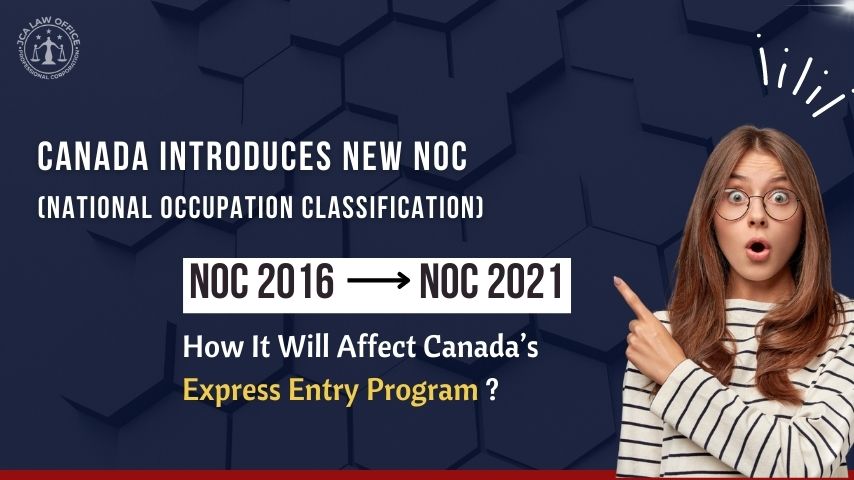
Changes in NOC and Its Effect on Express Entry System
How the NOC 2021 update replaces the four-category skill structure with a six-category TEER system, adds 16 new eligible occupations, and introduces five-digit codification.
How It Will Affect Canada’s Express Entry Program
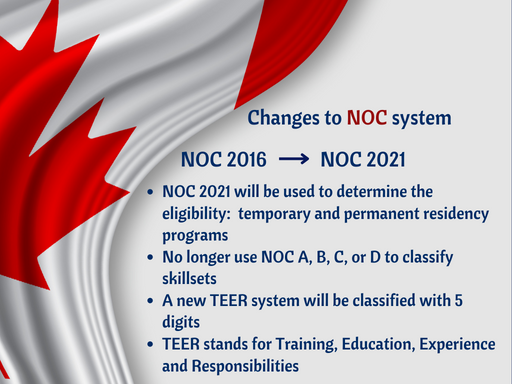
Beginning November 2022, the National Occupational Classification (NOC) 2021 version will be used by the Immigration, Refugees and Citizenship Canada (IRCC) to determine the eligibility of occupations under both temporary and permanent residency programs.
The changes will reflect the following:
Four-category skill level structure replaced by six-category level under the new TEER system
Sixteen additional eligible occupations for Express Entry
Five-digit codification system to replace the current four-digit system
Changes to NOC System
Changes in the Four-Category Skill Structure
The current four-category NOC skill level structure will be replaced by a six-category level that will show the required Training, Education, Experience, and Responsibilities (TEER) for every occupation. The TEER system will assess the level of training, of formal education, of experience required to gain entry into each occupation, and the responsibilities associated to it which is more precise than simply assessing the level of skills.
NOC 2016
NOC 2021
Skill Type 0
Management occupations
TEER 0
Management jobs (usually require a degree)
Skill Type A
Usually require university education
TEER 1
University degree (bachelor’s, master’s, or doctorate); or several years of experience from TEER 2
Skill Type B
Usually require college education, specialized training or apprenticeship
TEER 2
Post-secondary 2-3 years; or apprenticeship 2-5 years; or supervisory/safety roles; or experience from TEER 3
TEER 3
Post-secondary <2 years; or apprenticeship <2 years; or 6+ months on-the-job training; or experience from TEER 4
Skill Type C
Usually require secondary school and/or occupation-specific training
TEER 4
Secondary school completion; or several weeks on-the-job training; or experience from TEER 5
Skill Type D
On-the-job training is usually provided
TEER 5
Short work demonstration and no formal educational requirements
Changes in Occupational Eligibility
With the implementation of NOC 2021, Express Entry Cut Off will be TEER 3. A total of sixteen (16) new occupations will become eligible for Express Entry:
16 New Eligible Occupations
Payroll administrators
Dental assistants and dental laboratory assistants
Nurse aides, orderlies and patient service associates
Pharmacy technical assistants and pharmacy assistants
Elementary and secondary school teacher assistants
Sheriffs and bailiffs
Correctional service officers
By-law enforcement and other regulatory officers
Estheticians, electrologists, and related occupations
Residential and commercial installers and servicers
Pest controllers and fumigators
Other repairers and servicers
Transport truck drivers
Bus drivers, subway operators, and other transit operators
Heavy equipment operators
Aircraft assemblers and aircraft assembly inspectors
On the other hand, three (3) occupations will become ineligible: a) other performers; b) program leaders and instructors in recreation, sport, and fitness; and c) tailors, dressmakers, furriers, and milliners. These occupations may still be eligible for programs with broader eligibility criteria and possible streams under the Provincial Nominee Program.
For the Atlantic Immigration Program (AIP), it is currently open to occupations categorized as Skill Level C or above. For NOC 2021, TEER 4 will be the cut-off for its Express Entry.
Twelve occupations will become ineligible for the AIP: Pet Groomers and animal care workers, Other support occupations in personal services, Longshore workers, Material handlers, Taxi and limousine drivers and chauffeurs, Delivery service drivers and door-to-door distributors, Boat and cable ferry operators and related occupations, Livestock labourers, Nursery and greenhouse labourers, Trappers and hunters, Food and beverage servers, Labourers in textile processing and cutting.
Changes in NOC Codification
NOC 2021 will use the new five-digit codification system as follows:
Hierarchy
Digit Order
Definition
Broad Category
1st Digit X
Occupational categorization
Major Group
2nd Digit XX
TEER categorization
Sub-Major Group
XX.X
Top level of the Sub-Major Group
Minor Group
XX.XX
Hierarchy within the Sub-Major Group
Unit Group
XX.XXX
Hierarchy within the Minor Group
The new codification system will be more flexible as it allows for the incorporation of many new unit groups in the future, as needed. With the changes, new unit groups were created for emerging occupations such as Data scientists and Cybersecurity specialists. Moreover, some occupations were considered statistically sufficient to have their own unit group, such as Financial advisors and Police investigators, and the three distinct unit groups created for Software developers and programmers.
For Filipino families dreaming of reuniting with parents and grandparents in Canada, the Enhanced Super Visa offers one of the most generous visitor programs in the world. Since June 2023, Super Visa holders can stay in Canada for up to 5 years per visit — a major improvement over the previous 2-year limit. This comprehensive 2026 guide covers everything Filipino-Canadian sponsors and their parents need to know: updated income requirements, the new OSFI foreign insurer option, step-by-step application instructions, and tips tailored specifically to applicants from the Philippines.
What Is the Super Visa and What Makes It “Enhanced”?
The Super Visa is a special multi-entry visitor visa designed exclusively for the parents and grandparents of Canadian citizens and permanent residents. Unlike a regular visitor visa that typically authorizes stays of up to 6 months, the Super Visa provides:
Up to 5 years per visit — no need to leave and re-enter every 6 months
Multi-entry validity for up to 10 years (or until passport expiry)
Faster alternative to the Parents and Grandparents Program (PGP) — no lottery, no cap on applications
No limit on the number of times you can enter Canada during the visa’s validity
What Changed in 2023 (The “Enhanced” Super Visa): On June 22, 2023, the Government of Canada enhanced the Super Visa by extending the authorized stay from 2 years to 5 years per visit. This means your parents or grandparents can live with you continuously for up to 5 years before needing to leave Canada, making it far more practical for long-term family reunification.
Super Visa Eligibility Requirements (2026)
Both the applicant (your parent or grandparent) and the host (the Canadian sponsor) must meet specific requirements.
Applicant Requirements (Parent or Grandparent)
Must be the parent or grandparent of a Canadian citizen or permanent resident
Must be admissible to Canada (no criminal inadmissibility or security concerns)
Must pass an immigration medical exam conducted by a designated panel physician
Must hold a valid passport (should be valid for at least the duration of the requested stay)
Must demonstrate ties to their home country (proof they intend to return)
Must have private medical insurance meeting specific requirements (see below)
Must be outside Canada when applying
Host (Sponsor) Requirements
Must be the applicant’s child or grandchild, at least 18 years old
Must be a Canadian citizen, permanent resident, or registered Indian
Must reside in Canada
Must meet or exceed the Minimum Necessary Income (MNI) threshold
Must provide a signed letter of invitation promising financial support
Minimum Necessary Income (MNI) Requirements — Updated July 2025
The Canadian host must demonstrate that their household income meets or exceeds the Low Income Cut-Off (LICO) threshold. These amounts were updated on July 29, 2025, reflecting a 3.9% increase to account for inflation. The income is calculated based on the total family size, which includes the host, their dependants, and the visiting parent(s) or grandparent(s).
How to Calculate Family Size: Count the host + their spouse/partner + their dependent children + the parent(s)/grandparent(s) being invited. For example, if you are married with 2 children and inviting both parents, your family size is 6 (you + spouse + 2 children + 2 parents).
Total Family Size
Minimum Necessary Income (CAD)
1 person
$30,526
2 persons
$38,002
3 persons
$46,720
4 persons
$56,724
5 persons
$64,336
6 persons
$72,560
7 persons
$80,784
Each additional person
+$8,224
Source: IRCC — Effective July 29, 2025. Based on the Low Income Cut-Off (LICO) for urban areas with 500,000+ population.
Important for Filipino Families: If multiple family members are pooling income to meet the threshold, only income earned by the host and their spouse or common-law partner counts. Income from the visiting parent or other relatives living in the household does not qualify. Your most recent Notice of Assessment (NOA) from the Canada Revenue Agency is the primary proof document.
Acceptable Proof of Income Documents
Notice of Assessment (NOA) — most recent, issued by the Canada Revenue Agency
T4 or T1 tax returns — for the most recent tax year
Employment letter — confirming position, salary, and length of employment
Recent pay stubs — covering the last 12 months
Bank statements — showing regular income deposits
Employment Insurance (EI) statements — if applicable
Self-employment documentation — letter from accountant with income details
Pension or investment income statements
Medical Insurance Requirements — Including the 2025 OSFI Change
One of the key differences between a Super Visa and a regular visitor visa is the mandatory private medical insurance requirement. Here is what you need to know for 2026:
Insurance Coverage Requirements
Requirement
Details
Minimum Coverage
$100,000 CAD
Validity Period
Minimum 1 year from the date of each entry to Canada
Coverage Must Include
Healthcare, hospitalization, and repatriation
Payment Status
Policy must be fully paid or have a deposit paid (quotes are not accepted)
Eligible Providers
Canadian insurance companies OR OSFI-authorized foreign insurers
2025 OSFI Change: Foreign Insurers Now Accepted
New as of January 28, 2025: IRCC now accepts private health insurance policies from foreign insurance companies authorized by the Office of the Superintendent of Financial Institutions (OSFI). Previously, only Canadian-based insurance companies were accepted. This change makes the Super Visa more accessible and potentially more affordable for Filipino families.
To qualify, the foreign insurer must:
Be authorized by OSFI to provide accident and sickness insurance
Appear on OSFI’s list of federally regulated financial institutions
Issue the policy under its insurance business in Canada
You can verify whether a foreign insurer is OSFI-authorized by checking OSFI’s website at www.osfi-bsif.gc.ca.
Tip for Filipino Families: Super Visa medical insurance typically costs between $1,000 and $5,000 per year, depending on the applicant’s age and health conditions. Comparing quotes from both Canadian and OSFI-authorized foreign insurers can help you find the best rate. Applicants over 70 years old generally face higher premiums. Be sure your policy is paid (not just quoted) before submitting your application.
Required Documents Checklist
Prepare all of the following documents before submitting your Super Visa application:
Documents from the Applicant (Parent/Grandparent in the Philippines)
☑ Valid Philippine passport (valid for at least 1 year beyond planned entry date)
☑ Completed application forms — IMM 5257 (Application for Visitor Visa) and IMM 5645 (Family Information Form)
☑ Two recent passport-sized photos (per IRCC photo specifications)
☑ Proof of relationship — birth certificate of the Canadian host showing the applicant as parent, or other official documents establishing the relationship
☑ Immigration medical exam results — from an IRCC-designated panel physician in the Philippines
☑ Private medical insurance policy — meeting all requirements listed above (paid, not quoted)
☑ Proof of ties to the Philippines — property ownership, bank accounts, employment, pension, family members remaining
☑ Travel history — previous visas or stamps in current and old passports
☑ Biometrics — fingerprints and photo at a designated collection point
Documents from the Host (Canadian Sponsor)
☑ Signed letter of invitation — promising financial support for the duration of the visit, listing all family members included in the income calculation with their names, dates of birth, and relationship
☑ Proof of Canadian status — Canadian citizenship certificate, permanent resident card, or Indian Status card
☑ Proof of income — Notice of Assessment (NOA), T4/T1 forms, employment letter, pay stubs, bank statements
☑ Proof of residence in Canada — utility bills, lease agreement, or mortgage statement
☑ Birth certificate — showing relationship to the applicant (host’s birth certificate listing applicant as parent)
Step-by-Step Application Process
Follow these steps to submit a successful Super Visa application:
Step 1: Confirm Eligibility and Calculate Family Size
Before gathering documents, confirm that the Canadian host meets the MNI threshold. Count everyone who will be included in the family size: the host, their spouse or common-law partner, their dependent children, and the parent(s) or grandparent(s) being invited. Check the MNI table above to confirm the income requirement.
Step 2: Schedule the Immigration Medical Exam
The applicant must undergo a medical exam with an IRCC-designated panel physician in the Philippines. Medical results are valid for 12 months. You can find designated panel physicians in Manila and other Philippine cities on the IRCC website. Schedule this early as appointments may have wait times.
Step 3: Purchase Medical Insurance
Obtain a private medical insurance policy that meets all Super Visa requirements: minimum $100,000 coverage, at least 1 year validity, covering healthcare, hospitalization, and repatriation. The policy must be paid (or have a deposit paid) — insurance quotes alone are not accepted. You may now purchase from Canadian insurers or OSFI-authorized foreign insurers.
Step 4: Gather All Supporting Documents
Collect all documents from both the applicant and the host as listed in the checklist above. Ensure all documents are current and that translations are provided for any documents not in English or French.
Step 5: Complete the Application Forms
Fill out the required forms completely — do not leave any sections blank. Key forms include:
IMM 5257 — Application for Temporary Resident Visa
IMM 5645 — Family Information Form
IMM 5409 — Statutory Declaration of Common-Law Union (if applicable)
Document Checklist (IMM 5484)
Step 6: Submit Online and Pay Fees
Create an account on the IRCC online portal and submit the application with all supporting documents. Pay the application processing fee and biometrics fee online.
Step 7: Provide Biometrics
After submitting the application, you will receive a Biometrics Instruction Letter. The applicant must then visit a designated biometrics collection point in the Philippines to provide fingerprints and a photograph. Biometrics are valid for 10 years.
Step 8: Wait for Processing and Decision
IRCC will process the application. If approved, the applicant will be asked to submit their passport for visa stamping. If additional information is needed, IRCC will send a request letter.
Processing Times and Fees
Application Fees
Fee Type
Amount (CAD)
Application Processing Fee
$100
Biometrics Fee
$85
Total Government Fees
$185
Medical Exam (approximate, Philippines)
$200 – $300
Medical Insurance (annual, varies by age)
$1,000 – $5,000
Government fees are in Canadian dollars. Medical exam fees vary by panel physician. Insurance costs depend on age, health, and provider.
Processing Times from the Philippines
As of the most recent IRCC data, Super Visa applications from the Philippines are typically processed within 95 to 116 days (approximately 13 to 17 weeks). The IRCC service standard is 112 days, with a goal of processing 80% of applications within this timeframe.
Planning Tip: Allow at least 4 to 5 months from the time you start preparing documents to when you expect your parents or grandparents to arrive. This accounts for medical exam scheduling, document gathering, application processing, and passport submission for visa stamping. If you are planning for a specific occasion (e.g., a grandchild’s baptism or graduation), start the process well in advance.
Super Visa vs. Regular Visitor Visa: Comparison
Understanding the differences between the Super Visa and a regular visitor visa helps you choose the right option for your family:
Feature
Super Visa
Regular Visitor Visa (TRV)
Who Can Apply
Parents and grandparents only
Anyone with a valid purpose of visit
Authorized Stay Per Visit
Up to 5 years
Up to 6 months
Visa Validity
Up to 10 years (multi-entry)
Up to 10 years (multi-entry)
Medical Insurance Required
Yes — $100,000 minimum, 1 year
No (recommended but not required)
Medical Exam Required
Yes — mandatory
No (unless requested by IRCC)
Host Income Requirement
Yes — must meet MNI/LICO
No formal income threshold
Application Fee
$100 + $85 biometrics
$100 + $85 biometrics
Can Extend Stay in Canada
Yes
Yes (must apply before status expires)
Work Permit Eligibility
No
No
Path to PR
No (separate PGP application needed)
No
Our Recommendation: If your parents or grandparents plan to stay for more than 6 months, the Super Visa is almost always the better choice. The additional requirements (medical insurance and income proof) are well worth the benefit of a 5-year authorized stay. For short visits of a few weeks or months, a regular visitor visa may be simpler and more cost-effective.
Tips for Filipino Families Applying for the Super Visa
Based on our experience helping Filipino-Canadian families with Super Visa applications, here are practical tips to improve your chances of approval:
1. Demonstrate Strong Ties to the Philippines
Even though the Super Visa allows a 5-year stay, your parents must still demonstrate they intend to return to the Philippines. Include evidence such as property ownership (land titles, tax declarations), active bank accounts, pension payments from SSS or GSIS, or family members remaining in the Philippines.
2. Write a Strong Invitation Letter
The letter of invitation is a critical document. It should be detailed and personal — explain why your parents are visiting (e.g., to help with a new baby, attend a family milestone, spend time with grandchildren). Include your commitment to financially support them during their stay.
3. Prepare Income Documents Carefully
If you are close to the MNI threshold, include multiple forms of income proof — not just your NOA. Supplementing with T4s, pay stubs, an employment letter, and bank statements creates a stronger financial profile. If your spouse also works, include their income documentation as well.
4. Get the Medical Exam Done Early
Schedule the immigration medical exam as soon as you begin the application process. Panel physician appointments in Manila and Cebu can have wait times, and results are valid for 12 months, so there is no disadvantage to completing this step early.
5. Do Not Submit a Bare-Minimum Application
Visa officers process thousands of applications. A well-organized, complete application with clear supporting documents stands out. Use a document cover page listing all enclosed items, and organize documents in the same order as the checklist.
6. Compare Insurance Quotes — Including Foreign Insurers
With the January 2025 OSFI change, you now have more options for medical insurance. Compare quotes from both Canadian and OSFI-authorized foreign insurers. Some Filipino families have found more affordable coverage through international providers. Just ensure the company is on the OSFI authorized list before purchasing.
Common Reasons for Super Visa Refusal
Understanding why applications get refused can help you avoid common pitfalls. In 2024, over 54% of all temporary resident visa applications to Canada were refused. The most common reasons for Super Visa refusals include:
1. Insufficient Proof of Income
The host’s income falls below the MNI threshold, or the income documentation is weak, inconsistent, or incomplete. Always verify your family size calculation and ensure your income clearly exceeds the minimum.
2. Inadequate Ties to Home Country
The visa officer is not convinced that the applicant will return to the Philippines. This is especially challenging for applicants who have children in Canada and few immediate family members remaining in the Philippines. Provide strong evidence of property, financial assets, community involvement, or obligations in the Philippines.
3. Medical Insurance Issues
The insurance policy does not meet requirements — it may have insufficient coverage, be from a non-qualifying insurer, not cover the required categories (healthcare, hospitalization, repatriation), or only be a quote rather than a paid policy.
4. Incomplete or Inconsistent Application
Missing forms (such as IMM 5257), blank fields, unsigned declarations, or information that conflicts between documents. Double-check every form before submission.
5. Failed Medical Exam
Certain medical conditions may result in inadmissibility. If your parent has a pre-existing condition, consult with an immigration lawyer before applying to understand the potential implications.
6. Purpose of Visit Not Consistent with Super Visa
If the officer believes the true purpose of the visit is not a family visit — for example, if there is evidence the applicant intends to work in Canada or not return to their home country — the application may be refused.
Frequently Asked Questions
Can my parents work in Canada on a Super Visa?
No. The Super Visa is a visitor visa only. Your parents or grandparents are not authorized to work in Canada. If they wish to work, they would need a separate work permit, which is not typically available under these circumstances.
Can I invite both parents at the same time?
Yes. Each parent must submit a separate application with their own medical exam and insurance policy. Both parents are included in the family size calculation for the income requirement. For example, inviting both parents would add 2 to your family size.
What happens if my parent’s insurance expires while they are in Canada?
Super Visa holders must maintain valid medical insurance at all times while in Canada. If the policy expires, it must be renewed before it lapses. Failure to maintain insurance could affect future entries or extensions. Many Canadian insurers offer renewal options for existing policyholders.
Can my parent apply for the Super Visa from inside Canada?
No. Super Visa applications must be submitted from outside Canada. If your parent is already in Canada on a visitor visa, they would need to leave Canada, apply for the Super Visa from the Philippines (or another country), and wait for approval before re-entering.
Is the Super Visa the same as the Parents and Grandparents Program (PGP)?
No. The PGP is a permanent residence program that grants your parents PR status in Canada. The Super Visa is a temporary visitor visa that allows extended stays. Many families apply for the Super Visa while waiting for the PGP lottery or while their PGP application is in progress.
Do visa-exempt nationals need a Super Visa?
Citizens of visa-exempt countries (such as those with dual citizenship in countries like the US) can still apply for the Super Visa to get the 5-year authorized stay benefit. Without a Super Visa, visa-exempt nationals are typically only authorized to stay for 6 months. Note: Philippine passport holders are not visa-exempt and must obtain a visa.
Can I sponsor my parents for the Super Visa if I am a temporary resident (e.g., on a work permit)?
No. The host must be a Canadian citizen, permanent resident, or registered Indian. If you are on a work permit, study permit, or any other temporary status, you do not qualify to host a Super Visa applicant. You would need to obtain permanent residence first.
What if my income is slightly below the MNI threshold?
If your income is below the required threshold, your application will likely be refused. Consider whether your spouse or common-law partner’s income can be added (their income counts toward the household total). If you still fall short, you may need to wait until your income increases or explore a regular visitor visa instead.
How JCA Law Office Can Help
At JCA Law Office Professional Corporation, we have extensive experience helping Filipino-Canadian families reunite with their parents and grandparents through the Super Visa program. Our immigration team understands the unique challenges Filipino families face — from navigating Philippine document requirements to building strong applications that address common refusal reasons.
Our Super Visa services include:
Eligibility assessment — We review your income, family size, and circumstances to confirm you meet all requirements
Document preparation — We prepare and organize all application forms and supporting documents
Invitation letter drafting — We help craft a compelling invitation letter that satisfies IRCC requirements
Insurance guidance — We advise on compliant insurance options, including OSFI-authorized foreign insurers
Application submission and follow-up — We submit the application and monitor its progress
Refusal response — If a previous application was refused, we analyze the refusal reasons and prepare a stronger re-application
Book Your Super Visa Consultation Today
Let our team guide your family through the Super Visa application process. We serve Filipino-Canadian families across the Greater Toronto Area and throughout Ontario.
Disclaimer: This guide is for informational purposes only and does not constitute legal advice. Immigration laws and policies change frequently. For advice specific to your situation, please consult with a qualified immigration lawyer. Information is current as of February 2026, based on IRCC policies and the MNI thresholds effective July 29, 2025.
For Filipino workers and international graduates looking to build a future in Canada, the Atlantic Immigration Program (AIP) offers one of the most accessible and streamlined pathways to permanent residence. Designed specifically for Atlantic Canada’s four provinces — New Brunswick, Nova Scotia, Prince Edward Island, and Newfoundland and Labrador — the AIP connects skilled foreign workers with employers who need them, while providing personalized settlement support to help newcomers thrive.
Unlike Express Entry’s competitive points-based ranking, the AIP is employer-driven — meaning a qualifying job offer from a designated employer is your ticket to permanent residence. With lower language requirements, no LMIA needed, and dedicated settlement services, the AIP is particularly well-suited for Filipino immigrants who have connections to Atlantic Canada or are open to building a new life in one of Canada’s most welcoming regions.
Updated February 2026: The Atlantic Immigration Program (AIP) became a permanent program on January 1, 2022, replacing the Atlantic Immigration Pilot. Under Canada’s 2026-2028 Immigration Levels Plan, the AIP is allocated approximately 4,000 admissions annually, with priority given to healthcare, skilled trades, construction, and French-speaking workers.
What Is the Atlantic Immigration Program (AIP)?
The Atlantic Immigration Program is a permanent federal immigration pathway that helps employers in Atlantic Canada hire qualified foreign nationals for positions they have been unable to fill locally. Originally launched as the Atlantic Immigration Pilot Program (AIPP) in 2017, the program was made permanent on January 1, 2022, reflecting its success in attracting and retaining immigrants to the region.
The AIP stands out from other Canadian immigration programs in several key ways:
Employer-driven: You need a job offer from a designated Atlantic employer — no points-based competition
No LMIA required: Designated employers are exempt from the Labour Market Impact Assessment (LMIA) process
Lower language requirements: As low as CLB 4 for intermediate-skilled positions (compared to CLB 7 for Express Entry)
Settlement support: Every applicant receives a personalized settlement plan through a designated service provider
Work while you wait: You can apply for an employer-specific work permit while your PR application is processed
Family included: Spouse/partner and dependent children are included in your PR application
Eligible Provinces
The AIP operates exclusively in Canada’s four Atlantic provinces:
New Brunswick — Largest Atlantic province by land area, with growing healthcare and IT sectors
Nova Scotia — Home to Halifax, the region’s largest city, with strong demand in healthcare and skilled trades
Prince Edward Island (PEI) — Canada’s smallest province, prioritizing healthcare, construction, and manufacturing workers
Newfoundland and Labrador — Resource-rich province with opportunities in healthcare, offshore energy, and aquaculture
AIP Eligibility Requirements
The Atlantic Immigration Program has unified eligibility requirements organized by NOC 2021 TEER categories (Training, Education, Experience, and Responsibilities). Your requirements depend on the TEER level of your job offer.
Who Can Apply
You may qualify for the AIP if you are a skilled worker with qualifying work experience, or a recent international graduate from a recognized post-secondary institution in Atlantic Canada. You can be living abroad or already in Canada as a temporary resident.
Requirements by TEER Category
The following table summarizes the eligibility requirements based on the TEER level of your job offer:
Requirement
TEER 0 & 1 (Management & Professional)
TEER 2 & 3 (Technical & Skilled)
TEER 4 (Intermediate)
Language (CLB/NCLC)
Minimum CLB 5
Minimum CLB 5
Minimum CLB 4
Education
Canadian 1-year+ post-secondary credential OR foreign equivalent with ECA
Canadian high school diploma OR foreign equivalent with ECA
Canadian high school diploma OR foreign equivalent with ECA
Work Experience
1,560 hours (min. 12 months) in past 5 years in TEER 0-4
1,560 hours (min. 12 months) in past 5 years in TEER 0-4
1,560 hours (min. 12 months) in past 5 years in TEER 0-4
Job Offer Duration
Minimum 1 year from PR date
Minimum 1 year from PR date
Permanent (no end date)
Job Offer Type
Full-time (30+ hrs/week), non-seasonal
Full-time (30+ hrs/week), non-seasonal
Full-time (30+ hrs/week), non-seasonal
Important Note for International Graduates: If you graduated from a recognized post-secondary institution in Atlantic Canada (program of at least 2 years), you are exempt from the work experience requirement — provided you completed your credential within the past 2 years and lived in the Atlantic region for at least 16 months during the last 2 years of study. This is a significant advantage for Filipino students studying in the Atlantic provinces.
Language Requirements in Detail
You must take an approved language test and achieve the minimum CLB level for your job offer’s TEER category. Test results must be less than 2 years old at the time of application.
Test
CLB 4 (TEER 4)
CLB 5 (TEER 0-3)
IELTS General
L: 4.5 / R: 3.5 / W: 4.0 / S: 4.0
L: 5.0 / R: 4.0 / W: 5.0 / S: 5.0
CELPIP General
L: 4 / R: 4 / W: 4 / S: 4
L: 5 / R: 5 / W: 5 / S: 5
TEF Canada (French)
L: 145-216 / R: 121-150 / W: 181-225 / S: 181-225
L: 217-248 / R: 151-180 / W: 226-270 / S: 226-270
Work Experience Requirements
You need a minimum of 1,560 hours of qualifying work experience accumulated over at least 12 months within the last 5 years. Your experience must be in a TEER 0, 1, 2, 3, or 4 occupation. The following types of work do not count:
Self-employment
Unpaid or volunteer work
Work performed while you were a full-time student (unless through a co-op program)
Remember: International graduates from Atlantic Canadian institutions who meet the exemption criteria do not need to show work experience.
Job Offer Requirements
The AIP is an employer-driven program, which means you must receive a genuine job offer from a designated employer in one of the four Atlantic provinces. Your job offer must meet these criteria:
Full-time: At least 30 paid hours per week
Non-seasonal: Consistent, regularly scheduled employment throughout the year
TEER 0-3 positions: Job must last at least 1 year from the date you become a permanent resident
TEER 4 positions: Job must be permanent (no set end date)
NOC TEER 0 through 4: The position must fall within these skill levels under the NOC 2021 classification
Good News for Filipino Workers: Many occupations commonly held by Filipino immigrants in Atlantic Canada qualify under the AIP, including positions in healthcare (personal care attendants, licensed practical nurses), food services, fish and seafood processing, trucking, and skilled trades. The AIP’s acceptance of TEER 4 occupations opens doors that programs like Express Entry do not.
Employer Designation Process
Before an employer can make you a job offer under the AIP, they must first become a designated employer through their provincial government. The designation process ensures that employers are legitimate and committed to supporting newcomers.
Employer Requirements
Must have been operating in Atlantic Canada for at least 2 years
Must be in good standing and comply with employment standards and occupational health and safety legislation
Must not be in violation of the Immigration and Refugee Protection Act (IRPA) or its regulations
Must commit to working with a settlement service provider organization to support the newcomer
Must apply for designation through the province where the position is located
How Designation Works
The employer applies for designation through the provincial government website
There is no cost to become a designated employer
The province reviews the application and, if approved, grants designation
Once designated, the employer can make job offers to foreign nationals under the AIP
The employer then submits an endorsement application to the province on behalf of the candidate
Each province manages its own designation process. You can find the application forms on the respective provincial websites:
One of the unique features of the AIP is the mandatory settlement plan. Before your employer can submit an endorsement application, you must connect with a designated settlement service provider organization to develop a personalized settlement plan.
What the Settlement Plan Covers
Community orientation: Information about your new community, including housing, transportation, and local services
Language training: Assessment of language needs and referral to language programs if needed
Labour market information: Help understanding the local job market and workplace culture
Social connections: Introduction to community groups, cultural organizations, and support networks
Education: Information about schools for children and credential recognition
Healthcare: How to register for provincial health insurance and find a family doctor
The settlement plan is developed at no cost to you. It is designed to help you and your family integrate successfully into your new community. This is particularly valuable for Filipino families who are new to Canada and want guidance navigating life in Atlantic Canada.
For Filipino Families: The settlement plan is especially helpful if you are bringing your spouse and children. The service provider can help connect your family with Filipino community groups in Atlantic Canada, Tagalog-speaking support services, and cultural organizations that can ease the transition. The AIP’s retention rate of 78% in the second year — higher than other immigration pathways — is largely attributed to this settlement support.
Settlement Funds (Proof of Funds)
Unless you are already working in Canada on a valid work permit, you must demonstrate that you have sufficient funds to support yourself and your family when you arrive. The required amounts are based on 12.5% of Canada’s Low-Income Cut-Off (LICO) and are updated annually by IRCC.
Minimum Settlement Funds (Effective July 29, 2025)
Family Size
Required Funds (CAD)
1 member (applicant alone)
$3,815
2 members
$4,749
3 members
$5,838
4 members
$7,090
5 members
$8,040
6 members
$9,069
7 or more members
$10,098
Each additional member
+$1,029
Key rules for proof of funds:
Funds must be readily accessible (cash, savings, or guaranteed investment certificates)
Must consist of personal savings only — borrowed funds do not qualify
Cannot include non-liquid assets such as property, vehicles, or investments that cannot be quickly converted to cash
You must provide official bank letters showing current balances and transaction history
Funds must be available both when you apply and when your visa is issued
Exemption: You are exempt from proving settlement funds if you are already working in Canada on a valid work permit
Required Documents
Preparing a complete and well-organized application is critical to avoiding delays and refusals. Here is a comprehensive checklist of documents you will need:
Identity and Status Documents
Valid passport (for you and all accompanying family members)
Birth certificate (PSA-issued for Filipino applicants)
Marriage certificate or proof of common-law relationship (if applicable)
Divorce or annulment documents (if applicable)
National identity card
Two passport-sized photographs meeting IRCC specifications
AIP-Specific Documents
Provincial endorsement certificate (issued by the province after employer applies)
Job offer letter from designated employer (using IRCC form)
Settlement plan (from designated settlement service provider)
Education Documents
Educational credential(s) — diploma, degree, or certificate
Educational Credential Assessment (ECA) report from a designated organization (for foreign credentials)
Transcripts
Work Experience Documents
Reference letters from past employers (on company letterhead, detailing duties, hours, and dates)
Employment contracts
Pay stubs or proof of compensation
Language and Financial Documents
Language test results (IELTS, CELPIP, TEF, or TCF — less than 2 years old)
Proof of funds — official bank letters with balances and transaction history
Other Documents
Police clearance certificates (from every country you have lived in for 6+ months since age 18 — for Filipino applicants, this means NBI Clearance from the Philippines)
Medical examination results (from an IRCC-designated panel physician)
Biometrics (fingerprints and photo — provided at a collection point after receiving instructions from IRCC)
Application Process: Step by Step
The AIP application involves coordination between you, your employer, the province, a settlement service provider, and IRCC. Here is the complete process:
Step 1: Find a Designated Employer and Receive a Job Offer
Your employer must already be designated under the AIP (or apply for designation). Once they identify you as a candidate, they will provide you with a written job offer that meets AIP requirements. The job must be full-time, non-seasonal, and in an eligible NOC TEER category.
Step 2: Develop Your Settlement Plan
Connect with a designated settlement service provider in the province where you will be working. They will assess your needs and create a personalized settlement plan covering housing, language training, community integration, and more. This step is mandatory and must be completed before your employer can submit the endorsement application.
Step 3: Employer Submits Endorsement Application
Your employer submits an endorsement application to the provincial government, including your settlement plan and job offer details. The province reviews the application to ensure the position is genuine and the employer meets all requirements.
Note: As of May 1, 2025, the AIP endorsement application process moved to a new online system called LaMPSS. Employers must now submit endorsement applications through this updated portal.
Step 4: Receive Provincial Endorsement
If approved, the province issues a provincial endorsement certificate. This certificate confirms that the province supports your application and is essential for your federal PR application. You will also receive a work permit support letter if you need to start working before your PR is approved.
Step 5: Apply for Permanent Residence
With your endorsement certificate in hand, submit your permanent residence application to IRCC online. Include all required documents, pay the applicable fees, and provide biometrics when requested.
Step 6: Apply for a Work Permit (Optional)
If you want to start working while your PR application is being processed, you can apply for an employer-specific work permit. You will need your job offer letter, provincial endorsement, and a work permit support letter from the province. This work permit is LMIA-exempt.
Step 7: Medical Exam and Biometrics
Complete your immigration medical examination with an IRCC-designated panel physician and provide biometrics (fingerprints and photo) at a designated collection point. IRCC will send you instructions after receiving your application.
Step 8: Receive Your Confirmation of Permanent Residence (COPR)
Once IRCC approves your application, you will receive your Confirmation of Permanent Residence (COPR) and, if applicable, a permanent resident visa. You can then travel to Canada (or confirm your PR status if already in Canada) and begin your new life in Atlantic Canada.
Processing Times and Fees
Processing Times
IRCC’s service standard for AIP applications is 6 months (approximately 180 days). However, actual processing times have varied significantly in recent periods. As of January 2026, the reported processing time is approximately 33 months for some applications, though this reflects a backlog that IRCC is actively working to reduce.
Important: Processing times fluctuate and depend on application volume, completeness of your application, and whether additional documents or verifications are required. The best way to minimize delays is to submit a complete and accurate application with all required supporting documents. Working with an experienced immigration lawyer can significantly reduce the risk of delays caused by incomplete or improperly prepared applications.
Fee Breakdown
Fee Type
Principal Applicant
Spouse/Partner
Dependent Child
Processing Fee
$1,525
$950
$260
Right of Permanent Residence Fee (RPRF)
$575
$575
Exempt
Biometrics
$85 per person / $170 maximum per family
Total Cost Examples
Scenario
Government Fees (CAD)
Single applicant
$2,185 (processing + RPRF + biometrics)
Applicant + spouse
$3,795 (both processing + both RPRF + family biometrics)
Applicant + spouse + 1 child
$4,055 (all processing + RPRF for adults + family biometrics)
Applicant + spouse + 2 children
$4,315 (all processing + RPRF for adults + family biometrics)
Additional costs to budget for:
Language test (IELTS/CELPIP): approximately $300-$400
Educational Credential Assessment (ECA): approximately $200-$350
Police clearance certificates (NBI Clearance for Philippines): approximately $10-$20
Medical examination: approximately $200-$450 per person
Under Canada’s 2026-2028 Immigration Levels Plan, the Atlantic Immigration Program is allocated approximately 4,000 admissions annually. This reflects the federal government’s continued commitment to supporting population growth and labour market needs in Atlantic Canada.
Year
Total PR Admissions (Canada)
AIP Allocation
Economic Class Share
2026
380,000
~4,000
64% by 2027-2028
2027
380,000
~4,000
64%
2028
380,000
~4,000
64%
Key trends for AIP under the new levels plan:
Stable allocations: The 4,000 annual target provides predictability for employers and applicants
Priority sectors: Healthcare, skilled trades, construction, and French-speaking roles are prioritized
Focus on retention: The AIP’s built-in settlement support continues to produce strong retention rates
Workers already in Canada: IRCC has signaled a stronger focus on transitioning temporary workers already in Canada to permanent residence
In-Demand Occupations in Atlantic Canada
Atlantic Canada is experiencing significant labour shortages across multiple sectors. The following occupations are particularly in demand and align well with the skills many Filipino workers bring:
Healthcare
Licensed Practical Nurses (LPNs)
Registered Nurses (RNs)
Nurse Practitioners (NPs)
Personal Care Attendants / Personal Support Workers
AIP vs. Express Entry vs. Provincial Nominee Programs
Understanding how the AIP compares to other major immigration pathways can help you determine the best route for your situation:
Feature
AIP
Express Entry (CEC/FSW)
Provincial Nominee (PNP)
Points-based ranking
No
Yes (CRS)
Varies by stream
Job offer required
Yes (designated employer)
No (but adds 50-200 CRS points)
Varies by stream
LMIA required
No
Yes (if claiming job offer points)
Varies
Min. language (CLB)
CLB 4-5
CLB 7 (FSW) / CLB 7 (CEC)
Varies (often CLB 4-6)
Settlement plan
Yes (mandatory)
No
No
Work experience needed
1,560 hrs / 5 yrs (exemptions for grads)
1 yr Canadian (CEC) or 1 yr foreign (FSW)
Varies
Geographic restriction
Atlantic Canada (4 provinces)
Anywhere in Canada
Nominating province
Processing time (standard)
6 months
6 months
15-22 months
Best for
Workers with Atlantic employer connections
High-scoring skilled workers
Workers with provincial ties
When AIP Is the Better Choice
You have a job offer from an Atlantic Canada employer
Your CRS score is too low for Express Entry draws (typically 470+)
You work in a TEER 4 occupation that does not qualify for Express Entry
Your language scores are below CLB 7 but meet CLB 4 or 5
You are an international graduate from an Atlantic Canadian institution
You value the personalized settlement support the AIP provides
Benefits for Filipino Applicants
The Atlantic Immigration Program offers several distinct advantages for Filipino immigrants:
Growing Filipino Community
Atlantic Canada’s Filipino community has grown significantly in recent years. Cities like Halifax (Nova Scotia), Moncton and Saint John (New Brunswick), Charlottetown (PEI), and St. John’s (Newfoundland) all have active Filipino community organizations, churches, and cultural groups. The growing community means access to familiar food, cultural celebrations like Flores de Mayo and Noche Buena gatherings, and a support network of kababayan who have navigated the same immigration journey.
Lower Cost of Living
Compared to major metropolitan areas like Toronto and Vancouver, Atlantic Canada offers a significantly lower cost of living. Housing is more affordable, allowing Filipino families to save more and send remittances home. A family that might struggle to afford a condo in Toronto can often purchase a house in Atlantic Canada for a fraction of the cost.
Skills Match
Many of the occupations in highest demand in Atlantic Canada align with the professional backgrounds of Filipino workers — healthcare, caregiving, food services, skilled trades, and seafood processing. Filipino nurses, personal support workers, and caregivers are particularly well-positioned to find employment through the AIP.
Pathway for Caregivers and Health Workers
For Filipino caregivers and healthcare workers who may not qualify for other immigration programs, the AIP’s acceptance of TEER 4 occupations (with CLB 4 language requirement) provides a viable path to permanent residence that other programs do not offer.
Frequently Asked Questions (FAQ)
Can I apply to the AIP without a job offer?
No. The AIP is an employer-driven program, and a valid job offer from a designated employer in Atlantic Canada is mandatory. You cannot apply independently without an employer. However, JCA Law Office can help you understand how to connect with designated employers and position yourself as a strong candidate.
Can I bring my family with me?
Yes. Your spouse or common-law partner and dependent children can be included in your permanent residence application. They will also benefit from the settlement plan services.
Can I work while my PR application is being processed?
Yes. Once you receive your provincial endorsement and a work permit support letter, you can apply for an employer-specific work permit that is LMIA-exempt. This allows you to start working for your designated employer while IRCC processes your PR application.
Do I have to stay in Atlantic Canada permanently?
The AIP is designed to address labour market needs in Atlantic Canada, and the expectation is that you will live and work in the province that endorsed you. However, as a permanent resident of Canada, you have the legal right to live and work anywhere in the country under the Canadian Charter of Rights and Freedoms. That said, maintaining ties to your endorsing province — especially during the early years — demonstrates good faith and supports the program’s goals.
What happens if I lose my job after getting PR?
Your permanent residence status is not tied to your specific employer. Once you become a permanent resident, you are free to seek other employment. The AIP settlement service provider can also assist you with job search support if needed.
Is the AIP the same as the old Atlantic Immigration Pilot Program (AIPP)?
The AIP replaced the AIPP on January 1, 2022, when it became a permanent program. While the core structure is similar, the permanent program has been refined with improved processes, updated TEER categories (replacing the old NOC skill levels), and the new LaMPSS endorsement portal.
Can I apply from the Philippines?
Yes. You can apply from abroad or from within Canada. If you are in the Philippines, you will need to obtain your NBI Clearance, complete your medical exam with an IRCC-designated panel physician in the Philippines, and provide biometrics at the nearest collection point. Your employer in Atlantic Canada will handle the endorsement process with the province.
How JCA Law Office Can Help
Navigating the Atlantic Immigration Program involves coordination between multiple parties — your employer, the provincial government, a settlement service provider, and IRCC. At JCA Law Office Professional Corporation, we provide comprehensive legal support at every stage of the process:
Eligibility assessment: We evaluate your qualifications, work experience, and language scores to determine if the AIP is the right pathway for you
Employer guidance: We help employers understand the designation process and endorsement requirements
Application preparation: We prepare your complete PR application package, ensuring all documents are properly organized and meet IRCC requirements
Document review: We review your job offer, settlement plan, and endorsement materials for compliance
Work permit applications: We assist with temporary work permit applications so you can start working while your PR is processed
Filipino-specific support: As a firm deeply connected to the Filipino-Canadian community, we understand the unique challenges Filipino applicants face — from obtaining NBI Clearances and PSA documents to navigating credential recognition
Ongoing communication: We manage correspondence with IRCC on your behalf and keep you informed of your application status
Ready to Start Your AIP Application?
Whether you are a skilled worker in the Philippines looking for opportunities in Atlantic Canada, or an international graduate from an Atlantic Canadian institution ready to settle permanently, JCA Law Office can guide you through every step of the Atlantic Immigration Program.
This guide was last updated on February 8, 2026. Immigration programs, fees, and processing times are subject to change. Always verify current requirements with IRCC or consult with an immigration lawyer for personalized advice. JCA Law Office Professional Corporation provides immigration legal services to the Filipino-Canadian community in the Greater Toronto Area and across Canada.
Food services workers can now apply to Nova Scotia Occupations in Demand PNP
Through its Occupations in Demand Stream, Nova Scotia is now accepting immigration applications from Food Services workers. As we all know, the pandemic hit the restaurant industry hard. As a result, places such as Nova Scotia province have been experiencing labour shortages in the Food Services Industry. To address this issue, Nova Scotia added 3 new eligible occupations to its Occupations in Demand immigration stream. These new eligible occupations are listed below in order of their NOC (National Occupation Classification) code:
NOC 6513 (Food and beverage servers)
NOC 6711 (Food counter attendants, kitchen helpers, and related support occupations)
NOC 6731 (Light duty cleaners)
Based on the above codes, employers will be able to hire you without needing to do an LMIA (Labour Market Impact Assessment). Also, according to the media release, you, as the employee, will not need to work with the employer for six months before applying to PNP (Nova Scotia Provincial Nominee Program) as was the case in the past.
We are excited to welcome newcomers who can help employers meet their labour needs and grow Nova Scotia’s population. The tourism, restaurant, and Hospitality sectors are critical to our economy. These changes will help these industries hire workers they need to prepare for a busy tourism season.
Jill Balser, Nova Scotia’s immigration minister
Nova Scotia’s Occupations in demand stream targets specific occupations that fall under NOC skill levels C and D. These skill levels have historically been called “low-skilled” or “unskilled” occupations, but due to the pandemic, the preference has now been to call them “essential” occupations.
As of July 1, Nova Scotia’s population was at an all-time 992,055 high, which the province credits to increased immigration into Nova Scotia due the need for hiring into “essential occupations”. Bear in mind, this population figure is still considerably lower than Ontario.
What is the eligibility for the Occupations in Demand stream?
In order to apply for a provincial nomination from Nova Scotia through the Occupations in Demand stream, you need to have a full-time job offer in one of the following occupations:
NOC 3413 (Nurse aides, orderlies, and patient service associates)
NOC 6513 (Food and beverage servers)
NOC 6711 (Food counter attendants, kitchen helpers, and related support occupations)
NOC 7611 (Construction trades helpers and labourers)
You also need to have at least one year of work experience related to the job you are applying for and be between the ages of 21 to 55 years old.
You should – at bare minimum – have a high school diploma, plus the appropriate training, skills, or accreditation for the job. You can look at Nova Scotia’s immigration website to see exactly what kind of training and skills are required. You need to prove that you have a language ability of at least a CLB (Canadian Language Benchmark) Level 4 – intermediate or higher – in English or French, even if either of these languages is your first language. You also need to show that you have enough financial resources of any kind to settle in Nova Scotia.
Why should you want to settle in Nova Scotia?
With more than 7,400 km of coastline, you are fortunate to be surrounded by the natural beauty of the rolling sea, lush green forests, lakes, and farmland. All of this, combined with Nova Scotia’s growing cities and low cost of living, makes Nova Scotia one of the most enjoyable places to live in Canada. Newcomers and locals alike now enjoy Nova Scotia for its high quality of life, family-friendly communities, incredible natural beauty, and affordable cost of living.
Aside from its incredible landscapes, and all other natural beauties, Nova Scotia is also one of the best places in Canada for newcomers who want to start their own small businesses, be it in Construction, Trucking, or Food services.
If you are confused about whether to hire a lawyer, this post is for you.
“If you think it’s expensive to hire a professional to do the job, wait until you hire an amateur.” – Red Adair
3 REASONS WHY YOU NEED TO HIRE A LAWYER
Reason No. 1: You do not know what to do with your legal matter
Legal matters can have long, unexpected, and unwanted consequences.
Get the information you need from a trusted and reliable source. Lawyers are expected to maintain professional standards involving competence and ethics. In Ontario, practicing lawyers are covered by professional liability insurance up to $1,000,000 or more.
Unless you know what you are doing or the matter is inconsequential, seeking legal advice from a professional will probably create the best value for your time and money. Avoid getting “free” legal advice from family or friends especially for matters that you deem important. First, they may cause more harm than good if they are not competent to provide such advice. Second, they may be biased or have a self-interest in the matter. Ironically, what many consider “free” are usually the ones that cost the most.
Some lawyers are better suited for your needs in terms of expertise, schedule, communication, and fees. Finding the right lawyer can be challenging, but whether you need one is probably the first decision you must make. Even if you do not get the solution to your legal matter right away, you are on the right track. A good lawyer should guide you with the process, lay out your options, and recommend your next steps. Moreover, such a lawyer is well connected and may refer you to another professional who is better able to meet your needs.
Reason No. 2: You do not have the time
Time is money or time is gold, so they say. Do you believe this? Of course!
Yes, you can spend your own time and do it yourself. There is no harm in trying if you know what you are doing (see Reason No. 1 above). However, specialists like lawyers are expected to do their job much better and a lot faster. Consider how that will translate to cost savings for you. They say practice makes perfect and anyone doing something repeatedly will naturally become proficient at it. Lawyers become experts in legal matters through years of education, training, and experience.
If you would rather spend your time doing something else, then hiring a professional is the right choice. Spend your time doing what you do best and let lawyers do what they do best. Does this make sense? We think it does! While lawyers charge at an hourly rate much higher than the minimum wage, the value of their service is usually more than its cost. In fact, some highly rated lawyers deliver value many times over what they charge. What this mean is that in some cases, the lawyers that cost more are the ones who can deliver more value. Consider what you will gain compared to what it will cost.
As with making any decision, be adequately informed before making one. As mentioned above, there are lawyers better suited to your needs than others. Find the right one for you to get the most out of your time and money. Do not get intimidated by the initial cost. Instead, try to understand you will get out of it. Do your searches and ask the right questions.
More experienced lawyers are expected to charge higher hourly rates for good reasons. Such lawyers are relatively in high-demand which allows them to increase their rates. As you can imagine, a lawyer’s availability in terms of time is limited. Hence, lawyers whose services are highly sought after will tend to charge higher fees so that their time will be devoted only to serious clients who recognize their value.
Reason No. 3: Your judgement is clouded
There are matters better left to be handled by someone else even if you have the knowledge and the time for them. This applies if you are emotionally attached to the matter at hand because it will affect your judgment. Worse, the matter can lead to anxiety and leave you emotionally drained. Examples are those involving sensitive family law matters, civil litigation and criminal charges.
The best judgments are usually made with reasons and not emotions. This holds true in complex or complicated situations including legal settings. This is where professionals such as lawyers can reach their true potential. They can set aside their personal view and handle the matter objectively to get optimal results.
Believe me when I say that even lawyers sometimes need other lawyers.
KEY TAKEAWAYS:
Do-it-yourself (DIY) is made available to the masses in this age of information which is a good thing. Social media, crowdsourcing, and highly efficient search engines allow anyone to obtain the right information at the right time at a minimal cost. Nothing can be better than that.
However, there are times when things are better left to the professionals. For some legal matters, the first step is usually to decide whether you need to hire a lawyer. As with almost everything else, there are trade-offs to your decisions and only you can know which is best for you. If any of the 3 reasons apply to you, strongly consider getting help from a lawyer. Depending on a lawyer’s policy, you may or may not be charged for the initial consultation.
Please message us for your comments and suggestions.
Canada wants 1 million more immigrants over the next 3 years
By Mariana Teixeira
Canada, a country well-known for its diversity and mixed culture, has been taking in many immigrants from all across the world for the past hundred years. In fact, there are four categories of immigrants:
Family-class (closely related persons of Canadian residents living in Canada)
Economic immigrants (skilled workers and business people)
Refugees (people who are escaping persecution, war, torture or cruel and unusual punishment)
Humanitarian and other categories (people accepted as immigrants for humanitarian or compassionate reasons).
All these types of people come to Canada for better jobs, higher education and better lifestyle choices. Canada is a very welcoming and multicultural country, but it also comes with its own perks. In order to stay in Canada, you have to apply as a permanent resident (PR). Permanent residency is a person’s resident status in a country of which they are not citizens and this is usually for a permanent period.
Once you have applied as a permanent resident and you have been living in Canada for 3-5 years, you may eventually apply to become a Canadian citizen. Being a Canadian citizen is such a wonderful thing because that means you get to stay in Canada without any problems, plus you get to enjoy all the healthcare benefits being provided by the Government. Another option for you to legally stay in Canada is to get a visa. A visa is a temporary authorization for a person to live in or visit a country. It is reported that there are over 38,000 immigrants in Canada since early 2017. Many people who came here are always saying that they are going to go back to their home country because they miss it but in the end, they get used to staying in Canada and simply enjoy living here so they decide not to leave.
Canada is such a welcoming and multicultural country that it is impossible to leave. Canada is known for accepting everyone regardless of their race or background. If you come to Canada as a skilled immigrant, you and your family will benefit from world-class education and a high quality of life. Canada is a diverse and multicultural country with plenty of support to help you and your family achieve success once you’ve settled in. Canada is a great place to live and work. In fact, Canada is ranked as the second-best country in the world behind Germany, from a list of 60 countries for overall sustainability, cultural influence, entrepreneurship, economic influence and most importantly, quality of life.
Coming to Canada is such a great experience for everyone and people migrating to this beautiful country makes it a wonderful place to live in. No wonder Canada wants one million more immigrants over the next 3 years or until 2021.
So seize this opportunity, come and visit JCA LAW OFFICE to speak to one of our immigration lawyers and qualified consultants. Our main office is located at 168B Eglinton Ave. East, Toronto, ON M4P 1A6. We have another location right within the Philippine Consulate building at 160 Eglinton Ave. East, Suite 406, Toronto, ON M4P 3B5.
Question: What if you’re an aspiring immigrant? You will need help from an immigration lawyer to process the papers for you, but unfortunately that is not what people – specifically Filipinos are taking the time to consider.
One of the first things people will learn when considering immigration is just how different the laws are.
The legal lexis itself, though still consisting of the same jargons, set a host of different parameters, leaving the people searching for answers more confused than when they started.
That said, people still choose to either seek help from their friends – their “kumares and kumpares,” who are-more often than not-as clueless as they are in the general scheme of things, or in some cases, heedlessly fill out online forms and join online forums while hoping for the best.
Perhaps it is the availability of information in the Internet that gives them the confidence to do so, relying on readily available resources. However, it should be noted that these readily available resources may or may not be as reliable as they seem at first glance.
It is a gamble, simply put, and therein lies the problem.
As such, it is highly recommended that a consultation be conducted-not just a random consultation, mind you, but a proper one, wherein an immigration lawyer will be asking particular questions regarding the client’s situation, along with appraising the documents at hand.
With this, any uncertainties will be cleared, and the client will have the opportunity to raise any questions that might arise and be given satisfactory answers from a trustworthy source who knows the subject inside and out.
A consultation is an entirely confidential process, where all relevant issues are addressed so that the immigration lawyer can obtain a complete knowledge of a client’s immigration matter. This way, any disturbances during the immigration filing will be avoided.
When the immigration lawyer has gotten all pertinent information, the client will be given proper legal advice.
Based on the case, the immigration lawyer will also be able to provide a time line for the whole process, and might even determine potential conclusions, such as the possibility of the application going through.
The consultation is also a great way for the client to see in person who they are dealing with, and they can determine if the immigration lawyer is reputable enough to represent them.
Moreover, they can see for themselves if the immigration lawyer actually knows the subject matter, and they can gauge the immigration lawyer’s capabilities firsthand.
Benefits of Consulting with an Immigration Lawyer
Procuring the services of an immigration lawyer lessens the chances of delays and complications in the process, since there already is a good understanding of the process itself, the guidelines involved, and the general and specific rules and regulations that encompass the procedure.
Intrinsically, an immigration lawyer will assist the client in the navigation of the immigration system, and an effective immigration lawyer will be skilled enough to steer the client to positive results.
An immigration lawyer’s services, once retained, include the provision of a retainer agreement wherein the professional relationship between the client and the immigration lawyer will be established. The client will also be given instructions as to how to proceed, as well as a detailed list of necessary documents for moving the case along.