The Immigration, Refugees and Citizenship Canada (IRCC) has launched two new programs to help smaller communities attract skilled workers and French speakers. The Rural Community Immigration Pilot (RCIP) and the Francophone Community Immigration Pilot (FCIP) provide pathways to permanent residency (PR) for eligible individuals.
What Are These New Immigration Programs?
1. Rural Community Immigration Pilot (RCIP)
This program connects skilled workers with rural communities in need of labor for essential jobs. If you have the right skills, you may qualify for permanent residency.
Participating communities include:
Ontario: North Bay, Sudbury, Timmins, Sault Ste. Marie, Thunder Bay
Manitoba: Steinbach, Altona/Rhineland, Brandon
Saskatchewan: Moose Jaw
Alberta: Claresholm
British Columbia: West Kootenay, North Okanagan Shuswap, Peace Liard
Nova Scotia: Pictou County
Eligibility Criteria for RCIP: To be eligible for the RCIP, applicants must have a valid job offer from an employer located in one of the participating communities. They must meet the minimum educational requirements, which typically include having at least a high school diploma. Additionally, candidates must demonstrate sufficient language proficiency in either English or French, at a level of CLB/NCLC 4 or higher. Financial stability is also necessary, as applicants must show they have enough funds to support themselves and their family if applicable. Lastly, they must have a genuine intention to reside in the community that extends the job offer.
Job Offer Requirements for RCIP: The job offer under RCIP must be full-time, non-seasonal, and permanent. It must meet the wage standards set by the province where the community is located. Additionally, the employer providing the job offer must be approved by the local economic development organization in that community to ensure reliability and sustainability.
2. Francophone Community Immigration Pilot (FCIP)
The FCIP is designed for French-speaking immigrants who want to settle outside Quebec. If you speak French or are willing to improve your French skills, this program could be an excellent opportunity.
Participating communities include:
New Brunswick: Acadian Peninsula
Ontario: Sudbury, Timmins, Superior East Region
Manitoba: St. Pierre Jolys
British Columbia: Kelowna
Eligibility Criteria for FCIP: To be eligible for the FCIP, applicants must be French-speaking and demonstrate a minimum proficiency of CLB/NCLC 5 or higher. They must have a valid job offer from an employer in one of the participating communities and must intend to live in that community. In addition to language requirements, applicants must also meet educational and work experience qualifications as outlined by IRCC.
Job Offer Requirements for FCIP: A qualifying job offer under FCIP must be full-time, non-seasonal, and permanent. The employer providing the job offer must be recognized by the local economic development organization to ensure compliance with program standards. These job offers are designed to support labor market needs in Francophone minority communities outside Quebec.
How Do These Programs Work?
For Interested Employers
Employers in participating communities can support the RCIP and FCIP by hiring skilled workers to fill essential job vacancies. To participate, they must offer full-time, non-seasonal jobs with competitive wages that meet provincial standards. They must also work with their local economic development organization to obtain a designation, ensuring that job offers align with community labor needs and program requirements.
Employer Training and Support
To assist employers in the hiring process, the Government of Canada provides training and resources on recruitment, onboarding, and retention of skilled workers through RCIP and FCIP. Employers receive guidance on program requirements, compliance with labor standards, and best practices for integrating newcomers into their workforce. This training ensures that both employers and employees benefit from a smooth transition and long-term employment success. More details on training opportunities and employer support services will be provided by local economic development organizations in each participating community.
Once designated, employers can actively recruit skilled workers to fill essential positions in their communities. This process includes submitting documentation to verify compliance with labor standards, confirming the job offer’s long-term nature, and demonstrating its contribution to local economic growth. By participating in RCIP and FCIP, employers help address labor shortages while providing newcomers with stable employment opportunities in Canada.
Why Consider These Immigration Pathways?
Easier access to permanent residency: Designed to fill labor shortages, these programs may offer faster processing times.
Welcoming communities: Enjoy a lower cost of living and better work-life balance in smaller towns.
High-demand jobs: Opportunities in healthcare, construction, hospitality, and other sectors.
French language advantage: The Francophone pilot opens doors for French-speaking immigrants.
JCA Law Can Assist You
At JCA Law, we provide expert guidance for both skilled workers and employers interested in the RCIP and FCIP programs. For prospective applicants, we assist in assessing eligibility, gathering required documents, and ensuring a strong application for permanent residency.
For employers, we offer support in understanding the designation process and meeting program requirements. We help businesses comply with immigration regulations while finding qualified employees who contribute to community growth.
Whether you are a worker looking for a new opportunity or an employer seeking to fill labor shortages, JCA Law is here to guide you every step of the way.
International Experience Canada Program Now Open For International Youth
Work, travel, and gain international experience in Canada through the IEC program for youth aged 18–35.
Immigration, Refugees and Citizenship Canada (IRCC) announced today, January 9th 2023, that the International Experience Canada (IEC) program is open to welcome international youth to Canada, providing an opportunity for them to live, work, and travel in the country. IEC allows young people from around the world to come to Canada and gain international experience through working holiday, internship, or co-op work terms.
The said program is open to citizens of certain countries who are aged 18 to 35. Participants can come to Canada on a working holiday visa, which allows them to work and travel in the country for up to two years. They can also come on an internship or co-op work term, which allows them to gain valuable work experience in their field of study or profession.
One of the benefits of participating in the IEC program is the opportunity to immerse oneself in Canadian culture and make connections with people from different countries. It is also a chance to improve language skills and build a global network of professional and personal contacts.
To participate in the IEC program, applicants must first create a profile on the International Experience Canada website and then apply for a visa. The application process can be competitive, as there are a limited number of spots available for each country. It is important for applicants to submit their application as early as possible and ensure that all required documents are included.
Once accepted into the IEC program, participants must meet certain requirements in order to maintain their visa status. These include having health insurance, maintaining a valid passport, and not engaging in illegal activities. Participants must also have enough money to support themselves during their stay in Canada.
Overall, the International Experience Canada program is a great opportunity for international youth to come to Canada and gain valuable work experience, make connections, and immerse themselves in Canadian culture. If you are interested in participating in the program, be sure to visit the International Experience Canada website for more information and to start your application.
Frequently Asked Questions
What countries are eligible to participate in the International Experience Canada program?
The International Experience Canada (IEC) program is open to citizens of 36 countries. Currently, the list of eligible countries includes Andorra, Australia, Austria, Belgium, Canada, Chile, Costa Rica, Croatia, Czech Republic, Denmark, Estonia, France, Germany, Greece, Hong Kong, Ireland, Italy, Japan, Korea, Rep., Latvia, Lithuania, Luxembourg, Mexico, Netherlands, New Zealand, Norway, Poland, Portugal, San Marino, Slovakia, Slovenia, Spain, Sweden, Switzerland, Taiwan, Ukraine, United Kingdom.
What is the International Experience Canada (IEC) program and who is it open to?
The International Experience Canada program is a government-run initiative that allows young people from around the world to come to Canada and gain international experience through working holidays, internships, or co-op work terms. It is open to citizens of certain countries who are aged 18 to 35. Participants can come to Canada on a working holiday visa, which allows them to work and travel in the country for up to two years, or on an internship or co-op work term, which allows them to gain valuable work experience in their field of study or profession.
How long can participants stay in Canada through the IEC program?
Participants in the IEC program can stay in Canada for up to two years on a working holiday visa, or for the duration of their internship or co-op work term, depending on the type of visa they obtain.
Can participants in the IEC program bring their family with them to Canada?
Participants in the IEC program are not permitted to bring their family with them to Canada. The program is intended for individuals to come and gain international experience on their own.
Are there any requirements that participants must meet in order to maintain their visa status through the IEC program?
In order to maintain their visa status through the IEC program, participants must meet certain requirements. These include having health insurance, maintaining a valid passport, and not engaging in illegal activities. Participants must also have enough money to support themselves during their stay in Canada.
If you need guidance on your legal and immigration matters, give us a call at 1-855-522-5290 during office hours. You may also send us your direct inquiries via our Facebook or Instagram Page, or by sending out a web form inquiry here on our website.
Interested in the IEC Program?
Our immigration lawyers can help you navigate the application process. Call us at 1-855-522-5290.
Tips for Applying to Scholarships as an International Student in Canada
A guide to government, non-government, and university scholarships available to international students studying in Canada.
Introduction
With Covid-19 restrictions easing up in Canada and the borders opening up to the world, more and more international students are getting encouraged to study abroad. However, the cost of attending a post-secondary education is no doubt expensive and this factor alone could be the reason why students will not pursue their studies abroad. If money is a huge obstacle in stopping you from getting an education outside of your home country, this article will guide and provide useful tips on getting a scholarship here in Canada as an International student.
For those who need an explanation of what a scholarship is: it is financial aid for students who were awarded for their academic standings and met any other criteria that was necessary. The awarded money is then used to pay for your education.
There are multiple ways to save and finance your money towards an education here in Canada, but it is more common for all students to apply for a scholarship. In Canada, there are three types of scholarships:
Three Types of Canadian Scholarships
Government Scholarships
Non-Government Scholarships
Canadian University/College Scholarships
Government Scholarships
International students who apply for this type of scholarship will be able to study in Canada at a reasonable price, while managing a good budget and healthy lifestyle. Global Affairs Canada is responsible for all major international scholarships and programs. You can check out their website to find various scholarship applications. You will also be able to plan your education and know the expenses of your program(s). Most of these types of scholarships offer assistance during your stay in Canada.
Non-Government Scholarships
These scholarships are not funded by the government and are owned by non-profit organizations or big corporations. They attract many international students because they could offer a lot of financial assistance depending on the type of career you want to pursue. You just need to invest a lot of time in researching and finding the legit organizations.
University/College Scholarships
Scholarships under this category are mostly merit-based, meaning a student is likely getting financial aid if they have an excellent academic, athletic, or artistic standings. If you have a high GPA and have a general idea of the career you want to pursue, it is recommended that you start researching for universities/colleges that have the programs you are interested in.
Tips for Applying Towards a Scholarship
To apply for scholarships in Canada, most organizations/schools will require an essay reflecting about your interest, work experiences and background, and of course getting impressive grades from your previous school. Depending on the scholarships, some will require additional responsibilities or duties to be eligible. All international students should utilize scholarship opportunities because managing school and a part-time job can really be stressful.
Tip 1: Apply for Scholarships That You Are Eligible For
There is no point in trying to apply for a scholarship that does not meet your or the scholarship’s requirements. Not only time and effort will be wasted in trying to apply, but you will also feel discouraged. It will take time looking for the right scholarship to apply for, so it is best to keep trying and be patient.
Tip 2: Get Letters of Recommendations
If possible, have teachers or professionals who share a strong relationship with you to write a letter of recommendation for your application. These people can vouch for you, your work/study ethics and explain your strengths and your ability to overcome your weaknesses. Ensure to provide additional information about yourself and the scholarship you are applying for to the recommender, so they can mention it in their letter. Give them at least two-weeks notice about the letter so they have time to write and figure out the right information they can provide in order to help you get that scholarship you are aiming for.
Need Immigration Services?
If you are an international student needing legal and immigration services, the Legal and Immigration Team of JCA LAW is ready to help you. Give us a call at 1-855-522-5290 during office hours, or send us a direct message on our Facebook or Instagram Page. You may also send your inquiries via our web form.
Have questions about studying in Canada? Our immigration team can help.
Canada’s immigration system is one of the most significant forces shaping the national economy — and in 2026, the relationship between immigration and economic growth is undergoing its most dramatic shift in decades. For Filipino newcomers and prospective immigrants, understanding this evolving landscape is essential for making informed decisions about your future in Canada.
Whether you are planning to apply through Express Entry, sponsoring family members, or already building your life in Canada, the economic forces tied to immigration policy directly affect your job prospects, housing costs, and long-term settlement success.
This comprehensive guide breaks down the immigration-economy relationship in 2026, what the federal government’s policy pivot means for you, and how Filipino immigrants continue to be vital contributors to Canada’s workforce and communities.
Canada’s Immigration-Economy Relationship: An Overview
Immigration has been the primary engine of Canada’s population and labour force growth for decades. In fact, immigration accounts for nearly 100% of Canada’s labour force growth, making it indispensable for sustaining economic output, funding public services, and supporting an aging population.
However, between 2022 and 2024, Canada experienced an unprecedented surge in both permanent and temporary immigration that strained housing, healthcare, and infrastructure. The result was a paradox: while aggregate GDP grew, real GDP per capita declined in five of the past six quarters and now sits approximately 2.5% below late-2019 levels. In other words, Canada’s economy got bigger, but the average Canadian did not get richer.
This disconnect between overall economic growth and individual prosperity became a central political issue, prompting the federal government to fundamentally rethink its approach to immigration levels.
Before the Pivot (2022-2024)
Record-high temporary and permanent immigration
Population growth exceeding 3% annually
Aggregate GDP growth, but declining per-capita GDP
Severe housing, rental, and healthcare pressure
After the Pivot (2025-2028)
Reduced permanent and temporary resident targets
Near-zero population growth projected for 2026
Per-capita GDP recovery expected
Focus on economic-class immigrants and labour gaps
The 2026-2028 Immigration Levels Plan: Canada’s Economic Pivot
In late 2025, the federal government released the 2026-2028 Immigration Levels Plan, marking a continued recalibration of immigration targets after the initial cuts announced in October 2024. The plan prioritizes economic sustainability over raw population growth.
Permanent Resident Targets
Year
PR Target
Range
Change from Previous Plan
2025
395,000
370,000 – 420,000
Down from 500,000
2026
380,000
350,000 – 420,000
Stabilized
2027
380,000
350,000 – 420,000
Stabilized
2028
380,000
350,000 – 420,000
Stabilized
Temporary Resident Targets
For the first time in Canadian history, the government set explicit targets for temporary residents:
Year
Total New Temporary Residents
Workers
Students
2026
385,000
230,000
155,000
2027
370,000
220,000
150,000
2028
370,000
220,000
150,000
This represents a 45% reduction in new temporary arrivals compared to 2025 levels of 673,650. The government’s goal is to reduce Canada’s total temporary resident population to below 5% of the total population by the end of 2027.
The Economic Shift: More Economic Immigrants, Fewer Overall Numbers
A critical change in the 2026-2028 plan is the increasing share of economic-class immigrants, rising from 59% to 64% of all permanent admissions by 2027-2028. This means:
Federal High Skilled (Express Entry): ~111,000 spaces annually
Provincial Nominee Program (PNP): ~92,500 spaces annually
Federal Economic Pilots: ~8,775 spaces annually
Family Reunification: ~81,000 (21-22% of admissions), including 15,000 for parents and grandparents
Refugees and Protected Persons: ~49,300 (13% of admissions)
What This Means for Filipino Applicants: With economic immigration taking a larger share, having strong language skills (English or French), Canadian work experience, and in-demand occupation credentials becomes even more important. Express Entry and PNP pathways remain the most accessible routes for Filipino skilled workers.
Labour Market Needs and Immigration
Despite the reduction in overall immigration numbers, Canada still faces significant labour shortages across key sectors. The government’s approach has shifted from “more workers” to “the right workers” — targeting specific high-demand occupations that complement the domestic workforce.
Key Sectors Facing Labour Shortages in 2026
Sector
Shortage Details
Immigration Response
Healthcare
Quadrupling of vacancies since 2015; 30%+ of nurses nearing retirement
New Express Entry category for doctors (5,000 spaces); 14-day expedited work permits; dedicated healthcare draws
Construction & Skilled Trades
Critical shortages in electricians, plumbers, welders
Strong demand for software developers, data analysts, cybersecurity
Tech-specific Express Entry draws; Global Talent Stream
Agriculture & Food Processing
Seasonal and year-round shortages
Temporary Foreign Worker Program; Agri-Food Pilot
Education
Teacher shortages, especially in rural areas
PNP nomination pathways
Healthcare: A Special Focus for 2026
Canada’s healthcare sector faces a particularly acute crisis. By 2030, one in four Canadians will be over 65, creating enormous demand for hospitals, long-term care, and home health support. The government has responded with several targeted immigration measures:
New Express Entry Doctor Category (2026): 5,000 federal admission spaces reserved for provinces and territories to nominate licensed doctors with job offers
Expedited Work Permits: Nominated doctors receive 14-day work permit processing, allowing them to work while awaiting permanent residence
Healthcare Express Entry Draws: In December 2025, 1,000 invitations were issued specifically for healthcare and social services workers (CRS cutoff: 476)
Credential Recognition Funding: $77.1 million over four years starting in 2025-26 to help internationally educated health professionals integrate into the workforce
Filipino Healthcare Workers Take Note: Filipinos represent over 34% of internationally trained nurses and 87-90% of migrant caregivers in Canada. With the government investing in credential recognition and creating new healthcare immigration pathways, 2026 presents significant opportunities for Filipino nurses, personal support workers, and other healthcare professionals.
Housing Affordability and Immigration: The 2026 Debate
The connection between immigration and housing costs has been one of the most contentious policy debates in recent Canadian history. For the first time, the federal government explicitly linked immigration reductions to housing affordability goals.
What the Data Shows
Research indicates that immigration is a factor, but not the dominant driver of rising housing costs:
New immigrant arrivals accounted for approximately 11% of the increase in housing prices and rents over a 15-year study period
Other factors — including supply constraints, zoning regulations, interest rates, and speculative investment — play larger roles
However, the pace of population growth between 2022-2024 did outstrip housing construction capacity, particularly in Toronto and Vancouver
Expected Housing Market Effects in 2026
Housing Indicator
2024
2026 Projection
Impact of Immigration Cuts
Rent Growth
6-7%
3-3.5%
Reduced demand, especially from international students
Housing Supply Gap
Significant deficit
Narrowing
CMHC estimates ~534,000 fewer units needed by 2030
Home Prices
Moderate growth
Stabilizing
Less demand pressure, but supply still constrained
Important for Newcomers: While reduced immigration may slow rent growth, housing affordability in the GTA remains challenging. Filipino newcomers should factor housing costs into settlement planning and explore areas outside downtown Toronto where costs are more manageable. The rental market is expected to soften, but not dramatically — plan your budget carefully.
Healthcare System and Immigration
Canada’s healthcare system is deeply intertwined with immigration — both as a source of critical healthcare workers and as a system under pressure from population growth.
The Challenge: Serving a Growing, Aging Population
Healthcare vacancies have quadrupled between 2015 and 2023
Over 30% of the current nursing workforce is nearing retirement age
Canadian colleges are not producing healthcare graduates fast enough to meet demand, especially in rural areas and provinces like Nova Scotia, Manitoba, and British Columbia
Wait times for family doctors and specialist care continue to increase
The Solution: Targeted Immigration
Rather than reducing healthcare immigration along with overall cuts, Canada is increasing targeted healthcare pathways. Between 2000 and 2022, 105,000 healthcare workers successfully transitioned from temporary to permanent residence in Canada. The government aims to accelerate this pattern through:
Dedicated Express Entry draws for healthcare workers (10,250 healthcare workers invited in 2024 alone)
Home Care Worker Immigration Pilots launched in March 2025
Provincial Nominee Program priority streams for healthcare occupations
$77.1 million federal investment in foreign credential recognition for health professionals
Filipino Economic Contributions to Canada
The Filipino community is one of the most economically active and impactful immigrant groups in Canada. With over 900,000 Filipino Canadians — the Philippines is the third-largest source country for immigration — the community’s contributions extend across virtually every sector of the economy.
Healthcare: The Filipino Backbone
Filipino immigrants have long been disproportionately represented in Canada’s healthcare system, filling critical gaps that would otherwise leave hospitals, long-term care facilities, and home care services severely understaffed:
Healthcare Role
Filipino Representation
Context
Internationally Trained Nurses
34.4%
More than one-third of all foreign-trained nurses in Canada are Filipino
Migrant Caregivers
87-90%
The vast majority of in-home caregivers under Canada’s caregiver programs
Nurse Aides & PSWs
30%
Nearly one-third of immigrant nurse aides, orderlies, and patient service associates
Total Healthcare Aide Workforce
5.6%
Share of Canada’s entire healthcare aide labour force
Beyond Healthcare: Diverse Economic Impact
Filipino Canadians contribute to the economy in ways that extend far beyond healthcare:
Skilled Trades and Construction: Increasing numbers of Filipino workers in electrician, plumbing, and welding trades — sectors with acute labour shortages
Hospitality and Food Services: A significant presence in hotels, restaurants, and food processing across Canada
Information Technology: Growing representation in tech roles, particularly in the GTA
Entrepreneurship: Filipino-owned businesses contribute to local economies, particularly in urban centres like Toronto, Vancouver, and Winnipeg
Remittances: Filipino Canadians send approximately $1.21 billion USD annually to the Philippines, strengthening transnational economic ties
The Overqualification Challenge
Despite their significant contributions, Filipino immigrants face a persistent challenge: 67% of nursing graduates from the Philippines are considered overqualified for their current jobs in Canada. This means many highly skilled professionals work in roles below their qualifications due to credential recognition barriers, costing both the individuals and the Canadian economy.
The government’s $77.1 million investment in foreign credential recognition — alongside new pathways for internationally educated healthcare professionals — is a step toward addressing this gap, but significant work remains.
Key Sectors Relying on Immigrant Workers
Canada’s economy depends on immigrant labour across multiple sectors. For Filipino newcomers planning their immigration strategy, understanding where demand is highest can help you position yourself for success.
In-Demand Sectors and Occupations for 2026
Sector
Key Occupations
Immigration Pathway
Filipino Relevance
Healthcare
Nurses, PSWs, doctors, pharmacists, medical technologists
The Economic Impact on Newcomers: Jobs, Wages, and Settlement
How do the 2026 policy changes affect Filipino newcomers already in Canada or planning to arrive? The effects are mixed — but there are reasons for cautious optimism.
Employment and Wages
Indicator
Current Trend (2025-2026)
What It Means for Newcomers
Unemployment Rate
Expected to decline from 6.8% to 6.3% by Q4 2026
Improving job market; less competition from temporary workers
Wage Growth
Tightening labour market expected to increase wages
Better earning potential, especially in shortage sectors
Median Entry Earnings
$42,900 (2021 cohort, rising trend)
Economic immigrants increasingly match or exceed Canadian-born wages
Per-Capita GDP
1.3% growth projected in 2026
Standard of living improvement after two years of decline
The Good News
Less competition: With fewer temporary residents arriving, there is less competition for entry-level and mid-level positions
Higher wages: A tighter labour market tends to push wages upward, benefiting workers in shortage sectors
Economic immigrants earn more: Data shows that principal applicants selected through economic programs surpass their Canadian-born counterparts in earnings soon after arrival
Rental market softening: Slower population growth is easing pressure on rental costs, with growth projected at 3-3.5% (roughly half of 2024’s rate)
The Challenges
More competitive immigration selection: With fewer spots available, CRS scores and eligibility thresholds may remain high
Credential recognition delays: Despite new funding, internationally educated professionals still face barriers to practising in their fields
Gender gaps persist: Immigrant men report higher employment rates than Canadian-born men, but immigrant women report substantially lower rates than their Canadian-born peers
Settlement service demand: Ontario is strengthening employment-related programming in settlement and language training, but waitlists can be long
The Bigger Picture: Zero Population Growth and What Comes Next
In 2026, Canada is expected to experience zero population growth for the first time since the 1950s. This is a historic shift with far-reaching economic consequences:
Economic Metric
Impact of Zero Population Growth
GDP Growth
Forecast at 1.3% in 2026 (down from 1.7% in 2025); approximately $16.2 billion less GDP than without cuts
Per-Capita GDP
Expected to grow at 1.3% — the same rate as total GDP — a significant improvement over recent declines
Labour Market
Unemployment expected to fall gradually; fewer workers needed to improve per-worker conditions
Consumer Spending
Weaker population growth may depress household spending in the short term
Rental Market
Softer rent growth, particularly in student-heavy areas
The Conference Board of Canada estimates that reduced immigration will lower GDP by $7.9 billion in 2025 and $16.2 billion in 2026, shaving approximately 0.3 percentage points of growth annually. However, the trade-off is that average income per person (real GDP per capita) is expected to rise by about 1.4% by 2027, because economic output is divided among a smaller population.
This is the core calculation behind the policy pivot: slower total growth, but better outcomes per person. Whether this strategy succeeds will depend on whether Canada can maintain productivity growth without the labour force expansion it has relied on for decades.
What This Means for Filipino Immigrants in 2026
For Filipino newcomers and prospective immigrants, the 2026 landscape presents both opportunities and challenges. Here is a practical summary of how these changes affect you:
If You Are Planning to Immigrate
Focus on economic pathways: With 64% of permanent admissions going to economic immigrants, Express Entry and PNP are your best routes. Strengthen your CRS score through language testing, education, and Canadian work experience.
Target in-demand occupations: Healthcare, skilled trades, and technology offer the strongest prospects. Category-based Express Entry draws give you an advantage if you qualify.
Consider provincial pathways: With ~92,500 PNP spaces annually, provinces like Ontario, BC, Alberta, Manitoba, and Saskatchewan offer alternative routes. Each province has streams aligned with its labour market needs.
Healthcare professionals — act now: New immigration pathways specifically target doctors, nurses, and caregivers. The $77.1 million credential recognition investment makes this the best time to pursue healthcare careers in Canada.
Be prepared for higher competition: Fewer total spots mean higher standards. Invest in IELTS preparation, credential assessments (WES/ECA), and skills upgrading before applying.
If You Are Already in Canada
Job market is improving: Less competition from temporary workers and a tightening labour market should improve employment prospects and wages.
Explore credential recognition programs: If you are working below your qualifications, the new federal funding for foreign credential recognition may open doors to roles matching your expertise.
Housing costs are stabilizing: While the GTA remains expensive, slower rent growth provides some relief. Consider secondary markets for better affordability.
Transition to PR if possible: If you are on a temporary permit, prioritize your pathway to permanent residence. The government is focused on converting qualified temporary residents to PRs rather than bringing in new temporary arrivals.
Access settlement services: Ontario is strengthening employment-related settlement programming, including women-only language classes, childcare support, and disability services.
Is Canada reducing immigration because of economic problems?
Not exactly. Canada is recalibrating immigration to better align with its economic capacity. The issue was not immigration itself, but the pace of growth — particularly in temporary residents — that outstripped housing, healthcare, and infrastructure capacity. The goal is sustainable immigration that improves per-capita outcomes rather than just aggregate GDP.
Will it be harder for Filipinos to immigrate to Canada in 2026?
It depends on your pathway. Economic immigration still has 64% of all permanent resident spots, and healthcare, skilled trades, and technology workers are in high demand. If you qualify for Express Entry or a PNP stream targeting your occupation, your chances remain strong. However, overall competition may increase due to fewer total spots available.
How does reduced immigration affect the Canadian job market?
With fewer temporary workers arriving, the labour market is tightening. Unemployment is expected to decline from 6.8% to 6.3% by the end of 2026, and wages in shortage sectors are expected to rise. For newcomers already in Canada, this generally means better employment prospects and earning potential.
Will housing become more affordable for newcomers?
Housing affordability is improving marginally. Rent growth is projected at 3-3.5% in 2026 (roughly half of 2024’s rate), and the housing supply gap is narrowing. However, the GTA remains one of the most expensive housing markets in North America. Newcomers should budget carefully and explore communities outside the downtown core.
What about family sponsorship — is it affected by the economic focus?
Family reunification remains a significant part of the plan at approximately 81,000 admissions (21-22% of total), including 15,000 spaces for parents and grandparents annually. While the economic class share is increasing, family sponsorship pathways are maintained. Spousal and partner sponsorship in particular remains a reliable pathway.
Are Filipino caregivers still welcome in Canada?
Yes. The government launched new Home Care Worker Immigration Pilots in March 2025, and caregiving remains a pathway to permanent residence. Filipino caregivers continue to fill a critical role in Canada’s home care system, representing 87-90% of migrant caregivers. The new pilots may offer improved conditions and clearer pathways to PR.
How JCA Law Office Can Help
Navigating Canada’s evolving immigration landscape requires expert guidance — especially as policies shift toward more targeted, competitive selection. At JCA Law Office Professional Corporation, we specialize in helping Filipino newcomers and families achieve their Canadian immigration goals.
Our immigration services include:
Express Entry applications — Federal Skilled Worker, Canadian Experience Class, and Federal Skilled Trades
Provincial Nominee Program (PNP) — Ontario OINP, BC PNP, Alberta AAIP, Manitoba MPNP, and Saskatchewan SINP
Family sponsorship — Spousal, partner, parent, and grandparent sponsorship
Work permits and LMIA applications — Including healthcare worker and caregiver pathways
Study permits and PGWP — For international students and post-graduation work
Credential recognition guidance — Helping healthcare professionals and skilled workers navigate Canadian credential assessment
As a firm rooted in the Filipino-Canadian community, we understand the unique challenges and opportunities facing Filipino immigrants. We provide services in English, Filipino, and Tagalog.
Phone:(416) 838-8122 Email:admin@jcalaw.ca Office: 168 Cannon Street East, Hamilton, Ontario Serving: Greater Toronto Area, Hamilton, and clients across Ontario
Last Updated: February 2026. This guide is for informational purposes only and does not constitute legal advice. Immigration policies and economic conditions change frequently. For advice specific to your situation, please book a consultation with JCA Law Office.
Sources: Immigration, Refugees and Citizenship Canada (IRCC); Statistics Canada; Conference Board of Canada; TD Economics; RBC Economics; Oxford Economics; CMHC; OECD International Migration Outlook 2025.
Tips on How to Find Work in Canada as an International Student
A practical guide to understanding your study permit work conditions and landing your first job in Canada.
Understanding Your Study Permit
If you are an international student or know anybody that is interested in working while they study in Canada, this reading will help and guide you through some important aspects of your study permit as well as provide you helpful tips in getting a job.
Before you start applying for jobs, it is important to understand what kind of permit you have. A work permit lets you work based on the conditions on it; i.e., the name of the specific employer who you can work for, the duration of the work period and sometimes the location of the work site. A study permit on the other hand can give the opportunity to find work, but there are strict requirements that must be complied.
To Work With a Study Permit, You Must:
Have a valid Canadian Study Permit
Maintain an average academic standing
Study for six months or longer towards a degree, diploma or certificate in a professional academic or vocational college/university
Determine whether or not your study permit states if you are allowed to work on or off campus
Once all requirements are met, you are able to head on and look for employment. As an international student, you might feel uneasy and overwhelmed about finding work since you are in a new environment away from home. The list below will provide you with some amazing tips and advice on getting your first job here in Canada.
5 Tips for Finding Employment
1. Make Your Resume Stand Out to Employers
The resume is essentially the first impression of yourself outside of the interview as the employer will get a general idea of who you are. A resume briefly describes your past work and educational experiences along with your skills and accomplishments in one single document. What makes a good resume is relating all your past work/volunteer experience to the job you are applying for. For example, if you were applying to become a line cook you would not put on your resume “did administrative work for two months;” rather it would make sense to put “distributed meals at a local food bank” on your resume.
Another important detail to remember when creating a resume is keeping the descriptions of your work experiences brief and very detailed. Employers have little time in reading long paragraph descriptions. Lastly, remember to put your name in big font and off to the side or below your name list all your updated contact information in little font.
2. Write an Amazing Cover Letter
It is highly recommended and beneficial to also submit a cover letter alongside your resume. A cover letter will explain your interest in the job as well as how you are the perfect candidate for the position. You could also write about how you wish to strive in their company and explain your current visa status. The cover letter talks more about your personal self versus the resume where it only covers work related experience.
3. Look Out for Volunteer Opportunities
The best and only way to build up your resume is to get out there and volunteer wherever you can. No matter what place you volunteer at, all volunteer opportunities are great experiences. A good place to start looking is your own school. They are constantly hosting networking events and have many creative clubs open for students to join. If interested in volunteering outside of school, a simple Google search will help you find countless volunteer opportunities near your area. Volunteering is all about going out there and giving back to the community, which employers love.
4. Be Prepared for an Interview
With a solid resume and cover letter, do not be surprised and nervous if the employer wants an interview with you. The best way to be prepared for an interview is to be confident in your strengths and acknowledge your weaknesses. Mention how you can overcome these weaknesses and prepare to elaborate more on some of the work experiences listed on your resume. Lastly, do some research on the company prior to the interview as employers will love it if you know what their company does and their goals.
5. Network and Ask for Referrals
Do not be afraid to spread the word that you are looking for work – get in touch with old friends, colleagues, schoolmates, and even family members. Make sure to update your LinkedIn profile especially if you would like to reconnect with them. Being referred by someone who knows the hiring manager gives you the edge and credibility, but of course you need to make sure that you are really capable to do the job and more than willing to learn the ropes. That way, the person who referred you knows that you respect and give importance to the work that you have been referred to, and that you appreciate the gesture he/she has done for you.
Conclusion
With these simple and straightforward steps, finding employment will be stress free and easy. An outstanding resume, a cover letter that highlights your interests and qualifications combined with worthwhile volunteer experiences and confidence will definitely get you employed in no time.
Need Legal or Immigration Help?
For all your legal and immigration matters, do not hesitate to get in touch with our amazing team – give us a call at 1-855-522-5290, or send us a direct message on our Facebook or Instagram page. You may also send your inquiries through our website online form.
Need help with your study permit or work authorization? Our immigration lawyers are ready to assist.
If you’re a Filipino professional dreaming of permanent residence in Canada, your Comprehensive Ranking System (CRS) score is the single most important number in your immigration journey. Whether you’re applying through the Federal Skilled Worker Program (FSWP), Canadian Experience Class (CEC), or Federal Skilled Trades Program (FSTP), a higher CRS score means a better chance of receiving an Invitation to Apply (ITA) for permanent residence.
This 2026 guide is written specifically for Filipino applicants — from nurses and healthcare workers to IT professionals and skilled tradespeople — with practical strategies to maximize your CRS score and get that ITA faster. Updated with the latest draw data, category-based selection changes, and the removal of job offer points effective March 2025.
Understanding the CRS Scoring System
The CRS assigns every Express Entry candidate a score out of 1,200 points, divided into four main components. Understanding how each factor contributes to your score is the first step toward improving it.
CRS Points Breakdown Table
Factor
With Spouse (Max)
Without Spouse (Max)
A. Core / Human Capital Factors
Age
100
110
Education
140
150
First Official Language
128
136
Second Official Language
22
24
Canadian Work Experience
70
80
Subtotal (A)
460
500
B. Spouse / Common-Law Partner Factors
Education
10
N/A
First Official Language
20
N/A
Canadian Work Experience
10
N/A
Subtotal (B)
40
N/A
C. Skill Transferability Factors
Education + Language
Up to 50
Education + Canadian Work Experience
Up to 50
Foreign Work + Language
Up to 50
Foreign Work + Canadian Work Experience
Up to 50
Trade Certificate + Language
Up to 50
Subtotal (C) — Max 100
100
D. Additional Points
Provincial Nomination (PNP)
600
French Language Bonus (NCLC 7+ all four skills, with CLB 5+ English)
50
French Language Bonus (NCLC 7+ all four skills, CLB 0-4 English)
25
Canadian Post-Secondary Education (3+ years)
30
Canadian Post-Secondary Education (1-2 years)
15
Sibling in Canada (citizen or PR)
15
Valid Job Offer (NOC 00)
200 Removed March 2025
Valid Job Offer (Other TEER)
50 Removed March 2025
Subtotal (D) — Max 600
600
GRAND TOTAL: 1,200 points maximum
Key takeaway: Without a provincial nomination (which adds 600 points and virtually guarantees an ITA), most candidates compete for ITAs based on their Core + Skill Transferability scores, which max out at 600 points.
Current CRS Cutoff Scores and Trends (2025-2026)
Understanding recent draw trends helps you set realistic targets and choose the best strategy. Here’s what the data shows as of early 2026:
Recent Express Entry Draws (2026)
Date
Draw Type
ITAs Issued
CRS Cutoff
February 6, 2026
French Language Proficiency
8,500
400
February 3, 2026
Provincial Nominee Program
423
746
January 21, 2026
Canadian Experience Class
6,000
509
January 7, 2026
General (No Program Specified)
8,000
511
2025 Trends That Shaped 2026
In 2025, IRCC issued nearly 114,000 Invitations to Apply across 58 draws. The key trends that continue into 2026:
General draws (CEC/FSWP): CRS cutoffs ranged from 518-547, typically hovering around 510-520
French language draws: Dramatically lower cutoffs of 379-428 CRS — the lowest thresholds in Express Entry
Healthcare category draws: CRS cutoffs around 476-520, lower than general draws
PNP draws: CRS cutoffs of 667-802 (reflecting the automatic 600-point nomination bonus)
Category-based selection now dominates, with multiple parallel draw streams operating simultaneously
What This Means for Filipino Applicants: If your CRS score is below 510, focus on category-based pathways (healthcare, French language) or provincial nomination. A general draw ITA now requires a very competitive profile — but the category-based system creates new opportunities for those who strategically position themselves.
Top 10 Strategies to Boost Your CRS Score
Below are the most effective strategies, ranked by potential impact. Many of these can be combined for maximum effect.
1. Learn French — The Biggest Game-Changer (Up to 72+ Additional CRS Points)
This is the single most impactful strategy available in 2026. Learning French can boost your score in three separate ways:
Second Official Language points: Up to 22-24 CRS points for CLB 5+ in French (even basic proficiency counts)
French language bonus: An additional 50 CRS points for achieving NCLC 7+ in all four French skills (if you also have CLB 5+ in English)
French-language category draws: Access to draws with CRS cutoffs as low as 379-400 — hundreds of points below general draws
Filipino Advantage: Many Filipinos already speak English fluently, meeting the CLB 5+ requirement for the maximum 50-point French bonus. You only need to add French as a second language — you don’t need to be fluent. Achieving NCLC 7 (intermediate level) is realistic with 6-12 months of dedicated study. Accepted tests are TEF Canada and TCF Canada, and results must be less than 2 years old.
Real impact example: A Filipino nurse with a CRS score of 430 could gain 50 bonus points (to 480) plus access to French-language draws where the cutoff is 400. That’s the difference between waiting indefinitely and receiving an ITA.
2. Get a Provincial Nomination (+600 CRS Points)
A Provincial Nominee Program (PNP) nomination adds a massive 600 CRS points to your profile, virtually guaranteeing an Invitation to Apply regardless of your base CRS score. This is the single largest point boost available.
How it works:
Apply to a province’s PNP stream that aligns with your skills and experience
If nominated, the province sends you a nomination certificate
You add the nomination to your Express Entry profile
Your CRS score instantly increases by 600 points
You receive an ITA in the next PNP-targeted draw
Best PNP options for Filipinos in 2026:
Ontario (OINP): Human Capital Priorities stream targets Express Entry candidates with work experience in Ontario’s priority occupations
British Columbia (BC PNP): Skills Immigration stream for healthcare workers and tech professionals
Alberta (AAIP): Alberta Express Entry stream with lower requirements than federal draws
Manitoba (MPNP): Skilled Workers Overseas stream, especially strong for candidates with Manitoba connections
Saskatchewan (SINP): International Skilled Worker category with an in-demand occupation list that includes many healthcare roles
3. Leverage Category-Based Draws (Healthcare, STEM, Trades)
Since 2023, IRCC has run category-based selection draws that target candidates with specific work experience. In 2026, the active categories are:
Category
Typical CRS Cutoff
Key NOC Codes
French Language Proficiency
379-428
Any (must have NCLC 7+)
Healthcare & Social Services
476-520
31301, 32101, 31120, 32111, 33102
STEM Occupations
480-530
21211, 21231, 21232, 21234, 20012
Trade Occupations
480-520
72010, 72011, 72020, 73200
Agriculture & Agri-food
470-510
82030, 84120, 85100, 85101
Education Occupations
480-510
41220, 41221, 42202
Physicians (NEW 2026)
TBD — First draws expected early 2026
31100, 31102
Filipino Healthcare Workers: Nurses (NOC 31301 — Registered Nurses, NOC 32101 — Licensed Practical Nurses) are among the most in-demand occupations in Canada, with over 21,000 registered nurse vacancies nationwide. Healthcare category draws typically have lower CRS cutoffs than general draws, and you compete only against other healthcare professionals — not the entire Express Entry pool. If you have at least 6 months of full-time nursing experience in the last 3 years (including experience from the Philippines), you may qualify.
4. Improve Your Language Test Scores (Up to 136 Points for First Language)
Language proficiency is the highest-weighted single factor in CRS scoring. Small improvements in your IELTS or CELPIP score can yield significant CRS gains.
CLB Level
IELTS Score
Points per Skill (Without Spouse)
Total (4 Skills)
CLB 10+
8.0-9.0 (varies by skill)
34
136
CLB 9
7.0-8.0 (varies by skill)
31
124
CLB 8
6.5-7.5 (varies by skill)
23
92
CLB 7
6.0-7.0 (varies by skill)
17
68
CLB 6
5.5-6.5 (varies by skill)
9
36
CLB 5
5.0-6.0 (varies by skill)
6
24
The jump from CLB 8 to CLB 9 is worth an extra 32 points (without spouse). Going from CLB 9 to CLB 10+ adds another 12 points. These are some of the easiest points to gain through test preparation.
Pro Tip: Many Filipino applicants score CLB 8-9 in Speaking and Listening but fall short in Writing. Focus your preparation on your weakest skill — improving just one skill from CLB 8 to CLB 9 adds 8 points. Consider CELPIP as an alternative to IELTS; some test-takers find it more straightforward since it is fully computer-based.
5. Earn a Canadian Education Credential (+15 to +30 Points)
Completing a post-secondary program in Canada adds bonus CRS points on top of any education points you already have:
1- or 2-year diploma or certificate: +15 CRS points
3+ year degree, or master’s, or doctoral program: +30 CRS points
This Canadian credential bonus stacks with your existing education score. For example, if you already hold a bachelor’s degree from the Philippines (120-140 CRS points for education), completing a 1-year Canadian post-graduate certificate adds 15 more bonus points. This strategy is especially effective for international students who can also gain Canadian work experience through a Post-Graduation Work Permit (PGWP).
6. Gain Canadian Work Experience (Up to 80 Points + Skill Transferability)
Canadian work experience is doubly valuable — it contributes directly to your core CRS score and unlocks additional Skill Transferability points when combined with other factors.
Canadian Work Experience
Core Points (Without Spouse)
Additional Skill Transferability (with strong language or foreign experience)
1 year
40
Up to 25
2 years
53
Up to 50
3 years
64
Up to 50
5+ years
80
Up to 50
Ways to gain Canadian work experience include temporary work permits, Post-Graduation Work Permits (PGWP), open work permits for spouses of skilled workers, and Bridging Open Work Permits (BOWPs).
7. Understand the Job Offer Points Removal (March 2025 Change)
Major 2025 Change: As of March 25, 2025, IRCC removed CRS points for arranged employment (job offers). Previously, a valid LMIA-backed job offer was worth 50-200 CRS points. This change was made to address LMIA system abuse and promote fairness. Job offers still matter for eligibility in some programs (like certain PNP streams), but they no longer add CRS points.
What this means for your strategy: Do not spend money on an LMIA purely for CRS points — it will not help. Instead, redirect that investment toward language testing, education credentials, or French language courses, which now provide better returns.
8. Maximize Spouse or Common-Law Partner Factors (Up to 40 Points)
If you have a spouse or common-law partner included in your application, their profile contributes up to 40 CRS points:
Spouse’s first official language: CLB 9+ in each skill = 5 points (up to 20 total)
Spouse’s Canadian work experience: 5+ years = 10 points, 1 year = 5 points
Strategic consideration: Having a spouse in your application reduces your maximum Core/Human Capital points (from 500 to 460). If your spouse has a weak profile (low education, low language scores, no Canadian experience), you may actually score higher by not declaring them as your accompanying partner. However, this has implications for their PR application — consult with an immigration lawyer to understand the trade-offs.
9. Get Your Education Credential Assessed (ECA)
Foreign education credentials must be assessed by a designated organization to count for CRS points. For Filipino applicants, this means getting your Philippine degrees evaluated.
WES (World Education Services): Most popular choice, typically fastest processing
IQAS, CES, MCC, PEBC: Other designated assessment agencies
Processing time: Usually 4-8 weeks (plan ahead!)
Ensure your ECA accurately reflects your highest credential. A 4-year Philippine bachelor’s degree should be assessed as equivalent to a Canadian bachelor’s degree (120-140 CRS points for education). If you have multiple credentials, getting them all assessed may unlock additional Skill Transferability points.
10. Claim Your Sibling in Canada Bonus (+15 Points)
If you have a brother or sister who is a Canadian citizen or permanent resident, you can claim an additional 15 CRS points. This is often overlooked but can make a real difference. Your sibling must be 18 years or older and must be related to you by blood, marriage, common-law partnership, or adoption.
Many Filipinos have family members who previously immigrated to Canada — check if any qualify as a sibling for this bonus.
Filipino-Specific Strategies and Advantages
Filipino applicants have several unique advantages in the Express Entry system. Here’s how to leverage them:
Healthcare and Nursing Pathway
The Philippines produces world-class nurses and healthcare professionals, and Canada desperately needs them. With over 21,000 registered nurse vacancies across the country, healthcare is one of the strongest pathways for Filipino immigrants.
Key NOC codes for Filipino healthcare workers:
NOC Code
Occupation
TEER Level
Category-Based Draw Eligible
31301
Registered Nurses
TEER 1
Yes — Healthcare
32101
Licensed Practical Nurses
TEER 2
Yes — Healthcare
33102
Nurse Aides, Orderlies, Patient Service Associates
TEER 3
Yes — Healthcare
31120
Pharmacists
TEER 1
Yes — Healthcare
32111
Dental Hygienists
TEER 2
Yes — Healthcare
31100
Specialists in Clinical & Laboratory Medicine
TEER 1
Yes — Physicians (NEW)
41300
Social Workers
TEER 1
Yes — Healthcare
Important for nurses: While Express Entry handles your immigration application, you will also need to go through the NNAS (National Nursing Assessment Service) process for provincial nursing licensure. Start this process early — it runs in parallel with your immigration application but has its own timeline and requirements.
IT and Tech Professionals
The Philippines has a growing tech sector, and Filipino software developers, web designers, and IT professionals can leverage STEM category-based draws. Key NOC codes include 21211 (Data Scientists), 21231 (Software Engineers), 21232 (Software Developers), 21234 (Web Developers), and 20012 (Computer and Information Systems Managers).
Skilled Trades Pathway
Filipino skilled tradespeople — including welders, electricians, plumbers, and carpenters — can access trade occupation draws. The Federal Skilled Trades Program (FSTP) has lower language requirements (CLB 5 for speaking and listening, CLB 4 for reading and writing) than the FSWP.
Family Networks and Community Support
The Filipino community in Canada — especially in the GTA, Winnipeg, Alberta, and British Columbia — is well-established. This provides several advantages:
Sibling bonus: 15 CRS points if you have a sibling who is a Canadian citizen or PR
Settlement support: Access to established community organizations that assist with job searching, licensing, and integration
Provincial connections: Having family or community connections in specific provinces can strengthen PNP applications
CRS Score Calculator Walkthrough
IRCC provides a free CRS score calculator on its official website. Here’s how to use it effectively:
Gather your documents first: Language test results, ECA report, work reference letters
Be accurate: Enter your actual scores — inflating numbers on the calculator gives you a false target
Run multiple scenarios: Try different combinations (with/without spouse, different language scores) to see which changes have the biggest impact
Compare to recent draws: Once you have your score, compare it to the latest draw cutoffs (see table above) for your target program
Identify the gap: If your score is below the cutoff, use the strategies in this guide to close the gap
Example Scenario — Filipino Nurse, Age 30:
Factor
Current Score
After Improvements
Age (30, no spouse)
110
110
Education (Bachelor’s, ECA)
120
120
English (IELTS CLB 8)
92
124 (retake to CLB 9)
French (None)
0
50 bonus (TEF NCLC 7+)
Canadian Work Experience
0
0
Foreign Work Experience (3 yrs)
0 (core)
0 (core)
Skill Transferability
50
50
Sibling in Canada
0
15
TOTAL
372
469
In this scenario, improving IELTS from CLB 8 to CLB 9 (+32 points), adding French NCLC 7+ (+50 bonus), and claiming sibling points (+15) boosts the score by 97 points — enough to qualify for French-language draws (cutoff around 400) and close to healthcare category draw cutoffs.
Frequently Asked Questions
What is a “good” CRS score for Express Entry in 2026?
It depends on the draw type. For general draws, you typically need 510+ CRS. For healthcare category draws, scores around 476-520 have been successful. For French-language draws, scores as low as 379-400 have received ITAs. With a provincial nomination, even a base score of 200 is enough (200 + 600 = 800, well above PNP draw cutoffs).
How long does it take to improve a CRS score?
It depends on the strategy. Retaking IELTS/CELPIP can be done within 1-2 months. Learning French to NCLC 7 typically takes 6-12 months of dedicated study. Obtaining a PNP nomination can take 3-12 months depending on the province. The fastest option is usually improving your language test scores.
Can I still get Express Entry points for a job offer?
No. As of March 25, 2025, CRS points for arranged employment (job offers) have been removed. However, having a valid job offer may still be required for eligibility in certain programs and PNP streams. Don’t spend money on an LMIA purely for CRS points.
Is it worth learning French just for Express Entry?
Absolutely. French language proficiency provides the best return on investment of any CRS-boosting strategy. The combination of bonus points (up to 50) and access to French-language category draws (with cutoffs 100+ points lower than general draws) makes it the single most impactful thing you can do. Canada is also targeting 9% Francophone immigration outside Quebec in 2026, meaning French-language draws will continue to be frequent and large.
What’s the difference between category-based draws and general draws?
General draws (also called “no program specified” or program-specific like CEC) invite the highest-scoring candidates regardless of occupation. Category-based draws target candidates with specific qualifications — like healthcare experience, French skills, or STEM backgrounds. Category-based draws typically have lower CRS cutoffs because you’re competing within a smaller pool of similar candidates.
I’m over 35. Is it too late to apply through Express Entry?
Not necessarily. While age points decrease after 30 (and reach zero at 45), you can compensate with strong language scores, education, Canadian work experience, or a provincial nomination. Category-based draws also help older candidates by lowering CRS cutoffs for those with in-demand skills. Many Filipino professionals receive ITAs in their late 30s and early 40s.
Do I need to be in Canada to enter the Express Entry pool?
No. You can create an Express Entry profile from anywhere in the world, including the Philippines. However, having Canadian work experience or education will significantly boost your CRS score. Some candidates choose to come to Canada first on a work or study permit to build their profile before entering the pool.
How JCA Law Office Can Help
At JCA Law Office Professional Corporation, we specialize in helping Filipino professionals navigate Canada’s Express Entry system. Our team understands the unique challenges and advantages that Filipino applicants bring to the process.
Our Express Entry services include:
CRS Score Assessment: Detailed analysis of your current profile with personalized improvement recommendations
Express Entry Profile Creation: Ensuring your profile is optimized and accurately reflects your qualifications
Provincial Nomination Guidance: Identifying the best PNP pathway based on your skills, experience, and goals
Category-Based Draw Strategy: Positioning your profile for healthcare, STEM, French language, or trade draws
Document Preparation: Comprehensive support for ECA, language tests, reference letters, and supporting documents
ITA Response and PR Application: Full representation from ITA receipt through to PR approval
Ready to Improve Your CRS Score?
Book a consultation with our immigration team. We will assess your Express Entry profile, identify the fastest path to boosting your CRS score, and guide you through every step of the process — from profile creation to permanent residence.
Last updated: February 2026. CRS cutoff scores and draw information are based on the most recent data available from IRCC. Immigration policies and programs are subject to change — consult with a licensed immigration professional for advice specific to your situation.
Changes in NOC and Its Effect on Express Entry System
How the NOC 2021 update replaces the four-category skill structure with a six-category TEER system, adds 16 new eligible occupations, and introduces five-digit codification.
How It Will Affect Canada’s Express Entry Program
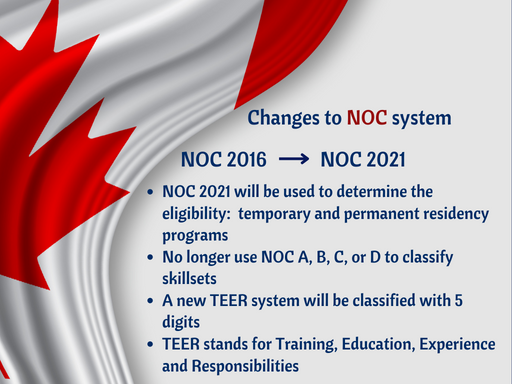
Beginning November 2022, the National Occupational Classification (NOC) 2021 version will be used by the Immigration, Refugees and Citizenship Canada (IRCC) to determine the eligibility of occupations under both temporary and permanent residency programs.
The changes will reflect the following:
Four-category skill level structure replaced by six-category level under the new TEER system
Sixteen additional eligible occupations for Express Entry
Five-digit codification system to replace the current four-digit system
Changes to NOC System
Changes in the Four-Category Skill Structure
The current four-category NOC skill level structure will be replaced by a six-category level that will show the required Training, Education, Experience, and Responsibilities (TEER) for every occupation. The TEER system will assess the level of training, of formal education, of experience required to gain entry into each occupation, and the responsibilities associated to it which is more precise than simply assessing the level of skills.
NOC 2016
NOC 2021
Skill Type 0
Management occupations
TEER 0
Management jobs (usually require a degree)
Skill Type A
Usually require university education
TEER 1
University degree (bachelor’s, master’s, or doctorate); or several years of experience from TEER 2
Skill Type B
Usually require college education, specialized training or apprenticeship
TEER 2
Post-secondary 2-3 years; or apprenticeship 2-5 years; or supervisory/safety roles; or experience from TEER 3
TEER 3
Post-secondary <2 years; or apprenticeship <2 years; or 6+ months on-the-job training; or experience from TEER 4
Skill Type C
Usually require secondary school and/or occupation-specific training
TEER 4
Secondary school completion; or several weeks on-the-job training; or experience from TEER 5
Skill Type D
On-the-job training is usually provided
TEER 5
Short work demonstration and no formal educational requirements
Changes in Occupational Eligibility
With the implementation of NOC 2021, Express Entry Cut Off will be TEER 3. A total of sixteen (16) new occupations will become eligible for Express Entry:
16 New Eligible Occupations
Payroll administrators
Dental assistants and dental laboratory assistants
Nurse aides, orderlies and patient service associates
Pharmacy technical assistants and pharmacy assistants
Elementary and secondary school teacher assistants
Sheriffs and bailiffs
Correctional service officers
By-law enforcement and other regulatory officers
Estheticians, electrologists, and related occupations
Residential and commercial installers and servicers
Pest controllers and fumigators
Other repairers and servicers
Transport truck drivers
Bus drivers, subway operators, and other transit operators
Heavy equipment operators
Aircraft assemblers and aircraft assembly inspectors
On the other hand, three (3) occupations will become ineligible: a) other performers; b) program leaders and instructors in recreation, sport, and fitness; and c) tailors, dressmakers, furriers, and milliners. These occupations may still be eligible for programs with broader eligibility criteria and possible streams under the Provincial Nominee Program.
For the Atlantic Immigration Program (AIP), it is currently open to occupations categorized as Skill Level C or above. For NOC 2021, TEER 4 will be the cut-off for its Express Entry.
Twelve occupations will become ineligible for the AIP: Pet Groomers and animal care workers, Other support occupations in personal services, Longshore workers, Material handlers, Taxi and limousine drivers and chauffeurs, Delivery service drivers and door-to-door distributors, Boat and cable ferry operators and related occupations, Livestock labourers, Nursery and greenhouse labourers, Trappers and hunters, Food and beverage servers, Labourers in textile processing and cutting.
Changes in NOC Codification
NOC 2021 will use the new five-digit codification system as follows:
Hierarchy
Digit Order
Definition
Broad Category
1st Digit X
Occupational categorization
Major Group
2nd Digit XX
TEER categorization
Sub-Major Group
XX.X
Top level of the Sub-Major Group
Minor Group
XX.XX
Hierarchy within the Sub-Major Group
Unit Group
XX.XXX
Hierarchy within the Minor Group
The new codification system will be more flexible as it allows for the incorporation of many new unit groups in the future, as needed. With the changes, new unit groups were created for emerging occupations such as Data scientists and Cybersecurity specialists. Moreover, some occupations were considered statistically sufficient to have their own unit group, such as Financial advisors and Police investigators, and the three distinct unit groups created for Software developers and programmers.
For Filipino families dreaming of reuniting with parents and grandparents in Canada, the Enhanced Super Visa offers one of the most generous visitor programs in the world. Since June 2023, Super Visa holders can stay in Canada for up to 5 years per visit — a major improvement over the previous 2-year limit. This comprehensive 2026 guide covers everything Filipino-Canadian sponsors and their parents need to know: updated income requirements, the new OSFI foreign insurer option, step-by-step application instructions, and tips tailored specifically to applicants from the Philippines.
What Is the Super Visa and What Makes It “Enhanced”?
The Super Visa is a special multi-entry visitor visa designed exclusively for the parents and grandparents of Canadian citizens and permanent residents. Unlike a regular visitor visa that typically authorizes stays of up to 6 months, the Super Visa provides:
Up to 5 years per visit — no need to leave and re-enter every 6 months
Multi-entry validity for up to 10 years (or until passport expiry)
Faster alternative to the Parents and Grandparents Program (PGP) — no lottery, no cap on applications
No limit on the number of times you can enter Canada during the visa’s validity
What Changed in 2023 (The “Enhanced” Super Visa): On June 22, 2023, the Government of Canada enhanced the Super Visa by extending the authorized stay from 2 years to 5 years per visit. This means your parents or grandparents can live with you continuously for up to 5 years before needing to leave Canada, making it far more practical for long-term family reunification.
Super Visa Eligibility Requirements (2026)
Both the applicant (your parent or grandparent) and the host (the Canadian sponsor) must meet specific requirements.
Applicant Requirements (Parent or Grandparent)
Must be the parent or grandparent of a Canadian citizen or permanent resident
Must be admissible to Canada (no criminal inadmissibility or security concerns)
Must pass an immigration medical exam conducted by a designated panel physician
Must hold a valid passport (should be valid for at least the duration of the requested stay)
Must demonstrate ties to their home country (proof they intend to return)
Must have private medical insurance meeting specific requirements (see below)
Must be outside Canada when applying
Host (Sponsor) Requirements
Must be the applicant’s child or grandchild, at least 18 years old
Must be a Canadian citizen, permanent resident, or registered Indian
Must reside in Canada
Must meet or exceed the Minimum Necessary Income (MNI) threshold
Must provide a signed letter of invitation promising financial support
Minimum Necessary Income (MNI) Requirements — Updated July 2025
The Canadian host must demonstrate that their household income meets or exceeds the Low Income Cut-Off (LICO) threshold. These amounts were updated on July 29, 2025, reflecting a 3.9% increase to account for inflation. The income is calculated based on the total family size, which includes the host, their dependants, and the visiting parent(s) or grandparent(s).
How to Calculate Family Size: Count the host + their spouse/partner + their dependent children + the parent(s)/grandparent(s) being invited. For example, if you are married with 2 children and inviting both parents, your family size is 6 (you + spouse + 2 children + 2 parents).
Total Family Size
Minimum Necessary Income (CAD)
1 person
$30,526
2 persons
$38,002
3 persons
$46,720
4 persons
$56,724
5 persons
$64,336
6 persons
$72,560
7 persons
$80,784
Each additional person
+$8,224
Source: IRCC — Effective July 29, 2025. Based on the Low Income Cut-Off (LICO) for urban areas with 500,000+ population.
Important for Filipino Families: If multiple family members are pooling income to meet the threshold, only income earned by the host and their spouse or common-law partner counts. Income from the visiting parent or other relatives living in the household does not qualify. Your most recent Notice of Assessment (NOA) from the Canada Revenue Agency is the primary proof document.
Acceptable Proof of Income Documents
Notice of Assessment (NOA) — most recent, issued by the Canada Revenue Agency
T4 or T1 tax returns — for the most recent tax year
Employment letter — confirming position, salary, and length of employment
Recent pay stubs — covering the last 12 months
Bank statements — showing regular income deposits
Employment Insurance (EI) statements — if applicable
Self-employment documentation — letter from accountant with income details
Pension or investment income statements
Medical Insurance Requirements — Including the 2025 OSFI Change
One of the key differences between a Super Visa and a regular visitor visa is the mandatory private medical insurance requirement. Here is what you need to know for 2026:
Insurance Coverage Requirements
Requirement
Details
Minimum Coverage
$100,000 CAD
Validity Period
Minimum 1 year from the date of each entry to Canada
Coverage Must Include
Healthcare, hospitalization, and repatriation
Payment Status
Policy must be fully paid or have a deposit paid (quotes are not accepted)
Eligible Providers
Canadian insurance companies OR OSFI-authorized foreign insurers
2025 OSFI Change: Foreign Insurers Now Accepted
New as of January 28, 2025: IRCC now accepts private health insurance policies from foreign insurance companies authorized by the Office of the Superintendent of Financial Institutions (OSFI). Previously, only Canadian-based insurance companies were accepted. This change makes the Super Visa more accessible and potentially more affordable for Filipino families.
To qualify, the foreign insurer must:
Be authorized by OSFI to provide accident and sickness insurance
Appear on OSFI’s list of federally regulated financial institutions
Issue the policy under its insurance business in Canada
You can verify whether a foreign insurer is OSFI-authorized by checking OSFI’s website at www.osfi-bsif.gc.ca.
Tip for Filipino Families: Super Visa medical insurance typically costs between $1,000 and $5,000 per year, depending on the applicant’s age and health conditions. Comparing quotes from both Canadian and OSFI-authorized foreign insurers can help you find the best rate. Applicants over 70 years old generally face higher premiums. Be sure your policy is paid (not just quoted) before submitting your application.
Required Documents Checklist
Prepare all of the following documents before submitting your Super Visa application:
Documents from the Applicant (Parent/Grandparent in the Philippines)
☑ Valid Philippine passport (valid for at least 1 year beyond planned entry date)
☑ Completed application forms — IMM 5257 (Application for Visitor Visa) and IMM 5645 (Family Information Form)
☑ Two recent passport-sized photos (per IRCC photo specifications)
☑ Proof of relationship — birth certificate of the Canadian host showing the applicant as parent, or other official documents establishing the relationship
☑ Immigration medical exam results — from an IRCC-designated panel physician in the Philippines
☑ Private medical insurance policy — meeting all requirements listed above (paid, not quoted)
☑ Proof of ties to the Philippines — property ownership, bank accounts, employment, pension, family members remaining
☑ Travel history — previous visas or stamps in current and old passports
☑ Biometrics — fingerprints and photo at a designated collection point
Documents from the Host (Canadian Sponsor)
☑ Signed letter of invitation — promising financial support for the duration of the visit, listing all family members included in the income calculation with their names, dates of birth, and relationship
☑ Proof of Canadian status — Canadian citizenship certificate, permanent resident card, or Indian Status card
☑ Proof of income — Notice of Assessment (NOA), T4/T1 forms, employment letter, pay stubs, bank statements
☑ Proof of residence in Canada — utility bills, lease agreement, or mortgage statement
☑ Birth certificate — showing relationship to the applicant (host’s birth certificate listing applicant as parent)
Step-by-Step Application Process
Follow these steps to submit a successful Super Visa application:
Step 1: Confirm Eligibility and Calculate Family Size
Before gathering documents, confirm that the Canadian host meets the MNI threshold. Count everyone who will be included in the family size: the host, their spouse or common-law partner, their dependent children, and the parent(s) or grandparent(s) being invited. Check the MNI table above to confirm the income requirement.
Step 2: Schedule the Immigration Medical Exam
The applicant must undergo a medical exam with an IRCC-designated panel physician in the Philippines. Medical results are valid for 12 months. You can find designated panel physicians in Manila and other Philippine cities on the IRCC website. Schedule this early as appointments may have wait times.
Step 3: Purchase Medical Insurance
Obtain a private medical insurance policy that meets all Super Visa requirements: minimum $100,000 coverage, at least 1 year validity, covering healthcare, hospitalization, and repatriation. The policy must be paid (or have a deposit paid) — insurance quotes alone are not accepted. You may now purchase from Canadian insurers or OSFI-authorized foreign insurers.
Step 4: Gather All Supporting Documents
Collect all documents from both the applicant and the host as listed in the checklist above. Ensure all documents are current and that translations are provided for any documents not in English or French.
Step 5: Complete the Application Forms
Fill out the required forms completely — do not leave any sections blank. Key forms include:
IMM 5257 — Application for Temporary Resident Visa
IMM 5645 — Family Information Form
IMM 5409 — Statutory Declaration of Common-Law Union (if applicable)
Document Checklist (IMM 5484)
Step 6: Submit Online and Pay Fees
Create an account on the IRCC online portal and submit the application with all supporting documents. Pay the application processing fee and biometrics fee online.
Step 7: Provide Biometrics
After submitting the application, you will receive a Biometrics Instruction Letter. The applicant must then visit a designated biometrics collection point in the Philippines to provide fingerprints and a photograph. Biometrics are valid for 10 years.
Step 8: Wait for Processing and Decision
IRCC will process the application. If approved, the applicant will be asked to submit their passport for visa stamping. If additional information is needed, IRCC will send a request letter.
Processing Times and Fees
Application Fees
Fee Type
Amount (CAD)
Application Processing Fee
$100
Biometrics Fee
$85
Total Government Fees
$185
Medical Exam (approximate, Philippines)
$200 – $300
Medical Insurance (annual, varies by age)
$1,000 – $5,000
Government fees are in Canadian dollars. Medical exam fees vary by panel physician. Insurance costs depend on age, health, and provider.
Processing Times from the Philippines
As of the most recent IRCC data, Super Visa applications from the Philippines are typically processed within 95 to 116 days (approximately 13 to 17 weeks). The IRCC service standard is 112 days, with a goal of processing 80% of applications within this timeframe.
Planning Tip: Allow at least 4 to 5 months from the time you start preparing documents to when you expect your parents or grandparents to arrive. This accounts for medical exam scheduling, document gathering, application processing, and passport submission for visa stamping. If you are planning for a specific occasion (e.g., a grandchild’s baptism or graduation), start the process well in advance.
Super Visa vs. Regular Visitor Visa: Comparison
Understanding the differences between the Super Visa and a regular visitor visa helps you choose the right option for your family:
Feature
Super Visa
Regular Visitor Visa (TRV)
Who Can Apply
Parents and grandparents only
Anyone with a valid purpose of visit
Authorized Stay Per Visit
Up to 5 years
Up to 6 months
Visa Validity
Up to 10 years (multi-entry)
Up to 10 years (multi-entry)
Medical Insurance Required
Yes — $100,000 minimum, 1 year
No (recommended but not required)
Medical Exam Required
Yes — mandatory
No (unless requested by IRCC)
Host Income Requirement
Yes — must meet MNI/LICO
No formal income threshold
Application Fee
$100 + $85 biometrics
$100 + $85 biometrics
Can Extend Stay in Canada
Yes
Yes (must apply before status expires)
Work Permit Eligibility
No
No
Path to PR
No (separate PGP application needed)
No
Our Recommendation: If your parents or grandparents plan to stay for more than 6 months, the Super Visa is almost always the better choice. The additional requirements (medical insurance and income proof) are well worth the benefit of a 5-year authorized stay. For short visits of a few weeks or months, a regular visitor visa may be simpler and more cost-effective.
Tips for Filipino Families Applying for the Super Visa
Based on our experience helping Filipino-Canadian families with Super Visa applications, here are practical tips to improve your chances of approval:
1. Demonstrate Strong Ties to the Philippines
Even though the Super Visa allows a 5-year stay, your parents must still demonstrate they intend to return to the Philippines. Include evidence such as property ownership (land titles, tax declarations), active bank accounts, pension payments from SSS or GSIS, or family members remaining in the Philippines.
2. Write a Strong Invitation Letter
The letter of invitation is a critical document. It should be detailed and personal — explain why your parents are visiting (e.g., to help with a new baby, attend a family milestone, spend time with grandchildren). Include your commitment to financially support them during their stay.
3. Prepare Income Documents Carefully
If you are close to the MNI threshold, include multiple forms of income proof — not just your NOA. Supplementing with T4s, pay stubs, an employment letter, and bank statements creates a stronger financial profile. If your spouse also works, include their income documentation as well.
4. Get the Medical Exam Done Early
Schedule the immigration medical exam as soon as you begin the application process. Panel physician appointments in Manila and Cebu can have wait times, and results are valid for 12 months, so there is no disadvantage to completing this step early.
5. Do Not Submit a Bare-Minimum Application
Visa officers process thousands of applications. A well-organized, complete application with clear supporting documents stands out. Use a document cover page listing all enclosed items, and organize documents in the same order as the checklist.
6. Compare Insurance Quotes — Including Foreign Insurers
With the January 2025 OSFI change, you now have more options for medical insurance. Compare quotes from both Canadian and OSFI-authorized foreign insurers. Some Filipino families have found more affordable coverage through international providers. Just ensure the company is on the OSFI authorized list before purchasing.
Common Reasons for Super Visa Refusal
Understanding why applications get refused can help you avoid common pitfalls. In 2024, over 54% of all temporary resident visa applications to Canada were refused. The most common reasons for Super Visa refusals include:
1. Insufficient Proof of Income
The host’s income falls below the MNI threshold, or the income documentation is weak, inconsistent, or incomplete. Always verify your family size calculation and ensure your income clearly exceeds the minimum.
2. Inadequate Ties to Home Country
The visa officer is not convinced that the applicant will return to the Philippines. This is especially challenging for applicants who have children in Canada and few immediate family members remaining in the Philippines. Provide strong evidence of property, financial assets, community involvement, or obligations in the Philippines.
3. Medical Insurance Issues
The insurance policy does not meet requirements — it may have insufficient coverage, be from a non-qualifying insurer, not cover the required categories (healthcare, hospitalization, repatriation), or only be a quote rather than a paid policy.
4. Incomplete or Inconsistent Application
Missing forms (such as IMM 5257), blank fields, unsigned declarations, or information that conflicts between documents. Double-check every form before submission.
5. Failed Medical Exam
Certain medical conditions may result in inadmissibility. If your parent has a pre-existing condition, consult with an immigration lawyer before applying to understand the potential implications.
6. Purpose of Visit Not Consistent with Super Visa
If the officer believes the true purpose of the visit is not a family visit — for example, if there is evidence the applicant intends to work in Canada or not return to their home country — the application may be refused.
Frequently Asked Questions
Can my parents work in Canada on a Super Visa?
No. The Super Visa is a visitor visa only. Your parents or grandparents are not authorized to work in Canada. If they wish to work, they would need a separate work permit, which is not typically available under these circumstances.
Can I invite both parents at the same time?
Yes. Each parent must submit a separate application with their own medical exam and insurance policy. Both parents are included in the family size calculation for the income requirement. For example, inviting both parents would add 2 to your family size.
What happens if my parent’s insurance expires while they are in Canada?
Super Visa holders must maintain valid medical insurance at all times while in Canada. If the policy expires, it must be renewed before it lapses. Failure to maintain insurance could affect future entries or extensions. Many Canadian insurers offer renewal options for existing policyholders.
Can my parent apply for the Super Visa from inside Canada?
No. Super Visa applications must be submitted from outside Canada. If your parent is already in Canada on a visitor visa, they would need to leave Canada, apply for the Super Visa from the Philippines (or another country), and wait for approval before re-entering.
Is the Super Visa the same as the Parents and Grandparents Program (PGP)?
No. The PGP is a permanent residence program that grants your parents PR status in Canada. The Super Visa is a temporary visitor visa that allows extended stays. Many families apply for the Super Visa while waiting for the PGP lottery or while their PGP application is in progress.
Do visa-exempt nationals need a Super Visa?
Citizens of visa-exempt countries (such as those with dual citizenship in countries like the US) can still apply for the Super Visa to get the 5-year authorized stay benefit. Without a Super Visa, visa-exempt nationals are typically only authorized to stay for 6 months. Note: Philippine passport holders are not visa-exempt and must obtain a visa.
Can I sponsor my parents for the Super Visa if I am a temporary resident (e.g., on a work permit)?
No. The host must be a Canadian citizen, permanent resident, or registered Indian. If you are on a work permit, study permit, or any other temporary status, you do not qualify to host a Super Visa applicant. You would need to obtain permanent residence first.
What if my income is slightly below the MNI threshold?
If your income is below the required threshold, your application will likely be refused. Consider whether your spouse or common-law partner’s income can be added (their income counts toward the household total). If you still fall short, you may need to wait until your income increases or explore a regular visitor visa instead.
How JCA Law Office Can Help
At JCA Law Office Professional Corporation, we have extensive experience helping Filipino-Canadian families reunite with their parents and grandparents through the Super Visa program. Our immigration team understands the unique challenges Filipino families face — from navigating Philippine document requirements to building strong applications that address common refusal reasons.
Our Super Visa services include:
Eligibility assessment — We review your income, family size, and circumstances to confirm you meet all requirements
Document preparation — We prepare and organize all application forms and supporting documents
Invitation letter drafting — We help craft a compelling invitation letter that satisfies IRCC requirements
Insurance guidance — We advise on compliant insurance options, including OSFI-authorized foreign insurers
Application submission and follow-up — We submit the application and monitor its progress
Refusal response — If a previous application was refused, we analyze the refusal reasons and prepare a stronger re-application
Book Your Super Visa Consultation Today
Let our team guide your family through the Super Visa application process. We serve Filipino-Canadian families across the Greater Toronto Area and throughout Ontario.
Disclaimer: This guide is for informational purposes only and does not constitute legal advice. Immigration laws and policies change frequently. For advice specific to your situation, please consult with a qualified immigration lawyer. Information is current as of February 2026, based on IRCC policies and the MNI thresholds effective July 29, 2025.
“Life is a series of natural and spontaneous changes. Don’t resist them; that only creates sorrow. Let reality be a reality. Let things flow naturally forward in whatever way they like.” -Lao Tzu
6 Things that change forever when immigrating to Canada
Immigrating to Canada and starting over is one of the most terrifying yet one of the most exciting adventures ever. Life as you know it will eventually change and you will have to get used to accepting the fact that what is in the past is in the past. Transition is not easy and as a migrating to Canada is not a guarantee of your success but it is up to you how you could handle your future. Let me say, hard works, patience, perseverance, and building up connections are the keys to achieve it.
You will be part of two different worlds, one world that will start to become more of a blur over time, and one that you will get more familiar with. It doesn’t necessarily mean that it’s over, it’s more of an experience and growing more as a person.
Little by little, you get used to what the Canadians are doing, and you eventually learn from it. You will step outside your comfort zone and try out new things. You will be part of a new culture and it’s a fantastic feeling.
You get wiser as time goes by. Moving away and leaving the people you care about is hard. You will quickly realize what stays and what goes in life. There will be people whom you will get closer with, and there will be people who will distance themselves. Try to figure out what you want and what you have outgrown.
Things will happen that is out of your control, and life goes on with or without you. Exciting things will happen to your friends, and you will miss out on family events. You will probably miss out on many things that are happening back at your old home. It’s hard to accept, but we all have to go through that change.
You are going to lose most of your friends after moving to another country like Canada. You could always try to keep in touch, but eventually, you will realize that it is not the same as before and the conversation becomes flat, and relationships become loose. You will feel a bit lonely moving into your new place. Don’t let those feelings get too deep; try to remember why you moved in the first place.
New opportunities. This will be the best part of the whole process. Moving to a new country is your new chance. Another chance to create or even start over your life. A new opportunity to meet different people, find interesting jobs, get involved with the community, and try out unique food. The process will be exciting, and maybe even hard but it will all be worth it. You will finally understand that the little things you used to stressed about was all for nothing. You will become happier and stronger.
It becomes challenging to figure out where home is, as it will change over time. Sometimes, it’s where you spent your childhood memories or where you lived during a significant life event. Sometimes, it is where your heart is.
For more information about immigrating to Canada, JCA Law Office can help.