Category: Express Entry

  • French Language Proficiency Express Entry: Complete Guide for Filipinos (2026)

    French Language Proficiency Express Entry: Complete Guide for Filipinos (2026)

    Canada’s Express Entry system now includes category-based selection draws that specifically target French-speaking candidates — and if you are a Filipino immigrant or prospective immigrant, this could be one of the most accessible pathways to Canadian permanent residency available today. In February 2026 alone, IRCC issued 8,500 invitations in a single French language proficiency draw with a minimum CRS score of just 400 points — far below the 520+ typically required in general draws.

    This comprehensive guide explains exactly how the French language proficiency Express Entry category works, what requirements you need to meet, how to prepare for the TEF Canada or TCF Canada tests, and why Filipino applicants should seriously consider learning French as a strategic immigration advantage.

    What Is the French Language Proficiency Category in Express Entry?

    The French language proficiency category is one of several priority categories under Canada’s Express Entry system. Introduced as part of category-based selection in 2023, it allows Immigration, Refugees and Citizenship Canada (IRCC) to conduct targeted draws that invite Express Entry candidates with strong French language skills — even if their overall Comprehensive Ranking System (CRS) score is lower than what general draws require.

    Unlike occupation-based categories (such as healthcare or trades), French language proficiency is the only language-based category in Express Entry. This reflects Canada’s commitment to strengthening Francophone communities outside Quebec and preserving its bilingual national identity.

    For 2025 and 2026, IRCC has confirmed that French language proficiency remains a designated priority category, meaning dedicated draws will continue throughout the year.

    French Category Express Entry Requirements

    To qualify for a French category draw in Express Entry, you must meet two sets of requirements:

    1. French Language Requirement

    You must achieve a minimum score of NCLC 7 (Niveaux de competence linguistique canadiens) in all four language skills:

    • Reading
    • Writing
    • Listening
    • Speaking

    NCLC 7 is roughly equivalent to a B2 level on the Common European Framework of Reference (CEFR) — an upper-intermediate proficiency level. You do not need to be a native French speaker. Many successful candidates learn French specifically for immigration purposes.

    2. Express Entry Program Eligibility

    You must also be eligible for at least one of the three Express Entry programs:

    • Federal Skilled Worker Program (FSWP) — For skilled workers with foreign work experience
    • Federal Skilled Trades Program (FSTP) — For qualified tradespersons
    • Canadian Experience Class (CEC) — For those with Canadian work experience

    You must have an active Express Entry profile in the pool with valid French language test results at the time a draw is conducted.

    Accepted French Language Tests: TEF Canada and TCF Canada

    IRCC accepts only two French language tests for Express Entry:

    TEF Canada (Test d’evaluation de francais pour le Canada)

    Administered by the Paris Chamber of Commerce and Industry (CCI Paris Ile-de-France). The TEF Canada tests all four skills in a single sitting. Results are scored on a scale of 0 to 699 for each skill.

    TCF Canada (Test de connaissance du francais pour le Canada)

    Administered by France Education International. The TCF Canada uses a scoring scale of 0 to 699 for listening and reading, and 0 to 20 for speaking and writing.

    Minimum Scores for NCLC 7

    The following table shows the minimum scores you need on each test to achieve NCLC 7 in all four skills:

    SkillTEF Canada (NCLC 7)TCF Canada (NCLC 7)
    Reading207 – 232453 – 498
    Writing310 – 34810 – 11 (out of 20)
    Listening249 – 279458 – 502
    Speaking310 – 34810 – 11 (out of 20)
    Minimum test scores required to achieve NCLC 7 for French language proficiency Express Entry draws. Source: IRCC Language Equivalency Charts.

    Important: Your test results must be less than two years old at the time you submit your Express Entry profile and when you apply for permanent residency. Plan your test timing accordingly.

    Testing centres are available across Canada, including in Toronto, Vancouver, Montreal, Ottawa, Calgary, and Edmonton. Slots fill up quickly — book your test at least 2 to 3 months in advance.

    CRS Points Boost for French Language Proficiency

    One of the biggest advantages of French proficiency in Express Entry is the significant CRS points boost you can earn. The bonus points depend on whether you also have English proficiency:

    ScenarioCRS Bonus Points
    NCLC 7+ in all four French skills AND CLB 5+ in all four English skills+50 points
    NCLC 7+ in all four French skills AND CLB 4 or lower in English (or no English test)+25 points
    CRS bonus points for French proficiency under the Express Entry Comprehensive Ranking System.

    This is a major advantage for Filipino applicants. Most Filipinos already have strong English skills (the Philippines ranks among the top English-speaking countries in Asia). If you achieve NCLC 7 in French and CLB 5 or higher in English, you earn the full 50 bonus CRS points — a substantial boost that can make the difference between receiving an Invitation to Apply (ITA) or remaining in the pool.

    French Language Proficiency Draw History and CRS Scores

    Since category-based draws began, the French language proficiency category has consistently featured some of the lowest CRS cutoff scores in the Express Entry system. Here is a summary of recent draw activity:

    Draw DateInvitations (ITAs)Minimum CRS Score
    February 6, 20268,500400
    December 17, 20256,000399
    October 29, 20256,000~420
    August 20255,500481
    March 21, 20257,500379
    March 6, 20254,500410
    Selected French language proficiency Express Entry draws. CRS cutoffs ranged from 379 to 481 — significantly lower than the 520–550 typical for general draws. Source: IRCC draw results.

    Key takeaway: French language proficiency draws typically require CRS scores of 379 to 481, compared to 520 to 550+ for general and Canadian Experience Class draws. In 2025 alone, IRCC issued over 30,000 invitations through French-language draws across 8 rounds — representing a massive expansion from previous years.

    The February 2026 draw (8,500 ITAs) was the largest French-language draw in Express Entry history, signalling that IRCC is accelerating its Francophone immigration targets.

    How Category-Based Draws Work

    Here is how the French language proficiency category-based selection process works:

    1. IRCC designates priority categories — Each year, the Minister of Immigration designates categories for Express Entry draws. French language proficiency has been a designated category since 2023.
    2. You create an Express Entry profile — Submit your profile to the Express Entry pool with your French language test results (TEF Canada or TCF Canada) showing NCLC 7 or higher.
    3. Your profile is automatically flagged — If your French test results meet the NCLC 7 threshold, your profile is automatically eligible for French category draws. No separate application is needed.
    4. IRCC conducts a category-based draw — When IRCC runs a French-language draw, it selects the highest-ranking candidates (by CRS score) who meet the French requirement.
    5. You receive an Invitation to Apply (ITA) — If your CRS score meets or exceeds the draw cutoff, you receive an ITA for permanent residency.
    6. You submit your PR application — You have 60 days from receiving your ITA to submit a complete application for permanent residency.

    You remain eligible for both general Express Entry draws and French category draws simultaneously. Having French proficiency does not exclude you from other draw types — it gives you an additional pathway.

    Step-by-Step: How to Qualify for the French Category

    1. Assess your French level. If you are starting from zero, budget 6 to 12 months of dedicated study to reach NCLC 7 (B2 level). Many candidates achieve this within 8 to 10 months with consistent effort.
    2. Register for the TEF Canada or TCF Canada. Book your test early — testing centres in Toronto and other major cities often have waitlists of 2 to 3 months. The TEF Canada costs approximately $400 to $450, while TCF Canada costs vary by location.
    3. Take an English language test. Also complete the IELTS General Training or CELPIP General to maximize your CRS score. Achieving CLB 5+ in English alongside NCLC 7+ in French earns you 50 bonus CRS points.
    4. Gather your Express Entry documents. Prepare your Educational Credential Assessment (ECA), work experience letters, police certificates, and other supporting documents.
    5. Create your Express Entry profile. Submit your profile online through the IRCC portal, including both your French and English test results.
    6. Wait for a French category draw. Keep your profile active and your test results valid. IRCC has been conducting multiple French-language draws per year.
    7. Respond to your ITA within 60 days. Once you receive an invitation, submit your complete PR application with all supporting documents.

    Why Filipino Immigrants Should Consider French Proficiency

    As a firm that serves the Filipino-Canadian community, we see firsthand how French proficiency can transform immigration outcomes for Filipino applicants. Here is why this matters:

    Lower CRS Cutoffs Mean Greater Access

    Many Filipino applicants have strong work experience and education but struggle to reach the 520+ CRS scores required in general draws. French category draws with cutoffs as low as 379 CRS open the door for candidates who would otherwise remain in the pool indefinitely.

    Filipinos Already Have Strong English Skills

    The Philippines is one of the largest English-speaking countries in the world. Most Filipino applicants easily achieve CLB 5+ in English, which means learning French to NCLC 7 automatically earns the maximum 50 CRS bonus points. This bilingual advantage is significant.

    Filipinos Excel at Language Learning

    Filipinos are well-known for their multilingual abilities — most speak at least two languages (Filipino and English), and many speak a third regional language. This strong foundation in language learning makes picking up French more achievable than many candidates expect.

    Career Advantages After Immigration

    Bilingual (English-French) professionals in Canada earn an average of 10 to 25 percent more than their unilingual counterparts. French proficiency opens doors to federal government positions, healthcare roles in bilingual communities, and management positions that require both official languages.

    Growing Filipino Communities in Francophone Areas

    Provinces such as Manitoba (with its bilingual city of Winnipeg), New Brunswick (Canada’s only officially bilingual province), and Ontario (with significant Francophone communities in Ottawa and Northern Ontario) all have growing Filipino populations and strong demand for bilingual workers.

    Resources for Learning French in Canada

    If you are in Canada, several free and subsidized programs can help you learn French:

    Government-Funded Programs

    • CLIC (Cours de langue pour les immigrants au Canada) — Free French language classes funded by IRCC for permanent residents and protected persons. Available in person and online through CLIC en ligne.
    • Ontario Adult French as a Second Language — Ontario school boards offer beginner, intermediate, and advanced French classes. Visit a language assessment centre near you to get started.
    • Centre Franco (Toronto) — Offers French language training with locations in Toronto, Brampton, Mississauga, Scarborough, and North York.
    • College Boreal (Mississauga) — Provides French language training and settlement services funded by the Government of Canada.

    Online Resources and Test Preparation

    • TV5Monde — Free French learning resources with Canadian content
    • Alliance Francaise — French courses available in Toronto, Vancouver, Ottawa, and other major cities (paid, but high quality)
    • Duolingo and Busuu — Good for building a foundation, but not sufficient on their own for NCLC 7
    • PrepMyFuture — Dedicated TEF Canada and TCF Canada practice tests and preparation materials

    Tip: For the best results, combine a structured course (such as CLIC or Alliance Francaise) with daily self-study and regular practice with native speakers. Most candidates who commit to consistent study can reach NCLC 7 within 6 to 12 months.

    Canada’s Francophone Immigration Targets

    The Canadian government has set ambitious and steadily increasing targets for Francophone immigration outside Quebec:

    • 2025 target: 8.5% of permanent resident admissions outside Quebec to be French-speaking (achieved — actual result was approximately 8.9%)
    • 2026 target: 9% of admissions outside Quebec
    • 2027 target: 10% of admissions outside Quebec — approximately 31,500 French-speaking newcomers

    In January 2026, Immigration Minister Lena Metlege Diab confirmed that Canada has exceeded its Francophone immigration target for the fourth consecutive year. This ongoing commitment means French category draws in Express Entry will likely continue and expand for the foreseeable future.

    Frequently Asked Questions

    What is the minimum CRS score for a French language proficiency Express Entry draw?

    CRS cutoffs for French category draws have ranged from 379 to 481 in 2025-2026. The most recent draw (February 2026) had a cutoff of 400. These scores are significantly lower than general Express Entry draws, which typically require 520 to 550+ points.

    Do I need to speak French fluently to qualify?

    No. You do not need to be fluent or a native French speaker. You need to demonstrate NCLC 7 proficiency (approximately B2/upper-intermediate level) in all four skills through an approved test. Many successful candidates learned French specifically for immigration.

    Which French test is easier — TEF Canada or TCF Canada?

    Neither test is officially easier than the other, but candidates report different experiences. The TEF Canada tends to be more widely available in Canada and has a more standardized format. The TCF Canada may feel more conversational in the speaking section. We recommend taking practice tests for both and choosing the one that better suits your strengths.

    Can I submit both French and English test results in my Express Entry profile?

    Yes, and you should. Submitting both French (TEF/TCF) and English (IELTS/CELPIP) results maximizes your CRS score. If you achieve NCLC 7+ in French and CLB 5+ in English, you earn 50 additional CRS points. Choose your strongest language as your first official language for maximum points.

    How long are French test results valid for Express Entry?

    Your TEF Canada or TCF Canada results must be less than two years old when you create your Express Entry profile and when you submit your PR application. Plan accordingly — if your results expire while you are waiting for a draw, you will need to retake the test.

    Do I need to settle in a French-speaking province?

    No. Qualifying for a French category draw does not require you to settle in a French-speaking area. You can live and work anywhere in Canada (outside Quebec, which has its own immigration system). However, bilingual cities such as Ottawa, Moncton, and Winnipeg may offer additional career advantages for French speakers.

    How often does IRCC conduct French language proficiency draws?

    In 2025, IRCC conducted 8 French-language draws, issuing over 30,000 invitations. The frequency and size of draws have been increasing each year. In 2026, the first draw (February 6) issued 8,500 ITAs — the largest single French-language draw in history.

    Can I qualify for both French category draws and general draws?

    Yes. Your Express Entry profile is automatically considered for all draws you are eligible for — including general draws, Canadian Experience Class draws, and French category draws. French proficiency gives you additional chances without limiting your eligibility for other draw types.

    How JCA Law Office Can Help

    At JCA Law Office Professional Corporation, we specialize in helping Filipino immigrants navigate the Canadian immigration system. Our team understands the unique challenges and opportunities that Filipino applicants face — including how to leverage French language proficiency for Express Entry success.

    We can assist you with:

    • Express Entry profile assessment — Evaluate your eligibility and CRS score potential
    • French category strategy — Determine whether learning French is a viable pathway for your immigration goals
    • Document preparation — Ensure your application is complete and error-free
    • CRS score optimization — Identify opportunities to maximize your points, including language test preparation strategies
    • Full application support — Guide you from profile creation through ITA response and PR application

    Whether you are already in Canada or applying from the Philippines, our bilingual Filipino-Canadian legal team is ready to help you explore every available pathway to permanent residency.


    Related Guides

    Last updated: February 2026. This guide is for informational purposes only and does not constitute legal advice. Immigration laws and policies change frequently — always verify current requirements with IRCC or consult a licensed immigration professional. Sources: IRCC — Express Entry for French-speaking skilled workers, IRCC — Language test results.
  • IRCC announces major updates on the Express Entry Category-Based Draws

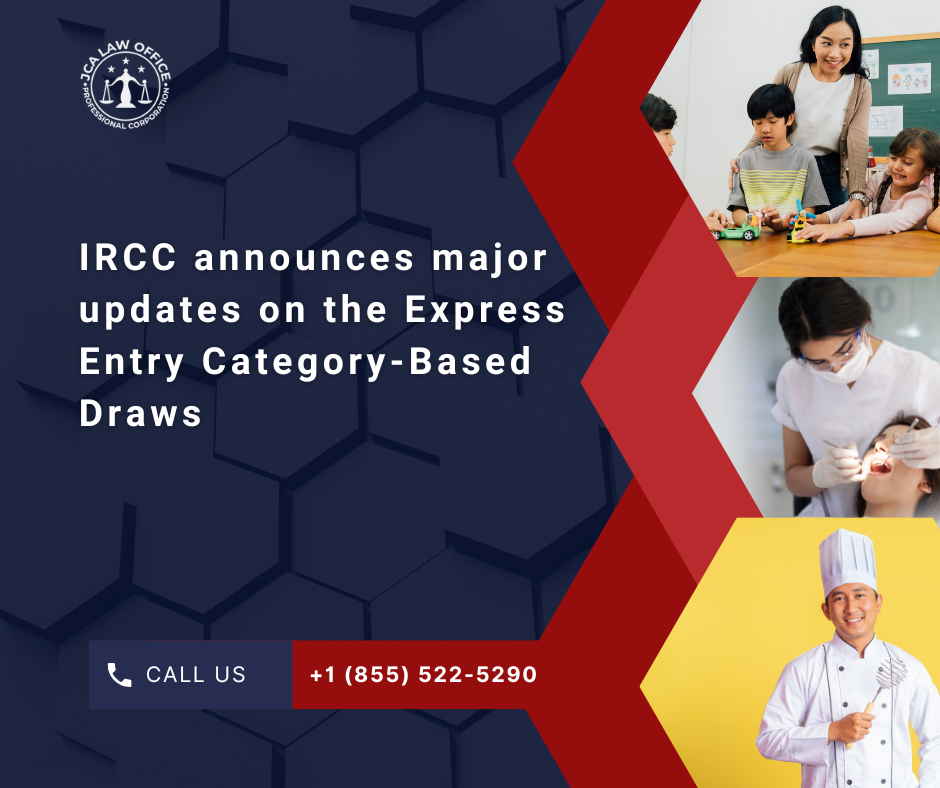
    Express Entry UpdatesThe Immigration, Refugees and Citizenship Canada (IRCC) has recently announced significant updates to the Express Entry category-based selection, a move that will impact thousands of skilled workers, including Filipinos in Canada. These changes aim to align Canada’s immigration system with current labor market demands. The most significant updates include:


    • Education professionals are now prioritized – More teaching and support roles added.
    • Healthcare occupations expanded – Additional medical and social service jobs included.
    • Trades category grows – More construction, skilled trades, and food service jobs now eligible.
    • Transport category removed – No more priority for truck drivers and related jobs.
    • STEM occupations cut back – Nineteen occupations removed, leaving a smaller list.
    📘 Comprehensive Guide: For a complete overview of all Canadian immigration pathways for Filipinos, including Express Entry, PNP, Family Sponsorship, and more, read our Filipino Immigrant Guide to Canada – From Visa to PR (2026).

    For Filipinos in Canada, these updates present new opportunities and challenges. To qualify for an Express Entry category-based draw, candidates must meet the following requirements:

    • You must have at least 6 months of full-time, continuous work experience (or an equal amount of part-time work) within the last 3 years.
    • Your work experience must be in one occupation from the list of eligible NOC codes below.
    • Your experience can be gained in Canada or abroad.

    If you meet these requirements, and your job falls under one of the priority categories, you may have a higher chance of receiving an Invitation to Apply (ITA) for permanent residency under the category-based Express Entry draws.

    Education Category Added – More Opportunities for Filipino Teachers and Assistants

    For the first time, education professionals have been added to Express Entry’s category-based draws. This means teachers, assistants, and special education instructors now have a higher chance of being invited for permanent residency.

    Who Qualifies?

    The following National Occupational Classification (NOC) codes are now eligible:

    Job Title NOC Code TEER Level
    Elementary and secondary school teacher assistants 43100 3
    Instructors of persons with disabilities 42203 2
    Early childhood educators and assistants 42202 2
    Elementary school and kindergarten teachers 41221 1
    Secondary school teachers 41220 1


    Many Filipinos work as early childhood educators and teacher assistants across Canada. If you are already in this field or planning to apply, now is a great time to update your Express Entry profile and ensure you meet the requirements.

    Healthcare Category Expanded – More Jobs for Medical and Social Services Workers

    Canada continues to prioritize healthcare occupations, adding more roles to Express Entry. Below is the full list of eligible healthcare jobs under the category-based draws for 2025.

    Full List of Healthcare Jobs Eligible for Express Entry (2025):

    Job Title NOC Code TEER Level
    Animal health technologists and veterinary technicians 32104 2
    Audiologists and speech language pathologists 31112 1
    Cardiology technologists and electrophysiological techs 32123 2
    Chiropractors 31201 1
    Dental hygienists and dental therapists 32111 2
    Dentists 31110 1
    Dieticians and nutritionists 31121 1
    General practitioners and family physicians 31102 1
    Licensed practical nurses 32101 2
    Massage therapists 32201 2
    Medical laboratory assistants and related techs 33101 3
    Medical laboratory technologists 32120 2
    Medical radiation technologists 32121 2
    Medical sonographers 32122 2
    Nurse aides, orderlies, and patient service associates 33102 3
    Nurse practitioners 31302 1
    Nursing coordinators and supervisors 31300 1
    Occupational therapists 31203 1
    Optometrists 31111 1
    Other medical technologists and technicians 32129 2
    Other professional occupations in health diagnosing & treating 31209 1
    Other technical occupations in therapy and assessment 32109 2
    Paramedical occupations 32102 2
    Pharmacists 31120 1
    Pharmacy technical assistants and pharmacy assistants 33103 3
    Pharmacy technicians 32124 2
    Physician assistants, midwives, and allied health pros 31303 1
    Physiotherapists 31202 1
    Psychologists 31200 1
    Registered nurses and registered psychiatric nurses 31301 1
    Respiratory therapists, clinical perfusionists & cardiopulmonary technologists 32103 2
    Social and community service workers 42201 2
    Social workers 41300 1
    Specialists in clinical and laboratory medicine 31100 1
    Specialists in surgery 31101 1
    Therapists in counseling & specialized therapies 41301 1
    Veterinarians 31103 1

    Trades Category Expanded – Cooks and More Jobs Added

    Canada has expanded its trades category, adding cooks and other skilled workers to support infrastructure and food service demands.

    Full List of Eligible Trades in Express Entry (2025):

    Here is the table for the eligible occupations with their 2021 NOC codes and TEER categories:

    Occupation 2021 NOC Code 2021 TEER Category
    Contractors and supervisors, oil and gas drilling and services 82021 2
    Floor covering installers 73113 3
    Painters and decorators (except interior decorators) 73112 3
    Roofers and shinglers 73110 3
    Concrete finishers 73100 3
    Other technical trades and related occupations 72999 2
    Water well drillers 72501 2
    Electrical mechanics 72422 2
    Heating, refrigeration, and air conditioning mechanics 72402 2
    Heavy-duty equipment mechanics 72401 2
    Construction millwrights and industrial mechanics 72400 2
    Bricklayers 72320 2
    Cabinetmakers 72311 2
    Carpenters 72310 2
    Gas fitters 72302 2
    Plumbers 72300 2
    Industrial electricians 72201 2
    Electricians (except industrial and power system) 72200 2
    Welders and related machine operators 72106 2
    Sheet metal workers 72102 2
    Machinists and machining and tooling inspectors 72100 2
    Home building and renovation managers 70011 0
    Construction managers 70010 0
    Cooks 63200 3
    Construction estimators 22303 2


    Transport Category Removed – What This Means for Workers

    The transport category has been completely removed from Express Entry. Truck drivers and other transport workers will no longer receive priority.

    Alternative Pathways:

    • Check Provincial Nominee Programs (PNPs) (e.g., Manitoba and Saskatchewan still prioritize transport workers).
    • Look for employer-sponsored PR options.
    • Increase CRS score to compete in the general Express Entry pool.

    STEM Category Reduced – Fewer Opportunities for Tech and Engineering Jobs

    Canada has removed 19 STEM (Science, Technology, Engineering, and Math) occupations from Express Entry. Below is the remaining list of STEM jobs still eligible.

    Remaining STEM Occupations in Express Entry (2025):

    Job Title NOC Code TEER Level
    Architecture and science managers 20011 0
    Civil engineering technologists and technicians 22300 2
    Civil Engineers 21300 1
    Cybersecurity specialists 21220 1
    Electrical and electronics engineering technologists and technicians 22310 2
    Electrical and electronics engineers 21310 1
    Geological Engineers 21331 1
    Industrial and manufacturing engineers 21321 1
    Insurance agents and brokers 63100 3
    Mechanical engineering technologists and technicians 22301 2
    Mechanical Engineers 21301 1

    What to Prepare If You Are in a Newly Added NOC Code

    • Update your Express Entry profile with your correct NOC code.
    • Prepare work experience letters, education credentials, and language test results.
      .

    Need Help? JCA LAW Can Assist You!

    Book a consultation with JCA LAW today! Canada’s immigration system is changing fast—don’t miss your opportunity for PR.


    Sources:

    IRCC

  • Express Entry’s French Proficiency Category: What It Is and How to Qualify

    This Guide Has Moved

    We’ve published a more comprehensive, updated version of this guide.

    Read the Updated French Express Entry Guide

    You will be redirected automatically.

  • Canadian Experience Class (CEC): Your Pathway to PR in Canada

    Canada offers various immigration pathways for skilled workers, and one of the fastest and most accessible options is the Canadian Experience Class (CEC). This program is designed for individuals who have gained skilled work experience in Canada and wish to transition to permanent residency.

    What is the Canadian Experience Class (CEC)?

    The Canadian Experience Class is an immigration program under the Express Entry system. It allows skilled workers who have already gained professional work experience in Canada to apply for permanent residence. The program is ideal for temporary foreign workers and international graduates who have accumulated at least one year of work experience in Canada.

    Who is Eligible to Apply?

    To qualify for the Canadian Experience Class, applicants must meet the following criteria:

    1. Work Experience

    • Applicants must have at least one year of full-time (or equivalent part-time) skilled work experience in Canada within the last three years.
    • The work must be in one or more of these job categories under the National Occupational Classification (NOC):
      • TEER 0: Managerial jobs (e.g., project managers, marketing managers)
      • TEER 1: Professional jobs requiring a degree (e.g., engineers, accountants, doctors)
      • TEER 2 & 3: Skilled trades and technical jobs (e.g., electricians, chefs, IT specialists)
    • The work experience must have been gained legally while on a valid work permit.

    2. Language Proficiency

    • Applicants must meet the Canadian Language Benchmark (CLB) levels:
      • CLB 7 for NOC TEER 0 and TEER 1 jobs
      • CLB 5 for NOC TEER 2 and TEER 3 jobs
    • Accepted language tests include IELTS, CELPIP (for English), TEF, or TCF (for French).

    3. Residency Requirement

    • Applicants must plan to live outside Quebec, as Quebec has its own immigration programs.

    4. Education (Optional but Beneficial)

    • There is no education requirement for CEC. However, holding a Canadian degree, diploma, or an Educational Credential Assessment (ECA) for foreign education can improve the Comprehensive Ranking System (CRS) score in Express Entry.

    Benefits of the Canadian Experience Class

    • Applications are usually processed within six months under the Express Entry system, making it one of the fastest routes to permanent residency.
    • Unlike other Express Entry programs, CEC applicants do not need to provide proof of settlement funds.
    • Applicants with Canadian work experience receive higher CRS scores, increasing their chances of receiving an Invitation to Apply (ITA) for permanent residency.

    How to Apply for the Canadian Experience Class

    1. Check Your Eligibility. Ensure you meet the work experience, language, and residency requirements.
    2. Create an Express Entry Profile. Submit details about your work experience, education, and language test results.
    3. Receive an Invitation to Apply (ITA). If your CRS score is high enough, you will be invited to apply for permanent residence.
    4. Submit a Complete Application. Provide documents such as work reference letters, language test results, and medical and police clearances.
    5. Wait for Processing. Most applications are processed within six months.
    6. Receive Confirmation of Permanent Residence (COPR). If approved, you can transition to permanent resident status in Canada.

    How JCA Law Can Help

    If you are a Filipino in Canada with skilled work experience and are considering permanent residency, JCA Law can assist you in:

    • Evaluating your eligibility for the Canadian Experience Class
    • Preparing a strong Express Entry profile
    • Ensuring your application is complete and error-free
    • Guiding you through the next steps after receiving permanent residence

    Applying for permanent residency can be complex, but with expert legal guidance, you can avoid mistakes and maximize your chances of success.

    The Canadian Experience Class is one of the best pathways to permanent residency for skilled workers already in Canada. If you meet the requirements, applying through Express Entry can be your ticket to building a future in Canada.

    Need help with your immigration application? Contact JCA Law today for expert assistance!

    Sources:
    IRCC

  • Latest Express Entry Draw: Minimum CRS Score Set at 527

    January 23 2025 Express Entry
    January 23 2025 Express Entry

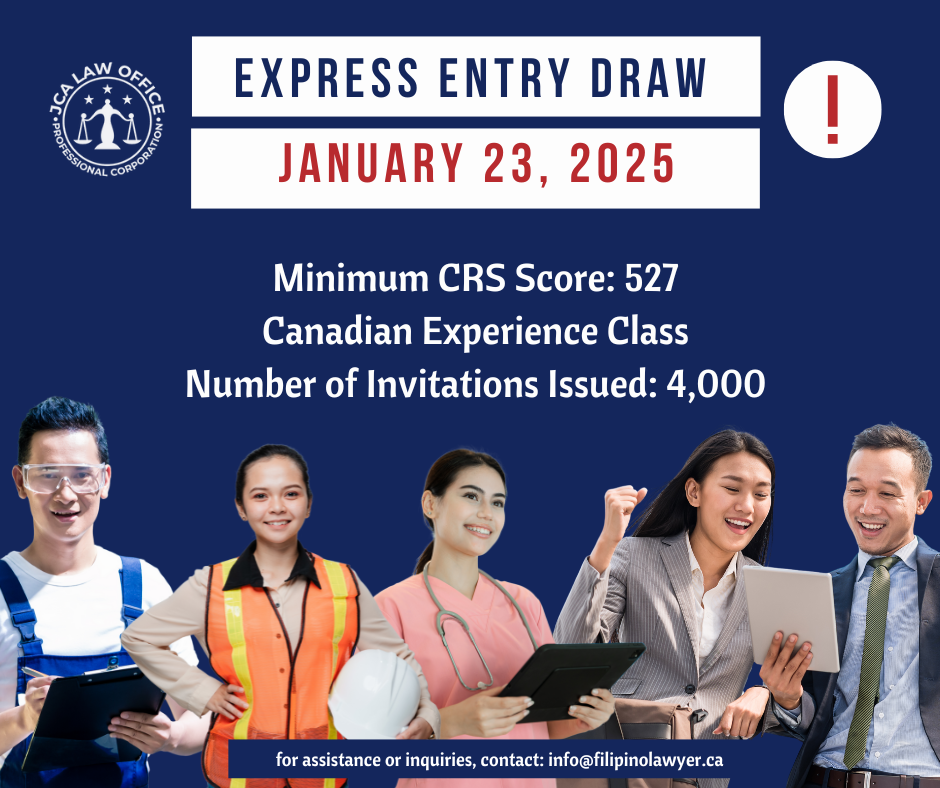
    On January 23, 2025, Immigration, Refugees and Citizenship Canada (IRCC) held the latest Canadian Experience Class (CEC) draw, inviting candidates with a Comprehensive Ranking System (CRS) score of 527 or higher to apply for permanent residency (PR) in Canada. A total of 4,000 Invitations to Apply (ITAs) were issued.

    The CEC program provides a pathway for skilled workers already in Canada who wish to transition to PR. To be eligible, applicants must have at least one year of skilled work experience in Canada within the last three years, gained under a valid work permit. They must also meet the required language proficiency levels in English or French and plan to live outside of Quebec. Unlike other Express Entry programs, the CEC does not require proof of settlement funds, making it an attractive option for those already working in Canada. 

    If you have Canadian work experience and meet the eligibility criteria, this could be your opportunity to secure permanent status in the country.

    At JCA Law, we help skilled workers navigate Express Entry applications, improve CRS scores, and provide immigration consultations. If you received an ITA or want to know your chances in future draws, contact us for guidance!

    Contact us for a consultation
    Visit our website to learn more

    Email us at info@filipinolawyer.ca for more details

    Don’t miss this opportunity—your pathway to Canadian PR starts now!

  • Express Entry Canada 2026: Comprehensive Guide for Filipino Immigrants

    Express Entry Canada 2026: Comprehensive Guide for Filipino Immigrants

    Express Entry Canada 2026: Comprehensive Guide for Filipino Immigrants

    Last Updated: February 2026 | Express Entry remains the fastest and most popular pathway to Canadian permanent residence. If you are a Filipino professional, tradesperson, or international graduate looking to immigrate to Canada, this comprehensive guide covers everything you need to know about Express Entry in 2026 — from CRS scoring and category-based draws to the latest fee changes and Filipino-specific strategies.

    At JCA Law Office Professional Corporation, we have helped hundreds of Filipino families navigate Express Entry successfully. This guide reflects the latest IRCC policies, draw results, and the 2026-2028 Immigration Levels Plan.


    What Is Express Entry?

    Express Entry is Canada s flagship immigration management system, introduced in 2015. It is not a visa or immigration program itself — rather, it is an online system that manages applications for three federal economic immigration programs. Candidates create an online profile, receive a Comprehensive Ranking System (CRS) score, and enter a pool of candidates. The highest-ranking candidates receive Invitations to Apply (ITAs) for permanent residence through regular draws conducted by Immigration, Refugees and Citizenship Canada (IRCC).

    In 2025, IRCC issued a total of 114,102 Invitations to Apply — and the 2026-2028 Levels Plan targets approximately 380,000 new permanent residents per year, with economic immigration (including Express Entry) making up 64% of admissions by 2027-2028.

    The Three Express Entry Programs

    Express Entry manages applications for three distinct federal programs. Each has different eligibility requirements:

    1. Federal Skilled Worker Program (FSWP)

    The FSWP is designed for skilled workers with foreign work experience who want to immigrate to Canada permanently. This is the most common pathway for Filipino applicants applying from outside Canada.

    Key Requirements:

    • At least 1 year of continuous full-time skilled work experience (NOC TEER 0, 1, 2, or 3) within the last 10 years
    • Language proficiency: Minimum CLB 7 in all four abilities (speaking, listening, reading, writing) in English or French
    • Education: Canadian secondary or post-secondary credential, OR foreign credential with an Educational Credential Assessment (ECA)
    • Proof of settlement funds (unless you have a valid job offer or are already authorized to work in Canada)
    • Must score at least 67 out of 100 on the FSW points grid (separate from CRS)

    2. Canadian Experience Class (CEC)

    The CEC is for candidates who already have skilled work experience in Canada. This pathway has become increasingly important, as IRCC held 15 CEC-specific draws in 2025, reflecting the government s priority for in-Canada candidates.

    Key Requirements:

    • At least 1 year of skilled work experience in Canada (NOC TEER 0, 1, 2, or 3) within the last 3 years
    • Language proficiency: Minimum CLB 7 for NOC TEER 0 or 1 jobs; CLB 5 for NOC TEER 2 or 3 jobs
    • No education requirement (but education boosts your CRS score)
    • No proof of funds requirement

    3. Federal Skilled Trades Program (FSTP)

    The FSTP targets workers in skilled trades such as electricians, plumbers, welders, and heavy equipment operators. Filipino tradespeople with Canadian experience or a valid job offer should strongly consider this pathway.

    Key Requirements:

    • At least 2 years of full-time skilled trade work experience (NOC groups under TEER 2 or 3) within the last 5 years
    • Language proficiency: Minimum CLB 5 for speaking and listening; CLB 4 for reading and writing
    • A valid job offer of at least 1 year OR a certificate of qualification from a Canadian provincial or territorial authority
    • No education requirement (but education boosts your CRS score)

    Program Comparison Table

    FactorFederal Skilled Worker (FSW)Canadian Experience Class (CEC)Federal Skilled Trades (FSTP)
    Work Experience1 year foreign skilled work (last 10 years)1 year Canadian skilled work (last 3 years)2 years skilled trade work (last 5 years)
    Language (English)CLB 7 minimumCLB 5-7 depending on NOC TEERCLB 4-5 depending on ability
    EducationRequired (with ECA for foreign)Not requiredNot required
    Proof of FundsRequiredNot requiredRequired
    Job OfferNot requiredNot requiredRequired OR certificate of qualification
    Best ForFilipino professionals abroadFilipino workers already in CanadaFilipino tradespeople

    Comprehensive Ranking System (CRS) Scoring Breakdown

    Every Express Entry candidate receives a CRS score out of a maximum of 1,200 points. Your CRS score determines your rank in the Express Entry pool and whether you will receive an Invitation to Apply. The CRS evaluates four main categories:

    CRS Score Components

    ComponentWith Spouse (Max)Without Spouse (Max)
    A. Core / Human Capital460 points500 points
    — Age100110
    — Education140150
    — Language (1st official)128136
    — Language (2nd official)2224
    — Canadian Work Experience7080
    B. Spouse/Partner Factors40 pointsN/A
    C. Skill Transferability100 points (max)
    — Education + Language50
    — Education + Canadian Work Exp.50
    — Foreign Work Exp. + Language50
    — Foreign + Canadian Work Exp.50
    — Certificate of Qualification + Language50
    D. Additional Points600 points (max)
    — Provincial Nomination (PNP)600
    — French language proficiency (NCLC 7+)25-50
    — Canadian education15-30
    — Sibling in Canada (PR/citizen)15
    TOTAL MAXIMUM1,200 points

    Important 2025 Change — Arranged Employment Points Removed: As of March 25, 2025, IRCC removed the 50-200 bonus CRS points previously awarded for having a valid job offer supported by an LMIA. This was a temporary measure to address fraud in the LMIA system. While having a job offer may still be required for eligibility under certain programs (e.g., FSTP), it no longer adds CRS points. IRCC has not announced when this measure will end.

    Age Points Breakdown

    AgePoints (Without Spouse)Points (With Spouse)
    17 or under00
    189990
    1910595
    20-29110100
    3010595
    319990
    329485
    338880
    348375
    357770
    367265
    376660
    386155
    395550
    405045
    413935
    422825
    431715
    4465
    45+00

    Category-Based Selection Draws (2025-2026)

    Since 2023, IRCC has conducted category-based selection draws that target candidates with specific attributes or work experience aligned with Canada s economic priorities. These draws are in addition to general, CEC, and PNP draws. In 2025, category-based draws accounted for approximately 59% of all ITAs issued.

    Current Categories for 2026

    IRCC has confirmed the following seven categories for Express Entry in 2026:

    CategoryDescription2025 Draw ActivityTypical CRS Range
    French-Language ProficiencyCandidates with strong French skills (NCLC 7+ in all abilities)High — multiple draws, large ITAs379-446
    Healthcare and Social ServicesNurses, physicians, medical technologists, social workers, and related occupationsHigh — multiple draws462-510
    STEM OccupationsScience, technology, engineering, and math professionalsNo draws held in 2025N/A (expected 480-520)
    Trades OccupationsElectricians, plumbers, welders, heavy equipment operators, etc.1 draw (September 2025)~505
    Agriculture and Agri-FoodButchers and related agri-food workersNo draws held in 2025N/A
    Education OccupationsTeachers, early childhood educators (added Feb 2025)Minimal draws~480-510
    Physicians (NEW)Physicians with 12+ months Canadian work experience (added Dec 2025)Draws expected to begin early 2026TBD

    Why This Matters for Filipinos: Category-based draws for healthcare and French language consistently have the lowest CRS cutoffs. Filipino nurses, medical technologists, and caregivers who qualify under the healthcare category have a significant advantage. Similarly, Filipino professionals who invest in French language training can dramatically lower their required CRS score — with cutoffs as low as 379 points for French-language draws in 2025.

    Key Changes to Categories in 2025

    • Transportation category removed (February 2025)
    • Education category added with 5 eligible occupations (February 2025)
    • Healthcare expanded to include social services occupations
    • Trades expanded with additional NOC codes
    • Agriculture narrowed from 3 occupations to 1 (Butchers — retail and wholesale, NOC 63201)
    • Physicians category introduced (December 2025) — requires 12+ months Canadian work experience in one of three eligible NOCs

    Latest Express Entry Draw Results (2025-2026)

    The following table shows recent Express Entry draws from late 2025 through early 2026. Note the significant variation in CRS cutoffs depending on the draw type:

    DateDraw TypeITAs IssuedCRS Cutoff
    February 3, 2026Provincial Nominee Program (PNP)423749
    January 21, 2026Canadian Experience Class (CEC)6,000509
    January 20, 2026Provincial Nominee Program (PNP)681746
    January 7, 2026Provincial Nominee Program (PNP)423711
    January 6, 2026Canadian Experience Class (CEC)8,000511
    January 3, 2026Provincial Nominee Program (PNP)574739
    December 17, 2025French Language Proficiency6,000399
    December 3, 2025Provincial Nominee Program (PNP)1,123729
    December 2, 2025Canadian Experience Class (CEC)5,000515
    September 2025Trades Occupations1,250505

    2026 Trend: IRCC has focused heavily on in-Canada candidates in early 2026, with large CEC draws (8,000 and 6,000 ITAs) and steady PNP draws. The CEC cutoff dropped to 509 — the lowest in over a year. This is excellent news for Filipino workers and graduates already in Canada.

    2025 Year in Review

    • Total ITAs issued in 2025: 114,102
    • Category-based draws: ~59% of all ITAs
    • CEC draws: ~26% (15 draws total)
    • PNP draws: Regular, consistent draws throughout the year
    • No general (all-program) draws: The last general draw was April 23, 2024
    • No STEM or Agriculture draws were held in 2025
    • Largest single-month issuance: December 2025 (17% of all 2025 ITAs)

    How to Improve Your CRS Score

    Many Filipino applicants find their CRS score falls just below the cutoff. Here are proven strategies to boost your score by 30-100+ points:

    1. Improve Your Language Scores (Up to 80+ Additional Points)

    Language proficiency is the single biggest factor you can control. Retaking your IELTS or CELPIP test to achieve higher scores can yield dramatic CRS improvements.

    CLB Level ImprovementApproximate CRS Gain
    CLB 7 to CLB 8 (in all abilities)+20 to +30 points
    CLB 8 to CLB 9 (in all abilities)+30 to +50 points
    CLB 9 to CLB 10+ (in all abilities)+15 to +25 points

    Filipino-specific tip: Many Filipinos score well on IELTS reading and listening but lose points on writing and speaking. Invest in an IELTS preparation course that focuses on these two modules. Even a 0.5-band improvement in writing (e.g., 6.5 to 7.0) can add meaningful CRS points.

    2. Learn French (25-50 Additional Points + Category Access)

    This is one of the most powerful strategies available in 2026. Achieving NCLC 7+ in French gives you:

    • 25 bonus CRS points for French proficiency with English CLB 4 or lower
    • 50 bonus CRS points for French proficiency with English CLB 5+
    • Access to French-language category draws with CRS cutoffs as low as 379

    French-language draws consistently have the lowest CRS cutoffs of any draw type. IRCC targets Francophone admissions of 9% in 2026, 9.5% in 2027, and 10.5% in 2028 outside Quebec, making this an increasingly valuable pathway.

    3. Obtain a Canadian Education Credential (15-30 Points)

    • 1- or 2-year diploma/certificate: +15 CRS points
    • 3+ year degree or graduate degree: +30 CRS points
    • Also boosts your Skill Transferability cross-factor points

    4. Gain Canadian Work Experience (Up to 80 Points)

    Canadian work experience is heavily weighted in the CRS. Each additional year (up to 5 years) adds significant points:

    Canadian Work ExperiencePoints (Without Spouse)Points (With Spouse)
    1 year4035
    2 years5346
    3 years6456
    4 years7263
    5+ years8070

    5. Get a Provincial Nomination (+600 Points)

    A Provincial Nominee Program (PNP) nomination adds 600 CRS points to your profile, virtually guaranteeing an ITA regardless of your base score. PNP draws in 2026 have had CRS cutoffs of 711-749, meaning even candidates with base scores as low as 111-149 can receive an ITA with a nomination.

    6. Additional CRS Boosters

    FactorCRS PointsNotes
    Sibling in Canada (PR/citizen)+15Must be 18+ and a PR or citizen
    Higher education levelVariesMasters or PhD scores highest
    Spouse language scoresUp to +20If accompanying spouse has CLB 5-9+
    Spouse Canadian work experienceUp to +10If accompanying spouse has Canadian experience
    Spouse educationUp to +10If accompanying spouse has post-secondary

    Provincial Nomination Through Express Entry (+600 Points)

    A provincial nomination is the most impactful way to receive an Express Entry ITA. With +600 CRS points, it effectively guarantees you will be invited in the next PNP draw.

    How PNP Works with Express Entry

    1. Create your Express Entry profile and enter the pool
    2. Apply to a province through their PNP Express Entry stream (or receive a Notification of Interest from a province)
    3. If nominated, accept the nomination in your Express Entry profile
    4. Receive +600 CRS points, boosting your score well above any cutoff
    5. Receive your ITA in the next PNP-specific draw

    Best PNP Options for Filipino Immigrants

    ProvinceKey StreamsFilipino-Friendly Features
    Ontario (OINP)Human Capital Priorities, Skilled Trades, French-SpeakingLargest Filipino community; GTA job market; healthcare demand
    British Columbia (BC PNP)Skills Immigration, Express Entry BCStrong tech and healthcare sectors; Metro Vancouver Filipino community
    Alberta (AAIP)Alberta Express EntryLower cost of living; strong trade and healthcare demand
    Manitoba (MPNP)Skilled Workers Overseas, Skilled Workers in ManitobaLarge established Filipino community in Winnipeg
    Saskatchewan (SINP)International Skilled Worker, Express EntryIn-demand occupations list favors Filipino skill sets

    Step-by-Step Express Entry Application Process

    Step 1: Determine Your Eligibility

    Before creating a profile, confirm you meet the minimum requirements for at least one of the three Express Entry programs (FSW, CEC, or FSTP). Use the IRCC Come to Canada tool for a preliminary assessment.

    Step 2: Prepare Your Documents

    Gather all required documents before creating your profile:

    • Language test results: IELTS General Training or CELPIP-General (English); TEF Canada or TCF Canada (French). Results must be less than 2 years old.
    • Educational Credential Assessment (ECA): Required for foreign education. Use a designated organization such as WES (World Education Services). For Philippine degrees, WES typically requires authenticated documents from CHED and DFA. Allow 4-8 weeks.
    • Passport: Valid Philippine passport
    • Work experience documentation: Reference letters from employers detailing job title, duties, dates of employment, hours per week, and salary
    • Proof of funds: Bank statements or investment records (for FSW and FSTP applicants)

    Step 3: Create Your Express Entry Profile

    Create an account on the IRCC website and complete your Express Entry profile. Your profile includes information about your:

    • Skills, work experience, language ability, and education
    • Family members (spouse/partner, dependent children)
    • Job offer details (if applicable)
    • Provincial nomination (if applicable)

    Once submitted, you receive your CRS score and enter the Express Entry pool. Your profile remains active for 12 months.

    Step 4: Receive an Invitation to Apply (ITA)

    If your CRS score is above the cutoff in a draw, you receive an ITA. You then have 60 days to submit a complete application for permanent residence.

    Step 5: Submit Your PR Application

    After receiving your ITA, submit your full application online with:

    • All supporting documents (identity, education, work experience, language)
    • Police clearance certificates — including NBI Clearance from the Philippines
    • Medical examination from an IRCC-designated panel physician
    • Application fees (see fee breakdown below)
    • Proof of funds (if required)
    • Photos meeting IRCC specifications

    Need NBI Clearance? Filipino applicants need an NBI (National Bureau of Investigation) clearance as part of their police clearance requirements. Learn about the process in our NBI Clearance Guide.

    Step 6: Wait for Processing and Decision

    IRCC processes your application. During this time, they may request additional documents or schedule an interview. If approved, you receive your Confirmation of Permanent Residence (COPR) and permanent resident visa.


    Processing Times and Fees (2026)

    Current Processing Times

    IRCC s service standard for Express Entry applications is 6 months (80% of cases). However, actual processing times vary:

    ProgramService StandardTypical Processing Time (2025-2026)
    Federal Skilled Worker (FSW)6 months5-8 months
    Canadian Experience Class (CEC)6 months4-6 months
    Federal Skilled Trades (FSTP)6 months5-7 months

    Processing times can be longer if IRCC requests additional documents, medical re-examination, or enhanced background checks.

    Fee Breakdown (as of 2026)

    Fee TypePrimary ApplicantSpouse/PartnerDependent Child
    PR Application Processing Fee
    Right of Permanent Residence Fee (RPRF)N/A
    Biometrics (if 14-79)
    Total per Adult,610,610

    Fee Increase Alert: IRCC reviews and increases PR application fees periodically. The current processing fee took effect in 2025 (up from ). The next fee adjustment is expected April 30, 2026. We recommend submitting your application before this date to lock in current fees.

    Additional Costs to Budget For

    ItemApproximate Cost
    IELTS General Training test
    CELPIP-General test
    TEF/TCF French test
    Educational Credential Assessment (WES)– (plus authentication fees)
    Medical exam (IRCC panel physician)– per person
    NBI Clearance (Philippines)PHP 155-580 (~- CAD)
    Police clearance (other countries)Varies by country
    Document translation and notarization– per document
    Photos (IRCC specifications)

    Total estimated cost for a single applicant: ,500-,200 CAD (including all fees, tests, and documents)

    Proof of Settlement Funds (2025-2026)

    FSW and FSTP applicants must demonstrate they have enough funds to support themselves and their family in Canada. These amounts are based on 50% of the Low-Income Cut-Off (LICO) and are updated annually (most recently July 2025):

    Family SizeMinimum Funds Required (CAD)
    1 member (single applicant),263
    2 members,005
    3 members,370
    4 members,362
    5 members,164
    6 members,276
    7 members,392
    Each additional member+,112

    CEC applicants do not need to show proof of funds. FSW applicants with a valid Canadian job offer are also exempt.


    2026-2028 Immigration Levels Plan: Impact on Express Entry

    Canada s 2026-2028 Immigration Levels Plan sets the framework for permanent resident admissions over the next three years. Here is what it means for Express Entry applicants:

    Key Numbers

    YearTotal PR TargetEconomic ImmigrationEE Share of Economic
    2026380,000239,800~85,000-122,000
    2027380,000244,700~85,000-122,000
    2028380,000244,700~85,000-122,000

    What This Means for Filipino Applicants

    • Stable admissions: The plan holds total PR admissions steady at 380,000 per year (down from the previous plan s 500,000 target), providing more predictability
    • Economic immigration is the priority: Economic class makes up 64% of admissions by 2027-2028, meaning Express Entry and PNP remain the primary pathways
    • Temporary to permanent transitions: IRCC plans to accelerate the transition of up to 33,000 temporary workers to PR in 2026 and 2027 — excellent news for Filipino workers on work permits in Canada
    • Francophone targets increasing: 9% (2026) to 9.5% (2027) to 10.5% (2028) of admissions outside Quebec must be French-speaking, meaning more French-language draws at lower CRS cutoffs
    • CRS scores may fluctuate: With lower overall targets but consistent category-based draws, CRS cutoffs for general/CEC draws may remain in the 500-530 range, while category-based draws will likely stay lower

    Tips for Filipino Express Entry Applicants

    As lawyers who serve the Filipino-Canadian community, we have identified the most effective strategies for Filipino applicants:

    1. Start Your ECA Early

    The Educational Credential Assessment process for Philippine degrees involves multiple steps: DFA authentication (red ribbon), CHED authentication, and then submission to WES or another designated organization. The entire process can take 2-4 months. Start this immediately — do not wait until you are ready to create your profile.

    2. Maximize Your IELTS Score

    Filipino applicants typically have strong English foundations but often score lower on IELTS Writing (especially Task 1 — the letter/report). A score of CLB 9 (IELTS 7.0 in each band) versus CLB 7 (IELTS 6.0) can mean a difference of 50-80 CRS points. Invest in a 4-8 week IELTS preparation course, particularly for Writing and Speaking.

    3. Consider French as a Strategic Advantage

    With French-language draw cutoffs as low as 379 CRS points compared to 509+ for CEC draws, learning French is one of the most impactful investments you can make. Many Filipino professionals can achieve TEF/TCF B2 (NCLC 7) within 6-12 months of dedicated study. Alliance Francaise centres in Manila and online French courses through platforms like TV5Monde are good starting points.

    4. Filipino Healthcare Workers: Leverage Category-Based Draws

    If you are a nurse, medical technologist, physiotherapist, occupational therapist, or social worker, you may qualify for healthcare and social services category-based draws. These draws have CRS cutoffs of 462-510 — significantly lower than CEC draws. Ensure your NOC code matches the eligible occupations list.

    5. Work in Canada First (If Possible)

    Canadian work experience is one of the most valuable CRS factors. If you can obtain a work permit (e.g., through an LMIA employer, post-graduation work permit, or IEC), even 1 year of Canadian experience can boost your score by 40-80 points and make you eligible for CEC draws, which have lower cutoffs than general draws.

    6. Explore Provincial Nomination

    If your CRS score is below the cutoff for direct Express Entry draws, a PNP nomination adds 600 points and guarantees an invitation. Provinces like Manitoba, Saskatchewan, and Alberta have streams that are particularly accessible for Filipino applicants. Our Filipino Immigrant Guide to Canada provides detailed information about each province s PNP programs.

    7. Keep Your Profile Updated

    Your Express Entry profile is valid for 12 months. During that time, update it whenever your circumstances change: new language test scores, additional work experience, new education, or a provincial nomination. Each update recalculates your CRS score and could push you above the cutoff.

    8. Apply to Multiple Provinces Simultaneously

    There is no rule against having both an Express Entry profile and applications to multiple Provincial Nominee Programs. Cast a wide net — apply to 2-3 provinces while maintaining your federal Express Entry profile.


    Frequently Asked Questions (FAQ)

    What CRS score do I need to get an ITA in 2026?

    It depends on the draw type. In early 2026, CEC draws have required CRS scores of 509-511, PNP draws require 711-749 (which includes the 600-point PNP bonus), and category-based draws (French, healthcare) can be as low as 379-510. There have been no general all-program draws since April 2024.

    Can I apply to Express Entry from the Philippines?

    Yes. Express Entry is an online system, and you can create your profile and submit your application from anywhere in the world. However, note that IRCC has heavily favored in-Canada candidates (through CEC draws) in 2025-2026. Candidates outside Canada are primarily invited through category-based draws (French, healthcare, STEM, trades) or through PNP nominations.

    How long does the entire Express Entry process take?

    From start to finish, the typical timeline is:

    • Document preparation: 2-4 months (ECA, IELTS, police clearances)
    • Profile creation and time in pool: Varies (could be days to months)
    • After ITA: 60 days to submit full application
    • Processing: 4-8 months
    • Total estimate: 8-16 months from first steps to COPR

    Do I still get CRS points for a job offer?

    No. As of March 25, 2025, IRCC removed the 50-200 bonus CRS points for arranged employment (LMIA-supported job offers). This was a temporary measure to combat LMIA fraud. However, having a valid job offer is still required for eligibility under the Federal Skilled Trades Program, and you should still list any job offers in your profile.

    What happens if my CRS score is too low?

    If your score is below recent cutoffs, you have several options: (1) improve your language test scores, (2) gain Canadian work experience, (3) learn French, (4) pursue additional education, (5) apply for a Provincial Nominee Program nomination (+600 points), or (6) wait for category-based draws that match your occupation. Your profile stays in the pool for 12 months and can be renewed.

    Can my spouse or common-law partner be included in my application?

    Yes. Your spouse or common-law partner and dependent children (under 22 and unmarried) can be included in your PR application. Note that having a spouse may reduce your CRS score slightly (because points are shared between human capital factors), but if your spouse has strong language scores, education, or Canadian work experience, they can add points to your total CRS.

    Is Express Entry still worth it with lower immigration targets?

    Absolutely. While the 2026-2028 plan reduced total PR targets to 380,000 (from a planned 500,000), economic immigration — which includes Express Entry — now represents 64% of all admissions. Express Entry remains the fastest, most efficient pathway to Canadian permanent residence, with processing times of 6 months or less for most applicants.

    Do I need a lawyer for Express Entry?

    While Express Entry can be done independently, working with an experienced immigration lawyer significantly reduces the risk of errors that can lead to refusals or delays. Common issues include: incorrect NOC code selection, inadequate reference letters, incomplete proof of funds documentation, and missed deadlines. An immigration lawyer ensures your application is complete, accurate, and optimized for success.


    How JCA Law Office Can Help

    JCA Law Office Professional Corporation is a Toronto-based law firm that specializes in serving the Filipino-Canadian community. Our immigration team provides comprehensive Express Entry services:

    • Free initial assessment of your Express Entry eligibility and CRS score
    • Profile optimization — strategies to maximize your CRS score
    • Provincial Nominee Program applications to secure the +600 point boost
    • Complete application preparation and submission after receiving your ITA
    • Document review — ensuring reference letters, ECA, and supporting documents meet IRCC requirements
    • Category-based draw strategy — identifying which category draws you qualify for and optimizing your profile accordingly
    • Post-ITA support — medical exams, police clearances (including NBI), and final submission

    We understand the unique challenges Filipino applicants face, from Philippine document authentication (DFA red ribbon, CHED, PSA) to NBI clearance requirements. Our team communicates in English, Filipino, and Tagalog.

    Ready to Start Your Express Entry Journey?

    Book a consultation with our immigration team to assess your eligibility, calculate your CRS score, and develop a personalized strategy for permanent residence in Canada.

    BOOK A CONSULTATION

    JCA Law Office Professional Corporation | Serving the Filipino-Canadian Community in the GTA


    Related Resources

    Official Government Resources

    Disclaimer: This guide is for informational purposes only and does not constitute legal advice. Immigration laws and policies change frequently. For advice specific to your situation, please book a consultation with our immigration team. Information is current as of February 2026.

  • How to Improve Your Express Entry CRS Score: 2026 Guide for Filipinos

    How to Improve Your Express Entry CRS Score: 2026 Guide for Filipinos

    If you’re a Filipino professional dreaming of permanent residence in Canada, your Comprehensive Ranking System (CRS) score is the single most important number in your immigration journey. Whether you’re applying through the Federal Skilled Worker Program (FSWP), Canadian Experience Class (CEC), or Federal Skilled Trades Program (FSTP), a higher CRS score means a better chance of receiving an Invitation to Apply (ITA) for permanent residence.

    This 2026 guide is written specifically for Filipino applicants — from nurses and healthcare workers to IT professionals and skilled tradespeople — with practical strategies to maximize your CRS score and get that ITA faster. Updated with the latest draw data, category-based selection changes, and the removal of job offer points effective March 2025.

    Understanding the CRS Scoring System

    The CRS assigns every Express Entry candidate a score out of 1,200 points, divided into four main components. Understanding how each factor contributes to your score is the first step toward improving it.

    CRS Points Breakdown Table

    FactorWith Spouse (Max)Without Spouse (Max)
    A. Core / Human Capital Factors
    Age100110
    Education140150
    First Official Language128136
    Second Official Language2224
    Canadian Work Experience7080
    Subtotal (A)460500
    B. Spouse / Common-Law Partner Factors
    Education10N/A
    First Official Language20N/A
    Canadian Work Experience10N/A
    Subtotal (B)40N/A
    C. Skill Transferability Factors
    Education + LanguageUp to 50
    Education + Canadian Work ExperienceUp to 50
    Foreign Work + LanguageUp to 50
    Foreign Work + Canadian Work ExperienceUp to 50
    Trade Certificate + LanguageUp to 50
    Subtotal (C) — Max 100100
    D. Additional Points
    Provincial Nomination (PNP)600
    French Language Bonus (NCLC 7+ all four skills, with CLB 5+ English)50
    French Language Bonus (NCLC 7+ all four skills, CLB 0-4 English)25
    Canadian Post-Secondary Education (3+ years)30
    Canadian Post-Secondary Education (1-2 years)15
    Sibling in Canada (citizen or PR)15
    Valid Job Offer (NOC 00)200 Removed March 2025
    Valid Job Offer (Other TEER)50 Removed March 2025
    Subtotal (D) — Max 600600
    GRAND TOTAL: 1,200 points maximum

    Key takeaway: Without a provincial nomination (which adds 600 points and virtually guarantees an ITA), most candidates compete for ITAs based on their Core + Skill Transferability scores, which max out at 600 points.

    Current CRS Cutoff Scores and Trends (2025-2026)

    Understanding recent draw trends helps you set realistic targets and choose the best strategy. Here’s what the data shows as of early 2026:

    Recent Express Entry Draws (2026)

    DateDraw TypeITAs IssuedCRS Cutoff
    February 6, 2026French Language Proficiency8,500400
    February 3, 2026Provincial Nominee Program423746
    January 21, 2026Canadian Experience Class6,000509
    January 7, 2026General (No Program Specified)8,000511

    2025 Trends That Shaped 2026

    In 2025, IRCC issued nearly 114,000 Invitations to Apply across 58 draws. The key trends that continue into 2026:

    • General draws (CEC/FSWP): CRS cutoffs ranged from 518-547, typically hovering around 510-520
    • French language draws: Dramatically lower cutoffs of 379-428 CRS — the lowest thresholds in Express Entry
    • Healthcare category draws: CRS cutoffs around 476-520, lower than general draws
    • PNP draws: CRS cutoffs of 667-802 (reflecting the automatic 600-point nomination bonus)
    • Category-based selection now dominates, with multiple parallel draw streams operating simultaneously

    What This Means for Filipino Applicants: If your CRS score is below 510, focus on category-based pathways (healthcare, French language) or provincial nomination. A general draw ITA now requires a very competitive profile — but the category-based system creates new opportunities for those who strategically position themselves.

    Top 10 Strategies to Boost Your CRS Score

    Below are the most effective strategies, ranked by potential impact. Many of these can be combined for maximum effect.

    1. Learn French — The Biggest Game-Changer (Up to 72+ Additional CRS Points)

    This is the single most impactful strategy available in 2026. Learning French can boost your score in three separate ways:

    • Second Official Language points: Up to 22-24 CRS points for CLB 5+ in French (even basic proficiency counts)
    • French language bonus: An additional 50 CRS points for achieving NCLC 7+ in all four French skills (if you also have CLB 5+ in English)
    • French-language category draws: Access to draws with CRS cutoffs as low as 379-400 — hundreds of points below general draws

    Filipino Advantage: Many Filipinos already speak English fluently, meeting the CLB 5+ requirement for the maximum 50-point French bonus. You only need to add French as a second language — you don’t need to be fluent. Achieving NCLC 7 (intermediate level) is realistic with 6-12 months of dedicated study. Accepted tests are TEF Canada and TCF Canada, and results must be less than 2 years old.

    Real impact example: A Filipino nurse with a CRS score of 430 could gain 50 bonus points (to 480) plus access to French-language draws where the cutoff is 400. That’s the difference between waiting indefinitely and receiving an ITA.

    2. Get a Provincial Nomination (+600 CRS Points)

    A Provincial Nominee Program (PNP) nomination adds a massive 600 CRS points to your profile, virtually guaranteeing an Invitation to Apply regardless of your base CRS score. This is the single largest point boost available.

    How it works:

    1. Apply to a province’s PNP stream that aligns with your skills and experience
    2. If nominated, the province sends you a nomination certificate
    3. You add the nomination to your Express Entry profile
    4. Your CRS score instantly increases by 600 points
    5. You receive an ITA in the next PNP-targeted draw

    Best PNP options for Filipinos in 2026:

    • Ontario (OINP): Human Capital Priorities stream targets Express Entry candidates with work experience in Ontario’s priority occupations
    • British Columbia (BC PNP): Skills Immigration stream for healthcare workers and tech professionals
    • Alberta (AAIP): Alberta Express Entry stream with lower requirements than federal draws
    • Manitoba (MPNP): Skilled Workers Overseas stream, especially strong for candidates with Manitoba connections
    • Saskatchewan (SINP): International Skilled Worker category with an in-demand occupation list that includes many healthcare roles

    Related Guides: Explore our detailed provincial guides — Ontario OINP Guide | BC PNP Guide | Alberta AAIP Guide | Manitoba MPNP Guide | Saskatchewan SINP Guide

    3. Leverage Category-Based Draws (Healthcare, STEM, Trades)

    Since 2023, IRCC has run category-based selection draws that target candidates with specific work experience. In 2026, the active categories are:

    CategoryTypical CRS CutoffKey NOC Codes
    French Language Proficiency379-428Any (must have NCLC 7+)
    Healthcare & Social Services476-52031301, 32101, 31120, 32111, 33102
    STEM Occupations480-53021211, 21231, 21232, 21234, 20012
    Trade Occupations480-52072010, 72011, 72020, 73200
    Agriculture & Agri-food470-51082030, 84120, 85100, 85101
    Education Occupations480-51041220, 41221, 42202
    Physicians (NEW 2026)TBD — First draws expected early 202631100, 31102

    Filipino Healthcare Workers: Nurses (NOC 31301 — Registered Nurses, NOC 32101 — Licensed Practical Nurses) are among the most in-demand occupations in Canada, with over 21,000 registered nurse vacancies nationwide. Healthcare category draws typically have lower CRS cutoffs than general draws, and you compete only against other healthcare professionals — not the entire Express Entry pool. If you have at least 6 months of full-time nursing experience in the last 3 years (including experience from the Philippines), you may qualify.

    4. Improve Your Language Test Scores (Up to 136 Points for First Language)

    Language proficiency is the highest-weighted single factor in CRS scoring. Small improvements in your IELTS or CELPIP score can yield significant CRS gains.

    CLB LevelIELTS ScorePoints per Skill (Without Spouse)Total (4 Skills)
    CLB 10+8.0-9.0 (varies by skill)34136
    CLB 97.0-8.0 (varies by skill)31124
    CLB 86.5-7.5 (varies by skill)2392
    CLB 76.0-7.0 (varies by skill)1768
    CLB 65.5-6.5 (varies by skill)936
    CLB 55.0-6.0 (varies by skill)624

    The jump from CLB 8 to CLB 9 is worth an extra 32 points (without spouse). Going from CLB 9 to CLB 10+ adds another 12 points. These are some of the easiest points to gain through test preparation.

    Pro Tip: Many Filipino applicants score CLB 8-9 in Speaking and Listening but fall short in Writing. Focus your preparation on your weakest skill — improving just one skill from CLB 8 to CLB 9 adds 8 points. Consider CELPIP as an alternative to IELTS; some test-takers find it more straightforward since it is fully computer-based.

    5. Earn a Canadian Education Credential (+15 to +30 Points)

    Completing a post-secondary program in Canada adds bonus CRS points on top of any education points you already have:

    • 1- or 2-year diploma or certificate: +15 CRS points
    • 3+ year degree, or master’s, or doctoral program: +30 CRS points

    This Canadian credential bonus stacks with your existing education score. For example, if you already hold a bachelor’s degree from the Philippines (120-140 CRS points for education), completing a 1-year Canadian post-graduate certificate adds 15 more bonus points. This strategy is especially effective for international students who can also gain Canadian work experience through a Post-Graduation Work Permit (PGWP).

    6. Gain Canadian Work Experience (Up to 80 Points + Skill Transferability)

    Canadian work experience is doubly valuable — it contributes directly to your core CRS score and unlocks additional Skill Transferability points when combined with other factors.

    Canadian Work ExperienceCore Points (Without Spouse)Additional Skill Transferability (with strong language or foreign experience)
    1 year40Up to 25
    2 years53Up to 50
    3 years64Up to 50
    5+ years80Up to 50

    Ways to gain Canadian work experience include temporary work permits, Post-Graduation Work Permits (PGWP), open work permits for spouses of skilled workers, and Bridging Open Work Permits (BOWPs).

    7. Understand the Job Offer Points Removal (March 2025 Change)

    Major 2025 Change: As of March 25, 2025, IRCC removed CRS points for arranged employment (job offers). Previously, a valid LMIA-backed job offer was worth 50-200 CRS points. This change was made to address LMIA system abuse and promote fairness. Job offers still matter for eligibility in some programs (like certain PNP streams), but they no longer add CRS points.

    What this means for your strategy: Do not spend money on an LMIA purely for CRS points — it will not help. Instead, redirect that investment toward language testing, education credentials, or French language courses, which now provide better returns.

    8. Maximize Spouse or Common-Law Partner Factors (Up to 40 Points)

    If you have a spouse or common-law partner included in your application, their profile contributes up to 40 CRS points:

    • Spouse’s education: PhD/Master’s = 10 points, Bachelor’s = 8 points
    • Spouse’s first official language: CLB 9+ in each skill = 5 points (up to 20 total)
    • Spouse’s Canadian work experience: 5+ years = 10 points, 1 year = 5 points

    Strategic consideration: Having a spouse in your application reduces your maximum Core/Human Capital points (from 500 to 460). If your spouse has a weak profile (low education, low language scores, no Canadian experience), you may actually score higher by not declaring them as your accompanying partner. However, this has implications for their PR application — consult with an immigration lawyer to understand the trade-offs.

    9. Get Your Education Credential Assessed (ECA)

    Foreign education credentials must be assessed by a designated organization to count for CRS points. For Filipino applicants, this means getting your Philippine degrees evaluated.

    • WES (World Education Services): Most popular choice, typically fastest processing
    • IQAS, CES, MCC, PEBC: Other designated assessment agencies
    • Processing time: Usually 4-8 weeks (plan ahead!)

    Ensure your ECA accurately reflects your highest credential. A 4-year Philippine bachelor’s degree should be assessed as equivalent to a Canadian bachelor’s degree (120-140 CRS points for education). If you have multiple credentials, getting them all assessed may unlock additional Skill Transferability points.

    10. Claim Your Sibling in Canada Bonus (+15 Points)

    If you have a brother or sister who is a Canadian citizen or permanent resident, you can claim an additional 15 CRS points. This is often overlooked but can make a real difference. Your sibling must be 18 years or older and must be related to you by blood, marriage, common-law partnership, or adoption.

    Many Filipinos have family members who previously immigrated to Canada — check if any qualify as a sibling for this bonus.

    Filipino-Specific Strategies and Advantages

    Filipino applicants have several unique advantages in the Express Entry system. Here’s how to leverage them:

    Healthcare and Nursing Pathway

    The Philippines produces world-class nurses and healthcare professionals, and Canada desperately needs them. With over 21,000 registered nurse vacancies across the country, healthcare is one of the strongest pathways for Filipino immigrants.

    Key NOC codes for Filipino healthcare workers:

    NOC CodeOccupationTEER LevelCategory-Based Draw Eligible
    31301Registered NursesTEER 1Yes — Healthcare
    32101Licensed Practical NursesTEER 2Yes — Healthcare
    33102Nurse Aides, Orderlies, Patient Service AssociatesTEER 3Yes — Healthcare
    31120PharmacistsTEER 1Yes — Healthcare
    32111Dental HygienistsTEER 2Yes — Healthcare
    31100Specialists in Clinical & Laboratory MedicineTEER 1Yes — Physicians (NEW)
    41300Social WorkersTEER 1Yes — Healthcare

    Important for nurses: While Express Entry handles your immigration application, you will also need to go through the NNAS (National Nursing Assessment Service) process for provincial nursing licensure. Start this process early — it runs in parallel with your immigration application but has its own timeline and requirements.

    IT and Tech Professionals

    The Philippines has a growing tech sector, and Filipino software developers, web designers, and IT professionals can leverage STEM category-based draws. Key NOC codes include 21211 (Data Scientists), 21231 (Software Engineers), 21232 (Software Developers), 21234 (Web Developers), and 20012 (Computer and Information Systems Managers).

    Skilled Trades Pathway

    Filipino skilled tradespeople — including welders, electricians, plumbers, and carpenters — can access trade occupation draws. The Federal Skilled Trades Program (FSTP) has lower language requirements (CLB 5 for speaking and listening, CLB 4 for reading and writing) than the FSWP.

    Family Networks and Community Support

    The Filipino community in Canada — especially in the GTA, Winnipeg, Alberta, and British Columbia — is well-established. This provides several advantages:

    • Sibling bonus: 15 CRS points if you have a sibling who is a Canadian citizen or PR
    • Settlement support: Access to established community organizations that assist with job searching, licensing, and integration
    • Provincial connections: Having family or community connections in specific provinces can strengthen PNP applications

    CRS Score Calculator Walkthrough

    IRCC provides a free CRS score calculator on its official website. Here’s how to use it effectively:

    1. Gather your documents first: Language test results, ECA report, work reference letters
    2. Be accurate: Enter your actual scores — inflating numbers on the calculator gives you a false target
    3. Run multiple scenarios: Try different combinations (with/without spouse, different language scores) to see which changes have the biggest impact
    4. Compare to recent draws: Once you have your score, compare it to the latest draw cutoffs (see table above) for your target program
    5. Identify the gap: If your score is below the cutoff, use the strategies in this guide to close the gap

    Example Scenario — Filipino Nurse, Age 30:

    FactorCurrent ScoreAfter Improvements
    Age (30, no spouse)110110
    Education (Bachelor’s, ECA)120120
    English (IELTS CLB 8)92124 (retake to CLB 9)
    French (None)050 bonus (TEF NCLC 7+)
    Canadian Work Experience00
    Foreign Work Experience (3 yrs)0 (core)0 (core)
    Skill Transferability5050
    Sibling in Canada015
    TOTAL372469

    In this scenario, improving IELTS from CLB 8 to CLB 9 (+32 points), adding French NCLC 7+ (+50 bonus), and claiming sibling points (+15) boosts the score by 97 points — enough to qualify for French-language draws (cutoff around 400) and close to healthcare category draw cutoffs.

    Frequently Asked Questions

    What is a “good” CRS score for Express Entry in 2026?

    It depends on the draw type. For general draws, you typically need 510+ CRS. For healthcare category draws, scores around 476-520 have been successful. For French-language draws, scores as low as 379-400 have received ITAs. With a provincial nomination, even a base score of 200 is enough (200 + 600 = 800, well above PNP draw cutoffs).

    How long does it take to improve a CRS score?

    It depends on the strategy. Retaking IELTS/CELPIP can be done within 1-2 months. Learning French to NCLC 7 typically takes 6-12 months of dedicated study. Obtaining a PNP nomination can take 3-12 months depending on the province. The fastest option is usually improving your language test scores.

    Can I still get Express Entry points for a job offer?

    No. As of March 25, 2025, CRS points for arranged employment (job offers) have been removed. However, having a valid job offer may still be required for eligibility in certain programs and PNP streams. Don’t spend money on an LMIA purely for CRS points.

    Is it worth learning French just for Express Entry?

    Absolutely. French language proficiency provides the best return on investment of any CRS-boosting strategy. The combination of bonus points (up to 50) and access to French-language category draws (with cutoffs 100+ points lower than general draws) makes it the single most impactful thing you can do. Canada is also targeting 9% Francophone immigration outside Quebec in 2026, meaning French-language draws will continue to be frequent and large.

    What’s the difference between category-based draws and general draws?

    General draws (also called “no program specified” or program-specific like CEC) invite the highest-scoring candidates regardless of occupation. Category-based draws target candidates with specific qualifications — like healthcare experience, French skills, or STEM backgrounds. Category-based draws typically have lower CRS cutoffs because you’re competing within a smaller pool of similar candidates.

    I’m over 35. Is it too late to apply through Express Entry?

    Not necessarily. While age points decrease after 30 (and reach zero at 45), you can compensate with strong language scores, education, Canadian work experience, or a provincial nomination. Category-based draws also help older candidates by lowering CRS cutoffs for those with in-demand skills. Many Filipino professionals receive ITAs in their late 30s and early 40s.

    Do I need to be in Canada to enter the Express Entry pool?

    No. You can create an Express Entry profile from anywhere in the world, including the Philippines. However, having Canadian work experience or education will significantly boost your CRS score. Some candidates choose to come to Canada first on a work or study permit to build their profile before entering the pool.

    How JCA Law Office Can Help

    At JCA Law Office Professional Corporation, we specialize in helping Filipino professionals navigate Canada’s Express Entry system. Our team understands the unique challenges and advantages that Filipino applicants bring to the process.

    Our Express Entry services include:

    • CRS Score Assessment: Detailed analysis of your current profile with personalized improvement recommendations
    • Express Entry Profile Creation: Ensuring your profile is optimized and accurately reflects your qualifications
    • Provincial Nomination Guidance: Identifying the best PNP pathway based on your skills, experience, and goals
    • Category-Based Draw Strategy: Positioning your profile for healthcare, STEM, French language, or trade draws
    • Document Preparation: Comprehensive support for ECA, language tests, reference letters, and supporting documents
    • ITA Response and PR Application: Full representation from ITA receipt through to PR approval

    Ready to Improve Your CRS Score?

    Book a consultation with our immigration team. We will assess your Express Entry profile, identify the fastest path to boosting your CRS score, and guide you through every step of the process — from profile creation to permanent residence.

    JCA Law Office Professional Corporation | Serving the Filipino-Canadian Community in the GTA and Across Canada

    Related Resources

    Last updated: February 2026. CRS cutoff scores and draw information are based on the most recent data available from IRCC. Immigration policies and programs are subject to change — consult with a licensed immigration professional for advice specific to your situation.

  • Changes in NOC and its effect on Express entry system

    Changes in NOC and its effect on Express entry system

    Changes in NOC and Its Effect on Express Entry System

    How the NOC 2021 update replaces the four-category skill structure with a six-category TEER system, adds 16 new eligible occupations, and introduces five-digit codification.

    How It Will Affect Canada’s Express Entry Program


    Beginning November 2022, the National Occupational Classification (NOC) 2021 version will be used by the Immigration, Refugees and Citizenship Canada (IRCC) to determine the eligibility of occupations under both temporary and permanent residency programs.

    The changes will reflect the following:

    • Four-category skill level structure replaced by six-category level under the new TEER system
    • Sixteen additional eligible occupations for Express Entry
    • Five-digit codification system to replace the current four-digit system
    How It Will Affect Canada's Express Entry Program?
    Changes to NOC System

    Changes in the Four-Category Skill Structure


    The current four-category NOC skill level structure will be replaced by a six-category level that will show the required Training, Education, Experience, and Responsibilities (TEER) for every occupation. The TEER system will assess the level of training, of formal education, of experience required to gain entry into each occupation, and the responsibilities associated to it which is more precise than simply assessing the level of skills.

    NOC 2016NOC 2021
    Skill Type 0Management occupationsTEER 0Management jobs (usually require a degree)
    Skill Type AUsually require university educationTEER 1University degree (bachelor’s, master’s, or doctorate); or several years of experience from TEER 2
    Skill Type BUsually require college education, specialized training or apprenticeshipTEER 2Post-secondary 2-3 years; or apprenticeship 2-5 years; or supervisory/safety roles; or experience from TEER 3
    TEER 3Post-secondary <2 years; or apprenticeship <2 years; or 6+ months on-the-job training; or experience from TEER 4
    Skill Type CUsually require secondary school and/or occupation-specific trainingTEER 4Secondary school completion; or several weeks on-the-job training; or experience from TEER 5
    Skill Type DOn-the-job training is usually providedTEER 5Short work demonstration and no formal educational requirements

    Changes in Occupational Eligibility


    With the implementation of NOC 2021, Express Entry Cut Off will be TEER 3. A total of sixteen (16) new occupations will become eligible for Express Entry:

    16 New Eligible Occupations

    • Payroll administrators
    • Dental assistants and dental laboratory assistants
    • Nurse aides, orderlies and patient service associates
    • Pharmacy technical assistants and pharmacy assistants
    • Elementary and secondary school teacher assistants
    • Sheriffs and bailiffs
    • Correctional service officers
    • By-law enforcement and other regulatory officers
    • Estheticians, electrologists, and related occupations
    • Residential and commercial installers and servicers
    • Pest controllers and fumigators
    • Other repairers and servicers
    • Transport truck drivers
    • Bus drivers, subway operators, and other transit operators
    • Heavy equipment operators
    • Aircraft assemblers and aircraft assembly inspectors

    On the other hand, three (3) occupations will become ineligible: a) other performers; b) program leaders and instructors in recreation, sport, and fitness; and c) tailors, dressmakers, furriers, and milliners. These occupations may still be eligible for programs with broader eligibility criteria and possible streams under the Provincial Nominee Program.

    For the Atlantic Immigration Program (AIP), it is currently open to occupations categorized as Skill Level C or above. For NOC 2021, TEER 4 will be the cut-off for its Express Entry.

    Twelve occupations will become ineligible for the AIP: Pet Groomers and animal care workers, Other support occupations in personal services, Longshore workers, Material handlers, Taxi and limousine drivers and chauffeurs, Delivery service drivers and door-to-door distributors, Boat and cable ferry operators and related occupations, Livestock labourers, Nursery and greenhouse labourers, Trappers and hunters, Food and beverage servers, Labourers in textile processing and cutting.

    Changes in NOC Codification


    NOC 2021 will use the new five-digit codification system as follows:

    HierarchyDigit OrderDefinition
    Broad Category1st Digit XOccupational categorization
    Major Group2nd Digit XXTEER categorization
    Sub-Major GroupXX.XTop level of the Sub-Major Group
    Minor GroupXX.XXHierarchy within the Sub-Major Group
    Unit GroupXX.XXXHierarchy within the Minor Group

    The new codification system will be more flexible as it allows for the incorporation of many new unit groups in the future, as needed. With the changes, new unit groups were created for emerging occupations such as Data scientists and Cybersecurity specialists. Moreover, some occupations were considered statistically sufficient to have their own unit group, such as Financial advisors and Police investigators, and the three distinct unit groups created for Software developers and programmers.

    References


    For all your legal and immigration matters, our team at JCA LAW is always ready to help. Call us at 1-855-522-5290 or visit our immigration page.